Dying without a will is more common than you might think. When it happens, a set of state laws, known as intestate succession (probate), kicks in to decide who gets your property.
Think of it as Arkansas’s automatic plan for you. It’s a strict set of rules based only on family connections.
How Intestate Succession Works in Arkansas
Let’s say you spent your life collecting things you care about—a house, some savings, maybe a car—but you never made a will. If you pass away, the state of Arkansas won’t guess what you wanted. Instead, it will use its intestate succession laws to divide everything you own.
This is a very common problem. A surprising 76% of people die without a will, leaving it to the courts to figure things out. As the 2025 Wills and Estate Planning Study from Caring.com shows, this often leads to confusion and fights among family members.
Your Plan or the State’s?
The state’s plan doesn’t know you. It doesn’t know about your best friend, your favorite charity, or that you haven’t talked to a cousin in twenty years. It only looks at legal family ties—like a husband, wife, children, parents, and siblings. This can cause big problems:
- Your wishes don’t matter. Promises you made to people don’t count in court. The law is the only thing that matters.
- Your stuff could go to the wrong people. A relative you barely know could get a lot of your things, while a partner you lived with for years might get nothing.
- It can cause family fights. Without your clear instructions, family members have to deal with a confusing court process, which can lead to arguments and hurt feelings.
You can learn more about the court process by exploring probate proceedings without a will and understanding intestate succession.
Intestate succession really means you lose control. You don’t get to choose who gets your property, who raises your kids, or how you are remembered.
Making a will or a trust lets you use your own plan instead of the state’s. Now, let’s look at exactly how Arkansas’s rules work and what you can do to make sure your wishes are followed.
Quick Guide to Arkansas Intestacy Rules
This chart gives you a simple idea of how your property might be divided in Arkansas if you die without a will. Remember, this is a basic guide, and real life can be more complicated.
| If you are survived by… | Who gets your property? |
|---|---|
| Spouse but no children | Spouse gets everything. |
| Children but no spouse | Children get everything, split equally. |
| Spouse and children | Spouse gets a one-third interest. Children get the other two-thirds. |
| Parents but no spouse or children | Parents get everything. |
| Siblings but no spouse, children, or parents | Siblings get everything, split equally. |
| No spouse, children, parents, or siblings | The property goes to other relatives (like grandparents, aunts, uncles, or cousins). |
This chart shows how things can change depending on who is in your family. Having your own plan is the only way to make sure your things go exactly where you want them to.
How Arkansas Decides Who Gets Your Property
When someone in Arkansas dies without a will, the state uses a strict legal plan called intestate succession. Think of it like a family tree flowchart that the law follows to give away your property.
This process is based only on legal family relationships. It doesn’t care if you were closer to a friend than a cousin or if you promised your car to your nephew. The law has a strict order and follows it every time.
This chart gives you a simple view of how the system works.
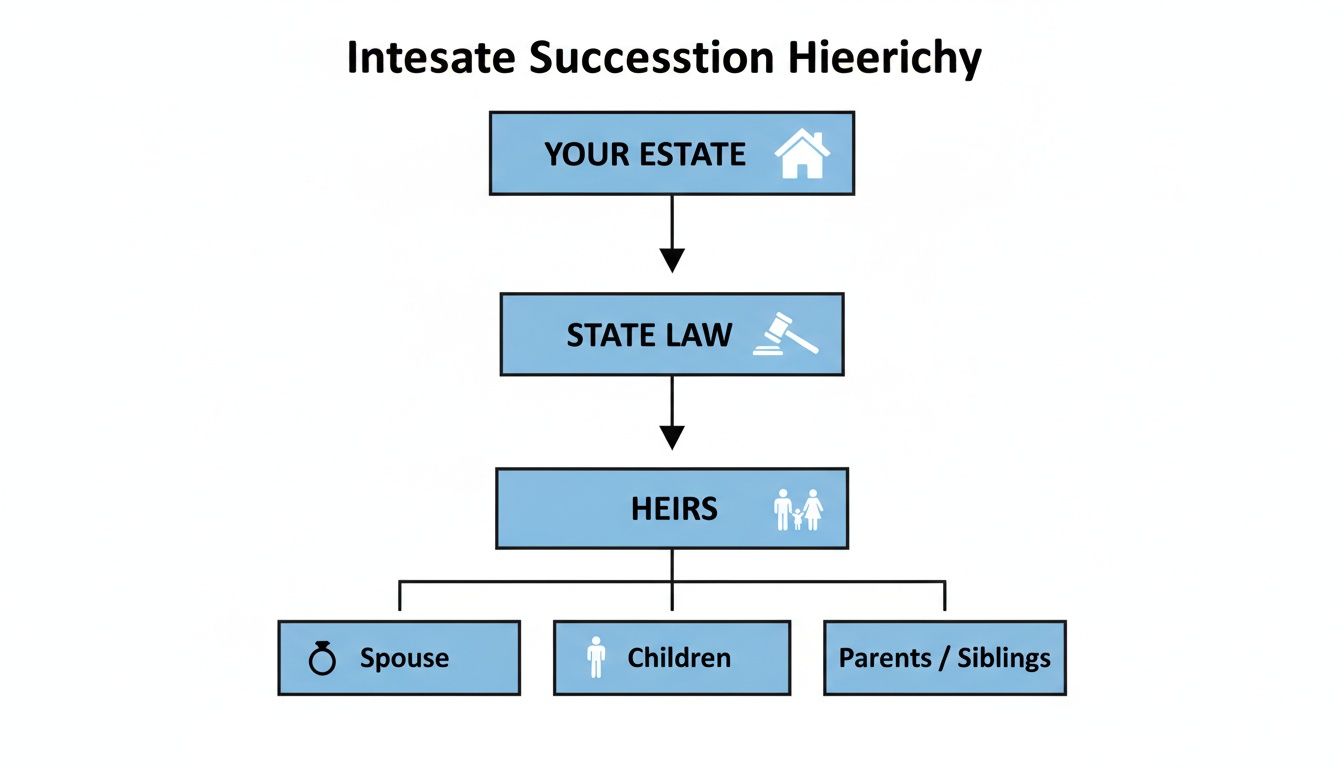
As you can see, the law acts like the person in charge, handing out your things based on a set order.
What Does a Surviving Spouse Inherit?
In Arkansas, a surviving husband or wife is first in line, but what they get isn’t always simple. It depends on who else is in the family. The state’s rules are based on old ideas called dower (for a wife) and curtesy (for a husband), which were made to be sure a surviving spouse got some property.
Here is how it works:
- If you have no children: Your spouse gets 100% of your property.
- If you have children: Your spouse gets a one-third interest in your property through dower or curtesy. Your children get the rest. It does not matter how long you were married.
This is a real problem for many families. A recent study on wills and estate planning found that 76% of people die without a will. When that happens, courts have to use these exact rules.
When Children Are the Main Heirs
If there is no surviving spouse, your children get everything. The state splits the property equally among them, no matter their age or how much money they have.
But what if one of your children has already passed away and left their own kids (your grandchildren)? In Arkansas, those grandchildren don’t get left out. They get to “step into their parent’s shoes” and inherit that share. This is called per stirpes distribution.
A Real-World Example
Imagine someone named Sarah passes away. She had no husband. She had three children: Alex, Ben, and Chloe.Alex is still alive. Ben passed away a few years ago and had two children. Chloe also passed away and had one child.
Here’s how Sarah’s property would be divided:
- Alex gets his full one-third share.
- Ben’s two children split their dad’s one-third share, so they each get one-sixth of the total property.
- Chloe’s child gets her entire one-third share.
This method makes sure that every branch of the family tree is treated fairly.
No Spouse or Kids? Here’s What Happens Next.
If you pass away with no spouse or children, the law looks further up and out on your family tree to find your next of kin, or closest relative.
- Your Parents: If your parents are alive, they get your entire property, split equally. If only one parent is alive, they get everything.
- Your Siblings: If you have no living parents, your property is divided equally among your brothers and sisters. Just like with children, if one of your siblings has passed away, their kids (your nieces and nephews) will get their share.
- Other Relatives: If there are no parents or siblings, the state keeps looking. The law will look for grandparents, aunts, uncles, or cousins, and give your property to the closest relatives.
This strict order is one of the biggest risks of not having a will. Your life savings could go to a cousin you haven’t seen in 20 years, while the unmarried partner you shared your life with gets nothing.
Navigating the Probate Process for Intestate Estates
When someone dies without a will, their property has to go through a court process called probate. Think of probate as a supervised system the court uses to make sure everything is handled correctly—from paying off debts to giving out property according to Arkansas law.

The court has to be involved when there’s no will to give instructions. It’s the state’s way of making sure the intestate succession rules are followed. This helps stop family fights and protects everyone involved.
Starting the Probate Case
First, a family member asks the local court to open a probate case. This legal paper tells the court, “This person has died without a will, and their property needs to be managed.” This is what starts the whole probate process.
After the request is filed, the court sets a date to meet. At this meeting, a judge will officially open the case and pick someone to be in charge. Since there’s no will that names a person (called an executor), the court picks an administrator. This is usually a close family member, like a spouse or an adult child.
The administrator’s job is very important. They are legally in charge of the property until the case is closed.
The Administrator’s Key Responsibilities
Think of the administrator as the temporary manager of the person’s money and property. They have to follow the law very carefully.
Here are the main jobs an administrator has to do:
Make a List of All Property: The first step is to find and list everything the person owned. This includes bank accounts, houses, cars, and any other valuable items. This list has to be given to the court.
Tell People Who are Owed Money and Pay Bills: Next, the administrator has to let anyone the person owed money to know about the death. All valid bills—like a mortgage, credit card debt, or medical bills—must be paid using money from the property. Heirs cannot get anything until all the debts are paid.
Take Care of the Property: During the probate process, the administrator must protect the property. This could mean taking care of a house or managing a business until it can be sold or given to the heirs.
File Final Taxes: The administrator also has to file the person’s final income tax forms.
Give Out What’s Left: Only after all debts, taxes, and court costs are paid can the administrator give out what is left. The property is then divided among the legal heirs, following Arkansas’s intestate succession laws.
The probate process when there is no will can be slow and cost a lot of money. Court fees and lawyer fees are paid from the property, which means there is less left for the family to inherit.
Because what is intestate succession is decided by a strict legal formula, the court’s job is just to enforce it. The administrator has no say in who gets what, even if they know the person would have wanted something different.
What Property Intestate Succession Does Not Control
Here’s an important point: intestate succession rules don’t apply to everything you own. It helps to think of your property as being in two different buckets after you die. One bucket holds things that go through the court process, where the state’s rules take over. The other bucket, however, skips this whole system.
These special items are called “non-probate assets.” They are powerful because they go directly to a person you have already named, no matter what the intestacy laws say.
Assets That Follow Their Own Rules
The key to a non-probate asset is that you have already named a beneficiary for it. A beneficiary is the person you choose to receive something. This is like a legal contract that is more powerful than the state’s plan. You’re telling the asset, “When I’m gone, go directly to this person.”
This is a smart way to make sure your property goes exactly where you want it to, often without the long waits and costs of court.
Here are the most common examples of assets that are not controlled by intestate succession:
- Life Insurance Policies: The money is paid right to the beneficiary you named on the policy.
- Retirement Accounts: Money in accounts like a 401(k) or IRA goes directly to the named beneficiary.
- Payable-on-Death (POD) Bank Accounts: Money in these accounts automatically goes to the person you listed as the POD beneficiary at your bank.
- Transfer-on-Death (TOD) Securities: Stocks and bonds with a TOD name on them pass to that person, skipping court.
Important note: Naming a beneficiary is a legally binding choice. It is more powerful than intestate succession laws and even what you write in a will. It is very important to keep your beneficiaries up to date.
Probate vs Non-Probate Assets
Understanding the difference between these two types of property is key. Some property must follow the state’s rules, while other property follows your direct instructions. To learn more, our firm has a guide on understanding what assets are not part of the probate process.
To make this clear, let’s look at a simple chart.
| Type of Asset | How It Is Given to Someone | Is It Affected by Intestacy? |
|---|---|---|
| House (owned by one person) | Through the court process, following state law. | Yes |
| Checking Account (owned by one person) | Through the court, following state law. | Yes |
| Life Insurance Policy | Directly to the named beneficiary on the policy. | No |
| 401(k) Retirement Plan | Directly to the named beneficiary on the account. | No |
| Property Owned as “Joint Tenants with Right of Survivorship” | Automatically to the other joint owner(s). | No |
This chart shows the big difference. Things you own in your name alone are part of the intestate process. But things with a co-owner or a named beneficiary are safe from it, giving you a powerful way to control your legacy.
Common Problems That Pop Up With Arkansas Intestacy
The state’s one-size-fits-all intestacy rules often cause painful and surprising results because they don’t fit modern families. The law tries to be fair, but its strict rules can feel the opposite. It follows an old-fashioned family tree and ignores the important personal relationships in our lives.
When you don’t leave your own instructions, Arkansas law uses its own plan. This can easily cause family fights and leave your property in the hands of people you never wanted to have it, while the people you cared about most are left with nothing.
Unmarried Partners Get Left Out Entirely
One of the saddest situations we see involves unmarried partners. In the eyes of Arkansas law, it doesn’t matter if you shared a home for 30 years or thought of each other as husband and wife. If you are not legally married, your partner has zero rights to inherit your property.
For example, imagine you and your partner own a home together, but only your name is on the official paper for the house. If you pass away without a will, the law gives that home to your closest legal relatives—maybe a cousin you haven’t seen in years. Your partner could be forced to move out of the home they shared with you.
The Struggles of Blended Families
Blended families are another area where intestacy laws cause problems. The law only recognizes legal relationships. This means your biological and legally adopted children are your heirs. But stepchildren are left out completely, no matter how close you were.
This means if you raised your stepchildren as your own, they will get nothing from you under intestate succession. The law will skip over them and pass your things to your biological children or other blood relatives. This could cause a lot of pain in a once-close family.
This is not a rare problem. Blended families, which are now about 16% of all households, have a much higher risk of fights when these strict intestacy rules are used. A report on estate planning trends shows how these issues cause big financial losses for families.
Complications with Half-Siblings and Other Relatives
Intestacy rules can also create confusion among brothers and sisters. In Arkansas, half-siblings (who share one parent with you) inherit the same as full siblings. This might be what you want, but what if you were much closer to one side of your family? The law doesn’t care; it treats them the same.
Other tricky situations can also happen:
- Children Born Outside of Marriage: Arkansas law does allow children born outside of a marriage to inherit, but the child may have to go through a stressful court process to prove who their father was.
- Relatives You Don’t Talk To: You might have a legal relative, like a brother or a parent, that you haven’t spoken to in years. Under intestacy, that family member could end up with a large part of your life’s savings.
- Heirs with Special Needs: If one of your family members has special needs and gets help from the government, getting a lot of money at once could stop them from getting that help. A proper plan can protect them, but intestacy does not.
These examples show how what is intestate succession often leads to results you didn’t want. The state’s plan is a simple tool that can’t possibly know the details of your life. The only way to make sure your property goes where you want it to is to create your own plan.
How to Avoid Intestate Succession with Basic Planning
After seeing all the problems that can happen when the state’s rules take over, I have good news. You have the power to use your own plan instead of the state’s. Avoiding intestate succession isn’t as hard as it sounds. With a little planning, you can make your own rulebook to be sure things are handled the way you want.

The easiest way to take control is by making a Last Will and Testament. Think of it as your personal instruction book for what happens after you’re gone. It’s the main tool for choosing your own plan instead of the state’s.
Creating Your Own Rulebook with a Will
A will is more than just a list of who gets your stuff. It’s a powerful paper that lets you make important choices the state can’t make for you. When you have a will, you can feel better knowing your wishes are written down and legally count.
Here are the key things a simple will lets you do:
- Choose Who Inherits: You get to name the people, friends, or even charities you want to get your property. This lets you go around the strict, family-only rules of intestacy.
- Pick an Executor: You can choose a trusted person (your executor) to be in charge of following your instructions, instead of a court picking an administrator who may not know you.
- Name a Guardian for Young Children: For parents, this is the most important reason to have a will. You can name the person you trust to raise your children—a choice no one should leave up to a judge.
Having a will is the difference between leaving a clear map for your loved ones and leaving a puzzle they have to solve in court. Any plan is better than no plan.
It’s strange, but many people know this and still don’t do anything. A 2025 Trust & Will survey found that while 83% of people know that having a plan is important, a surprising 55% have nothing set up.
Going a Step Further with a Living Trust
For some families, another great tool is a Living Trust. The best way to think of a trust is as a private box you create to hold your property while you are alive. You manage everything in it, and when you pass away, a person you’ve chosen (the successor trustee) gives everything out according to your private instructions.
Understanding how to manage property with these tools, like the process of selling a house held in a trust after death, shows just how much control you can have.
The biggest plus of a trust is that it helps your property avoid the probate court process completely. This means your family can handle things privately, often much faster and with less cost than a public court case.
Whether a will or a trust is right for you, taking that first step is the most important part of protecting your family from the problems of what is intestate succession.
Frequently Asked Questions About Intestate Succession
We’ve talked about what intestacy is, but you probably still have a few questions. Let’s answer some of the most common ones we hear from people in Northwest Arkansas.
What Happens to My Property If I Have No Family? Does the State Get It?
This is a common worry, but it almost never happens. When the state takes property, it’s called escheat, and it’s the very last option.
Before that can happen, the law says a full search must be done for any living relatives, no matter how far away they are. In nearly every case, someone—a long-lost cousin or a great-aunt—is found. The state doesn’t just take everything because you don’t have a spouse or kids.
What About My Debts? Do They Just Disappear?
Sadly, no. Your debts don’t go away when you die. During the probate process, the administrator of your property is required by law to pay your outstanding bills first.
Your family does not have to pay your debts themselves. The bills get paid from the money and property you left behind. Only after the debts are paid can your family members get anything.
Think of it as closing out your financial life. All bills must be paid before what is left can be given to others.
Can Someone Challenge an Intestate Inheritance?
Yes, but not in the way you might think. You can’t really argue with the state’s inheritance rules—those are set by Arkansas law.
What you can argue about is who counts as a legal family member. These arguments can get messy. Someone might have to go to court to prove they are related to the person who died.
Common arguments include:
- Proving you are a child of the person who died.
- Proving that a marriage was legal.
- Arguing that another person is not really a legal heir.
These are not simple disagreements; they are serious legal fights. If you are in this situation, you will need an experienced Arkansas probate lawyer to help you through the courts and protect your rights.