When someone passes away, the big question is always, “What happens to their stuff?” The simplest rule is this: things owned only in that person’s name are the ones that usually have to go through a special court process called probate.
Think about a bank account with only one name on it or a house with just that one person on the deed. There’s no automatic way for someone else to take over. That’s where the court steps in to make sure everything goes to the right people.
What Is Probate and Why Does It Matter
Imagine a person’s stuff is like a business that has just closed. Probate is the official process of shutting everything down and giving things to the new owners. A judge makes sure it’s all done correctly.
Here in Arkansas, the probate court does a few main jobs:
- It checks to make sure the person’s Will is real and valid.
- It puts someone in charge (called a “personal representative”) to handle everything.
- It makes sure any money owed (like bills or taxes) gets paid.
- Finally, it gives the okay to pass the leftover belongings to the family or friends named in the Will.
This court process creates an official record of who gets what. It helps prevent arguments and makes sure things like a house or a car are legally put in the new owner’s name.
Defining the Probate Estate
All the things that the court has to deal with are called the “probate estate.” This is the pile of stuff that needs the judge’s help.
Usually, the probate estate is made up of property owned only by the person who passed away. This could be their car, their checking account, or even personal items like jewelry. In Arkansas, it includes real things you can touch and things you can’t, like money in the bank. For a deeper look at how this works in other places, the International Bar Association has some helpful guides.
Here’s the key idea: If something has a clear, automatic way to go to a new owner without the court’s help (like a joint bank account), it usually skips probate. If it doesn’t, it’s probably part of the probate estate.
Understanding this one simple difference is the first step in planning and can save your family a lot of trouble. To learn more about how probate works, you can read this guide on What Is Probate And How Does It Work.
Which Assets Typically Go Through Probate in Arkansas?
When you want to know if something needs to go through probate, ask this question: who legally owned it when the person died?
If something was owned only in the dead person’s name—with no plan for it to automatically go to someone else—it almost always needs the court’s help to change hands. Think of these as items left “stranded” without a clear path to their new owner.
In Arkansas, this pile of stranded property is what we call the probate estate. The court’s job is to create that path, making sure everything gets to the right people based on the Will or, if there is no Will, state law. Let’s look at the common things that usually end up here.
Property Owned by One Person
This is the easiest one to understand. Anytime a person owned something in their name and their name alone, it’s going to probate.
- Real Estate: A house or land that was titled only in the dead person’s name is a common probate item. Without a co-owner on the paper, no one can automatically take over.
- Bank Accounts: A checking or savings account where the person who died was the only owner. If there is no co-owner or a “Payable-on-Death” (POD) person named, the bank can’t give the money to anyone without the court’s permission.
- Vehicles and Personal Items: This includes cars, boats, furniture, jewelry, and art. Since these things don’t usually have official co-ownership papers, they are considered part of the probate estate.
This simple chart can help you see if something you are dealing with is likely to need probate.
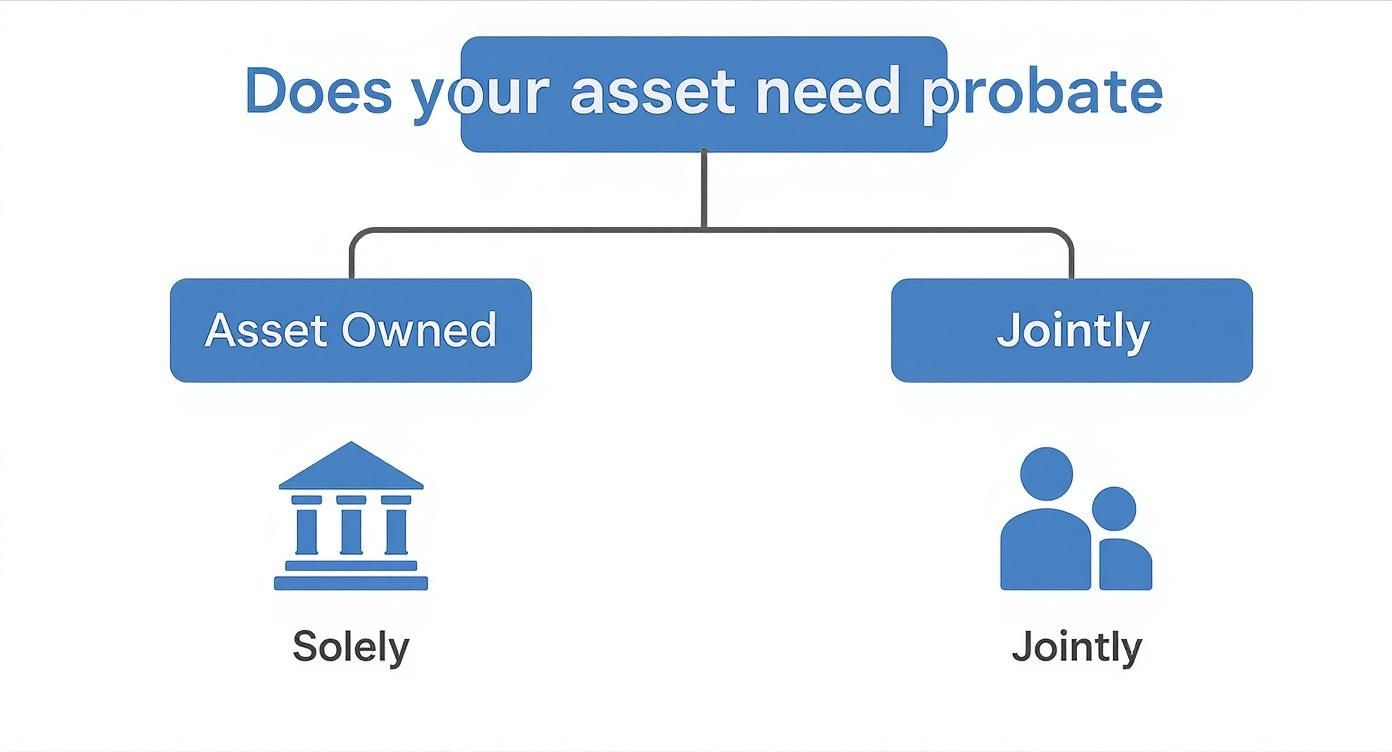
As the chart shows, the most important question is whether the item was owned by one person or by more than one. That one detail often decides its path.
Understanding Tenants in Common
Here’s something that often surprises people and sends property to probate: a special type of co-ownership called “tenants in common.”
Imagine you and a friend buy a piece of land together as tenants in common. You each own half. If you die, your half does not automatically go to your friend. Instead, your half is treated like anything else you own by yourself—it becomes part of your probate estate and goes to whoever you named in your will or to your legal family members.
It’s like owning one slice of a pizza. Your slice belongs to you and your family, not to the people who own the other slices. This is very different from another type of ownership called “joint tenancy with right of survivorship,” which we’ll talk about next.
This is common for people who are not married but buy property together. Because there is no automatic handover when one person dies, the court has to step in to move that person’s share to the correct new owner. This shows how even something you co-own can end up in probate.
Which Assets Can Skip the Probate Process

Good news! Not everything has to go through the court. Some things have a built-in “fast pass” that lets them go directly to your family or friends. Knowing how these work is the key to making things easier and faster for the people you leave behind.
These “non-probate” items skip court because the plan for who gets them is already written down in their legal papers. They have their own set of instructions, so they don’t need a judge’s help. This saves your family time, money, and stress.
Assets With Named Beneficiaries
One of the easiest ways to keep things out of probate is to name a “beneficiary” on the account. A beneficiary is the person you choose to get something when you die. This creates a direct path for the money to go to them, completely skipping the court.
This simple tool works for many common accounts:
- Life Insurance Policies: The money is paid right to the person you named as the beneficiary—no probate needed.
- Retirement Accounts: Money in accounts like 401(k)s and IRAs goes straight to the beneficiaries you picked.
- Bank Accounts: In Arkansas, you can add a “Payable-on-Death” (POD) name to your checking and savings accounts.
- Investment Accounts: You can do the same thing for stocks and other investments with a “Transfer-on-Death” (TOD) form.
Think of a beneficiary form as a contract. You are telling the bank or company exactly who to give the money to when you’re gone.
Property Owned With Right of Survivorship
Another great way to avoid probate is through joint ownership, but the kind of ownership is very important. The magic words are “joint tenants with right of survivorship.”
Let’s say you and your husband or wife own a house together this way. When one of you passes away, the other one automatically becomes the full owner of the whole house. It happens instantly. The house never becomes part of the probate estate because its ownership plan was already built into the legal paper (the deed).
The Power of a Living Trust
A living trust is like a superhero for avoiding probate. It’s a special legal tool you can create. When you make a living trust, you move your big assets—like your house or bank accounts—out of your own name and into the name of the trust.
While you’re alive, you still control everything. You can buy and sell things just like before. But on paper, the trust owns the property, not you. Because you don’t personally “own” these things when you die, there is nothing for the probate court to handle. The person you chose to be in charge of the trust (the “successor trustee”) simply follows your instructions and gives the assets to the people you named, all without going to court.
How Property in Other States Complicates Probate

When someone from Arkansas dies, their main probate case happens here at home. This is called domiciliary probate, and it covers their personal things—like bank accounts and cars—no matter where they are. But if they owned a house or land outside of Arkansas, things get more complicated.
What about that beach house in Florida or the cabin in Missouri? Real estate is special. It is always handled by the laws of the state where it is located. This means your family will have to open a second probate case in that other state just to deal with that one piece of property.
The Headaches of Ancillary Probate
This second court process is known as ancillary probate. Imagine having to go through security at two different airports for one trip. It’s annoying and a waste of time and money. That’s what ancillary probate is like for a sad family.
Your family has to hire another lawyer in that other state, pay more court fees, and learn a whole new set of rules. It makes everything take much longer and costs a lot more. Instead of one court case, your family is stuck with two.
Basically, ancillary probate means your family has to do double the paperwork, pay double the lawyer fees, and wait much longer just to get a property from another state.
The same idea applies to other countries. Land is probated where it is, even if it’s overseas. You can find more insights on navigating overseas probate challenges if you are curious.
How Smart Planning Can Prevent This Problem
The good news is that you can avoid this whole mess. With a little planning, you can make sure your property in other states never has to go to probate court.
The best way is to put that property into a living trust. When the trust owns the property—not you—it is no longer part of your probate estate. When you die, the person you put in charge of the trust can simply give the property to your family like you wanted. No court, no extra lawyers, and no ancillary probate. This one step can save your family a lot of money and stress.
How You Can Simplify or Avoid Probate in Arkansas
Knowing what things will end up in probate court is the first step. The next step is figuring out how to keep them out. By doing a few simple things now, you can make a clear path for your belongings to follow. This means more of your money goes to your family without the court taking a cut or causing long delays.
This isn’t about doing complicated legal tricks. Often, the best tools are simple forms you can get from your bank. A little bit of time spent today can save your family a lot of trouble later.
Take Action with Beneficiary Forms
One of the easiest and best ways to avoid probate is to fill out—and update—your beneficiary forms. Think of these as direct orders that tell a company exactly who gets your money when you die.
- Bank Accounts: Just ask your bank for a Payable-on-Death (POD) form. This lets you name a person who can get the money with a death certificate and an ID. The court is not involved at all.
- Retirement Plans: Your 401(k) and IRA accounts all have beneficiary forms. Make sure you have filled them out and that the person you chose is still the right one.
- Life Insurance: The money from a life insurance policy goes straight to the person you named as the beneficiary. It’s a perfect example of something that skips probate on purpose.
It’s very important to look at these forms every few years, especially after big life changes like getting married or divorced, or having a baby. An old, forgotten beneficiary form can cause big problems for your family.
Using a Living Trust Effectively
For a plan that covers everything, a living trust is one of the best tools for avoiding probate. Think of it as a special box you create to hold your most important things. You legally move your house, bank accounts, and other property out of your name and into the name of your trust.
While you are alive, you are still in complete control. But on paper, the trust owns everything. After you die, the person you put in charge (your “successor trustee”) simply follows your written instructions to hand out the property. It all happens in private, without a judge needing to approve it.
Arkansas Small Estate Affidavit: A Faster Path
What if there’s not a lot of money or property? Luckily, Arkansas law has a shortcut called a Small Estate Affidavit. This is a simpler process for estates worth $100,000 or less (this amount does not include the main home or certain amounts set aside for the family).
Instead of a full probate case, your family can use this special signed paper to collect your property. They still file it with the court, but it allows them to get the assets much faster and for less money. For many families in Arkansas, this can turn a long process into a simple task.
Common Questions We Hear About Arkansas Probate
Once you learn the basics of what goes through probate, other questions usually come up. Let’s answer a few of the most common ones we hear from families in Arkansas.
“I have a will, so I can skip probate, right?”
This is one of the biggest myths about wills. The answer is no, a will does not avoid probate. In fact, a will is a letter of instructions written for the probate court.
Think of your will as a guide for the judge. It tells the judge exactly how you want your stuff to be given out, but you still need the court process to make it happen. To actually skip probate, you need to use other tools like living trusts, beneficiary forms, or owning property with “right of survivorship.”
“What happens if my loved one died without a will?”
When someone dies without a will, it’s called dying “intestate.” Their stuff still has to go through court, which is usually probate. The big difference is that there is no instruction letter from them.
Instead of following their wishes, the court has to follow a set of rules from Arkansas law. This means the state decides who gets what. Sometimes, this can mean your things go to a faraway relative you hardly knew, instead of a close friend you thought of as family. This is why having a will is so important.
When you die without a will, you are letting the state of Arkansas decide who gets everything you worked for. It’s a risk that often doesn’t match what people would have wanted.
“Is probate required for small estates in Arkansas?”
Good news: no, not always. Arkansas law has a much simpler path for smaller amounts of property. If the total value of the things that would normally go through probate is $100,000 or less, your family can probably use a shortcut called a Small Estate Affidavit.
This is a big help for many people because it’s much faster and cheaper than a full probate case. It’s important to know that this $100,000 limit does not include the person’s main home or certain money set aside for the family. But if the property is worth more than that, you’re usually looking at a full probate process.