Let’s make this simple. Testamentary capacity is a legal term that means you have a “sound mind” when you sign your will. It’s the law’s way of checking that you are mentally able to make these big decisions.
Think of it like a pop quiz on your own life that you only have to pass for a moment. You don’t need to be perfectly healthy or remember every single detail of your life. You just have to understand the basics of what you are doing.
What Is Testamentary Capacity in Arkansas
Imagine you are deciding who gets your favorite things after you’re gone. To do this fairly, you would need to know what you have, who your family members are, and understand that you are making a final choice. In Arkansas, that’s pretty much what testamentary capacity means.
The law isn’t trying to be tricky. This rule is a safety net. It protects you and makes sure your will shows what you really want, not what someone else wants or what you might say on a confusing day.
The Snapshot Moment
Here’s the most important part: your mental state is judged only at the exact moment you sign the will. Think of it like a camera taking a picture. All that matters is how clear you are in that single “snapshot moment.”
A person can have good days and bad days. Even with an illness like dementia or Alzheimer’s, someone might have times when they are perfectly clear-headed. In Arkansas, if they sign their will during one of these clear moments, the courts will usually say it’s a valid will. The only thing that matters is how their mind was working right then and there.
To check this, Arkansas courts look for a few key things. Here is a simple checklist of the ideas a person needs to understand.
Quick Checklist for a Sound Mind
| The Question the Court Asks | What It Really Means for You |
|---|---|
| Do you know you’re making a will? | You get that this paper gives away your stuff after you pass away. |
| Do you know what you own? | You don’t need a perfect list, just a general idea of your money and property. |
| Do you know who your family is? | You can name or think of the close family members who would normally get your things. |
| Do you understand your plan? | You can see the connection between your stuff and the people you are giving it to. |
These questions just confirm that the person signing the will is in charge and understands what they are doing.
Why It Matters for Your Family
Getting this right is a huge deal because a valid will is built on testamentary capacity. If someone signs a will without it, the will can be challenged in court and might get thrown out. This can start painful fights between family members and lead to expensive legal battles. Your property might not go where you wanted it to.
It also helps to know how this idea compares to other legal jobs. For example, knowing the difference between power of attorney and guardianship helps you see who can legally make choices for someone else and why that’s different from being able to make your own will.
In the end, proving you have a sound mind protects your final wishes. It makes sure the instructions you leave are followed, which gives your family peace and clarity when they need it most.
The Four Elements of a Sound Mind in Arkansas
To have testamentary capacity in Arkansas, the law isn’t looking for a genius. You don’t need a perfect memory or a law degree. The court just wants to know that you could pass a four-part test at the exact moment you signed your will.
Think of it as a quick mental checklist to make sure you were making your own choices.
This legal idea is not new. It comes from a famous English court case from 1870 called Banks v Goodfellow. That case created the basic four-part test that courts in Arkansas—and all over the world—still use today to decide if someone had a “sound mind” when they wrote their will. For a deeper dive, you can explore more about testamentary capacity.
Let’s break down each of these four parts with simple examples.
1. Knowing You Are Making a Will
First, you have to understand that the paper you are signing is a will. This means you get the basic idea that it will give your property to certain people after you pass away.
You don’t need to understand every fancy legal word. You just have to know what signing your name will do.
For example, if you say to the people watching you sign, “I’m signing my will so my daughter gets the house and my son gets my tools,” you’ve got it. You clearly know this isn’t just a random piece of paper; it’s a plan for your things.
2. Understanding Your Property
Next, you need to have a general idea of what you own. Nobody expects you to list every single thing you have, down to the last penny in your bank account.
You just need to be aware of your main assets, like a house, car, or savings.
An Arkansas court wants to see that you know you have a house, a car, and a bank account. Forgetting about a small savings account you rarely use probably isn’t a problem. But not knowing that you own a 100-acre farm? That would make a judge wonder if you really understood what you were doing.
This rule is just to make sure you can make smart choices because you know what you have to give away.
To help you see how these pieces fit, here is a simple diagram that shows how a will connects your property to your family.
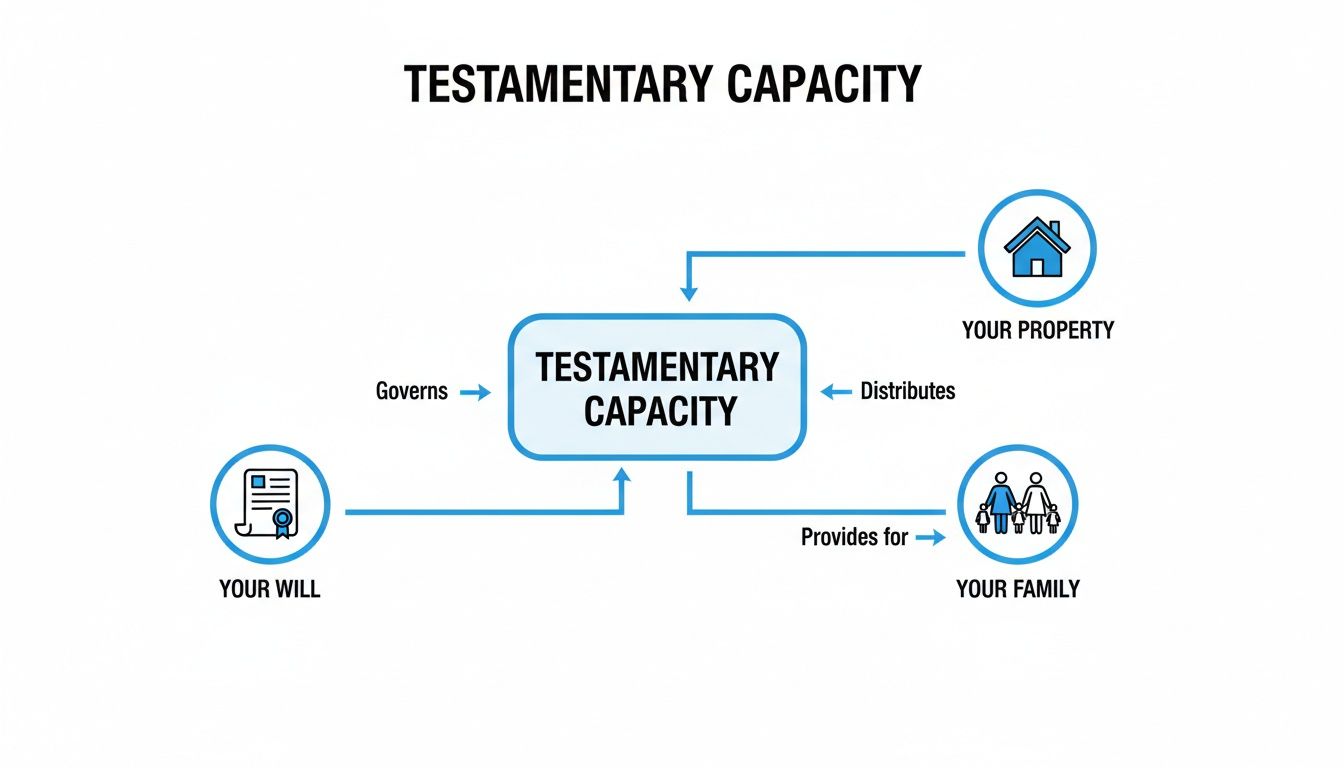
As you can see, a valid will is the main link between knowing what you have and deciding who gets it.
3. Recognizing Your Closest Relatives
Third, you must be able to recognize the “natural objects of your bounty.” This is a fancy, old-fashioned way of saying you know who your closest family members are. These are the people who would usually expect to get something from you, like your spouse, kids, or grandkids.
This does not mean you have to give them anything. You have the right to leave a child out of your will if you want to.
What’s important is that you know they exist. If you have two kids but think you only have one, that’s a sign that you might lack capacity. But if you know you have two kids and choose to leave everything to only one of them, that is a choice, not confusion. The will just needs to show that you understand your family relationships and your plan for them.
4. Connecting the Dots
The last part ties everything together. You have to be able to hold the other three ideas in your mind at the same time and use them to make a clear plan for who gets what.
This is the “connecting the dots” part. It means you can:
- Think about your property.
- Think about your family members.
- Make a clear decision about how to divide everything up.
Let’s say you have a house and two kids. You might decide to give the house to your older child, who has a family and needs more room. Then you might give your savings to your younger child, who is better with money. Making that decision shows you can think through your options and create a logical plan. It proves your choices are based on clear thinking—which is what testamentary capacity is all about in Arkansas.
How Testamentary Capacity Is Proven in Court

When someone claims a will is invalid because of capacity, the case goes to court. A judge has to try to figure out what the will-maker’s state of mind was on the exact day they signed the paper. It all comes down to that single “snapshot moment.”
In Arkansas, the law starts by assuming the person who made the will did have capacity. This means the person challenging the will has the burden of proof. They must show strong evidence to make the judge doubt the person’s mental state.
If they can do that, the tables turn. Then, the person defending the will must prove that the will-maker was, in fact, thinking clearly. The court looks at all the evidence, much like in other cases for proving incapacity in court.
The Key Players and Their Evidence
A judge can’t go back in time, so they rely on what people say and what documents show. Some evidence is more powerful than others, and a judge considers everything to find the truth.
Here are the main things a court will look at:
- Medical Records and Doctor Testimony: This is often the strongest proof. A doctor’s notes, especially from around the time the will was signed, can give a professional opinion on the person’s thinking and memory.
- Witness Testimony: The people who watched the will being signed are very important. Their memories of what happened—what was said, how the person acted—give the court a direct look at that snapshot moment.
- Family and Friends: Relatives and friends who saw the will-maker often can talk about their mental state. Did they have good and bad days? Were they managing their own money? Their stories help show what the person was like over time.
- The Attorney Who Wrote the Will: A lawyer’s notes and memory can be very convincing. A good lawyer will have checked the client’s capacity during their meetings and written down their thoughts, giving the court a trusted, professional opinion.
The Idea of a Lucid Interval
A key idea in these cases is the lucid interval. This is a period of clear thinking for someone who usually struggles with confusion. Think of a person with dementia who might be mixed up in the morning but perfectly sharp for a few hours in the afternoon.
In Arkansas, a will is valid if it was signed during a lucid interval. That’s because the law only cares about capacity at the moment of signing. The fact that someone was confused an hour before or a day after doesn’t automatically cancel the will.
This is why what the people who were in the room at the signing say is so important. They can confirm that even if the person had a medical condition, they were having a “good day” and knew exactly what they were doing when they signed.
Being Proactive: The Golden Rule
To stop these court fights from ever starting, many lawyers follow the “Golden Rule.” This is a smart practice when working with older or sick clients. The rule suggests having a doctor check the person’s capacity at the same time the will is signed.
Getting a doctor’s okay on paper creates a powerful piece of evidence that is very hard for anyone to argue against later. It is a smart step that provides solid proof of capacity, which can prevent family arguments years from now.
Common Red Flags That Raise Capacity Questions
Some situations just don’t feel right. When it comes to a will, these moments are called red flags. They don’t automatically mean a will is bad, but they are a big sign for an Arkansas court to look closer and ask if the person truly had testamentary capacity.
Think of it like a mystery. A red flag is a clue—it doesn’t solve the case, but it tells you where to start looking. Let’s look at some common situations that often cause concern.
Sudden and Drastic Changes to the Will
Imagine this: A mother has had the same will for 30 years. Her plan was always to divide her property equally among her three children. But then, just weeks before she dies—and right after being diagnosed with dementia—a new will appears. This new will leaves everything to one child and cuts out the other two completely.
That’s a huge red flag. Why would she suddenly change a plan she stuck with for decades?
A court will ask serious questions:
- What was her state of mind on the day she signed the new will? Medical records and what people who saw her that day say become very important.
- Why did she make such a big change? Was there a family argument, or did it happen for no clear reason?
- Who helped make the new will? If the child who gets everything was the one who found the lawyer and went to all the meetings, that looks suspicious.
A person can change their mind. But a change this big needs a good explanation to show it was a clear-headed choice, not the result of confusion or sickness.
Wills Signed in Unusual Circumstances
Here is another story that happens too often. An elderly man is taken to the hospital after a bad fall. He is on strong pain medicine and is clearly confused. A few days later, while still in his hospital bed, he signs a new will leaving all his money to a caregiver he has only known for a few months.
This situation is full of red flags. A will signed in these conditions, sometimes called a “deathbed will,” is immediately questionable.
The real question for a judge is simple: Could someone who is sick, on strong drugs, and in a strange place really meet the legal standard for a sound mind? The timing and the location alone are enough to make the will seem doubtful.
Courts will want to know who called the lawyer, who watched the signing, and what the doctors and nurses saw about the man’s mental state.
Unnatural or Unexplained Choices
Sometimes, a will just feels wrong because it goes against normal family relationships. For example, a will that leaves out a loving, dedicated child to give a fortune to a distant cousin the person hadn’t seen in 20 years would be an unnatural provision.
Everyone has the right to give their property to anyone they choose. But when the choices are strange, they need a logical reason. If a will has odd or shocking gifts with no good explanation, it makes you wonder about the person’s judgment.
Here are a few other red flags that can lead to a will being challenged in Arkansas:
- The new will was made in secret.
- The main person who gets everything from the will was also the one who arranged for the will to be made.
- The will itself is messy, full of mistakes, or doesn’t make sense.
- The will-maker was suddenly kept away from old friends and family right before the will was signed.
Any of these clues can be a sign that something is wrong. They are the starting point for a court—and for worried family members—to ask the most important question: Was this will truly the final wish of a person with a sound mind?
Undue Influence Compared to Lack of Capacity

People often mix up a lack of testamentary capacity with another big reason to challenge a will: undue influence. They can seem similar, but in the eyes of the law, they are two totally different problems.
Understanding the difference is key, because it changes how you would challenge a will in an Arkansas court.
Let’s use a simple comparison. Think of the person making the will as the driver of a car.
A lack of testamentary capacity is like a driver who is too confused to drive. They don’t know where they are, where they’re going, or even how to use the gas and brake. They simply aren’t mentally able to drive the car by themselves.
Undue influence, on the other hand, is like a passenger grabbing the steering wheel and forcing the driver to turn down a street they didn’t want to go down. The driver might be able to drive just fine, but someone else has taken away their free will.
When a Sound Mind is Bullied
Here’s the most important thing to get: a person can have 100% testamentary capacity and still be a victim of undue influence. Someone can have a perfectly sound mind—knowing what they own and who their family is—but be so pressured or tricked that the will they sign shows what the bully wants, not what they want.
Undue influence is all about taking away someone’s free will. It happens when a trusted person uses their relationship to get something for themselves, basically replacing the will-maker’s wishes with their own.
Classic Red Flags for Undue Influence
When an Arkansas court looks at a claim of undue influence, it looks for specific, troubling behaviors. The judge wants to know if someone in a position of trust used that power to get an unfair advantage.
Some of the most common signs are:
- Isolation: The bully cuts the will-maker off from family and friends so they can’t get advice or help from others.
- Sudden Dependence: The will-maker suddenly needs one person for everything—food, rides, money, and personal care.
- Taking Control: The bully starts managing the will-maker’s money, finds them a new lawyer, and sits in on all the legal meetings.
- A Suspicious Will: The will has shocking or unfair parts, like leaving out a child to give everything to a new caregiver the family hardly knows.
The main question an Arkansas court asks is whether the will-maker was acting on their own or was just a puppet for someone else. Proving this often means showing a pattern of control and manipulation.
While these two problems can seem related, they need different kinds of proof in court. Let’s look at the key differences.
Lack of Capacity vs. Undue Influence
| Factor | Lack of Testamentary Capacity | Undue Influence |
|---|---|---|
| Focus | The will-maker’s own mind. | The actions of a bully. |
| Core Issue | The will-maker was not mentally able to make a will. | The will-maker’s free will was taken over by someone else. |
| Evidence Needed | Medical records, doctor’s opinions, stories about memory loss. | Proof of isolation, a controlling relationship, and suspicious events. |
| Key Question | Did they understand what they were doing? | Were they forced or tricked into doing it? |
A lack of capacity is about the will-maker’s mind, while undue influence is about a bully’s actions. This big difference guides the entire legal plan for proving a will is bad and should be thrown out by the court.
Steps to Protect Your Will or Challenge an Unfair One
Whether you are planning for your own future or are worried about a loved one’s will, knowing what to do is important. A few smart steps can help protect your wishes. At the same time, acting fast is the only way to protect your rights if you think a will is unfair.
Let’s go over some practical tips for both situations here in Arkansas.
Making Your Will Challenge-Proof
When you make your will, your goal is to make it as strong as possible. You want to remove any doubt about your state of mind or your true wishes. Taking a few smart steps can make a big difference later on.
Here is how you can build a strong will:
- Get a Doctor’s Note: If you have health problems or are getting older, it’s a great idea to have your doctor check your mental clarity around the time you sign your will. A note from your doctor in your file can be powerful, unbiased proof.
- Choose Witnesses Wisely: The people who watch you sign your will should have no personal interest in it—meaning they don’t get anything from it. Using witnesses who aren’t getting anything helps prove you were acting freely with a sound mind. You can learn more about the importance of will witnesses in Arkansas to see why this is so important.
- Explain Unusual Choices: If you are making a decision that might seem strange, like leaving a child out of your will, it’s smart to include a short, clear explanation. You can put this in the will or in a separate letter. This shows you thought about it, making it clear it was your choice, not a mistake from confusion.
How to Challenge an Invalid Will
If you truly believe a loved one’s will is not valid because they lacked capacity, you must act fast. Arkansas has strict deadlines, called statutes of limitation, for challenging a will. If you miss that deadline, you lose your right to challenge it forever.
The first thing to do is start gathering proof. This means collecting medical records, getting contact information for friends and caregivers, and finding any older wills. These papers help you build a timeline of your loved one’s mental state.
With this information, your next call should be to an experienced Arkansas probate attorney. They can review the facts, guide you through the legal process, and make sure your challenge is filed on time. Trying to handle a will contest alone is very difficult; getting professional help gives you the best chance to honor your loved one’s true wishes.
Common Questions About Testamentary Capacity
When you are dealing with a will, especially if you have questions about someone’s mental state, a lot of questions come up. Let’s answer some of the most common ones we hear from people in Arkansas.
Does a Dementia Diagnosis Automatically Mean a Will Is Invalid?
No, not at all. A diagnosis like dementia or Alzheimer’s does not automatically mean a person cannot make a valid will.
What really matters is the person’s state of mind at the exact moment they sign the will. Think of it like a photo. If they were having a lucid interval—a short time of clear thinking—and could understand the four key parts of making a will, it can still be valid.
What Happens If a Court Throws Out a Will?
If an Arkansas court rules that a will is invalid because the person lacked testamentary capacity, that will is tossed out completely. It’s like it never existed.
From there, one of two things usually happens:
- An Older Will Is Used: If there’s an older, valid will, the court will use that one to decide who gets the property.
- The State’s Rules Take Over: If there is no other valid will, the person is said to have died “intestate.” In that case, Arkansas state laws decide who gets what. These laws have a set formula, usually giving property to the spouse and children first.
What’s a No-Contest Clause? Does It Actually Work?
A no-contest clause is a part of a will that says, “If you challenge this will and lose, you get nothing.” Lawyers sometimes call it an in terrorem clause because it is meant to scare people away from filing silly challenges just because they are unhappy.
In Arkansas, these clauses are usually followed. But there is a big exception: if the person challenging the will had “probable cause” and acted in “good faith”—meaning they had a good reason and real evidence to believe the will was invalid—the court will not enforce the penalty. This makes sure people with real concerns can speak up without being afraid.
How Long Do I Have to Challenge a Will in Arkansas?
The clock starts ticking right away, and the deadlines are very strict. In general, you must file a last will and testament contest either before the will is officially accepted by the court (admitted to probate) or within a short time right after.
If you wait too long, you lose your right to challenge the will forever, no matter how good your proof is. If you have any concerns about what is testamentary capacity in a loved one’s will, it is very important to talk to an Arkansas probate attorney immediately to understand your options.