
Imagine you have a favorite video game or a special collection of toys. You want to make sure that if anything happens to you, your best friend gets it. A beneficiary designation is like leaving a super clear, official note that says, “When I’m gone, give the money in this account to this person.”
It’s a simple form you fill out for things like a bank account, a retirement fund, or a life insurance policy. This note is one of the most powerful tools for planning your future. It acts like a VIP pass for your money, making sure it goes directly to the people you choose without having to go through a long and expensive court process called probate.
The Power of a Simple Form

It’s a bit like taping a note to your bike that says, “This goes to my sister, Jane.” The beneficiary designation does the same thing for your money, but it’s a legal instruction that the bank or insurance company has to follow.
This form is a special agreement between you and the company holding your money. They promise to follow your instructions and give the money directly to the person (or people) you’ve named. It’s that simple.
Why Beneficiary Designations Matter So Much
So, what happens if you don’t name a beneficiary on an account? That money can get stuck in a court process called probate. Probate is when a judge looks at all your stuff and decides who gets it based on your will—or if you don’t have a will, based on Arkansas state law.
This court process can be a real headache for your family. It often takes many months, sometimes even years, and can cost a lot in lawyer fees. Those fees are paid with the money you wanted to leave for your family.
A beneficiary designation cuts through all that waiting and expense.
Beneficiary Designation vs. a Will
It’s easy to get confused about the difference between a beneficiary designation and a will. Here’s the most important thing to know: for the specific account it’s attached to, the beneficiary designation almost always wins.
Here’s a quick comparison to make it clear:
Beneficiary Designation vs a Will at a Glance
| Feature | Beneficiary Designation | Will |
|---|---|---|
| What It Covers | Only a specific account (like a life insurance policy or retirement fund) | Most of your property (like your house, car, clothes, and bank accounts without beneficiaries) |
| Court Process (Probate) | Avoids probate; the money goes directly and quickly to the person you named | Assets must go through the probate court process, which can be slow and expensive |
| When It Works | Takes effect right away when you pass away | Has to be approved by a court before anything can be given out |
| Who Wins in a Fight | Overrides your will for that specific account | Controls the property not covered by a beneficiary form |
Knowing this is super important. You could write a will that says you leave everything to your spouse. But if your old retirement account from a past job still lists your brother as the beneficiary, your brother gets that money. The form the company has on file is what matters.
How It Fits into Your Overall Plan
A beneficiary designation is a key piece of your financial puzzle, but it’s not the only piece. It works together with your other essential estate planning documents to make a complete plan.
By setting up your beneficiaries correctly, you make sure that some of your most important savings can give immediate help to your family. For anyone in Arkansas who wants to protect their family’s future, getting this simple step right is a must.
Where You Will Find Beneficiary Designations
You’ve probably filled out a beneficiary designation form before, maybe when you started a new job or opened a bank account. These forms are a normal part of setting up many financial accounts. They are like secret instructions waiting for the day they are needed. Knowing where these forms are and what they do is the first step to making sure your wishes are followed.

Think of it like a treasure map. The “treasure” is the money you’re leaving for your family, and the “map” is made up of these forms on different accounts. Let’s look at the most common places you’ll find these powerful little papers.
Life Insurance Policies
This is the classic example everyone knows. When you get a life insurance policy, you have to name a beneficiary.
That person (or even a charity or a special account called a trust) is who the insurance company will pay the money to when you pass away. It’s a direct line, designed to get money to your loved ones quickly without it getting stuck in court.
Retirement Accounts
Your retirement savings are often the result of a whole life of hard work. Naming a beneficiary on these accounts lets the money pass directly to that person, skipping the time, cost, and public record of probate court. Since a retirement account is often one of a person’s biggest assets, getting this right is very important.
You’ll find beneficiary forms for all kinds of retirement plans, including:
- 401(k)s and 403(b)s: These are common retirement plans you get through your job.
- Individual Retirement Accounts (IRAs): This includes Traditional IRAs and Roth IRAs.
- Pensions: Many company pension plans also pay out money to a named beneficiary.
Key Takeaway: One of the biggest mistakes people make is forgetting to update the beneficiary on a 401(k) from an old job. That form is legally binding, even if you left that company a long time ago. For more details, our guide on understanding retirement account beneficiaries has helpful information from an Arkansas lawyer.
Bank and Investment Accounts
Here’s a tip many people don’t know: you can add beneficiaries directly to your everyday bank accounts. This simple step turns a regular account into one that avoids probate, which can save your family a lot of trouble.
Payable-on-Death (POD) Bank Accounts
In Arkansas, you can add a Payable-on-Death (POD) label to your bank accounts, like checking or savings.
While you’re alive, the account is 100% yours and the beneficiary can’t touch the money. After you pass away, they can get the money from the bank by showing a death certificate and their ID. It’s that easy.
Transfer-on-Death (TOD) Investment Accounts
This works just like a POD account, but it’s for your investments—like stocks and bonds. A Transfer-on-Death (TOD) registration lets you name someone to get your investments directly.
This is a great way to pass on your investments without them getting stuck in court. Just like with a POD, you have full control while you are alive. When you pass away, the investments go smoothly to the person you named.
Why Your Beneficiary Form Overrides Your Will
This is one of the most important rules in planning for your future: when you name a beneficiary on an account, that form will almost always beat what you’ve written in your will. It’s a simple rule, but it surprises many families.
Think of your beneficiary designation as a direct, legal command for that specific account. Your will is like a more general set of instructions for everything else you own. For that one account, the direct command always wins.
The Power of a Contract
Why does a simple form have so much power? It’s because a beneficiary designation is a legal agreement between you and the company, like your bank or insurance company.
This agreement says, “When I die, give the money in this account directly to the person I’ve named right here.” Because it’s a legal agreement, it works outside of your will and the whole probate court process. This is what makes it so fast, but it’s also what makes it final.
This flowchart shows the two different paths your money and property can take. One path is a direct route using a beneficiary form. The other path has to go through your will and the courts.
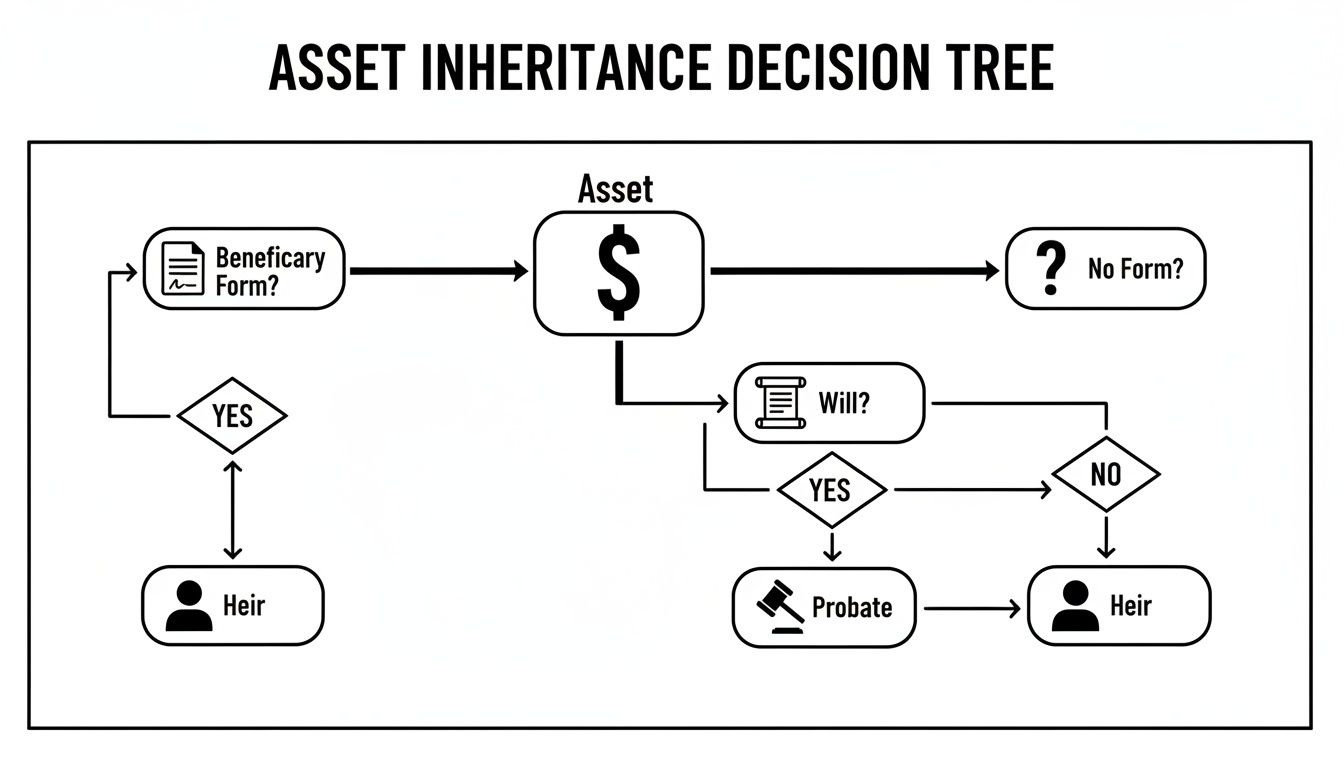
As you can see, the beneficiary form creates a straight line from your account to your loved one. Everything else has to go through the longer, more complicated probate process directed by your will.
A Real-World Arkansas Example
Let’s imagine a situation that happens often in Arkansas. John wrote a will a few years ago, leaving everything he owned—his house, car, and all his money—to his wife, Maria. He made his wishes very clear.
But John also has a 401(k) retirement account from an old job he left 10 years ago. When he started that job, he was single and named his brother, David, as the beneficiary. He got busy with life and forgot all about that old paperwork.
When John passes away, who gets his property?
- The Will Says: Everything goes to his wife, Maria.
- The 401(k) Beneficiary Form Says: The account goes to his brother, David.
Under Arkansas law, the 401(k) company must pay all the money directly to David. Maria won’t get any of that retirement money, even though John’s will said something different. The beneficiary form—that direct, legal command—overruled the will.
This isn’t a mistake in the system; it’s how it is designed to work. The company must follow the agreement they have on file. They can’t look at your will or try to guess what you really wanted.
Why This Rule Exists
This might sound strict, but the rule is there for a good reason: it provides speed and certainty. It makes sure that important money, like life insurance payments or retirement savings, can be given to family members right away, without waiting months or years for a court to approve everything.
Here’s an easy way to think about it:
- Beneficiary Designation: It’s like sending a package with overnight shipping. You put a name on it, and it goes directly there with no stops.
- Your Will: This is more like regular mail. All your other property goes to a main sorting center (the probate court) to be organized and then sent out.
The system assumes the name on each account’s form is your most recent and specific instruction for that money. That’s why it is so important to check and update these forms regularly. Your will can’t fix an old beneficiary form, making it one of the most powerful—and potentially dangerous—pieces of paper in your financial life.
How to Choose and Name Your Beneficiaries
Deciding who should get your money and property is a very personal choice. But actually naming them on a form is a technical step where the details really matter.
Getting it right makes sure your wishes are followed exactly, and it helps avoid confusion or legal problems for your family. It can be the difference between a smooth transfer of money and a messy family argument.

This isn’t just about writing a name; it’s about giving perfectly clear instructions. Let’s go through the steps so you can fill out these forms the right way.
Your Starting Lineup: Primary and Contingent Beneficiaries
Think about your beneficiaries like players on a sports team. You have your starters who get in the game first, and then you have your backup players on the bench, ready to go in if they’re needed.
Primary Beneficiaries are your starting lineup. They are the first people in line to receive the money. You can name one person or split it between several people by giving them percentages (like 50% to your son and 50% to your daughter).
Contingent (or Secondary) Beneficiaries are your backup players. They only get the money if all of your primary beneficiaries have passed away before you or can’t legally accept it.
Naming a contingent beneficiary is your safety net. If you don’t name one and something happens to your first choice, the money could end up going back into your estate. That often means it has to go through probate court—the very process you were trying to avoid.
The Importance of Being Specific
When you fill out a beneficiary form, being unclear is your worst enemy. You have to be very specific to prevent any confusion later on.
Crucial Tip: Always use a person’s full, legal name. Don’t use general descriptions like “my wife” or “my children.” Life can be complicated—people get divorced and remarry, and families change.
For example, instead of writing “my spouse Jane,” use “Jane Marie Doe.” It leaves no room for doubt. If the form has a space for it, adding their birthday or Social Security number is also a smart idea.
Special Cases: Naming Minors in Arkansas
Naming a child (anyone under 18 in Arkansas) directly on a beneficiary form can cause big problems. Financial companies usually can’t just give a large amount of money to a kid.
If you name a minor directly, a court will probably have to choose a legal guardian to manage the money until the child becomes an adult. That court process costs money, takes time, and adds stress.
Luckily, you have better options in Arkansas:
Name a Custodian: Under the Arkansas Uniform Transfers to Minors Act (UTMA), you can name a trusted adult as a “custodian.” This person will manage the money for the child until they turn a certain age (usually 21 in Arkansas).
Create a Trust: You can name a special account called a trust as the beneficiary. In the trust paperwork, you can give exact instructions for how and when the child gets the money, giving you much more control.
It’s important to understand the specific considerations when naming minors as beneficiaries to make sure your plan works. These rules are there to protect both the child and the money you want them to have.
This level of detail is very important for retirement accounts. Around the world, retirement savings plans hold huge amounts of money. These plans depend completely on clear beneficiary forms to pass that wealth to the right people.
Common Mistakes Arkansans Make and How to Avoid Them
Knowing what a beneficiary designation is and how it works is the first big step. The next is avoiding the simple, but very common, mistakes that can accidentally send your life’s savings to the wrong person. These small mistakes can turn into major headaches, family arguments, and results you never wanted.
Think of it like setting up dominoes. If just one is in the wrong spot, the whole thing can fail. Here in Arkansas, we see the same few mistakes happen over and over. Let’s look at them so you can make sure your plan is strong.
Mistake 1: Forgetting to Update After Major Life Events
This is the most common mistake people make. Life is always changing—you might get married, divorced, have a child, or a loved one might pass away. If you don’t update your beneficiary forms to match these changes, your old choices are still legally binding.
For example, you might name your spouse as the beneficiary on your life insurance. Years later, you get divorced and remarry, but forget to update that one form. Your ex-spouse could still have the legal right to the money. While Arkansas law sometimes cancels a beneficiary designation for an ex-spouse on certain accounts, it’s not a good idea to rely on that. The only safe way is to update the form yourself.
The Fix:
Set a date to review your beneficiaries once a year. Put a reminder on your calendar, maybe around your birthday. Look at your documents and ask a simple question: “Do these forms still show what I want?”
Mistake 2: Naming a Minor Directly
It seems natural to name your child as your beneficiary. The problem is, in Arkansas, a minor (anyone under 18) cannot legally own property or receive large amounts of money directly.
If you name a minor, the money gets stuck in court. A judge will have to appoint a legal guardian to manage the money until the child becomes an adult. This process is public, can be expensive, and adds stress that your family doesn’t need.
The Fix:
You have a couple of much better options to protect the money for a child:
- Use a Custodian: Name a trusted adult as a “custodian” for the minor under the Arkansas Uniform Transfers to Minors Act (UTMA). This is a simple way to have someone manage the funds.
- Create a Trust: For more control, you can name a trust as the beneficiary. This lets you set specific rules for how and when the money is used, like for college or a first home.
Mistake 3: Failing to Name a Backup Beneficiary
What happens if your primary beneficiary—your first choice—passes away before you do? If you haven’t named a backup, often called a “contingent” beneficiary, the money usually goes back to your estate.
When that happens, the money gets mixed in with all your other property and must go through the probate court process. This defeats the main purpose of having a beneficiary designation, which is to skip court and get money to your loved ones quickly.
Key Insight: Not naming a contingent beneficiary is like going on a road trip without a spare tire. You might not need it, but if you do, not having one turns a small problem into a big one.
The Fix:
Always, always name a contingent beneficiary. Think of it as your Plan B. It’s an easy step that provides a very important safety net for your plan.
Mistake 4: Using Vague or Unclear Language
Being specific is your best friend when filling out these forms. Using general terms like “my children” or “my spouse” can cause serious confusion later. What if you have stepchildren? What if you get remarried?
Unclear language opens the door for legal fights and family disagreements. The company holding the money needs a perfectly clear instruction on who gets it.
The Fix:
Be exact. Use full legal names for every beneficiary you list. For example, instead of “John,” write “John Michael Smith.” If the form lets you, add other details like their birthday to remove any possible confusion. This leaves no room for error and makes sure your money goes exactly where you want it to.
When Should You Talk to an Arkansas Attorney?
Beneficiary designations seem simple, and they often are. But some family or financial situations are more complicated. When you have a lot going on, trying to do it all yourself can lead to the very problems you were trying to avoid.
Knowing when to ask an expert for help isn’t about making things complicated; it’s about being smart and making sure your plan will actually work. Think of an Arkansas estate planning lawyer as a guide who can help you through tricky spots and make sure your wishes are legally solid.
Planning for a Beneficiary with Special Needs
This is a very important one. If you have a loved one who depends on government help like Supplemental Security Income (SSI) or Medicaid, you need to be extremely careful. Naming them as a direct beneficiary might feel like the right thing to do, but it could actually hurt them financially.
Getting a lot of money at once could put them over the strict limits for these programs, causing them to lose the benefits they need for healthcare and support. A lawyer can help you set up a special needs trust. This is a legal tool that lets you set aside money for their care without messing up the government help they rely on.
Navigating Blended Family Dynamics
Life isn’t always simple, and blended families are a wonderful part of that. But they do make planning for the future more complex. You probably want to provide for your current spouse while also making sure your children from a previous marriage are taken care of.
Just naming one person on a form might not give you the fair result you want. A lawyer can show you tools, like certain types of trusts, that let you provide for everyone. This helps make sure no one is accidentally left out and helps keep the peace in the family.
A Word of Advice: Talking to a lawyer doesn’t mean something is wrong. It’s a sign of good planning. You’re taking a smart step to prevent future confusion and make sure your beneficiary choices match exactly what you want for your family.
Managing a Large or Complicated Estate
If you have a lot of assets, like a family business, several houses, or large investments, getting professional advice is a must. A lawyer can explain how your choices might affect taxes and help you set everything up in the smartest way.
They help you see how your what is beneficiary designation decisions fit into your entire financial plan. This is key when you have different types of accounts, like for retirement and healthcare. For example, by 2025, more than half of people on Medicare are expected to be in Medicare Advantage plans, where you sometimes need to name someone to help manage benefits. You can learn more about Medicare Advantage enrollment trends here. A lawyer makes sure all these different parts of your financial life work together without causing problems.