
When you get divorced, the most important thing you can do to protect your inheritance is to keep it totally separate from the money you share with your spouse. Think of it like having your own special piggy bank that no one else can put money into or take money out of.
In Arkansas, the law is on your side at first. An inheritance is usually seen as your separate property. This means it belongs only to you. But this protection can disappear if you mix, or “commingle,” your inheritance money with your shared money. The best way to protect it is to keep good records from the very beginning.
How Arkansas Law Sees Your Inheritance
You see your inheritance as a special gift from a loved one, meant just for you. The good news is that Arkansas law usually agrees. The law starts by calling inherited things separate property. This means they belong only to you, not to the marriage.
This is very different from marital property. Marital property is everything you and your spouse earned or got together while you were married. This could be your shared bank account, the house you bought together, or retirement accounts you both paid into. All of that stuff goes into a big “marital pot” that gets divided up if you get a divorce. Your inheritance, thankfully, starts outside of that pot.
The “Equitable Distribution” Rule
Arkansas is an “equitable distribution” state. This does not mean everything gets split 50/50. It means a judge will divide your marital property in a way they think is fair. Sometimes fair is equal, and sometimes it’s not.
But look at that important word: marital. A judge can only divide marital property. Your inheritance, as long as you keep it separate, should be safe. So, what’s the catch? It’s very easy to accidentally turn your separate inheritance into marital property. This usually happens when you mix it with shared money. Once you mix them, trying to separate them later can be a big legal headache.
Expert Insight: Arkansas law gives your inheritance a head start by calling it separate property. But it’s your job to keep it that way. If you aren’t careful, a judge might think you gave your inheritance as a gift to the marriage. If that happens, it can be divided in a divorce.
Marital vs. Separate Property: A Clear Look
To help you understand, here is a chart that shows the difference between what’s shared and what’s yours alone in an Arkansas divorce.
Marital vs Separate Property in Arkansas
| Property Type | What It Means | Real-World Example |
|---|---|---|
| Marital Property | Things and money gotten by either spouse during the marriage. The judge will divide these fairly. | The house you bought after your wedding, cars you bought while married, shared bank accounts, or a business you started together. |
| Separate Property | Things owned by one spouse before the marriage, or received during the marriage as a gift or inheritance. | A house you owned before you got married (and kept only in your name), a classic car your dad gave you, or money you inherited from your grandma (that you kept in a separate account). |
It all comes down to keeping things in different buckets. Everything you and your spouse earn and buy together goes into the marital bucket. Your inheritance needs to go into its own, clearly marked separate bucket—and stay there.
The problem starts the moment you pour something from your separate bucket into the marital one. For example, if you put your inheritance check into a shared bank account, you’ve just mixed it. If you use that money to help buy a house for your family, you’ve done the same thing. It’s a simple mistake that can have very bad results.
Protecting your inheritance is more important than ever. In the U.S., about 50% of marriages end in divorce, so inherited money is often at risk. Experts think that Baby Boomers will pass down around $30 trillion. Without good planning, a lot of that family money could be lost in divorces. Learn more about the financial risks inheritance faces during divorce. This makes it very important to understand the rules and be careful.
How Mixing Assets Can Put Your Inheritance at Risk
The biggest mistake you can make with an inheritance is also the easiest. Lawyers call it commingling. This is just a fancy word for mixing your separate inheritance with your shared marital money.
Once you do this, it’s almost impossible to un-mix it.
Think of it like this: your inheritance is a glass of pure, clean water. Your shared bank account is a glass of muddy water. The second you pour the clean water into the muddy glass, it all becomes muddy. You can’t get the clean water back out. That’s what happens in the eyes of the law when your inheritance touches shared money.
This simple chart shows how quickly your separate property can become marital property, putting it at risk of being divided in a divorce.
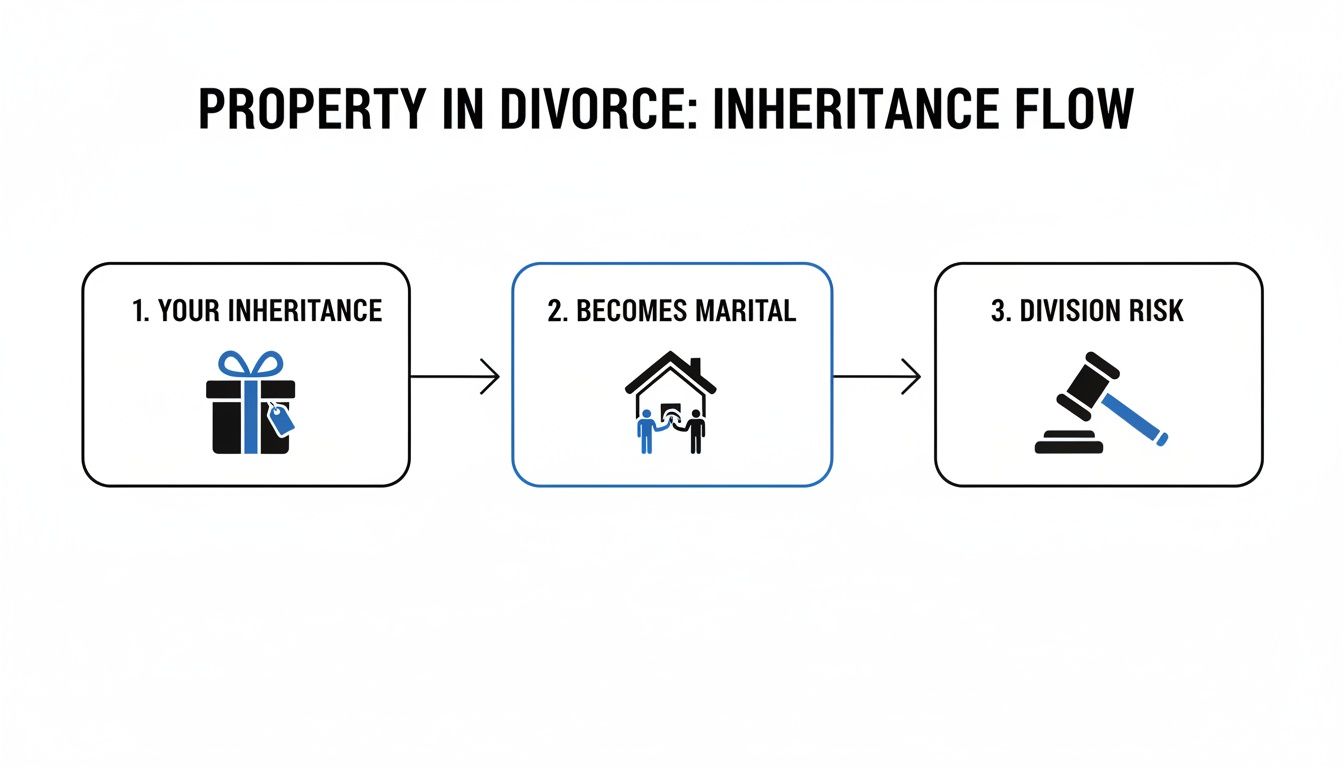
As you can see, the moment you use that inheritance for a shared reason—like for a down payment on a family house—it crosses a legal line. It changes from “yours” to “ours” and can be split up by a judge.
Common Ways People Accidentally Mix Assets
Mixing money usually happens with good intentions. People don’t mean to cause problems. They just don’t know that these simple, everyday actions can risk something they thought was protected.
Here are a few common ways people mix assets:
- Putting it into a Joint Account: You get a check from an estate and, without thinking, put it into the savings account you share with your spouse. Legally, the moment that money goes into a shared account, it is seen as a gift to the marriage.
- Paying Off Shared Debt: Using inherited money to pay off the mortgage on the family home or a shared credit card bill turns those separate funds into a marital asset.
- Investing Together: Putting inherited cash into a stock market account that is in both of your names is another clear way of mixing it.
- Making a Down Payment: When you use your inheritance for a down payment on a house that you and your spouse will own and live in together, that money loses its separate identity.
These actions might seem normal or even nice at the time. But to an Arkansas judge, they show that you meant to share. That intention is what changes the legal status of your inheritance.
The Problem of Transmutation
When you mix assets, a legal process called transmutation happens. That’s the official word for when separate property changes, or “mutates,” into marital property. Once an asset has been transmuted, it’s in the marital pot, and a judge will divide it fairly in a divorce.
Here’s a real-world example. Let’s say you inherit $100,000 and put it into a shared savings account that already has $20,000 of marital money. Over the next year, you use that account for everything—food, vacations, car repairs. A year later, the balance is $90,000.
It would be very hard to prove which of those remaining dollars are from your inheritance versus the original marital money. It’s like a messy math problem.
The job of proving the money should stay separate is on you. Without perfect records, judges will almost always assume the whole amount is marital property.
This isn’t just a rule in Arkansas. Keeping inheritance separate is a key way to protect assets everywhere. This is true in other countries too. For example, in the UK and Canada, family laws say that using inherited money to pay for a shared home mortgage means it can be split equally. You can read more about how inheritance is treated in divorce in England and Wales to see how common this idea is.
The Golden Rule: Keep It Separate from Day One
To keep your inheritance safe from a possible divorce, the best plan is to draw a bright, clear line between your assets and your shared marital assets from the start. This isn’t about being sneaky or not trusting your spouse. It’s about smart financial planning and protecting a family legacy.
Here’s exactly what you need to do:
- Open a New, Separate Account. Before you even get the inheritance check, open a new bank or investment account in your name only.
- Deposit Directly. Make sure the money from the estate is put directly into this new, separate account. Don’t let it go through a shared account first, not even for one day.
- Pay Expenses Separately. If you inherit a house, pay for all taxes, insurance, and repairs from your separate account. Using shared money for these things could give your spouse a claim to the house’s value.
- Keep Titles in Your Name Only. For things like a house, car, or boat, make sure the official title or deed is only in your name.
By taking these steps, you create a clear paper trail. It proves the asset was always meant to be, and has always been, your separate property.
Using Prenups and Postnups for Financial Peace of Mind
Let’s be honest: talking about legal agreements before or during a marriage can feel strange. But it’s one of the smartest and kindest things you can do for your relationship. Think of it not as planning for a breakup, but as creating a clear financial map for your life together. This openness can stop future arguments and make you both feel secure.
The main tools for this are prenuptial agreements (signed before you get married) and postnuptial agreements (signed after). They do the same thing: you and your spouse decide ahead of time how certain things, like an inheritance, will be handled. This removes any confusion or fights later on.
If you are worried about protecting an inheritance, these agreements are your best defense. They let you put in writing, very clearly, that any inheritance you get will stay your separate property, no matter what.
Why Are These Agreements So Powerful?
If you don’t have a prenup or postnup, you have to follow Arkansas’s normal rules for dividing property. You are also hoping you never make a mistake with your money. As we’ve discussed, one simple mistake—like putting an inheritance check in your shared savings account for a week—can blur the lines forever and put your separate property at risk.
A good agreement replaces the state’s rules with your own. It’s your way of telling a judge, “Thanks, but we already talked about this and made a plan that works for us. Here it is.”
Key Takeaway: A prenup or postnup isn’t about not trusting someone. It’s about being respectful and clear with each other. It’s a way to agree on “what’s yours, what’s mine, and what’s ours” before any problems come up.
It’s not surprising that these agreements are getting more popular. As couples see how messy a divorce can be, more are choosing to plan ahead. Keeping an inheritance separate is a big reason for this. For example, after divorces in the UK went up by 9.6% in 2021, lawyers saw more couples asking for prenups to protect family money. As the experts at Rose Legal explain, judges are now more likely to follow these agreements, as long as they are made fairly.
Making Your Agreement Strong in Arkansas
Just signing a piece of paper is not enough. For a judge in Arkansas to accept your prenup or postnup, it has to follow some important rules. If it doesn’t, a judge can throw the whole agreement out.
Here’s what you must get right:
- Put It in Writing. A spoken promise about who gets what won’t hold up in court. It must be a formal, written paper that you both sign.
- Share All Financial Information. This is a big one. Both you and your partner have to be honest about all your money—every asset, every debt, and all your income. Hiding even one thing can ruin the whole agreement.
- Sign It Willingly. A judge needs to be sure that both of you signed freely, without being pushed, threatened, or forced. Any sign of duress (being forced to do something) is a major problem.
- Get Your Own Lawyers. This is very important. To make sure the agreement is fair and that you both understand what you’re agreeing to, you must each have your own lawyer. Sharing a lawyer is one of the quickest ways to have an agreement thrown out.
- Keep It Fair. The agreement cannot be “unconscionable”—a legal word for extremely unfair or one-sided. An agreement that would leave one spouse with nothing while the other gets millions is not going to be accepted.
Taking the time to make one of these agreements is one of the best things you can do for your financial future. It replaces worry with a clear, shared plan, letting you and your partner build a life together with confidence. It’s the best way to know your family’s legacy will stay protected.
How Trusts Can Create a Protective Shield
So far, we’ve talked about what you can do to protect your inheritance. But what if the person leaving you that inheritance could build a wall around it before it ever gets to you?
That’s exactly what a trust does. In my experience, it’s one of the strongest ways to keep family money from getting mixed up in a future divorce.
Think of it like this: getting an inheritance directly is like being handed a beautiful, fragile vase. You have to carry it carefully and make sure it doesn’t get mixed with marital property. But if that same inheritance is put into a trust, it’s like putting the vase inside a locked, unbreakable display case. You can enjoy what’s inside, but you never technically “hold” it. This makes it very hard for a spouse to claim a part of it.

The Basic Idea: How a Trust Works
A trust is just a legal setup. The person creating it (the grantor) gives control of certain assets to a person or company they trust (the trustee). The trustee then manages those assets for you (as the beneficiary).
Here’s the most important part: you don’t legally own the things inside the trust. The trust owns them. This small but very important difference is what gives a trust its protective power in a divorce. Since the property isn’t legally yours, it usually can’t be called marital property to be divided.
Key Insight: When assets are held in a good trust, they are not legally yours to mix with marital money. This creates an automatic wall against mixing and makes it very hard for a divorcing spouse to claim a share.
The Irrevocable Trust: Your Best Asset Shield
Not all trusts give the same amount of protection. When it comes to protecting assets from a divorce, the best type is an irrevocable trust.
Once the grantor creates this type of trust and puts assets into it, the rules are basically set in stone. This is its superpower.
Because the grantor gives up control forever, the assets are truly separate from everyone—both the person who made the trust and you. This makes them almost impossible to touch in a divorce. The trustee follows the rules in the trust document and can give you money for things like school, health care, or living costs, but the main assets stay safely locked away.
For a complete plan to secure your assets and make sure they go where you want, looking into effective estate planning is a great idea. These plans work together with protective tools like trusts.
Of course, trusts are not for everyone. To see which kind might be best for your family, you can learn more about a revocable trust vs an irrevocable trust in our detailed guide.
Seeing It in Action: Real-World Examples
Let’s look at how this works in real life. The difference a trust makes is huge.
- Example 1 (No Trust): Your grandmother leaves you $200,000 in her will. You are smart and put it into a separate savings account. A year later, you and your spouse use $50,000 from that account for a down payment on a family house. In a divorce, your spouse has a good case that the $50,000 has become marital property.
- Example 2 (With a Trust): Instead, your grandmother puts that $200,000 into an irrevocable trust for you. The trustee, following the trust’s rules, pays your monthly rent directly to your landlord. You never touch the money yourself. If you get divorced, the money inside the trust is safe because you never legally owned or controlled it.
This clean separation is very hard for a spouse’s lawyer to argue against in court.
The Important Role of the Trustee
The trustee is the gatekeeper. This person or company has a legal duty to follow the trust’s instructions and manage the assets smartly. The trustee can be a trusted family friend, a professional, or a bank.
Their job is to:
- Make smart investments for the trust’s assets.
- Give you money, but only as the trust document says.
- Keep perfect records and handle all taxes for the trust.
Having an independent trustee adds another layer of separation. It stops you from making a quick decision—like using the money to pay off a shared credit card—that could accidentally turn your separate inheritance into marital property. By planning ahead with a trust, your loved one can give you a gift that is truly protected for your future, no matter what happens.
Keeping Good Records to Prove Your Case
When you are in front of a judge during a divorce, it is your job to prove that your inheritance is, and always has been, your separate property. Good, organized records are your best friend here.
Without a clear paper trail, things can get messy. It becomes a “he said, she said” argument. I’ve seen it many times: judges will almost always believe what can be proven on paper. Think of yourself as a detective for your own money. You need to gather the evidence that tells one clear story: “This money came from my family, I kept it in its own account, and it never touched our shared marital money.”

This might sound like a lot of work, but it’s really about being careful from the very start. A simple habit of saving the right papers can save you a lot of trouble and money later.
Your Document Protection Toolkit
The minute you hear an inheritance is coming your way, it’s time to start a file. It can be simple—a folder, a box, or a labeled folder on your computer. The important thing is to have one safe place for everything about the inheritance.
Here are the papers you must collect and keep safe:
- The Will or Trust Document: This is the birth certificate of your inheritance. You need a full copy. It’s the main paper that proves where the assets came from and that they were meant just for you.
- Letters from the Estate: Don’t throw away letters from the person in charge of the estate (the executor or trustee). These letters often say how much the inheritance is worth and when you will get it. This helps set a clean starting point for your records.
- Records of Payment: Get a copy of the check from the estate or the wire transfer confirmation. This is your proof of the exact amount you got and the date you got it.
- Statements for Your Separate Account: This is the most important evidence you will have. From the day you open that account, save every single statement. This creates a clear record showing the money was put there and never mixed with marital money.
A Pro Tip From Experience: Don’t just file these papers away. Scan every single one. Making digital copies is like an insurance policy in case of a fire, flood, or just losing a folder years later. Store them in a secure online place you trust.
Creating an Unbreakable Paper Trail
Good record-keeping is more than just collecting papers. It’s about telling a consistent story over time. Every piece of paper should support the clear line you’ve drawn between your inheritance and your shared finances. There should be no gaps for a judge to question.
Let’s say you inherit a rental property. Your file should include:
- The deed, showing the property was put only in your name.
- Receipts and bank statements from your separate account that prove you paid for the property taxes, insurance, and repairs yourself.
If you use money from your shared bank account for any of those costs, you’ve just mixed the asset. That one small action could give your spouse a right to a share of the property’s value. Your records need to be perfect to prove that every dollar spent on that property came from your separate money. This level of detail is exactly what an Arkansas judge will look for.
To help you get started, here’s a simple checklist of the documents you’ll want to keep organized.
Inheritance Protection Document Checklist
Having the right paperwork is half the battle. This table shows what you need and why it’s important.
| Document Type | Why It’s Important | Where to Store It |
|---|---|---|
| Copy of Will or Trust | Proves where the money came from and that you were meant to get it. | Secure digital folder and a fireproof safe at home. |
| First Bank/Investment Account Statements | Shows the exact date and amount of the first deposit into your separate account. | Digital folder, saved right when you get it. |
| All Later Account Statements | Creates a full history showing the money was not mixed with marital money. | Organized by date in both a digital folder and a physical file. |
| Titles and Deeds | Confirms legal ownership of things (like a car or house) in your name only. | Original in a safe deposit box; copies in your digital/home file. |
| Receipts for Asset-Related Costs | Proves that costs for inherited property were paid with separate, not marital, funds. | Scanned and filed digitally by type of cost and date. |
Treating these documents with care from day one is the best, cheapest way to protect what’s yours.
Common Questions About Protecting Your Inheritance
Understanding the rules about inheritance can feel like a lot, especially when you are also dealing with the stress of a possible divorce. Let’s go through some of the most common questions we hear from clients at DeWitt & Daniels about keeping an inheritance safe in Arkansas.
What if I Already Mixed My Inheritance with a Joint Account?
If you’ve already put inherited money into a shared account, don’t panic—but you need to act fast. This is a classic example of commingling, and it puts your separate property at risk. The good news is, you can often fix some of the damage.
A good lawyer can help you with a process called tracing. This is like being a detective for your money. They look through bank statements to make a clear map showing where your inherited money came from and where it went. The goal is to prove to a judge that a certain part of that mixed money is from your inheritance.
Sometimes, you and your spouse might be able to sign a postnuptial agreement. This would officially change the money back to your separate property, even after it has been mixed. But the most important first step is to stop adding any more of your separate money to that shared account and get legal help.
Does It Matter if My Inheritance Is a House Instead of Cash?
No, it doesn’t matter. The type of inheritance—whether it’s a house, stocks, a car, or cash—doesn’t change how it’s treated at first. In Arkansas, it starts as your separate property. The real risk is what you do with it after you get it.
Here’s an example we see all the time:
- You inherit your family’s home, and the deed is put in your name only. This is your separate property.
- A year later, the roof needs to be replaced for $15,000. You pay for it from the shared bank account you have with your spouse.
- If you get divorced later, your spouse now has a good reason to ask for a share of the home’s value. Why? Because shared marital money was used to fix and improve your separate property.
To keep an inherited property truly separate, the title must stay in your name only. All costs for it—like taxes, insurance, and repairs—must be paid from a separate account with your own money or the inheritance itself. If you ever add your spouse’s name to the deed, you have legally given it to the marriage, and the whole property usually becomes marital.
Key Takeaway: An inherited asset is only as safe as the wall you build around it. Any money from the marriage used on it, no matter how little, can open the door for your spouse to make a claim.
Can My Spouse Get My Inheritance if We Were Married a Long Time?
How long you were married does not automatically turn your separate property into marital property in Arkansas. If you inherited something 20 years ago and have been very careful to keep it separate that whole time, it should still be yours alone in a divorce.
However, a long marriage can change things in other ways. When a judge divides the marital property, they look for a fair result. If one spouse has a very large, protected inheritance and the other has very little, the judge might give the non-inheriting spouse a bigger share of the marital property to make things more even.
This is why your record-keeping is so important. Having a perfect paper trail is the best defense you have to show that your inheritance was never meant to be part of your shared financial life, no matter how long you’ve been married.