Imagine you and a friend decide to share a big jar for your money. After you start sharing, any money you both earn goes into this one jar. That’s a simple way to think about community property. It’s a legal idea that says almost everything a married couple gets during their marriage belongs to both of them equally, a perfect 50/50 split.
But what if you live in Arkansas? Does that big jar rule apply here? Let’s find out.
What Is Community Property?

In a community property state, when you get married, it’s like starting a team. From the day you get married, every dollar earned and everything you buy with that money belongs to the team. If one person buys a car with their paycheck, the car belongs to both people. If one person puts money into a retirement account, that money is shared, too.
This idea is based on fairness. The law sees that both people in a marriage help the family, even if they do different things. The person who earns money and the person who takes care of the home are both seen as equal partners.
Where Is Community Property the Law?
This “we’re-a-team” rule isn’t used everywhere. In the United States, only nine states have community property laws: Arizona, California, Idaho, Louisiana, Nevada, New Mexico, Texas, Washington, and Wisconsin.
Even though that’s not many states, a lot of people live in them. For a deeper look, you can find more insights about which states use this system and how it works.
It’s very important to know that Arkansas is not a community property state. Arkansas uses a different system called “common law,” which divides things “equitably,” or fairly. So, if you live in Arkansas, why should you care about community property? Because people move. You might move here from Texas, or you might have lived in California before. The property you got in those states is still treated by their rules. Understanding both systems is just being smart.
Community Property vs. Common Law
To really understand the difference, let’s look at the two systems side-by-side. The main difference is who owns what during the marriage and how it’s split up if the marriage ends.
In a community property state, when a couple gets divorced, they usually start by splitting everything 50/50. In a common law state like Arkansas, the goal is to split things “fairly,” which might not be an even half.
This quick table shows the big ideas.
| Feature | Community Property States | Common Law States (like Arkansas) |
|---|---|---|
| Who Owns It? | Things you get during marriage are owned 50/50 by both people. | Each person owns the property that has their name on it. |
| How It’s Divided | Marital property is usually split equally (50/50) in a divorce. | Marital property is divided “equitably” or fairly, which may not be 50/50. |
| Basic Idea | “What’s ours is ours.” | “What’s yours is yours, and what’s mine is mine.” |
As you can see, the state where you live—or used to live—can make a big difference in your money matters, especially during big life changes like a divorce.
How Arkansas Divides Property in a Divorce
Since Arkansas is not a community property state, it has a different set of rules for dividing things when a marriage ends. The legal way it’s done here is called equitable distribution.
Instead of one big shared money jar, it’s easier to think of it like three separate jars.
You have one jar for everything you owned before you got married (that’s your separate property). Your spouse has one, too. Then there’s a third, bigger jar for everything you both got during the marriage. That’s the marital property.
When a divorce happens in Arkansas, a judge’s main job is to divide the things in that third jar “fairly.”
Fair Does Not Always Mean Equal
Here’s the most important thing to know about equitable distribution: “fair” is not always a 50/50 split.
While splitting things in half is often where the judge starts, an Arkansas judge can change the split if a 50/50 division wouldn’t be fair. This is very different from community property states, where the law often says things must be split evenly.
Instead, the court looks at the whole story of your marriage to figure out what a truly fair split looks like. A judge might decide a 60/40 or even a 70/30 split is more fair, depending on what happened in your family. The goal is to make sure both people can be okay financially after the divorce.
What Factors Do Arkansas Courts Consider?
To figure out what’s fair, a judge will look at many things, not just bank accounts and who owns what. They want to understand your whole partnership.
Some of the key things that a judge thinks about include:
- Length of the Marriage: A short marriage might end with each person taking what they brought into it. A marriage that lasted 20 or 30 years is a different story.
- Each Person’s Age and Health: The court will think about if one person has health problems that could make it harder for them to earn money in the future.
- Occupation and Income: A judge looks at what each person does for a living, how much money they make now, and how much they could make in the future.
- Vocational Skills: This is about being able to get a job—things like education and special training.
- Each Person’s Estate and Financial Needs: The court looks at the whole money picture for both people, including any separate property they might own.
The big takeaway here is that Arkansas law sees non-money contributions as valuable. The work a stay-at-home parent does by running the home and raising kids is seen as a direct contribution to the family’s ability to get property.
This is very important. A spouse who didn’t earn a paycheck from a job isn’t punished. Their hard work is seen as helping the family succeed with money, so they get a fair share of the marital property.
Valuing Your Marital Assets
Of course, before anything can be divided, you have to know what it’s worth. This step is very important for a fair result. For some things, like a savings account, the value is clear. But for things like a house, a family business, or a retirement plan, it’s more complicated.
Before property can be fairly divided in a divorce, it’s key to know its real market worth; learn more about how to accurately determine home value. Getting experts to value major things makes sure the division is based on real numbers, not guesses. This correct value is the foundation of a truly fair property split.
Identifying What Is Yours Versus What Is Ours
One of the first things to do in a divorce is figure out who owns what. It’s like sorting laundry—you need to separate what belongs to just you, what belongs to your spouse, and what you both own together. In Arkansas, the law calls this telling the difference between separate property and marital property.
Think of it like this: the savings account you’ve had since you were in college? That’s probably your separate property. It was yours before you got married. But the house you and your spouse bought a few years after your wedding? That’s almost definitely marital property, because you got it as a team.
This process of sorting everything into “yours,” “mine,” and “ours” piles is the foundation of a fair property division. Only the marital property—the “ours” pile—gets divided by an Arkansas court.
Defining Separate And Marital Property
So, what makes something separate or marital? When you got it is usually the biggest clue.
- Separate Property: This is usually anything you owned before the marriage. It also includes gifts or inheritances you received during the marriage, as long as they were meant only for you.
- Marital Property: This is the big bucket. It covers almost everything you or your spouse got during the marriage—from your wedding day until you are legally separated. This includes money from jobs, houses, cars, and even retirement accounts you paid into with your earnings.
This simple flowchart helps show the basic question an Arkansas court asks when looking at something you own.
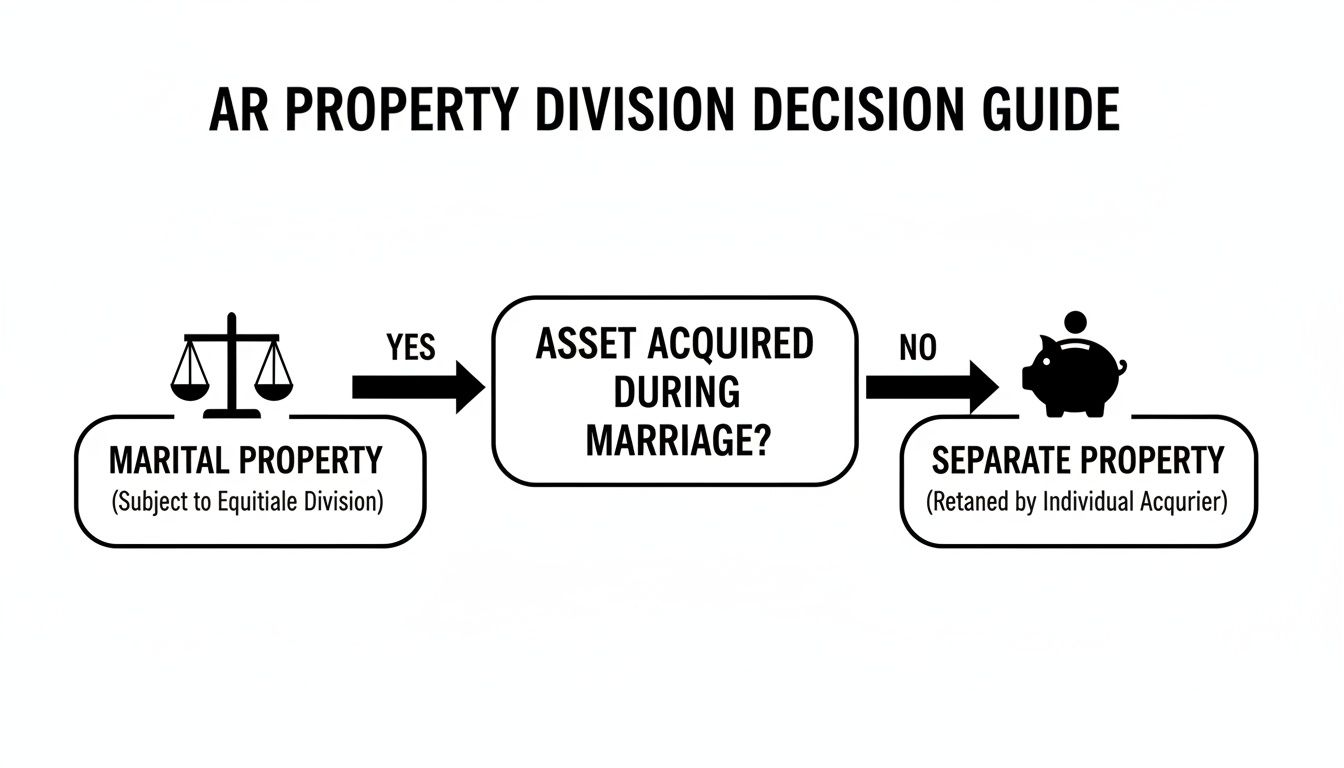
As the chart shows, the court usually assumes that anything gotten during the marriage is marital. Anything from before is separate. This is where every conversation about dividing property starts.
The Blurry Line Of Commingling
Now, here’s where things can get confusing. What happens if you mix everything up?
Let’s say you inherit $20,000 from your aunt. That money starts out as your separate property. But instead of putting it into its own account, you put it into the joint bank account you share with your spouse.
You’ve just done something called commingling—mixing separate and marital money together.
Once things are commingled, it can be very hard to prove what was originally yours alone. If that $20,000 was used over the years to pay for the house or buy food, the law might see it as a gift to the marriage. By mixing it, you may have accidentally turned your separate property into marital property.
This idea is a major reason for arguments in divorces. What started as clearly separate property can legally become marital property because of things you do during the marriage, often without even knowing it would have a big effect later.
This can be a big deal for your money. You can even explore how the IRS views these property distinctions to get a deeper look. This is exactly why keeping inherited money or savings from before marriage in their own separate accounts is so important.
Common Examples Of Property Division
To make this easier to understand, let’s look at some real-life examples. Knowing how different things are usually sorted can help you think about your own situation. Here’s a quick breakdown.
Examples of Separate vs Marital Property in Arkansas
| Asset Type | Usually Separate Property | Usually Marital Property |
|---|---|---|
| Bank Accounts | A savings account you had before the wedding with only your own money in it. | A joint checking account opened after marriage that you both put your paychecks in. |
| Real Estate | A condo you bought and paid off five years before getting married. | The family home you bought together and made house payments on during the marriage. |
| Inheritance | Money or property you inherited from a family member, kept in a separate account. | An investment property bought with a mix of inherited money and marital money. |
| Retirement Funds | The amount of money in your 401(k) on the day you got married. | All the money added to and grown in your 401(k) during the marriage. |
| Vehicles | A classic car you owned as a teenager. | The family minivan bought during the marriage for everyone to use. |
Correctly identifying each thing you own is the first and most important step toward a fair and just division. It’s a job that requires careful attention to detail and a clear understanding of how Arkansas law works.
So, Why Does Community Property Matter in Arkansas?
It’s easy to think, “Arkansas is a ‘fair division’ state, so I don’t need to worry about community property.” But it’s not always that simple. Life changes, people move, and laws from other states can affect you even when you’re here.
Think about it. Maybe you and your spouse lived in Dallas—a community property state—for the first ten years of your marriage. During that time, you saved money, bought a car, and started a retirement account. Every single one of those things you got in Texas is legally community property, owned 50/50 by both of you.
Then, you move to Fayetteville for a great new job. Just because you live in Arkansas now doesn’t mean those Texas things magically change. They are still looked at through the eyes of Texas law. If you were to get a divorce here, an Arkansas court would have to look back and use Texas rules to divide everything you got while you lived there.
When Your Past Homes Follow You
This happens a lot, especially in Northwest Arkansas, which brings in people from all over the country. Moving to a new state doesn’t wipe the past clean. The type of property something is (community or separate) is often decided by the laws of the state where you lived when you got it.
Think of it like a legal souvenir. The property you get in a state carries that state’s legal rules with it, even when you move. An Arkansas judge will respect the laws from where you lived when you earned or bought that property.
This means your property could be a mix of things, all handled differently:
- Texas Property: That savings account from your Dallas days? It would be treated as community property and likely split right down the middle, 50/50.
- Arkansas Property: The house you bought in Rogers and the money you earned while living here? That’s marital property, and it gets divided equitably (which means fairly, not always equally) under Arkansas law.
Untangling Complex Assets
This gets even harder with things that grow over time, like retirement accounts or a business. Let’s say you started a business a year before you got married. At that time, it was worth $50,000—that’s your separate property.
But over the next 15 years of marriage, you and your spouse work hard on it, and its value grows to $500,000. That $450,000 increase is usually seen as a marital asset here in Arkansas because it was built through your work together during the marriage.
The same idea applies to a 401(k) or pension. The money in the account before the wedding is yours alone. But the money added and the growth that happened during the marriage belongs to both of you and will be divided fairly. If you lived in a community property state while that account was growing, those rules would apply to that piece of it.
The Impact on Inheritance and Estate Planning
This mix of state laws also has a huge effect on what happens when a spouse dies. The line between community and separate property is very important in inheritance law.
How an asset is classified decides whether you can give it to someone in a will or if your spouse automatically owns half of it. For a deeper dive into this, you can learn more about how community property affects inheritance matters on international-probate-lawyer.com. Understanding these details is the only way to make sure your property actually goes where you want it to.
How to Protect Your Separate Assets

Let’s be clear: taking steps to protect your own property isn’t about expecting a marriage to end. It’s just smart money planning. It’s about making things clear to avoid a lot of stress later. When you and your partner set clear lines for your property, you build a stronger money foundation together.
Think about it like starting a business. You wouldn’t start a company without an agreement that explains everyone’s jobs and duties. A marriage can use the same kind of money roadmap. This is where tools like prenuptial and postnuptial agreements are helpful.
Creating a Financial Roadmap for Your Marriage
A prenuptial agreement, often called a “prenup,” is a legal paper you and your partner sign before you get married. It’s a simple document that lists each person’s separate property and debts. More importantly, it explains how those things—and any new ones you get—will be handled during the marriage and if it ever ends.
A postnuptial agreement does the exact same thing, but you make it after you’re already married. These are often used when a couple’s money situation changes a lot—like if one person starts a business or gets a big inheritance.
Don’t think of these agreements as a plan for divorce. See them as a plan for your shared money life. They make you have open, honest talks about money from the start, getting you both to agree on your goals.
Basically, these documents let you and your partner make the rules for your own property. If you don’t, you’re leaving it up to a court to decide for you later.
Practical Steps to Keep Separate Property Separate
Besides legal agreements, you can use simple, everyday habits to keep your separate and marital property from getting mixed up. The goal is to avoid “commingling,” which is just a legal word for mixing your things together.
Here are a few easy ways to do this:
- Keep Separate Bank Accounts: If you inherit money or get a gift just for you, put it in a bank account that is only in your name. Never put it into a joint account. That’s the quickest way to turn it into marital property.
- Keep Good Records: If you use your separate money to help buy a house together, write down where the money came from. Save the bank records and have a simple note signed by both of you that says the money was your separate property.
- Pay for Separate Debts with Separate Money: Have a student loan from before you were married? Keep making those payments from your own bank account, not the joint one.
- Be Careful with Titles: When you buy something important with your own money, make sure the title or deed says it is your “sole and separate property.”
Taking these small steps creates a clear paper trail that can stop a lot of headaches and arguments later. It’s all about being organized and careful with your money.
How Property Division Affects Debts and Your Will
When a marriage ends, people mostly talk about property—who gets the house, the car, the savings. But there’s another side that’s just as important: debt. Dividing property in Arkansas isn’t just about what you own; it’s also about what you owe.
Just like property, debts are sorted as either marital or separate. Let’s say your spouse used a personal credit card during the marriage to pay for family groceries, vacations, and car repairs. That’s almost certainly a marital debt, and you’re both usually responsible for paying it.
Sorting Out Marital and Separate Debts
The important things here are timing and purpose. A student loan from long before you even met? That’s a classic example of separate debt—it belongs to the person who took it out.
On the other hand, a car loan for the family car that you bought a year after the wedding is a shared, marital debt.
An Arkansas court will divide marital debts fairly, the same way it handles property. The judge is looking for a fair result, which doesn’t always mean a perfect 50/50 split. Sometimes, debts are given to the person who is in a better money situation to pay them.
The Connection to Your Estate Plan
How your property is sorted has a huge effect on what happens after you die. Your will can only give away property that you legally own.
You are free to give away 100% of your separate property to anyone you choose.
But marital property is different. You only own a share of it. You can’t, for example, write a will leaving the entire family home to your brother if it’s marital property, because your spouse has a legal right to their fair share.
Think of it this way: your will says how your half of the marital property and all of your separate property should be given out. Not understanding this can cause big problems and could lead to your final wishes being challenged or even ignored by a court.
Understanding this link is very important for good estate planning. After a big life change like a divorce, it’s key to update your will and other legal papers. For a detailed guide, you can learn more about how divorce affects an estate plan on dewitt.law.
It’s also smart to understand the bigger picture of how an estate is handled. Getting familiar with trustee responsibilities after death can give you more information. Making sure your property is correctly identified and handled protects your wishes and gives your loved ones much-needed clarity during a hard time.
Common Questions About Marital Property in Arkansas
Once you learn the basics, you start to see how they work in real life—and that’s where the hard questions come up. Let’s go over some of the most common situations we see in Arkansas.
Does It Matter Whose Name Is on the Car Title?
Not as much as you might think. If a car was bought during the marriage with money either of you earned, it’s almost always considered marital property. It doesn’t matter if only one name is on the title.
Arkansas courts look past the paperwork to find out when and how the car was bought. If you used your paycheck to buy it, the car belongs to the marriage. Where the money came from is what matters most.
Who Gets to Keep the Engagement Ring?
This question comes up all the time. In Arkansas, an engagement ring is legally seen as a “conditional gift.” The gift has one big condition: that you actually get married.
Once you are married, the condition is met, and the ring becomes the separate property of the person who received it. If you later get divorced, the ring is yours to keep.
Is Arkansas a Strict 50/50 State for Divorce?
No, it’s not. Arkansas is an equitable distribution state, which just means “fair.” While a 50/50 split is often the starting point, the judge’s main goal is to find a fair result, not a perfectly equal one.
A judge might decide on an unequal split based on a few things:
- How long you were married
- Each person’s age, health, and ability to earn money
- Help one spouse gave as a homemaker or stay-at-home parent
This lets the court make the property division fit your family’s specific situation.
Remember, “equitable” means fair, not always equal. An Arkansas court can divide property in whatever way it thinks is just, whether that’s 50/50, 60/40, or something else.
How Do I Prove Something Is My Separate Property?
The short answer? Paperwork. Proving something is your separate property means having good records that show a clear trail. You need to show the court that it belongs only to you and was never mixed with marital property.
Good proof usually includes things like:
- Bank statements from before you got married
- Deeds or titles showing you were the only owner before the wedding
- A will or trust document showing an inheritance was meant just for you
It’s not enough to show you owned it at one time; you also have to show that you kept it separate during the whole marriage.