An annulment in Arkansas is a way for a court to say a marriage was never legal. Think of it like this: a divorce ends a real marriage, but an annulment says the marriage wasn’t real to begin with. With an annulment, the marriage is erased because something was seriously wrong from the very start. Knowing this difference is the first step to figuring out your options.
What an Annulment Really Means in Arkansas

Here’s an easy way to think about it. Imagine a marriage is like a house. A divorce is like selling a good, strong house that you lived in. The house was real, you made memories in it, but now you are moving out and splitting everything up.
An annulment is different. It’s like finding out the house was built on a bad foundation. Maybe the builder used the wrong materials. Because the foundation was bad, the house was never truly safe or legal. An annulment doesn’t just tear the house down; it’s a court saying a real, legal house never existed there.
This is why annulments in Arkansas are rare. It’s not a quick way to end a short marriage. It’s for a marriage that was missing a key legal part that made it real.
Why Annulment Is a Special Legal Tool
You don’t choose an annulment over a divorce like you pick what to eat for dinner. You can only get an annulment if the marriage had a major legal problem from day one. The law calls these marriages either “void” or “voidable.”
- Void Marriage: This kind of marriage was never legal, not even for a minute. For example, if someone marries you while they are still married to another person, that new marriage is void.
- Voidable Marriage: This marriage is considered real until a judge says it’s annulled. This usually happens when there was a big problem like a lie or someone wasn’t able to truly agree to the marriage.
Understanding this is the first step. It helps you see why a judge has to have a very specific, serious reason to grant an annulment.
An annulment is like hitting a rewind button, saying a legal marriage never happened. A divorce just hits the stop button on a marriage that was legal. This changes everything, from your legal status to how property is divided.
Annulments in Arkansas
Talking about ending a marriage is common in our state. Arkansas often has one of the highest divorce rates in the U.S., with about 10.7 divorces for every 1,000 people. That’s much higher than most other states. Because of this, people sometimes ask about other options, like annulments. You can read more about Arkansas marriage and divorce statistics to get the full story.
This high rate shows why it’s so important to know all your legal choices. Divorce is the most common way to end a marriage, but an annulment is there for the few cases where the marriage was legally flawed from the start.
The Four Legal Reasons for an Annulment in Arkansas

In Arkansas, you can’t get an annulment just because you changed your mind about being married. Unlike a divorce, which ends a real marriage, an annulment says the marriage was never legal.
To get one, you have to prove that a specific, legally recognized problem existed when you got married. These problems are called grounds, and Arkansas law is very strict about them.
There are only four valid reasons for an annulment in our state. If your situation doesn’t fit into one of these, a judge will say no, and divorce will be your only option.
Reason 1: Bigamy
This one is simple. Bigamy is when a person gets married while they are already married to someone else. In Arkansas, you can only be married to one person at a time.
A marriage with bigamy is “void,” which means it was never legal. A judge’s job is just to make it official that the marriage was never real.
Reason 2: Underage Marriage
The second reason is when one or both people were too young to get married without the right permission. These laws protect kids from making a commitment they aren’t ready for.
Here are the age rules for getting married in Arkansas:
- You must be 18 years old to marry on your own.
- A 17-year-old can get married, but only if their parents or legal guardians give written permission.
- No one under 17 can get married at all.
If a marriage breaks these rules—like if a 16-year-old gets married—it is not legally valid and can be annulled.
Reason 3: Not Able to Consent
This reason is about whether someone could truly understand what they were doing. A marriage is like a legal contract, and you have to be able to understand and agree to it. If someone was not mentally able to give real consent at the wedding, the marriage can be annulled.
This is hard to prove. It doesn’t mean you were just nervous or had second thoughts. It means something seriously affected your judgment.
For example, if someone was so drunk or high on drugs that they didn’t understand they were getting married, that could be a reason. A serious mental health problem happening at that exact moment could also count.
The key is proving that the person’s mind was not clear at the time of the ceremony, so they couldn’t understand the big promise they were making.
Reason 4: Fraud (Being Tricked)
The last reason, which is often the hardest to prove, is fraud. This means one person was tricked into the marriage by a big lie or by someone hiding a very important fact. The fact has to be so important that the other person would not have gotten married if they had known the truth.
This isn’t about small lies. Lying about being a good cook or hiding a small debt won’t work. The lie must be about something central to the marriage itself.
Some examples of fraud that might work for an annulment are:
- Hiding that you can’t have children when you know your partner wants them.
- Hiding a serious criminal past.
- Marrying someone just to become a U.S. citizen, with no plan to live like a married couple.
- Lying about who you are in a major way, like your religion, if that was very important to your partner.
To win a case based on fraud, you need to show clear proof of the lie and how that lie tricked you into a marriage you never would have agreed to.
Here is a simple chart to help you remember the four reasons:
Reasons for Annulment in Arkansas Explained
| Legal Reason | Simple Explanation | What Matters Most |
|---|---|---|
| Bigamy | One person was already married. | There was another legal marriage that hadn’t ended. |
| Underage Marriage | Someone was too young to get married. | The person’s age and if they had permission from parents. |
| Not Able to Consent | Someone couldn’t understand what they were doing. | The person’s state of mind during the wedding ceremony. |
| Fraud | Someone was tricked by a big lie about the marriage. | The lie was huge, not small, and was done on purpose. |
Understanding these four reasons is the most important first step. A good family lawyer can help you figure out if your situation fits the strict rules for an annulment in Arkansas.
Annulment vs. Divorce: How They Are Different
Many people use the words “annulment” and “divorce” as if they mean the same thing. It might not seem like a big deal, but in the eyes of Arkansas law, they are totally different. Understanding this difference is one of the most important first steps.
The easiest way to think about it is what each one says about your marriage. A divorce is how you legally end a marriage that was real. It’s like closing a book after you finish reading it—the story happened, but now it’s over.
An annulment, on the other hand, says a real marriage never happened in the first place. It’s like finding out that book was printed with no words inside. The law basically erases the marriage because a key legal part was missing on your wedding day.
The Main Legal Difference
What happens to the status of your marriage is the biggest difference. A divorce says you were married, and now you are not. But after an annulment, the law sees you as single, as if the wedding never legally happened.
This is more than just words; it has real effects. After an annulment, you can legally check the “single” box on forms. After a divorce, your legal status is “divorced.”
How Property and Money Are Handled
When you talk about money and property, the differences get even bigger. In a divorce, Arkansas courts have a clear system for splitting up property and deciding if one person should pay the other support (alimony). The law knows you built a life together and tries to fairly divide what you earned and the debts you took on.
With annulments in Arkansas, the court has a different job. Since the law says the marriage wasn’t real, there is no “marital property” to divide.
However, a judge can still step in to untangle your money and property fairly. The goal is to return each person to the financial spot they were in before the invalid marriage started. This can be harder than just splitting things in half.
For the same reason, alimony is not usually given in an annulment. Since there was no real marriage, there is no legal reason for one person to support the other. To learn more about how money works when a real marriage ends, you can read about the specific divorce laws in Arkansas.
A Simple Comparison
To see how different these two are, let’s compare them side-by-side. This chart breaks down the key differences that matter most.
| What It Is | Annulment in Arkansas | Divorce in Arkansas |
|---|---|---|
| Legal Status | Says the marriage was never legally real. | Ends a legally real marriage. |
| Your Marital History | You can legally say you were never married. | Your status is “divorced.” |
| Reason to File | You must prove one of the four specific legal reasons. | You can file for “no-fault” reasons (like you just separated). |
| Property Division | A judge separates property to return you to where you were before. | A judge divides property you got while married. |
| Spousal Support | Usually not available, since there was no real marriage. | Can be ordered based on one person’s need and the other’s ability to pay. |
In the end, choosing between an annulment and a divorce isn’t really a choice. It all depends on your situation. If one of the four specific reasons for an annulment was true on your wedding day, you might be able to get one. If not, divorce is the only legal way to end a valid marriage.
Your Step-by-Step Guide to Filing for Annulment
Thinking about the legal steps for an annulment can feel confusing, like trying to follow a map you can’t read. But if you break it down into smaller steps, it becomes much clearer. Let’s walk through the basic process of filing for an annulment in Arkansas, from the first paper to the final court date.
It all starts with one important document. This is your official request to the court, and it gets the whole process started.
Step 1: Filing the First Papers
Your journey begins when your Divorce Lawyer prepare a document called a Complaint for Annulment. This is the formal paper you file with the Circuit Court in the county where you or your spouse lives. It’s more than just a form; it’s how you tell your story to the judge.
In the Complaint, you have to clearly state:
- Who you and your spouse are (your names and information).
- When and where you got married (so the court knows it can handle your case).
- Which of the four legal reasons you are claiming. You must name the specific reason—like fraud or bigamy—and explain exactly why it applies to your marriage.
This document is the foundation for your whole case. Getting it right is very important, because mistakes can cause delays or even get your case thrown out.
Step 2: Telling Your Spouse Legally
Once you file your Complaint, you can’t just move on. The law requires you to officially let your spouse know that you have started a legal case. This is called service of process, and it’s a very important step to make sure everything is fair.
You can’t just hand the papers to your spouse yourself. In Arkansas, it must be done the right way:
- A county sheriff or a special delivery person (a process server) can give them the papers in person.
- Sometimes, you can send it by certified mail where they have to sign for it.
Proper service gives your spouse a chance to respond. If they disagree with the annulment, they can file their own paper with the court, called an “Answer.”
The specific rules for filing papers can be a little different from one Arkansas county to another. This is a great example of why it’s smart to check local court rules or work with a lawyer who knows how things are done in your area.
Step 3: Gathering Your Proof
A judge won’t grant an annulment just because you ask for one. You have the burden of proof, which means it’s your job to convince the judge that your reason for the annulment is true. This means you need good, solid proof.
The kind of proof you need depends on the reason you’re claiming.
- For Bigamy: This is often easy to prove. You would need a certified copy of the other marriage license.
- For Underage Marriage: Birth certificates that show the person’s age at the wedding are the best proof.
- For Fraud: This is usually the hardest to prove. You might need emails, text messages, or even have other people testify to show that your spouse tricked you about something very important.
If you need to use documents from another country, it’s very important to know how to prepare them for court. You might find it helpful to look up tips for translating legal documents to make sure everything is done right. This helps make sure your proof is clear and that the judge can accept it.
This picture shows how an annulment erases a marriage, while a divorce ends it.
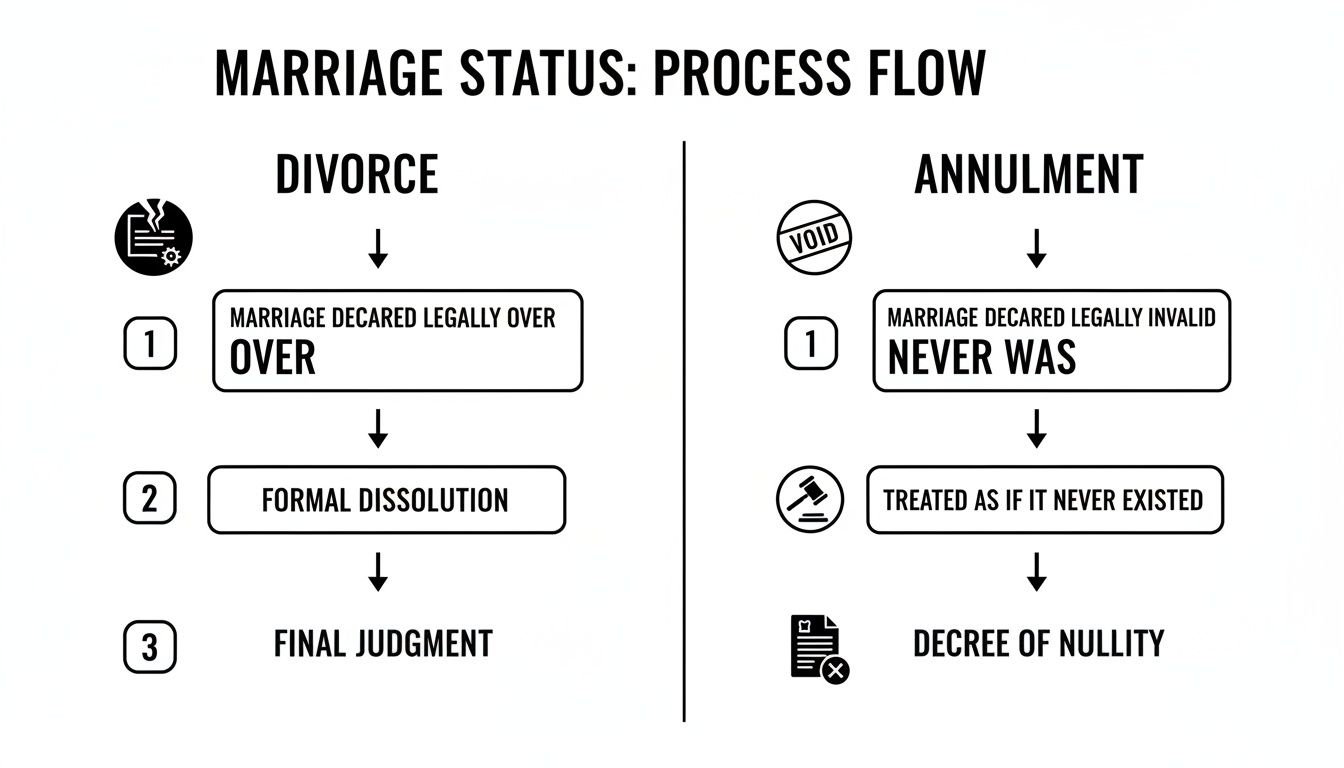
This image makes it simple: an annulment treats the marriage like it never happened, but a divorce says it did happen and is now over.
Step 4: Going to Your Court Hearing
The final step is the court hearing. This is your chance to tell your side of the story to the judge. Unlike what you see on TV, most annulment hearings are short, especially if your spouse agrees.
During the hearing, this is what will happen:
- You will testify. This means you will explain, under oath, why you believe the marriage should be annulled.
- Your proof will be shown. If you have a lawyer, they will present your documents and ask any witnesses to speak for you.
- The judge might ask questions. The judge will want to be sure they understand your case before making a decision.
If the judge believes you have proven one of the legal reasons, they will sign a Decree of Annulment. This is the official court order that says your marriage is legally erased. It’s the final paper that makes it official.
What Happens After an Annulment Is Granted
When an Arkansas judge signs your Decree of Annulment, it’s a big relief. But what happens next? Legally, it’s as if you were never married. This simple fact affects everything, from your property and debts to your children and legal papers.
Knowing what to expect helps you move forward with confidence. The court’s job is to untangle your lives fairly, especially if you have kids.
How Property and Debts Are Handled
What about the car you bought together or the credit card bill you both used? Since the law says the marriage was never real, there is no “marital property” to split like in a divorce.
But a judge will still help sort out your money. The main goal is to put each of you back in the same financial spot you were in before the marriage, as much as possible.
This usually means:
- Dividing Property: The court will work to fairly divide any property you got together, like money in a bank account or furniture.
- Assigning Debts: Any loans or other debts will be fairly given to one or both of you to pay back.
The goal is to be fair so that one person isn’t stuck with all the bills.
An Important Note About Children
One of the biggest myths about annulment is that it makes a child “illegitimate.” This is wrong and causes parents a lot of worry.
Let’s be very clear: in Arkansas, this is not true. State law protects children. A child born during a marriage that is later annulled is still the legal child of both parents. The annulment has no effect on your child’s legal status or your rights as a parent.
The judge’s top priority is always what’s best for the child. A judge will create orders for custody, visitation, and child support, just like they would in a divorce. These orders are the law and give your child the stability they need.
Updating Your Records and Will
Once the annulment is final, your legal status goes back to “single.” On any future legal form, you can honestly say you have never been married. This also has a big impact on your will and other plans for your property.
In Arkansas, an annulment automatically cancels any part of your will that leaves something to your former spouse. For example, if your will said they get the house, that part is now erased. But it’s a mistake to just let this happen automatically—you need to take action.
It is very important to review and update who gets your money or property on all of your accounts, including:
- Life insurance policies
- Retirement accounts (like a 401(k))
- Legal papers that give someone the power to make medical or financial choices for you
If you forget this step, your ex-spouse could end up getting your property or making important medical decisions for you, which you might not want.
Courts have been handling cases like this for a long time. In fact, for over a hundred years, government records have often included annulments with divorce numbers. States like Arkansas have been part of this data collection since the 1900s. You can learn more about how the CDC has tracked marriage and divorce data for many years. This long history shows that there are clear legal steps to help people get a fresh start.
Got Questions About Annulments in Arkansas? We’ve Got Answers.
When you’re thinking about ending a marriage, you probably have a lot of questions. Annulments, in particular, can seem confusing. They are not as common as divorces and have very specific rules. To help you get some clarity, we’ve answered some of the most common questions about annulments in Arkansas.
Getting clear, simple answers is the first step toward feeling sure about what to do next. Let’s look at the details you need to know.
How Long Do I Have to File for an Annulment?
This is a very important question because timing matters a lot. Unlike some other legal cases, there is no single deadline for filing for an annulment in Arkansas. The time limit, called the statute of limitations, depends on the reason you want the annulment.
For example, if you are filing because you were tricked into the marriage (fraud), you must act very soon after you find out about the lie. If you wait too long, a judge might think you were okay with the marriage after all, which could ruin your case.
Here’s how timing can work for different reasons:
- Fraud: The clock starts running the moment you find out about the big lie. Don’t wait. A judge will not be happy with a request filed months or years after you knew the truth.
- Underage Marriage: The time to file is also very specific. A person who got married when they were too young only has a short time after they turn 18 to get the marriage annulled.
These deadlines are strict. If you miss the deadline, you will probably lose your right to get an annulment, and divorce will be your only option.
Can I Get an Annulment After Many Years of Marriage?
Many people think annulments are only for very short marriages. While the length of the marriage is something a judge will consider, it doesn’t automatically stop you from getting one, even after many years.
What really matters is proving that one of the four legal reasons for an annulment was true on the day you got married. But be aware: the longer you were married, the harder it is to convince a judge. For example, trying to say you were tricked into a marriage after being married for 10 years will look suspicious. A judge will want to know why you waited so long and might decide that you accepted the marriage, even with its problem.
While it is possible, getting an annulment for a long-term marriage is very difficult. You will need very strong proof to convince a judge who will naturally question the long delay.
Do I Really Need a Lawyer to Get an Annulment?
Legally, you are allowed to represent yourself in court, including for an annulment. This is called filing “pro se.” But just because you can do something doesn’t mean it’s a good idea.
Annulment cases are much more complicated than a simple divorce. The job of proving your case is all on you. You have to show clear proof to the judge, follow all the court rules, and make a good legal argument. That’s a lot to handle for someone who is not a lawyer.
A good family law lawyer who understands annulments in Arkansas knows exactly what judges are looking for. They can prepare the paperwork correctly, build a strong case with good proof, and speak for you in court. This greatly increases your chances of success.
What Happens if the Judge Denies My Annulment Request?
It’s a hard thing to think about, but sometimes it happens. A judge might say no to your request if they feel your situation doesn’t fit one of the four legal reasons. If that happens, your marriage is still considered legal.
But a “no” from the judge isn’t the end of the story. You still have the right to file for a divorce. In many cases, a lawyer can help you change your annulment case into a divorce case. This can save you the time and stress of starting all over again. It just changes the goal from erasing the marriage to legally ending it.