
When you hear someone talk about a “Class Y felony” in Arkansas, it’s important to know this is the most serious type of crime in the state, besides capital murder. This isn’t a small mistake. It’s a name saved for crimes the state thinks are extremely dangerous. The punishments for these crimes can change a person’s life forever.
What Does a Class Y Felony Charge Really Mean?

Simply put, a Class Y felony charge means Arkansas sees the crime as very, very serious. These are acts that usually involve a lot of violence, put someone’s life in danger, or cause great harm to the community. The punishments are meant to be very tough to match how bad the crime was.
Imagine the justice system in Arkansas has different levels for how serious crimes are. A Class Y felony is at the very top, right under crimes where the death penalty could be a punishment.
The Most Severe Non-Capital Crime
Arkansas made the Class Y felony level just for crimes that are so bad they need punishments tougher than other felonies. The law is designed to be harsh on these crimes because of the huge amount of damage they cause.
For example, being found guilty of a Class Y felony in AR comes with a very long prison sentence. The usual time is 10 to 40 years, but it can even be a life sentence. You can learn more about these sentences by looking at expert guides on Arkansas felony classifications.
Facing a Class Y felony charge is like being caught in a giant storm. You are up against the full power of the state’s justice system, where everything is on the line and every choice is a big deal.
Why This Specific Class Is So Important
This label isn’t just a legal term; it decides how the whole legal fight will go. It affects how the state’s lawyer (the prosecutor) builds their case, what a defense lawyer can do, and the strict sentencing rules a judge must follow. From the moment the charge is made, it changes everything.
Here’s why the Class Y label is so important:
- No Probation: Unlike less serious felonies, a guilty verdict almost always means going to prison. Being let go with just probation (staying out of trouble) is usually not an option.
- Tough Parole Rules: The chance to get out of prison early (parole) is very limited. A person has to serve a much bigger part of their sentence before they can even be considered for release.
- A Permanent Mark: In Arkansas, a Class Y felony conviction is a permanent mark on your record. It can’t be removed or hidden. This makes it hard to get a job, find a place to live, and do other important things for the rest of your life.
This label means a long and hard legal journey is ahead. Understanding what you are up against from the very beginning is extremely important.
To give you a clearer idea, let’s see how Class Y felonies compare to other felony levels in the state.
Arkansas Felony Classes at a Glance
This table shows how Class Y felonies compare to other felony levels in Arkansas. It gives you a quick look at how the state ranks crimes by how serious they are.
| Felony Class | How Serious It Is | Usual Prison Sentence |
|---|---|---|
| Class Y | Most Serious | 10 to 40 years, or life |
| Class A | Very Serious | 6 to 30 years |
| Class B | Serious | 5 to 20 years |
| Class C | Pretty Serious | 3 to 10 years |
| Class D | Least Serious | Up to 6 years |
As you can see, the jump to a Class Y felony means a lot more potential prison time. This shows how seriously these crimes are treated in Arkansas.
When you hear the term “Class Y felony,” it’s easy to feel confused by the legal words. To really get what it means, you have to look past the laws and see how it affects people. These aren’t just mistakes. In Arkansas, a Class Y felony is an act so harmful that it hurts everyone’s safety.
Think of it this way: if a regular felony is a house fire, a Class Y felony is a huge wildfire that could burn down the whole town. It’s the most serious type of crime, second only to capital murder.
What Puts a Crime in This Category?
So, what makes a crime this serious? It all comes down to how bad the act is and the deep harm it causes to a person or the whole community. Lawmakers in Arkansas didn’t create this level for just any crime; they saved it for acts they believe need the toughest punishments the state can give.
These crimes are not all the same, but they often share a few scary things:
- Extreme Violence: The act is meant to cause, or does cause, serious injury or death.
- Deep Personal Harm: The crime takes away a person’s basic right to be safe and in control of their own body, like in a sexual assault.
- Goal to Create Fear: The act is done to make one person or a whole group of people very afraid.
- Widespread Community Damage: The crime has a terrible effect on many people, like bringing huge amounts of dangerous drugs into a community.
It’s these things that make a Class Y felony different. The law knows that the damage from these crimes doesn’t just stop when the act is over. It leaves deep, lasting scars—on the body and in the mind—and hurts the feeling of safety we all need.
A Look at Common Class Y Felonies in Arkansas
Let’s look at some real-world examples. This isn’t just a list of words; these are the specific actions that have life-changing results in the Arkansas justice system.
In Arkansas law, a crime is called a Class Y felony because it is seen as especially awful and dangerous. These crimes are picked out for the toughest sentences possible to show how much they hurt victims and public safety.
Rape (Arkansas Code § 5-14-103): This crime involves sexual acts forced on someone with violence or the threat of it. It’s a Class Y felony because it hurts the victim’s body and mind so badly—the law sees it as one of the worst personal attacks.
Kidnapping (Class Y version, Arkansas Code § 5-11-102): While not all kidnapping is in this category, it becomes a Class Y felony if the reason for it is to hurt someone, scare them, or use them as a shield or a hostage. Holding someone for these bad reasons is what makes the crime so serious.
Aggravated Robbery (Arkansas Code § 5-12-103): This is much more than just stealing something. Aggravated robbery is when someone robs another person while they have a deadly weapon (or say they do). The weapon immediately creates a danger of death or serious harm, which turns a crime about property into a violent, life-threatening one.
Trafficking of a Controlled Substance (Large Amounts): Moving huge amounts of drugs like meth, cocaine, or fentanyl is often a Class Y felony. For example, trafficking 200 grams or more of meth is a Class Y felony. The state doesn’t just see this as a drug crime; it’s seen as an act that causes widespread drug addiction, creates violence, and destroys communities.
The Reality of a Class Y Felony Conviction

When a judge announces a Class Y felony conviction in AR, the results are fast, harsh, and don’t go away. This isn’t a situation with lots of different possible results. Instead, Arkansas law has a very clear and tough path for punishment—one that changes a person’s life forever.
The effects of a conviction like this go far beyond the prison walls. It creates a new life for the person, one filled with challenges and lost chances. To really understand how serious a Class Y felony charge is, you have to understand these lifelong results.
The Strict Rules of Sentencing
For a Class Y felony, a judge’s choices are very limited. The law doesn’t allow for lighter sentences, like probation or community service. The punishments are made tough on purpose to match how bad the crime is.
It’s like being forced onto a one-way street with no way to turn around. Once you’re on it, you can’t go back. The law requires a prison sentence within a very specific and strict range.
In Arkansas, being found guilty of a Class Y felony means you must go to prison. The law says the sentence will be no less than 10 years and no more than 40 years, or life in prison. This is the starting point for punishment, and it’s not up for debate.
This means that other options available for lesser crimes, like a suspended sentence, are just not possible. A person found guilty of a Class Y felony is going to prison. The only real question is for how long.
Life After Prison: A Permanent Record
The results of a Class Y felony in AR don’t end when a person leaves prison. In many ways, that’s when a different kind of sentence starts—one that lasts a lifetime. The biggest problem is the permanent label of “convicted felon.”
Under today’s Arkansas law, a Class Y felony conviction cannot be erased or sealed. It’s a permanent part of your public record that anyone can see, forever. This creates problems that affect almost every part of life after prison.
Losing Your Basic Rights
One of the first and biggest effects is losing basic rights that most of us have. This isn’t just a short-term problem; it’s a permanent change in your legal position in society.
- The Right to Vote: A convicted felon in Arkansas loses the right to vote. This means they no longer have a say in who leads their town, state, or country.
- The Right to Own a Firearm: Both national and state laws permanently stop any convicted felon from owning or even holding a gun. For Class Y felons, there are no exceptions.
- The Right to Serve on a Jury: A felony conviction also means you can no longer be on a jury, which is another key duty of a citizen.
Losing these rights is a big deal and makes it much harder to get back into society.
Facing a Future of Closed Doors
Besides losing specific rights, a Class Y felony conviction creates huge real-life problems. That permanent criminal record often acts as a giant wall, blocking the way to rebuilding a life.
Many people find that doors that were once open are now locked.
- Finding a Job: Almost all companies do background checks. A Class Y felony, especially for a violent crime, can make it seem impossible to find a good job.
- Finding a Place to Live: Landlords also do background checks, and a felony conviction often means they will say no to renting to you. This makes finding a safe home very hard.
- Getting an Education: Some school programs, especially in areas like healthcare or teaching, may be completely closed to someone with a serious felony on their record.
This cycle of being told “no” is discouraging and can make you feel alone. It makes it very difficult to move on and be a contributing member of society again. The hard truth is that a Class Y felony conviction follows you for the rest of your life, long after you have finished your prison sentence.
How a Class Y Felony Case Moves Through the Arkansas Courts
When someone is accused of a Class Y felony in AR, they are suddenly in a confusing legal world. It can feel like being lost in a maze without a map. To help you understand what’s ahead, let’s walk through the usual steps of a case, from the arrest to a possible trial.
Each step has its own rules and reasons. Knowing what to expect can make a scary experience feel a little easier to handle.
This graphic gives you a simple overview of the process, from the first charge to the tough sentences that come with being found guilty.
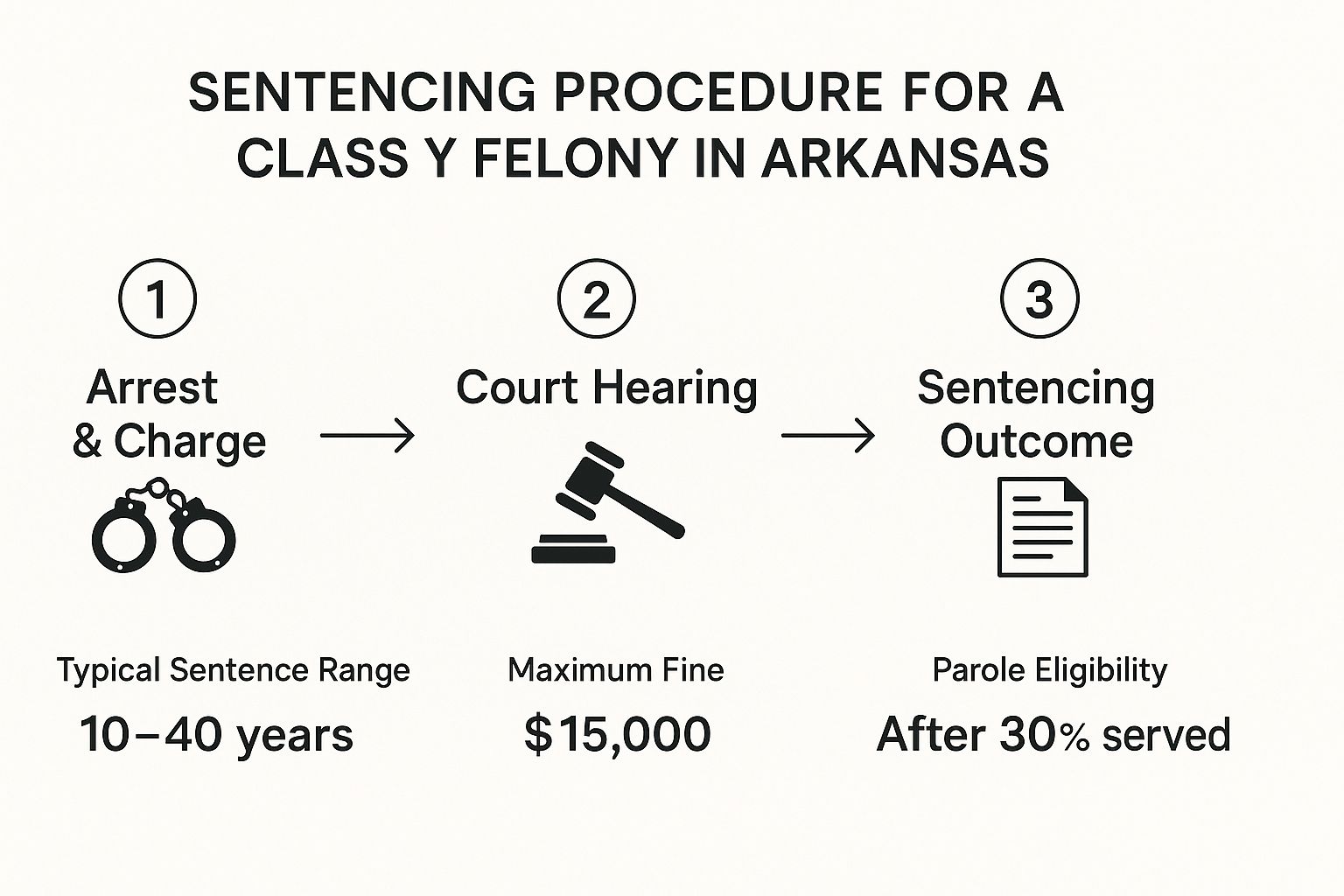
As the picture shows, the journey from an arrest to a court date can lead to a prison sentence of 10 to 40 years, or even life, for a Class Y felony.
The First Steps: Arrest and Booking
It all begins with an arrest. This happens when police have a good reason to believe that a person committed a crime—and take them to jail.
After that, the person is taken to a police station or county jail for booking. This is just where they take your name, fingerprints, and a photo (mug shot) to create a record. They also collect your personal items and keep them safe for you.
The First Appearance and Setting Bail
Within 48 to 72 hours after booking, the person must see a judge for a first appearance. This is not the trial. It’s an early hearing where the judge reads the charges and tells the person their basic rights, like the right to have a lawyer.
This is also when the judge talks about bail. Bail is money paid to the court to get out of jail. It acts as a promise that you will show up for all your future court dates. For a Class Y felony in AR, the situation is very serious. Bail might be set at a very high amount or not allowed at all, especially if the judge thinks the person might run away or is a danger to others.
The Prosecutor’s Role and Filing Charges
After the arrest, the police give the case file to the prosecutor’s office. The prosecutor is the state’s lawyer. It’s their job to look at all the evidence—police reports, things witnesses said, lab results—and decide if there’s enough to officially charge someone with a crime.
The prosecutor has a few options:
- File the charges as they are: If the evidence looks strong, they will file an official complaint, which starts the court case.
- File different charges: They might change the charge to something more or less serious based on what they think the evidence shows.
- Choose not to prosecute: If the evidence is too weak, they can drop the case.
It’s important to understand that being arrested is not the same as being officially charged. The prosecutor has all the power at this stage and decides if the case even goes to court.
Arraignment: Pleading Guilty or Not Guilty
If the prosecutor decides to file charges, the next big step is the arraignment. This is a formal court hearing where the official charges are read, and the person accused (the defendant) must enter a plea.
There are three basic pleas:
- Guilty: Saying you did the crime.
- Not Guilty: Saying you did not do the crime. This starts the process for a trial.
- No Contest: You don’t say you are guilty, but you accept the punishment. In Arkansas, this is usually treated the same as a guilty plea.
Pleading “not guilty” is almost always the normal thing to do at an arraignment. It gives the defense lawyer the time they need to look at the evidence and start building a defense.
Pre-Trial Phase and Plea Negotiations
The time between the arraignment and the trial is very busy. This is when the real work for the defense begins, from looking into the state’s claims to filing court papers that challenge certain evidence.
This is also the main time for plea negotiations. The defense lawyer and prosecutor will likely talk about a plea bargain—a deal where the defendant might plead guilty to a less serious crime for a lighter sentence. For a Class Y felony, however, the options for a good plea deal are very limited because the crime is so serious and the state has strict sentencing laws.
If the two sides can’t agree, the case is scheduled for the final step: a trial. Here, both the prosecutor and the defense will present their cases to a judge or jury, who will make the final decision on whether the defendant is guilty beyond a reasonable doubt.
Exploring Potential Defenses to a Class Y Charge

When you’re facing a Class Y felony charge in AR, it’s easy to feel like there’s no hope. But it is very important to remember a key idea of our justice system: being accused of a crime doesn’t mean you are guilty. The law says every person is innocent until proven guilty.
This isn’t just a nice idea; it’s a basic right. It means the state’s lawyer (the prosecutor) has the entire job of proving the case. They have to prove every single part of the crime beyond a reasonable doubt—which is a very high bar to clear. A defense lawyer’s job is to take apart the prosecutor’s case and show a jury that the state can’t prove it.
The Foundation of Any Strong Defense
The first step in fighting a Class Y felony in AR is always a deep look into the state’s case against you. A good defense lawyer acts like a detective, carefully looking at every piece of evidence, every report, and every claim the prosecutor makes. The goal is to find the weak spots and mistakes in their story.
Your lawyer will carefully check things like:
- Police Reports: Are there mistakes in how police did things? Does the report say different things at different times?
- Witness Statements: A good lawyer will talk to witnesses to see if their stories stay the same or if they can be trusted.
- Physical Evidence: How was the evidence collected and stored? Any mistake in how evidence was handled can make it unusable in court.
- Lab Results: Lab reports are not always perfect. A lawyer will check them for possible mistakes.
This careful review is very important. If any of the prosecutor’s evidence was gotten illegally or can’t be trusted, your lawyer can ask a judge to throw it out. When a judge agrees to get rid of key evidence, it can seriously hurt the state’s case, sometimes leading to lesser charges or the case being dropped completely.
Common Defense Strategies in Felony Cases
While every case is different, some basic defense plans are often used to fight a Class Y felony charge. The right plan always depends on the facts and evidence of the case.
Challenging the Evidence
This is the most basic defense. It involves arguing that the prosecutor’s evidence is too weak, not trustworthy, or just doesn’t prove guilt beyond a reasonable doubt. For example, a defense lawyer might question how accurate an eyewitness was or the way a piece of evidence was handled.
Mistaken Identity
It happens more than you might think: the wrong person is charged with a crime. This could be because of a bad police lineup or a witness’s unclear memory. The defense of mistaken identity tries to prove that while a crime might have happened, the person on trial is not the one who did it.
An alibi is one of the strongest defenses you can have. It’s a simple claim: you were somewhere else when the crime happened and, because of that, you could not have done it.
Alibi
This defense is just what it sounds like—proving you were at another place when the crime was committed. A good alibi needs to be supported by solid evidence, like other people who can say where you were, credit card receipts, security camera video, or even GPS data from your phone.
Self-Defense
In cases with violence, you may be able to argue that you were defending yourself. This defense says that you used a reasonable amount of force to protect yourself from being hurt or killed. To win with this defense, you usually have to show that you truly believed you were in danger and that the force you used was needed to stop the threat.
The Absolute Need for a Skilled Attorney
Trying to handle a Class Y felony case by yourself is not a good idea. A good defense attorney does much more than just talk in court; they protect your rights at every step, from the first police interview to the final verdict. As a case moves through the system, it’s helpful to see how law firms work; you may even see them discussing strategies for criminal law practices to help people who need a lawyer.
Your lawyer is your helper, your planner, and your guide through a confusing and scary process. They know the local courts, have experience with prosecutors, and know how to build a defense that finds the weaknesses in the state’s case. With a possible sentence of 10 years to life, going it alone is a risk no one should ever take.
Common Questions About Class Y Felonies in Arkansas
When you’re dealing with something as scary as a Class Y felony in AR, you probably have a lot of questions. The legal world can be confusing, especially when so much is on the line. Getting clear answers is the first and most important step. Here, we’ll answer some of the biggest questions people have about these serious charges.
Think of this as a quick guide to explain some of the hard truths we’ve already talked about.
Can a Class Y Felony Sentence Be Reduced or Suspended?
In almost every case, the answer is no. Arkansas law is very strict about this. The laws were written to limit a judge’s choices, taking away their power to be more forgiving for these specific crimes.
What does that mean for you? It means a judge can’t just decide to cancel the sentence or let someone have probation instead of going to prison. Being found guilty of a Class Y felony means you have to go to a state prison. While there might be ways to try to change a sentence years later, the first sentence is not something a judge can just get rid of.
Is Parole Possible for a Class Y Felony in Arkansas?
Yes, but it’s a long and difficult process. A person found guilty of a Class Y felony must serve at least 70% of their prison sentence before they can even be thought about for parole (early release).
Let’s make that clearer. If someone gets a 20-year sentence, they have to serve at least 14 years in prison before the parole board will even look at their case. This is much tougher than for any other felony level in Arkansas, where people can often be considered for parole much sooner.
Key Takeaway: Parole is never promised. Serving 70% of your time only makes you able to be considered; it doesn’t mean you will be released. The parole board will look very closely at how an inmate behaved in prison, what they did to improve themselves, and their plan for life outside before making a choice.
Can a Class Y Felony Be Expunged From Your Record?
No. This is one of the toughest long-term results. Under current Arkansas law, a Class Y felony conviction is a permanent mark on your record. These convictions are not allowed to be sealed or expunged (removed) from criminal records.
This means a Class Y felony in AR follows you forever, creating lifelong problems that affect almost every part of your life:
- Finding a Job: A serious felony on a background check often means a company will automatically say “no.”
- Renting a Home: Many landlords will refuse to rent to someone with a serious felony conviction.
- Professional Licenses: Getting or keeping a license in jobs like nursing, teaching, or law becomes almost impossible.
This permanent record is a heavy burden to carry long after the prison sentence is over.
What Is the Difference Between a Class Y and a Capital Felony?
It’s easy to mix these two up, but the difference is very important. Think of them as the two highest steps on the ladder of crime in Arkansas. Each has a different final punishment.
- Class Y Felony: This is the most serious crime you can be charged with that does not have the death penalty. The worst punishment is life in prison, but with a small chance of getting out on parole one day.
- Capital Felony: This is a separate, even more serious level for the worst crimes, like planned murder. It is the only crime in Arkansas where the prosecutor can ask for the death penalty or a sentence of life in prison with no chance of ever getting out on parole.
So, while a Class Y felony is the most serious punishment inside the regular prison system, a capital felony charge brings the most severe penalties of all into the picture. A skilled defense lawyer is needed to understand these differences and fight for the best possible result.