
Getting a divorce when you and your spouse agree on everything is called an uncontested divorce. In Arkansas, this is the simplest and cheapest way to end a marriage. It means you have worked out every single detail before you give any papers to the court. Think of it like bringing a finished puzzle to a judge instead of dumping a box of pieces on their desk.
Uncontested Divorce in Arkansas Can Be Simple
If you and your spouse agree, our firm can prepare the paperwork and finalize everything quickly — often without stress or court delays. Call today for a flat-fee consultation.
Understanding an Uncontested Divorce in Arkansas

Many people think an uncontested divorce just means you are still friends with your spouse. That helps, but it’s more than that. A real uncontested divorce needs a written agreement that explains every part of your separation.
This is not a casual handshake deal. It’s a legal paper that leaves no room for questions or future fights. Every single thing must be decided before you go to the courthouse.
What You Must Agree On
So, what does it mean to agree on “everything”? For a court, it comes down to four big things. You need a plan for all of them.
- Splitting Your Stuff (Property): Who gets the house, the cars, and the furniture? How will you divide the money in your bank accounts? Every item you own together must be given to one person.
- Handling Your Bills (Debts): This is just as important as your stuff. You have to decide who will pay for the house loan, car loans, credit cards, and any other money you owe.
- Kids and Visitation: If you have children under 18, this is a must. You need a clear plan for where the kids will live (physical custody), who makes big decisions for them (legal custody), and a schedule for when each parent will see them.
- Money for Kids and a Spouse: Your agreement must say who will pay child support and how much, based on Arkansas’s rules. You also have to decide if one person will pay money to the other for a while, called alimony or spousal support.
If you can’t agree on even one of these things, your divorce is called “contested.” That one disagreement makes everything more difficult, more expensive, and take much longer.
When an Uncontested Divorce is a Good Idea
An uncontested divorce works best when things are simple and you can work together.
Imagine a couple married for three years. They don’t have kids, they rent an apartment, and they each have their own car payment. Their money is mostly separate. Dividing the few things they share is easy. For them, an uncontested divorce is the perfect, simple answer.
An uncontested divorce is about having all the answers before you ask the court any questions. It lets you and your spouse decide what happens, not a judge. You control how long it takes and how much it costs.
This method works well in Arkansas. The state has a divorce rate of about 11.9 divorces per 1,000 people, which is one of the highest in the country. The courts are used to handling these cases quickly. A clear, complete agreement can move through the system fast. You can learn more about how Arkansas divorce statistics affect the courts.
Seeing the two types of divorce side-by-side can help you understand.
Key Differences: Uncontested vs. Contested Divorce in Arkansas
| Factor | Uncontested Divorce | Contested Divorce |
|---|---|---|
| Agreement Level | Agree on everything before you start | Disagree on one or more big things |
| How Long It Takes | 30-90 days | 6 months to 2+ years |
| How Much It Costs | Low (mostly court fees) | High (lawyer fees, court costs) |
| The Process | File papers, have a short court meeting | Investigations, court dates, arguments, maybe a trial |
| Who Decides | The couple decides the outcome | A judge makes the final choices |
| Stress Level | Low to medium | High |
This chart shows how different the two paths can be. The one you choose makes a big difference for your money, your time, and your stress.
When to Choose a Different Path
Now, think about a couple married for 20 years. They own a house, have two kids, retirement accounts, and a small business. They can’t agree on who the kids should live with during the school year or how much the business is worth.
For them, trying to file for an uncontested divorce right away would be a mistake. Their situation has too many disagreements. They will need lawyers or a helper (a mediator) to work out these tough money and parenting issues. Only after they agree on everything could they file for an uncontested divorce.
Understanding Arkansas Divorce Rules and Timelines
Getting a divorce in Arkansas is not as easy as just saying you are done. The state has specific rules you have to follow. You can’t just say you don’t get along anymore. The law here needs a specific legal reason, called grounds for divorce, before a judge will look at your case.
Knowing these rules from the start helps make things go smoothly. If you do it right, you can avoid annoying delays.
The Legal Reasons for Divorce in Arkansas
In Arkansas, the papers you file must give a reason for the divorce. For an uncontested divorce, the most common reason is a no-fault one, but it has a big catch.
Here are the main reasons, or grounds:
- No-Fault Separation: This is the best choice when you both agree to split. The catch is that you and your spouse must have lived in separate homes for 18 months in a row. This means no living together and no acting like a married couple for that whole time. It’s simple, but it’s a long wait.
- Fault-Based Grounds: If you can’t wait 18 months, you have to use a “fault” reason. This means you are legally blaming your spouse for the marriage ending. Common reasons are cheating (adultery), being drunk all the time for at least a year, or being cruel in a way that puts your life in danger.
For a friendly, uncontested divorce, agreeing to use the 18-month separation is almost always the easiest and calmest way to go. You can find out more in this guide to no-fault divorce in Arkansas.
The reason you give for the divorce is the foundation of your case. For a calm, uncontested divorce, the 18-month separation is the standard choice. Otherwise, you have to pick a blame-based reason that Arkansas law allows.
Important Timelines You Must Follow
Besides having a reason, Arkansas law has a strict schedule for the process. These timelines are not suggestions—they are rules. They affect how long your divorce will take, even if you agree on everything.
The clock starts ticking before you ever go to court. The state has rules about how long you have to live here before its courts will handle your divorce.
This timeline shows the important steps you have to meet.
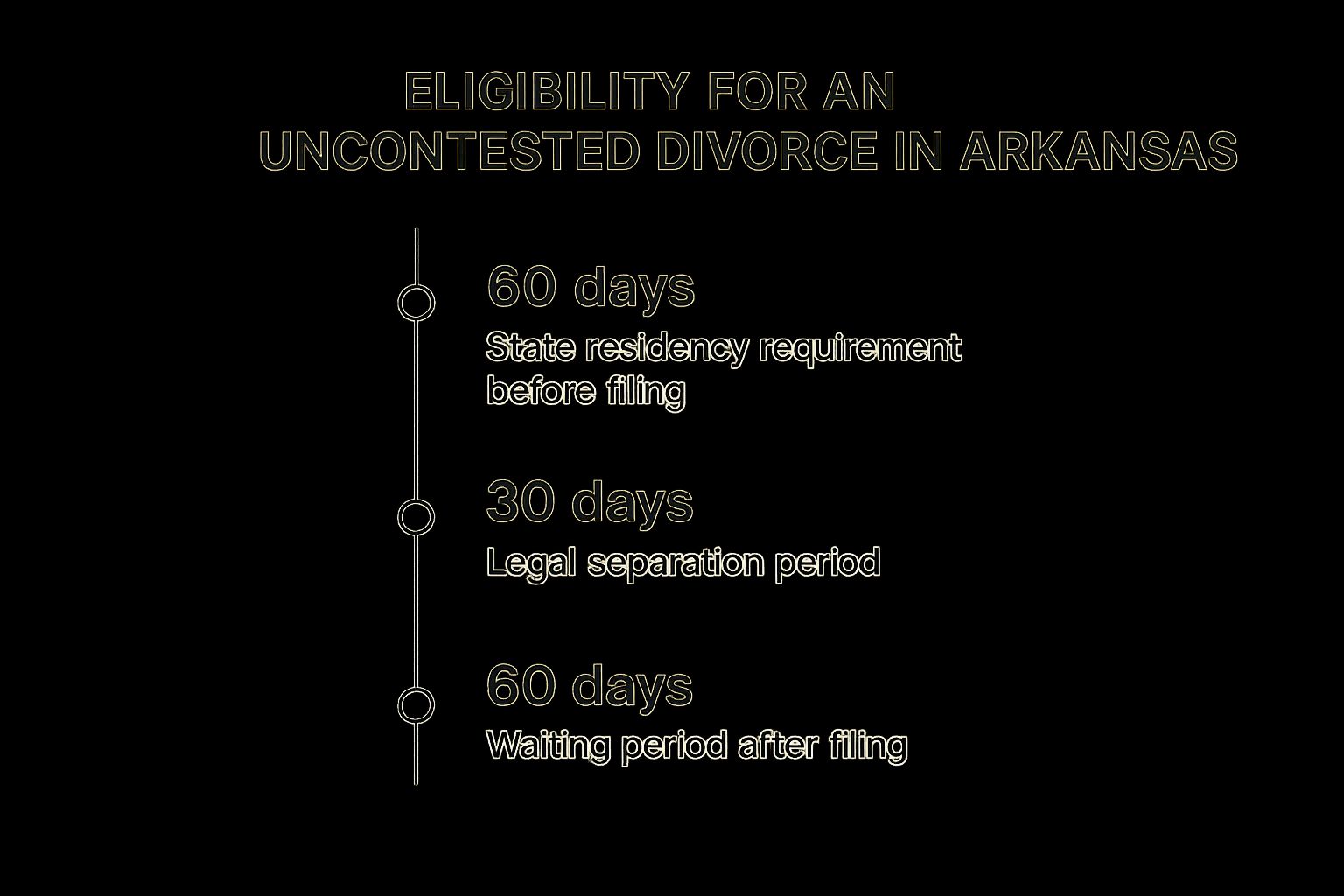
As you can see, the process includes several waiting periods that add up. You cannot get a divorce overnight in Arkansas.
Breaking Down the Waiting Periods
Each waiting period has a legal purpose. If you don’t understand them, your case can stop.
1. Live Here for 60 Days Before Filing
Before you can file the first divorce paper (the Complaint for Divorce), one of you must have lived in Arkansas for at least 60 days. This gives an Arkansas court the legal power to handle your case.
2. 30-Day Wait After Filing
After you file your papers, a 30-day “cooling off” period begins. The law makes you wait to give you both a last chance to change your minds. A judge cannot sign your final divorce papers during these 30 days.
3. Live Here for 90 Days Before It’s Final
This one often happens at the same time as the others but is just as important. A judge cannot sign the final divorce papers until one spouse has lived in Arkansas for at least three months (90 days).
These rules are set in stone and decide how fast your divorce can happen. Even a simple uncontested divorce in Arkansas will take about two to four months from the day you file.
Let’s look at an example.
Example: Maria and David’s Timeline
Imagine Maria moves to Bentonville on January 1st. She and her husband, David, have already agreed on everything for an uncontested divorce. David still lives in another state.
- January 1 – March 1: Maria has to wait 60 days just to meet the first residency rule. She can’t file any papers until March.
- March 2: She can now file the divorce papers at the courthouse. The clock starts on the next waiting period.
- March 2 – April 1: The 30-day waiting period is now active. The judge can’t finalize the divorce yet.
- April 2: By now, Maria has lived in Arkansas for over 90 days, which meets the final residency rule. The 30-day waiting period is also over. They can now ask the court for a short final meeting to get the divorce papers signed.
In the best case, the earliest Maria’s divorce could be final is early April—a little over three months after she moved to Arkansas. This shows how all the timelines work together.
How to Prepare Your Arkansas Divorce Paperwork

Okay, you know you meet the residency rules and have your reason for divorce. Now comes the part that can feel like a lot: the paperwork. This is where you take all your agreements and turn them into official, legal papers.
Don’t let the papers scare you. Think of it as telling the court your story in an organized way—who you are, why you are getting a divorce, and how you have agreed to move on. Getting this part right is key to keeping your uncontested divorce in AR moving forward.
The Key Papers in Your Divorce Filing
The exact papers you need can be a little different from county to county, but there are a few main ones that are used all over Arkansas. You can usually get these forms from the Circuit Clerk’s office at your local courthouse.
Here are the most important papers:
- Complaint for Divorce: This is the paper that starts everything. It says who you are (the Plaintiff) and who your spouse is (the Defendant). It also states the legal reason for the divorce, like your 18-month separation.
- Summons: This is an official notice to your spouse that you have filed for divorce. In a friendly divorce, your spouse can just sign a form saying they got a copy of the complaint.
- Marital Settlement Agreement: This is the most important paper in the whole process. It’s the written contract that explains every detail you’ve agreed on, from who gets the dog to who pays the old credit card bill.
- Final Decree of Divorce: This is the finish line. It’s the order the judge signs to legally end your marriage. It includes your Marital Settlement Agreement, making it a court order.
Basically, the Complaint starts the process, and the Final Decree makes it official. Your Marital Settlement Agreement is the detailed plan for everything.
Making a Strong Marital Settlement Agreement
How good your settlement agreement is will decide if your uncontested divorce works. If it’s unclear or missing information, it can cause problems later. The goal is to be super clear so there is no room for mistakes.
A good agreement needs to cover everything you shared in your life. You’ll list all your property and all your debts, then say which person gets each one.
What to Include in Your Property and Debt Lists
- Real Estate: Don’t just say “the house.” List the full street address. Say who will own it and, most importantly, who will pay the house loan (mortgage).
- Vehicles: For every car or truck, include the year, make, model, and VIN (the car’s ID number). Give the car and any loan for it to one person.
- Bank Accounts: List every single bank account—checking, savings, retirement accounts, everything. Explain if the account will be closed and the money split, or if one person is getting the whole account.
- Debts: Be specific about every credit card, loan, and medical bill. Don’t just say “we’ll split the debt.” Instead, list each company you owe money to and say exactly who is responsible for paying it.
When you’re splitting up big things like a house, it’s very important to handle the money part correctly. This might mean looking at your options, like understanding mortgage assumption during a divorce, to make sure you both are protected.
A well-written settlement agreement is the best way to avoid fights in the future. The more details you include now, the fewer questions and arguments you’ll have later.
Avoiding Common Paperwork Mistakes
It’s easy for small mistakes on the papers to cause big delays. A judge will look at these forms, and if anything is not clear, not filled out, or wrong, your case will be sent back.
A common mistake is using unclear words. Instead of writing “Jane gets the furniture,” be specific: “Jane will get the main bedroom set (queen bed, two nightstands, dresser), and John will get the living room sofa and the 65-inch TV.”
Another common mistake is forgetting to list something you own or owe. If that old retirement account from a past job or a store credit card isn’t in the agreement, it’s not legally divided. That could mean you have to go back to court years later to fix it, which is expensive and stressful.
Getting Your Divorce Filed and Finalized
With all your papers ready, it’s time to take them to the court. This part might seem scary, but for a divorce where you both agree, it’s just a few steps to get to the end.
Starting Things at the Courthouse
Your first stop is the Circuit Clerk’s office in the county where you or your spouse lives. You will bring all your completed papers, with the Complaint for Divorce on top. Giving these papers to the clerk is called filing, and it officially starts your case.
When you file, you’ll also have to pay a court fee. In Arkansas, this is usually between $150 and $200.
“Serving” Your Spouse the Easy Way
Next is a legal step called “serving” your spouse. The word “serve” sounds serious, but in a friendly, uncontested divorce, it’s not a big deal. It’s just the court’s way of making sure your spouse has been officially told about the case and has copies of everything.
The easiest way to do this is to have your spouse sign a form called an Entry of Appearance and Waiver of Service. This form is a shortcut. By signing it, they are telling the judge:
- “I know about the divorce.”
- “I have a copy of the papers.”
- “I agree with what they say.”
- “I don’t need to be served in a formal way.”
This one signature keeps things friendly, saves time and money, and lets you move on without any problems.
The Required 30-Day Waiting Period
Once the case is filed and your spouse has signed the waiver, a waiting period starts. Arkansas law requires a 30-day “cooling-off” period from the day you file before a judge can finalize your divorce.
You cannot get around this. It’s part of the process to give you both one last chance to be sure this is what you want. Even if a judge wanted to sign your papers on day two, they legally have to wait until day 31.
The timeline for an uncontested divorce is set by Arkansas’s laws, like the 60-day residency rule and this 30-day waiting period. These rules set the minimum time it will take, which is why even the easiest cases often take two to four months. You can learn more about Arkansas divorce grounds and procedures on gavel.io.
This waiting time makes sure the process is done carefully and all legal rules are followed.
Your Quick and Final Court Hearing
After the 30 days are over, the last step is usually a very short meeting at court. Don’t imagine a TV show courtroom drama—for an uncontested divorce in AR, the final hearing is often just a five-minute chat with the judge.
The judge just needs to check a few things quickly:
- Who you are: To make sure you are the right person.
- Where you live: To make sure you meet the state’s rules for living here.
- That you agree: To make sure both of you signed the agreement freely.
- If it’s fair: To ask if you both think the agreement is fair.
The judge’s main job is to look at your Marital Settlement Agreement and make sure it is fair and legal, especially if you have kids. They need to see that the children are being taken care of.
Getting the Final Divorce Papers
Once the judge is happy, they will sign the Final Decree of Divorce. That’s it. When the judge signs that paper, your marriage legally ends. Your settlement agreement is attached to it, which turns your private agreement into an official court order.
The clerk will file the signed paper, and you’ll get a copy. This paper is very important. You’ll need it for things like changing your last name, updating bank accounts, or getting a new loan for a house. Keep it in a safe place—it’s your official proof that you are divorced.
Common Mistakes That Can Delay Your Divorce
: “John gets the tools, and Jane gets the furniture.”
- Clear (and will probably be approved): “John will get the Craftsman tool chest and all the tools inside it from the garage. Jane will get the living room sofa, the matching chair, and the dining room table with six chairs.”
Being this specific might seem like a lot of work, but it stops a judge from sending your agreement back. More importantly, it protects both of you from future arguments about what you really meant.
Forgetting to List Property or Debts
Another big mistake is not listing every single thing you own and owe. It’s easy to forget about an old retirement account from a job you had years ago or a store credit card you don’t use much. But here is the rule: if it belongs to the marriage, it must be in your divorce papers.
If you remember something you forgot after the divorce is final, it can be a huge problem. You might have to go back to court to divide it, which is expensive and stressful. That defeats the whole purpose of an uncontested divorce in AR.
An uncontested divorce is built on two things: being completely honest and agreeing on everything. Hiding or forgetting something you own breaks that foundation and can lead to serious legal problems.
Before you file anything, sit down with your spouse and make a complete list of everything you own and owe, together and by yourselves. It’s better to spend an extra hour being careful now than to spend thousands of dollars fixing a mistake later.
Not Understanding the Waiting Periods
Arkansas has specific waiting periods that you cannot skip. A common mistake is thinking you can get your final papers as soon as you file. As we covered, there’s a required 30-day waiting period after you file before a judge can legally sign anything.
If you try to set up your final meeting before this period is over, the court will turn you away. The clerk will just tell you to come back after the 30 days have passed. Following this timeline is very important for a smooth process.
Filing Before You Really Agree on Everything
Finally, one of the worst mistakes is filing for an uncontested divorce when you still have things to work out. You might agree on 95% of everything and think, “We can figure out the last few things later.” This is a bad idea.
The moment you disagree on something after you have filed, your case is no longer uncontested. This can stop the whole process, push you into meetings with a helper (mediator), or force you to hire lawyers. That makes the cost and the time it takes go way up. Make sure every single detail is decided, written down, and signed before you ever go to the courthouse.
Your Uncontested Divorce Questions Answered
Even when you and your spouse agree, you will probably have questions. That’s normal. Let’s go over some of the most common questions people ask so you can feel more sure about the process.
Do I Really Need a Lawyer for an Uncontested Divorce in Arkansas?
By law, no, you don’t have to hire a lawyer. But is it a good idea? That’s a different question.
Having a lawyer look over your Marital Settlement Agreement is one of the smartest things you can do. They can find problems you might miss, especially if you have kids or own a lot of property. Think of it as spending a little money now to avoid a huge problem later.
If your situation is very simple—like a short marriage with no kids and nothing to divide—you might be okay doing it yourself. For most other people, getting a professional to check your work is a very good idea.
How Much Does an Uncontested Divorce Cost in Arkansas?
The main cost you can’t avoid is the court filing fee, which is usually between $150 and $200. You might also have a small fee for serving papers, but you can skip that if your spouse agrees to sign a waiver form.
If you decide to have a lawyer look over your final papers (which is a good idea!), you can expect to pay a few hundred dollars for their time. This is much, much cheaper than a contested divorce, which can easily cost thousands of dollars for each of you.
The money side of divorce is more than just court fees. As you go through an uncontested divorce, it’s also important to know how this big life change can affect your money. You can read more about the tax implications of major life changes, including divorce.
Understanding the whole money picture now will help you make smarter choices for your future.
What if We Disagree on Something After We File?
This is very important to understand. The moment you disagree on something after filing, your case is no longer uncontested. It becomes “contested,” and everything changes.
The case will stop, causing delays and adding new costs. You’ll probably need to hire lawyers or a mediator to help you solve the disagreement. This is exactly why it is so important to have a solid, signed agreement on every single detail before you file any papers with the court.
Can We Get an Uncontested Divorce in AR if We Have Children?
Yes, you definitely can. Having kids does not stop you from getting an uncontested divorce in AR, but it does mean your agreement needs to be more detailed.
A judge will look very closely at the parts of your agreement about the children to make sure they are being protected. Your Marital Settlement Agreement must have a clear and complete plan that covers a few key things:
- Child Custody: This needs to explain both physical custody (where the kids will live most of the time) and legal custody (who has the power to make big decisions about their health, school, and life).
- Visitation Schedule: Be very specific here. Write out a clear schedule for when each parent has the children. Don’t forget to include plans for holidays, birthdays, and summer vacations to avoid confusion later.
- Child Support: The amount is not just a number you agree on. It has to be figured out using Arkansas’s official child support rules.
The judge has to believe that your plan is fair and good for the children before they will sign the final divorce papers.