
Getting a divorce can feel complicated, but in Arkansas, there’s a way to do it without blaming anyone. It’s called a no-fault divorce. The most important rule for this is that you and your spouse must live in separate homes for 18 months in a row before you can even start the paperwork.
What is a No-Fault Divorce?

Think of a no-fault divorce like ending a partnership that just isn’t working anymore. Nobody has to be the “bad guy.” You just agree it’s time to move on. This lets you end a marriage without having to prove in court that your spouse did something wrong.
Instead of fighting about who caused the problems, you just tell the judge that the marriage is broken and can’t be fixed. This way is often less stressful and costs less money than a divorce where you have to prove who was at fault.
Two Ways to Get Divorced in Arkansas
To understand a no-fault divorce, it helps to see how it’s different from a “fault” divorce, where one person blames the other. This chart shows the main differences.
| What’s Different? | No-Fault Divorce | Fault-Based Divorce |
|---|---|---|
| What You Need | Live in separate homes for 18 months | Prove your spouse did something wrong (like cheating or being cruel) |
| Blame | No one is legally blamed | One person is found to be at fault by the court |
| How Fast Is It? | Slower, because you have to wait 18 months first | Can be faster if it’s easy to prove who was at fault |
| How Much Fighting? | Usually less, since you don’t have to prove blame | Often more, because you have to use proof and argue |
| Privacy | More private, because you don’t share personal details in court | Less private, because personal business can become part of the court record |
Which path you choose depends on your situation. Even though waiting 18 months for a no-fault divorce feels like a long time, it can make the final steps of the divorce much easier and more peaceful.
The Most Important Rule: Living Apart
That 18-month wait is the biggest rule for a no-fault divorce in Arkansas. The law says you and your spouse must live “separate and apart without cohabitation” for that whole time.
Key Takeaway: This is a very strict rule. If you spend even one night together trying to get back together, the 18-month clock can start all over again from day zero.
This waiting period is one of the longest in the country. The state’s laws want to give couples a long “cooling-off” period to be sure they want to end the marriage. You can read more about the state rules in the Arkansas divorce laws.
What Does “Living Separate and Apart” Mean?
This means more than just sleeping in different rooms in the same house. To follow the rule, you and your spouse must live in two completely different homes. One of you has to move out.
The goal is to show the judge that the marriage is truly over. During these 18 months, you must not:
- Live at the same address.
- Be in a romantic relationship.
- Act like a married couple in public (like going to family parties together as a couple).
Think of it as starting two new, separate lives. The day one of you moves out is the day the 18-month countdown begins.
Understanding the 18-Month Separation Rule
The 18-month wait is the biggest step for anyone wanting a no-fault divorce in Arkansas. It’s a rule you must follow. The law wants to make sure both people are completely sure about ending their marriage.
This long wait is what makes Arkansas divorce law different. It really does change things. Studies show that states with no waiting period had more divorces after making no-fault divorce an option. But states like Arkansas with a long wait saw fewer divorces. You can learn more about this on how unilateral divorce laws affect states on stlouisfed.org.
What “Living Separate and Apart” Really Means
When a judge in Arkansas hears “living separate and apart,” they mean it. You cannot live in the same house. Sleeping in a different room or on the couch does not count.
The law requires you to live in two different homes. This is a rule you can’t bend. It proves to the court that the marriage is over.
Crucial Point: The 18-month clock starts on the exact day one of you moves out. Keep a good record of this date, as you will need it for your legal papers.
Common Questions and Mistakes to Avoid
This long wait leads to a lot of questions. It’s important to know the rules so you don’t make a mistake that makes the 18-month clock start over.
Here are a few common situations:
- Can we still see each other? Yes. You can still be good parents to your kids, go to their sports games, or meet for coffee. The important part is that you don’t act like a married couple or get romantic again.
- What if we spend one night together? This is very risky. It’s a gray area, but if a judge thinks you tried to get back together, they might say your separation ended. If that happens, you’re back to day one. It’s best to avoid this.
- Can we share a mailing address? No. Living separately means you each get your own mail, pay your own bills, and manage your own money at your own home. The court needs to see two separate households.
Think of this time as building two new, separate lives. It’s more than just living in different places. It’s about separating your daily lives, friends, and money. This helps you follow the law and prepares you for life after the divorce.
A Simple Guide to Filing Your Divorce Papers
You’ve made it through the 18-month separation. Now it’s time to file for your no-fault divorce in Arkansas. This can seem scary, but it’s really just a set of simple steps.
First, you must meet the state’s residency rule. This means at least one of you must have lived in Arkansas for 60 days before you can file the papers. After you file, you also have to wait at least 90 days before a judge can finalize your divorce.
Finding and Filling Out the Right Forms
The first paper you will need is the Complaint for Divorce. This is the official paper that starts the divorce process. It tells the court you want a divorce and that you have met the rule of living apart for 18 months.
You can often get these forms from the Arkansas court’s website or from your local courthouse. Be very careful and truthful when you fill them out. This is not the place for arguments, just facts for the court.
This picture shows the basic steps for filing your paperwork.
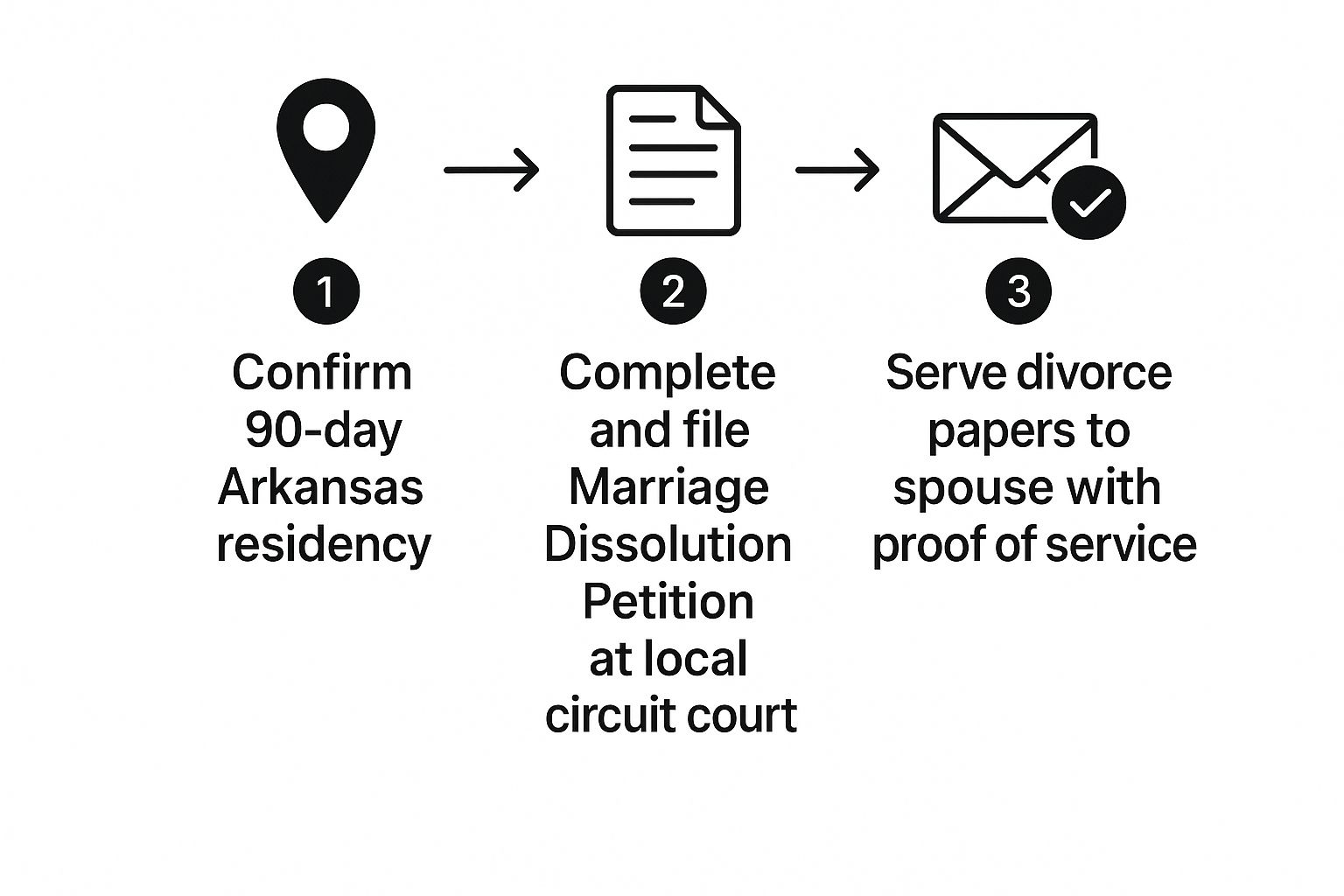
As you can see, you first make sure you meet the rules, then you file the main paper, and then you let your spouse know in an official way.
The Final Steps: Filing and Serving
Once your Complaint for Divorce is filled out, you take it to the courthouse in the county where you or your spouse lives. It costs money to file. The fee is usually about $165, but it can be a little different in each county.
Important Step: After you file, you must legally tell your spouse that you have started the divorce. This is called “service of process.” You can’t just give them the papers yourself.
Here are the right ways to do it:
- Hire a Sheriff or Process Server: For a small fee, a sheriff’s deputy or a professional server will hand-deliver the papers to your spouse.
- Certified Mail: You can mail the papers using special mail that requires a signature. This gives you proof they received them.
- Your Spouse Can Agree: If you are working together, your spouse can sign a form saying they got the papers. They file this with the court.
If you and your spouse agree on everything, the process can be even easier. You can learn more about an uncontested divorce in Arkansas.
Dealing with all this paperwork can be stressful. Learning some strategies for efficient document processing can help you stay organized.
What Does a Divorce in Arkansas Actually Cost?
Let’s be real: money is a big worry during a divorce. Knowing what costs to expect can help you feel less stressed. The total cost of a no fault divorce in Arkansas mostly depends on one thing: how much you and your spouse can agree on.
There are a few costs you can’t get around. First, you have to pay a court filing fee. This is the fee to open your case with the court. It’s usually about $165.
Next, you have to pay to have your spouse officially told about the divorce. This is “service of process.” Having the sheriff do it usually costs between $50 and $100.
Typical Divorce Costs in Arkansas
Here is a simple list of common costs to help you see where your money goes. This can help you make a budget.
| Expense | Estimated Cost | What It’s For |
|---|---|---|
| Court Filing Fee | ~$165 | The fee the court charges to start your divorce case. |
| Service Fee | $50 – $100+ | The cost to have the divorce papers legally delivered to your spouse. |
| Lawyer Fees | $2,000 – $15,000+ | The cost for a lawyer’s help and advice. This cost can change a lot. |
| Mediation | $100 – $300 per hour | The cost for a helper (a mediator) to guide you and your spouse in making agreements. |
As you can see, lawyer fees are the biggest and most unpredictable cost. If your divorce is simple and you both agree on everything, a lawyer might charge you one set price.
But if you and your spouse argue over big things like who gets the house, how to divide retirement money, or if one person needs money from the other (alimony), lawyer bills can grow very fast. In divorces with a lot of fighting, lawyers usually charge for every hour they work. Each phone call and email adds to the bill.
Financial Reality: A divorce where you both agree is almost always cheaper. The more you can agree on without lawyers, the more money you will both save.
Besides these fees, you will be making huge financial decisions. You will need to decide how to split everything you own together, from your house to your bank accounts. You also have to split any debts, like loans or credit card bills. Figuring this all out early can help you manage the money side of your divorce.
Making Decisions About Children and Support

When children are part of a divorce, taking care of them is the most important thing. Arkansas courts always follow one main rule: do what is in the “best interest of the child.” This means every decision a judge makes is about giving the children the most stable and loving home possible.
Even though it can be hard, working with your spouse on these issues is the best thing to do. It shows the judge you are putting your kids first.
Understanding Custody in Arkansas
In Arkansas, “custody” has two parts. Think of them as two different kinds of parent jobs.
- Legal Custody: This is about who makes the big decisions for your child. This includes things like where they go to school, what religion they are raised in, and big health choices. Judges in Arkansas usually give joint legal custody, which means both parents get to help make these choices.
- Physical Custody: This is about where the child lives most of the time. One parent is usually the primary custodial parent—the parent the child lives with. The other parent, called the non-custodial parent, gets a schedule for when they will see the child (visitation).
The goal is to make sure the child has a good relationship with both parents after the divorce.
How Child Support Is Figured Out
Child support is another big piece of the divorce. A judge doesn’t just pick a number. In Arkansas, child support is calculated using a special formula from the state.
It starts with how much money the non-custodial parent makes. The court then uses a chart to find a starting support amount based on that income and the number of children. This income-based plan is the starting point for all child support.
Key Insight: It’s good to remember that child support is not a payment to your ex. It is money for your child’s needs, like their home, food, clothes, and healthcare.
The Importance of a Parenting Plan
One of the best things you can create during your no fault divorce in Arkansas is a Parenting Plan. This is a detailed agreement that you and your spouse write together. It explains exactly how you will raise your kids as co-parents.
Think of it as a rulebook for raising your kids as a team, even if you are not married anymore. A good Parenting Plan should include:
- A clear visitation schedule for weekends, holidays, and summer.
- Rules for how you and your ex will talk to each other.
- A plan for what to do in an emergency or for school events.
- A way to make big decisions together in the future.
When you go to court with a Parenting Plan that you both agree on, it sends a good message. It tells the judge you are both focused on what’s best for your kids. This can make the whole process much smoother for everyone.
Finalizing Your Divorce and Moving On
You have finished the long separation and handled all the paperwork. You are at the end of the process. The last step in an Arkansas no-fault divorce is a short court hearing where a judge makes it official.
At this hearing, a judge will sign a Final Decree of Divorce. This paper is the official rulebook for your life after marriage. It makes all your agreements on property, money, and children legal. For most simple cases, this hearing is very quick. The judge will check that you met the 18-month separation rule and that your agreement is fair.
Your Post-Divorce Checklist
Once you have the decree, you are officially single again. But before you move on, there are a few things you should do to protect yourself.
Here is a simple checklist to get you started:
- Update Your Will: This is very important. A divorce changes your family, so you need to update your will and other plans for what happens when you die. You can learn about how divorce can impact your estate plan.
- Change Your Beneficiaries: Don’t forget to change who gets your money from life insurance, retirement accounts (like a 401(k)), and bank accounts.
- Close Joint Accounts: To keep your money separate, work with your ex-spouse to close any shared bank accounts or credit cards.
Arkansas has one of the highest divorce rates in the U.S., which shows why having a good plan for after the divorce is so important. These steps help you start your new life on the right foot. You can find more United States divorce statistics on brandonbernsteinlaw.com.
Common Questions About Arkansas Divorce
Going through a divorce brings up a lot of questions, especially with the long separation period in Arkansas. Let’s answer some of the most common ones.
Can My Spouse Stop Our No-Fault Divorce?
No. In Arkansas, only one person has to decide the marriage is over. If you can prove you have lived apart for the required 18 months, the court can grant your divorce even if your spouse doesn’t want one or won’t sign any papers.
It might take a few extra steps to prove they were notified, but they cannot legally stop you from getting a divorce if you have followed the separation rule.
Do We Really Have to Go to Court?
Most likely, yes, but it probably won’t be like a TV show. Even in the simplest divorces where you agree on everything, a judge in Arkansas will usually want one of you to come to a short final hearing.
This isn’t a trial. It’s just a final check. The judge will ask a few simple questions, look at your agreement to make sure it is fair, and then sign your Final Decree of Divorce. Most of the time, you are in and out of the courtroom in just a few minutes.
What If We Get Back Together During the 18 Months?
This is a very important rule. If you get back together and live like a married couple again, the 18-month separation clock stops and resets to zero.
Important Rule: If you decide to separate again later, you have to start a brand new 18-month period from the new date you moved apart. A single dinner date probably won’t reset the clock, but moving back in together definitely will.