
Have you ever heard the words “quiet title” and wondered what they mean? In Arkansas, a quiet title is a type of lawsuit. It’s like asking a judge to make the final decision about who really owns a piece of land. This clears up any confusion and gives the owner a clear title, which means no one else can claim it. Think of it as the ultimate fix for old property mistakes or arguments over ownership.
What Is a Quiet Title Action in Arkansas?

Imagine your property’s ownership history is like a storybook. A perfect title means every page is clean and tells a clear story of who owned the land from one person to the next. But what happens when that story gets a little messy?
Sometimes, things from the past can mix up the story. Maybe there’s an old loan on the property that was never marked as paid. Or maybe there was a typo in a deed from 50 years ago. These problems are called a “cloud on the title.”
A clouded title is a big problem. It can stop you from selling your land or getting a loan using your property. It can even make you worry if you’re the real owner. This is where a quiet title action can help.
Cleaning Up the Storybook
Filing a quiet title action is like asking a judge in Arkansas to be the final editor of your property’s story. You show the judge all the proof that you are the rightful owner. The judge then looks at the property’s whole history to get the full picture.
The goal is to legally erase those confusing parts of the story. The lawsuit tells anyone who might think they have a claim—like an old family member, a company with an old loan, or a neighbor—that they have one last chance to speak up in court. If they can’t prove their claim, or if no one says anything, the judge makes a final decision.
This court order is called a “quiet title decree.” It’s like a brand-new, perfect page in your property’s story. It silences—or “quiets”—all other claims and proves you are the one true owner.
Why This Is So Powerful
A quiet title lawsuit is the best way to fix ownership problems because it’s final. Once the judge makes a decision, your ownership is settled for good. That kind of legal certainty is very important for any property owner.
Without a clear title, you could have all sorts of trouble:
- You Can’t Sell: A person who wants to buy your land won’t be able to get insurance for it if the title is cloudy. This usually kills the sale.
- You Can’t Get a Loan: Banks won’t lend you money using a property that has a confusing title.
- Future Problems: Old claims can pop up years later and cause expensive and stressful legal fights.
A quiet title action gives you peace of mind. It turns a messy title into a clear one, making sure your property is a safe and valuable thing to own. It’s the best way to protect your land and make your ownership story perfectly clear for the future.
When You Might Need to Quiet a Title
Life can create confusing situations with property. A quiet title lawsuit can fix many kinds of ownership problems. Most of the time, the problems we see in Arkansas fall into a few common groups.
Knowing about these common problems is the first step. It helps you figure out if a lawsuit is the right way to fix your property issue. Leaving a title problem alone is like ignoring a crack in your house’s foundation. At some point, that small problem can get bigger and make it impossible to sell, get a loan, or pass the property to your family.
Let’s look at the most common reasons why someone might need to quiet a title in Arkansas.
Adverse Possession Claims
Imagine your neighbor builds a fence, but it’s five feet onto your land by mistake. For years, they mow that strip of land and treat it like it’s theirs. In Arkansas, this could turn into a claim for adverse possession. This is a law that lets someone become the owner of land they have used openly for a long time.
This happens more than you might think, especially in the country or with older properties where boundary lines are not clear. In Arkansas, a person usually has to use the land openly and without permission for at least seven years and pay taxes on it to claim adverse possession.
A quiet title action is the right way to get a final answer from a judge. It can be used to stop someone from taking your land or to make land legally yours if you’ve been using it for decades. To learn more, check out this in-depth guide on Adverse Possession in Arkansas.
Disagreements Over Boundary Lines
This is another common reason for arguments between neighbors that can end up in court. A boundary line disagreement happens when you and your neighbor can’t agree on where your property ends and theirs begins. This confusion often comes from different land surveys or old deeds that aren’t very clear.
For example, your survey might say your land goes to an “old oak tree,” but your neighbor’s survey says their property line is ten feet past that same tree. This creates a strip of land that you both think you own. These arguments can go on for years, creating a cloud on the title for both properties and stopping any potential sale.
A quiet title lawsuit is made to fix this for good. A judge will look at all the proof—like deeds, surveys, and how the land has been used over time. Then, the judge will issue a final order that draws a clear line, legally defining the boundary forever.
Old Mistakes and Clouds on the Title
Finally, many quiet title lawsuits are filed just to clean up old messes. We call these title defects or “clouds.” They are any old issues that make it unclear who really owns the property today. These problems can hide in public records for years before they cause trouble.
Some of the most common issues are surprisingly simple, but they can cause big problems if they aren’t fixed.
This table shows the most common property issues that lead to a quiet title action. It can help you see if your situation is on the list.
Common Reasons for a Quiet Title Lawsuit in Arkansas
| Problem | Simple Explanation | Example Scenario |
|---|---|---|
| Unreleased Liens | An old debt (like for a repair) is still attached to your property in official records, even though you paid it off. | A roofer put a lien on your house 10 years ago. You paid the bill, but they never filed the paperwork to remove the lien. |
| Clerical Errors | A typo or mistake on an old deed or other official paper creates confusion about who owns what. | A deed from 1975 spelled the old owner’s name wrong. This creates a “break” in the official ownership story. |
| Breaks in the Chain of Title | A missing deed in the property’s history creates a gap in the timeline of ownership. | Your great-uncle sold land to your father with just a handshake. They never filed a deed, so the official record is not complete. |
| Claims from Heirs | A past owner died, and a family member you never knew about shows up to claim part of the property. | The person you bought your house from had a long-lost sister. Now, she claims she inherited part of the house and never agreed to the sale. |
Each of these problems makes your ownership unclear. A quiet title action is like a legal “deep clean.” It removes these old clouds and leaves you with a clear title that no one can argue about.
The Quiet Title Lawsuit Process in Arkansas
The idea of going to court can seem scary. But a quiet title lawsuit is not like a chaotic TV show. It’s a step-by-step process with a clear goal: to get you a clean, clear property title. The system is designed to look at every possible claim fairly before a judge makes a final decision that is legally binding.
Let’s walk through the journey step-by-step. Knowing what to expect makes it less scary. From filing the first papers to telling everyone involved and showing your proof, each step has a purpose. It all leads to that final court order that makes your ownership official.
Starting the Lawsuit
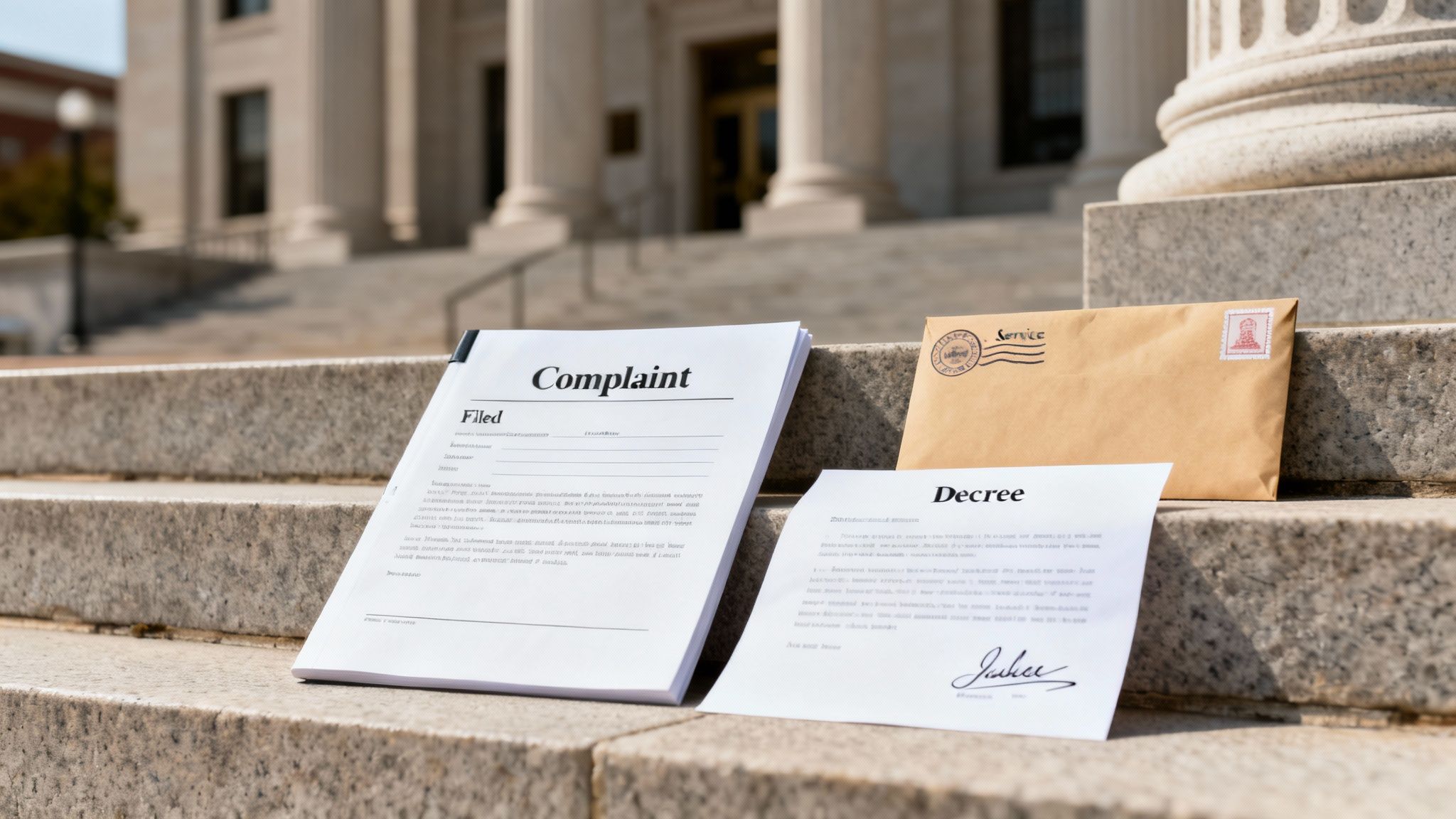
It all begins by filing a legal paper called a “complaint” or “petition” at the Arkansas Circuit Court in the county where the property is. This is the official start of your case. Think of it as telling the court your side of the story—who you are, what property is involved, and why you believe you are the only true owner.
Your lawyer writes this complaint. It explains the facts and points out the “cloud” on your title. The cloud could be a neighbor’s fence on your land, an old debt that was never cleared, or someone else trying to claim the property. The complaint formally asks the judge to look at the proof and fix the problem for good.
Notifying Everyone Involved
Once the complaint is filed, the next step is very important: “service of process.” This is the official way you must tell anyone who might have a claim to the property about the lawsuit. Arkansas law is very strict about this to make sure everyone’s rights are protected.
This is not as simple as sending an email. It involves special legal methods:
- Personal Service: A process server personally hands a copy of the lawsuit to any person or company who might have a claim.
- Certified Mail: If someone with a claim lives in another state, the notice is often sent by certified mail so there’s proof they got it.
- Warning Order: What if someone can’t be found? The court can issue a “Warning Order.” This means a notice about the lawsuit is printed in a local newspaper for a few weeks to let the public know.
After being notified, each person has a limited time—usually about 30 days—to file a response. If they miss the deadline, they usually lose their right to argue about your ownership in the future.
This picture shows a few common reasons people need to file a quiet title action.
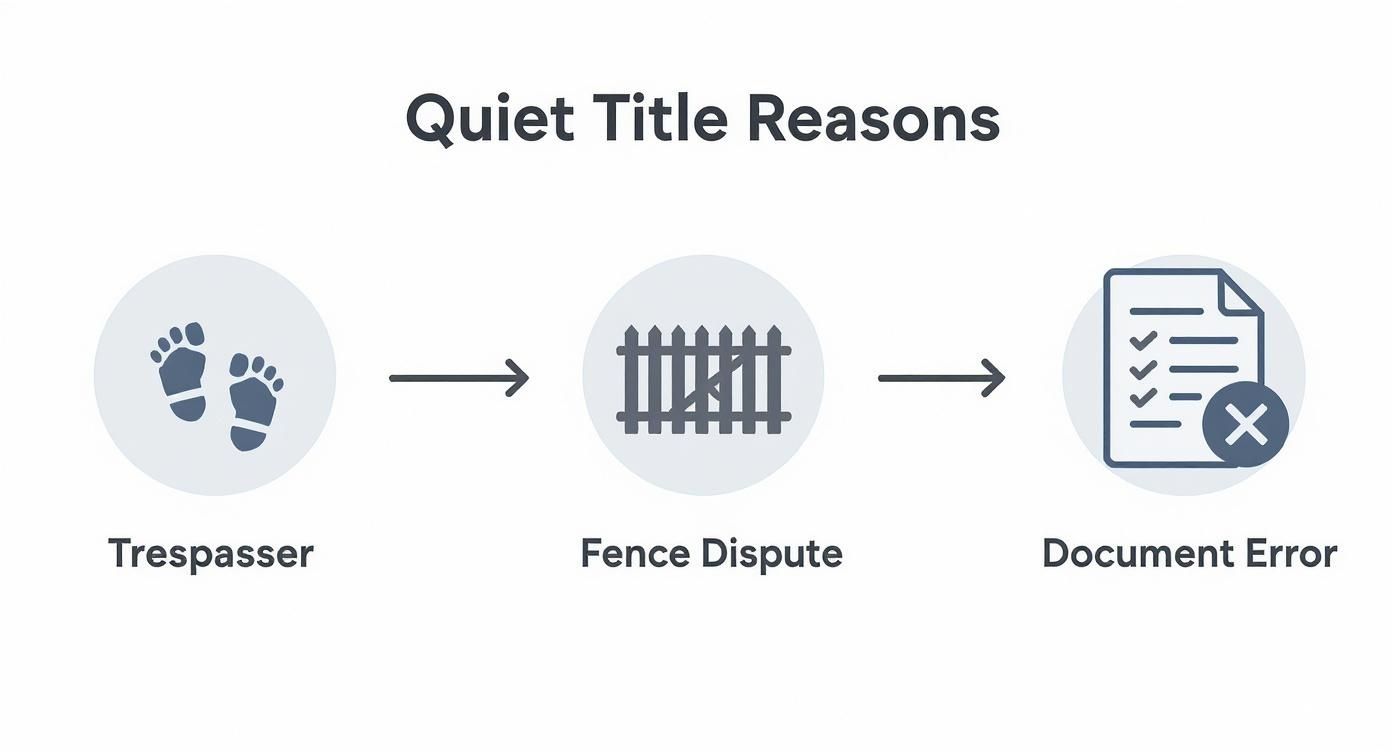
As you can see, the problems can be physical, like someone building on your land, or they can be simple mistakes in old papers. All of them create doubt that only a court can fix.
The Court’s Review and Final Decision
After the time for responding is over, what happens next depends on one simple question: Did anyone show up to challenge your claim?
If nobody files a response, the case is “uncontested.” This is the best situation—it’s faster and simpler. Your lawyer will put together your proof (deeds, surveys, tax receipts, and statements from witnesses) and show it to the judge. Since no one is arguing against you, the judge reviews your proof. If it’s strong, the judge signs an order saying you win.
But if someone does file an answer, the case becomes “contested.” This means you and the other person will both have to prove your side of the story. Things get more complicated here. It usually means sharing documents and maybe even going to a trial where the judge hears from both sides before making a decision. When you are in a quiet title lawsuit, it is helpful to have a basic idea of understanding key legal exceptions like Res Judicata as they can affect your case.
The Final Decree: The End of the Story
Whether your case is simple or contested, the goal is to get a “quiet title decree.” This is the official court order signed by the judge. It declares that you are the one true owner of the property and quiets any other claims forever.
This decree is recorded in the county land records and becomes a permanent part of the property’s history. It washes away the cloud and gives you the legal certainty you need to sell, get a loan, or leave your property to your family without any problems. It’s the final word.
Gathering Proof to Strengthen Your Claim
Winning a quiet title action isn’t just about telling a judge you own the land. You have to prove it. Think of it like building a case with puzzle pieces. You need to gather enough evidence so it’s completely clear that you are the rightful owner.
It’s not just one paper that wins the case. A strong quiet title claim is built on different kinds of proof that, when put together, tell the complete story of your ownership. The more proof you gather, the easier your case will be in the Arkansas courts.
Your Most Important Paperwork
Some documents are the most important players in a quiet title lawsuit. They are the official records that form the base of your whole claim. Before you go to court, you and your lawyer need to find these papers.
Here’s the key paperwork to start with:
- Your Property Deed: This is your best piece of evidence. It’s the legal paper that officially gave you the property.
- Official Land Surveys: A professional survey map is very helpful, especially in arguments over boundaries. It draws a clear line—literally—showing exactly what you own.
- Proof of Property Tax Payments: Showing that you have paid the property taxes for many years is very powerful. It proves you have been acting like an owner.
A very important first step is to identify every single person who might have a claim to the property. This often starts with the basics of finding the property owner name and then digging into public records. Getting this right at the beginning can prevent legal problems later on.
Evidence Beyond Official Records
Proof of ownership isn’t just about papers filed at the courthouse. How you’ve actually used the property over the years tells a powerful story. This is the real-world proof that makes your claim come alive for a judge.
This is your chance to show the court that you haven’t just owned the land on paper. You have lived on it, taken care of it, and spent money on it. This kind of proof can be what decides the case, especially in situations involving adverse possession or unclear boundary lines.
Your actions on the land can speak just as loudly as a legal deed. Showing a history of using, fixing up, and investing in the property proves to a judge that you are the true owner.
Think about gathering these kinds of real-life proof:
- Dated Photographs: Old photos of your family on the property, building a shed, or even just mowing the lawn can create a strong timeline of your presence.
- Receipts for Improvements: Did you put up a new fence or pave the driveway? Every receipt is a small piece of proof that you spent your own money on the land.
- Utility Bills: Water, electric, and gas bills sent to you at the property are simple but good proof that you’ve been in charge of it.
The Power of Witnesses
Sometimes, the best proof comes from another person. What your neighbors have seen over the years can add a lot of weight to your ownership claim.
These sworn, written statements are called affidavits. They add an important human touch to your case. Imagine how powerful it would be to have a statement from a neighbor of 20 years who says they’ve only ever known you to take care of that land. Your lawyer can help you get these statements in the right way so they can be used in court. They add a final, personal layer of proof to help you win your quiet title.
Why Arkansas Has Quiet Title Laws
The idea of a “quiet title” might sound new, but it’s actually a very old idea. To understand why Arkansas has these laws, you have to understand something called equity.
Think of equity as the law’s way of being fair. It was created for situations where the strict, black-and-white rules of law just didn’t lead to a fair result. It’s the legal system’s way of saying, “Let’s look at what’s right here, not just what’s written in a rulebook.”
A Tradition of Fairness
Imagine a farmer who bought land with a handshake deal 40 years ago. He’s worked that land ever since and paid taxes on it. Everyone in town knows it’s his. But what if the original deed was never filed correctly? Under strict legal rules, he might lose the land. But equity steps in to see that it’s only fair for him to be the owner.
Arkansas, like many states, built its legal system on this idea of fairness. The state has always known that property ownership can get messy. Deeds get lost, property lines are forgotten, and family deals are not always written down. To protect landowners and keep things fair, the state created legal tools like the quiet title action.
This lawsuit is the modern version of a very old system designed to make property ownership both fair and clear. It gives a judge the power to look at the whole story—not just one piece of paper—and make a final decision that settles ownership for good.
How Arkansas Law Grew
The history of the quiet title Arkansas process is part of the state’s own legal story. For a long time, Arkansas had two different types of courts: courts of law and courts of equity. This could make things confusing.
A big change happened in 2000 when the state combined these two court systems. This made the process much simpler. Now, quiet title lawsuits can be filed in our modern circuit courts, but they are still guided by those old principles of fairness. You can explore more about this significant legal history and see how it still affects property law today.
This change made it much easier for regular property owners to get help clearing up title problems. It made the quiet title action a very important tool for protecting what is often a person’s biggest investment.
Why It Still Matters Today
These laws are not just from the past. They are very important for a healthy real estate market. Without a clear way to solve ownership arguments, many properties would be stuck in legal limbo. It would be impossible to sell them, get loans for them, or even pass them down to family.
A quiet title action is important for several reasons:
- It Creates Certainty: A judge’s final decision, called a decree, replaces all the confusion with a single, legally binding answer.
- It Protects Investments: It confirms that the property you paid for and took care of is truly yours.
- It Helps the Economy: Clear titles allow properties to be bought and sold freely, which is good for everyone.
At the end of the day, Arkansas has quiet title laws for one simple reason: to protect property owners. It’s a system that grew from a deep belief in fairness. It gives you a way to stand before a judge, tell your story, and leave with the peace of mind that comes from owning your property without any doubt.
Common Questions About Arkansas Quiet Title Actions
Even after learning the basics, you probably have some practical questions about a quiet title lawsuit. What does it really cost? How long will it take? These are the real-world questions we hear from clients every day.
Let’s answer some of the most common questions to give you a clearer picture of what to expect.
How Much Does a Quiet Title Action Cost in Arkansas?
This is usually the first question people ask, and the honest answer is: it depends. There’s no single price for a quiet title action. The cost depends on how complicated your situation is.
The simplest and cheapest cases are uncontested. This means no one comes to court to challenge your ownership claim. In these cases, your main costs will be for:
- Attorney Fees: This pays for the lawyer’s time to research your property, write the lawsuit, and handle all the court paperwork.
- Court Filing Fees: The Circuit Court charges a fee just to start a new case.
- Service Costs: You have to legally tell anyone who might have a claim. This might mean paying a professional to deliver the papers or paying to put a notice in a local newspaper.
For a simple, uncontested case, the total cost might be a few thousand dollars. But if someone decides to fight your claim, the cost goes up. A contested lawsuit involves a lot more legal work—like gathering more proof, interviewing witnesses, and going to court more than once. This naturally makes it take more time and money. We can give you a better idea of the cost after we learn about your specific property in a first meeting.
How Long Does the Process Usually Take?
When you’re dealing with the courts, it’s important to be patient. How long a quiet title action takes really depends on one thing: whether or not it’s contested.
For an uncontested lawsuit where nobody argues, you can often expect the whole thing to be finished in about three to six months. This amount of time allows for filing the lawsuit, telling all the right people, and waiting for the legally required time for them to respond.
If the lawsuit is contested, however, it will take much longer. As soon as another person files a response to challenge you, the process becomes a real legal battle that moves at the court’s speed. It is not unusual for a contested case to take a year or even more to be resolved.
Remember, the legal system is built to be careful, not fast. The waiting periods are there to make sure everyone gets a fair chance to tell their side of the story. This is what makes the final court order so powerful and final.
Can I File a Quiet Title Lawsuit Without a Lawyer?
Legally, yes, you can represent yourself in an Arkansas court. But for something as technical as a quiet title action, it’s a very risky idea. We strongly recommend you do not do it.
The rules for these cases are very specific, especially the rules for telling all possible owners about the lawsuit. One small mistake can ruin the whole case. Forgetting to properly tell a distant family member or an old company you owed money to could cause a judge to throw out your case. If that happens, you’ve spent a lot of time and money only to end up back where you started, with a cloudy title.
Hiring a good real estate lawyer is an investment in getting it done right the first time. A good lawyer knows the exact steps the Arkansas courts require. This gives you the best possible chance of getting a clear title for good.
What Happens If Someone Fights My Claim?
If another person or company officially responds to your lawsuit and challenges your ownership, your case is now “contested.” This completely changes things. It’s no longer just about fixing paperwork. It’s a real legal argument where a judge will have to decide who has the stronger claim to the property.
Once a case becomes contested, the process gets much more serious:
- Discovery: This is the phase for gathering proof. Both sides will ask for documents, take sworn statements from witnesses (called depositions), and sometimes hire experts like land surveyors to help their case.
- Motions and Hearings: Lawyers for both sides might argue about specific legal points in front of the judge before a trial. These hearings can decide what proof is allowed in court.
- Settlement or Trial: Most of the time, the two sides find a way to agree and settle the argument to avoid the cost of a full trial. But if they can’t agree, the case goes to trial. A judge will hear all the proof and make a final, binding decision.
This is when having a skilled lawyer on your side is a must. A contested quiet title action is a serious legal fight, and you need a strong plan to protect your property rights in court.