
Getting pulled over because a police officer thinks you’re driving while intoxicated (DWI) in Arkansas can be scary. The whole thing can feel confusing, but knowing what might happen is the first step to getting through it. This is where a good DWI attorney becomes your most important helper, guiding you through the legal system and protecting your rights.
What Happens After a DWI Arrest in Arkansas

What happens right after a police officer pulls you over can affect your whole case. A normal traffic stop can quickly turn into a DWI arrest, so it’s important to understand the steps police must follow. Let’s go through what usually happens so you know what’s going on and when a lawyer can step in to help you.
The First Traffic Stop
It all starts with flashing lights in your rearview mirror. A police officer can’t just pull you over for no reason. They need what the law calls reasonable suspicion. This means they must suspect you broke a law, even a small one. Maybe you were speeding, swerving a little, or had a broken taillight.
From the moment the officer comes to your window, they are watching you. They are trained to look for signs that you might be impaired, such as:
- The smell of alcohol in the car or on your breath
- Slurring your words or having trouble answering simple questions
- Fumbling to find your driver’s license and registration
- Red or glassy-looking eyes
If the officer suspects you’ve been drinking, they will likely ask you to get out of your car for the next step.
Roadside Tests and Chemical Tests
Next, the officer may ask you to do Field Sobriety Tests (FSTs). You can think of these as quick tests of your balance and coordination done on the side of the road. The three main tests are the walk-and-turn, the one-leg stand, and an eye-tracking test. It’s important to know that these tests are not always accurate, and a good DWI lawyer knows how to question the results.
If the officer thinks you did not pass the FSTs, they will almost certainly ask you to take a chemical test, which is usually a breathalyzer. This is a very important moment because of a special law in Arkansas.
What is Implied Consent? When you get a driver’s license in Arkansas, you automatically agree to take a chemical test if you are arrested for DWI. This is called “implied consent.” If you refuse to take the test, you will automatically lose your driver’s license for a long time, even if you are not found guilty of DWI.
The Arrest and Booking
If you don’t pass the roadside tests or if the breathalyzer shows your Blood Alcohol Concentration (BAC) is 0.08% or higher, you will be arrested for DWI. After that, you’ll be taken to the police station for booking. This is when they take your photograph and fingerprints.
At this point, it is very important to remember your rights. Be polite and calm, but know that anything you say can be used against you in court. This is the time to say clearly that you want to talk to a DWI attorney. Getting expert legal help right from the start is the best thing you can do to build a strong defense.
Why You Need an Experienced DWI Attorney
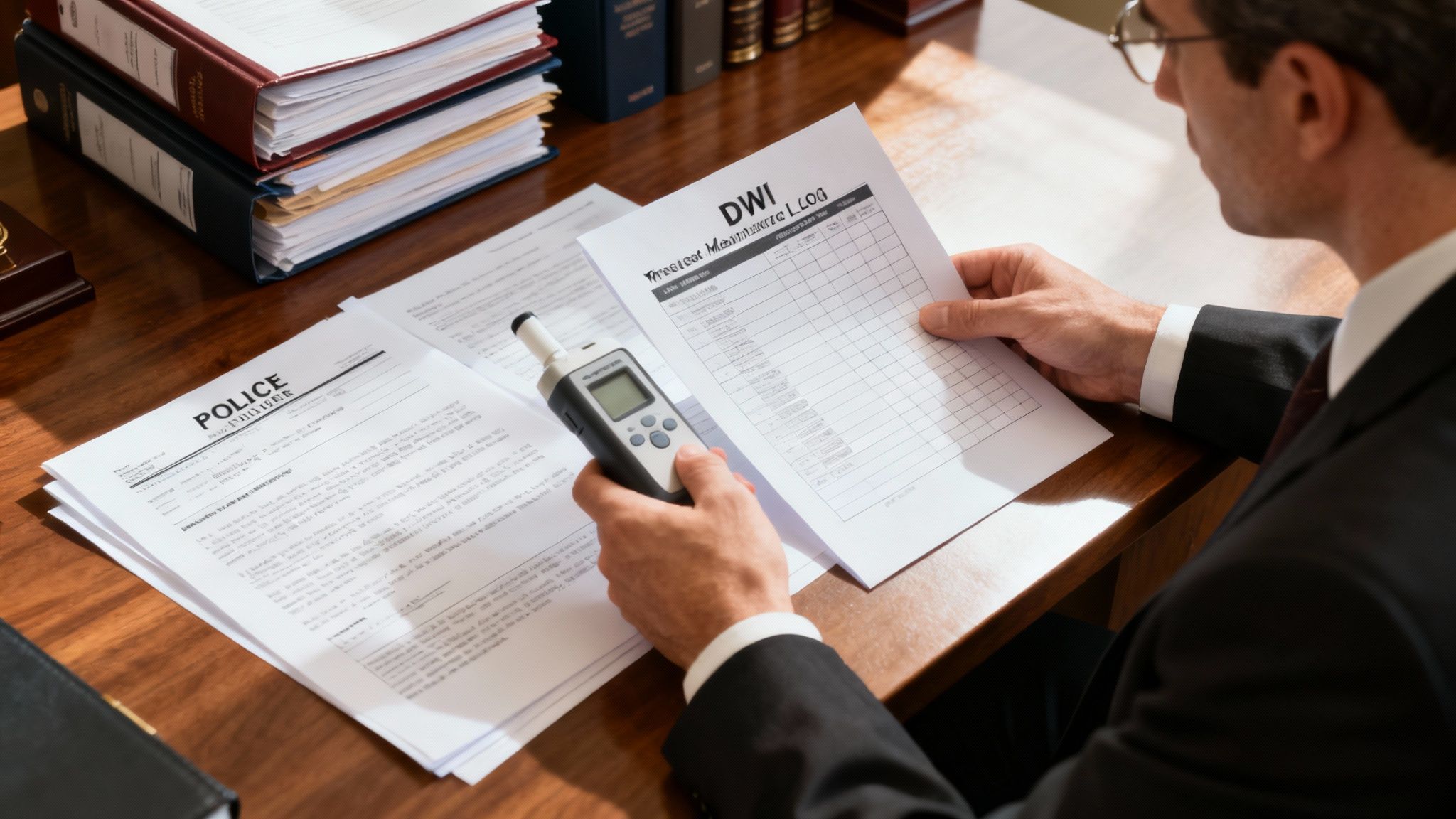
If you’ve been arrested for a DWI, you might be asking, “Do I really need a lawyer?” The answer is a strong yes.
Trying to handle a DWI charge by yourself is like trying to do surgery on yourself. You might know a little, but you don’t have the special training needed to handle all the complicated details. You could miss small but important things that could change the outcome of your case.
An experienced DWI attorney is more than just someone who speaks for you in court. They are your planner, your investigator, and your biggest supporter. The first thing they do is get every piece of evidence the other side thinks it has against you.
Looking for Weak Spots in the Case
Think of the prosecutor’s case like a chain. To prove you’re guilty, every link in the chain must be strong. A good lawyer’s job is to find the weak links and break them. This work starts as soon as they take your case.
A skilled lawyer will ask for all the evidence, including:
- The Police Report: They will read the officer’s report carefully, looking for parts that don’t match up or don’t make sense.
- Dashcam and Bodycam Videos: Videos don’t lie. This footage often shows a different story than the police report, revealing important details about the traffic stop and sobriety tests.
- Breathalyzer Records: These machines are not perfect. Your attorney will check the machine’s repair and testing records to see if it was working right.
This deep look into the evidence is where a good DWI attorney really helps. They know exactly what to look for and, more importantly, how to use what they find to build a strong defense for you.
A DWI charge is not the same as being found guilty. An arrest is just the start of a legal process. A dedicated attorney is there to protect your rights and challenge the prosecutor’s evidence from every possible angle.
Asking the Right Questions
Your lawyer will focus on key parts of the arrest that you might never think of. They will look at the entire event and ask sharp questions to find holes in the prosecutor’s story.
For example, did the officer have a good reason to pull you over in the first place? This is a very big deal. If the stop wasn’t legal, any evidence they collected after that could be thrown out of court.
They will also look closely at the field sobriety tests. Were the instructions explained correctly? Was the test done on a flat, well-lit surface? These small details are often missed, but they can become a key part of your defense. To keep track of every detail, many top DWI attorneys use tools like legal dictation software to make sure nothing gets missed.
The legal field is huge. As of January 1, 2024, there were over 1.3 million lawyers in the United States. But DWI law is a very specific area. The need for experts is growing, with an expected job growth of 10% by 2031. This shows how important it is to find someone who knows DWI cases inside and out. You can find more facts about lawyers from the American Bar Association’s research.
In the end, hiring the right DWI attorney isn’t just about having someone stand with you in court. It’s about having a specialist who knows how to handle a system that is set up to get convictions. They make the fight fair and make sure your side of the story is not just heard—it’s supported by a smart, strong defense.
Understanding Arkansas DWI Penalties
Being charged with a DWI in Arkansas is a serious matter. It’s more than just a costly ticket—it’s a legal problem that can follow you for years. It can affect your job, your money, and your freedom to drive. The first step to protecting yourself is to understand what you are facing.
Many people don’t know that a DWI charge starts two different legal battles at the same time. It’s like fighting a war on two fronts, and each one has its own rules.
- The Criminal Case: This is what you see on TV—the fight in the courtroom. The state’s prosecutor tries to prove you are guilty of DWI. If you are found guilty, you could face jail time, big fines, and required classes.
- The DMV Hearing: This is a separate fight with the Arkansas Department of Finance and Administration (DFA). This hearing is only about one thing: whether you get to keep your driver’s license.
Here’s the tricky part: you can win your criminal case but still have the DFA take away your license. The opposite can also happen. That’s why having an experienced DWI attorney is so important—they know how to defend you in both fights at once.
Penalties Get Worse with Each Offense
Arkansas law is very tough on people who get more than one DWI. The penalties don’t just go up; they get much, much worse. A bad situation can turn into something that changes your life. The problems go far beyond paying a fine and spending some time in jail.
Think about the bigger picture. In 2022, drunk-driving crashes killed 13,524 people in the United States. For you personally, a DWI conviction often makes your car insurance payments go up by about 80%. That’s a lot of extra money to pay for years.
To give you a better idea of what could happen, let’s look at the penalties in Arkansas.
Arkansas DWI Penalties at a Glance
This table shows the lowest and highest penalties you could face. It’s a clear look at how quickly the punishments get more serious from one offense to the next.
| Penalty Type | First Offense | Second Offense | Third Offense |
|---|---|---|---|
| Jail Time | 24 hours to 1 year | 7 days to 1 year | 90 days to 1 year |
| Fines | $150 to $1,000 | $400 to $3,000 | $900 to $5,000 |
| License Suspension | 6 months | 24 months | 30 months |
| Alcohol Education | Required | Required | Required |
| Ignition Interlock | Often Required | Required | Required |
As you can see, the law sets clear low and high points for punishments. A judge has to give these sentences if you are found guilty. This is why a strong defense is so important from the very beginning.
The Long Road of License Suspension
For most people, losing their license is the first and worst part of a DWI. All of a sudden, getting to work, taking kids to school, or even going to the grocery store becomes a huge problem.
The time you lose your license for in Arkansas gets much longer with each offense. You might also have to deal with things like court-ordered driving school requirements.
Take a look at how quickly the time you can’t drive adds up.
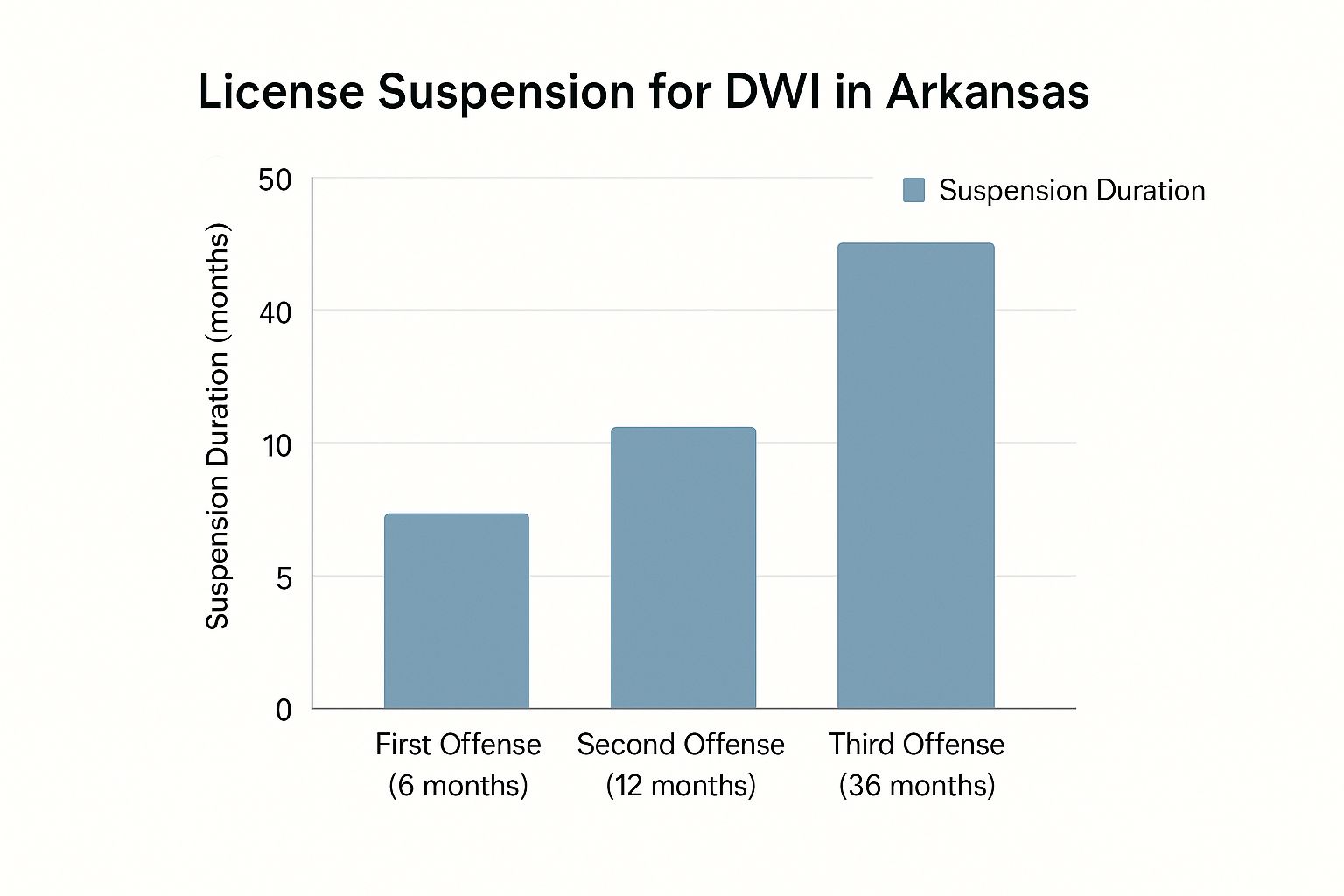
As the chart shows, going from a first to a third offense isn’t just double or triple the punishment—it’s a suspension that’s five times longer.
A good DWI lawyer knows all the details of both the criminal court and the license suspension process. They can help you meet important deadlines for your DMV hearing and build a case to protect your right to drive. The laws are complicated, but an expert can guide you through them. For a deeper look at the specific laws, you can learn more about DWI Arkansas law in our detailed article.
With so much at risk, having a professional on your side isn’t a luxury—it’s something you need.
How a Skilled Attorney Builds Your DWI Defense

Being arrested for DWI can make you feel like the case is already over. But an arrest is just the start of the story, not the end. A smart DWI attorney works like a detective, carefully looking through every piece of your case to find weak spots in the prosecutor’s argument and build a strong defense for you.
Their job is to question everything. They don’t just accept the police report as the truth; they see it as just one side of the story that needs to be checked and challenged. This whole process begins by looking at the very first moment you saw flashing lights in your mirror.
Challenging the Traffic Stop
The first thing your lawyer will try to challenge is the traffic stop itself. Under Arkansas law, an officer can’t pull you over just because they feel like it. They need a real legal reason, called reasonable suspicion, to believe you have broken a law.
It could be something simple like speeding or a broken taillight. But if your attorney can prove the officer had no good reason to stop you, then all the evidence collected after that—like the breath test and sobriety tests—could be thrown out of court. This is often how cases get dismissed completely.
Looking at the Field Sobriety Tests
Field Sobriety Tests (FSTs) are a big part of most DWI arrests, but they are not always reliable. Think of them as physical tests you have to take on the side of a road, often while you are very nervous. A good lawyer knows these tests can be unfair and looks for mistakes in how they were given.
Your attorney will ask important questions like:
- Were the instructions clear? The officer must give instructions exactly as they are written. If they mess up the instructions, the test results might not be valid.
- Was the location right for the test? Trying to balance on a bumpy road, in bad weather, or next to fast-moving cars is hard for anyone, even if they haven’t been drinking.
- Do you have any medical problems? Many health issues can make it almost impossible to “pass” these tests, even if you are completely sober.
By pointing out these problems, your attorney can argue that the FST results are not a good way to measure if you were impaired. This helps weaken the prosecutor’s case against you.
An arrest is not a conviction. A strong defense can show mistakes, challenge evidence, and change the entire result of your case. An experienced DWI attorney is your best chance to make sure your rights are protected.
Questioning the Chemical Test Results
The result from a breathalyzer or blood test can feel like the final proof, but it’s not always perfect. A breathalyzer is like a scale at the grocery store; if it’s not checked and cared for regularly, it won’t give a correct reading.
A skilled DWI lawyer will challenge the chemical test evidence by asking to see the paperwork:
- Repair and Testing Records: These machines need to be checked often to stay accurate. Your lawyer will look for any missed service appointments or signs that the machine was not working right.
- Officer Training Records: The officer who gives the test must be properly trained and certified. If their certification is out of date, the test result might not be allowed in court.
- Correct Steps: Arkansas has very strict rules for how to give chemical tests, including a required waiting period before the test. If the officer didn’t follow the rules, the results can be challenged.
By looking into these technical details, an attorney can create serious doubt about how accurate that important BAC number really is. It’s a common and very good strategy that can lead to lesser charges or the case being thrown out. A dedicated lawyer will check every detail when your freedom is at stake.
How to Choose the Right DWI Attorney for Your Case
Let’s be direct: facing a DWI charge is scary. The most important choice you will make is who will stand with you in court. Not all lawyers are the same. Picking a DWI attorney is like finding a heart surgeon for a big operation—you need a specialist, not a general doctor who does a little bit of everything.
Finding the right person can feel like a huge task, especially when you are already stressed. But if you know what to look for, it gets much easier. You need someone who knows Arkansas DWI law inside and out, not a general lawyer who takes any case that comes along.
Start with Special Experience
The first thing to look for is focus. A lawyer who spends all their time on DWI defense knows the system much better than someone who only handles a few of these cases a year. They understand the science behind breathalyzers, know the common mistakes officers make, and have a list of defense plans that work in Arkansas courts.
When you meet with a potential lawyer, don’t be afraid to ask direct questions. Their answers will tell you a lot.
Here are a few questions you should definitely ask:
- What percentage of your work is DWI defense? A high number is a great sign that they are a true specialist.
- How often do you take DWI cases to trial? This shows they are ready to fight for you and not just take the first deal offered.
- Have you had any special DWI training? Look for training in things like field sobriety testing or how breathalyzers work.
Local Knowledge Is a Big Plus
Knowing the law is one thing; knowing the local courts is another. A lawyer who is always in Northwest Arkansas courtrooms will know the judges and prosecutors. This isn’t about secret deals; it’s about understanding their personalities, how they argue, and what they find convincing.
That local knowledge can be a real game-changer. Your lawyer will have a much better idea of how a certain judge might decide on a request to throw out evidence, or what kind of deal a prosecutor might offer. This helps them create a smarter plan for you from the start.
A great DWI attorney is more than just a legal expert; they are your guide through a confusing and scary system. Their job is to protect your rights, challenge the evidence, and fight for the best possible result for your future.
It’s worth knowing how many lawyers are out there. In the United States, there are about 402 lawyers for every 100,000 people. This means there is roughly one lawyer for every 250 people. While there are many lawyers, finding a real DWI specialist means you have to look closer. You can learn more about these global legal professional statistics and see how this compares around the world.
Look for Good Signs and Bad Signs
As you meet with lawyers, you’ll start to see good signs and bad signs. Trust your gut feeling and watch out for these.
Good Signs to Look For (Green Flags):
- Clear Talking: They explain complicated legal things in a way you can understand, without using a lot of confusing words.
- Good Reviews from Clients: Look for comments that talk about the lawyer’s skill, how they respond to questions, and their professionalism.
- Honesty: They tell you the truth about all the possible results—good and bad—without making it sound better than it is or making crazy promises.
Bad Signs to Avoid (Red Flags):
- Guarantees a Win: This is the biggest warning sign. No good lawyer can ever promise a certain result. If they promise your case will be dismissed, walk away.
- Not Focused: Their website lists a dozen different types of law, from car accidents to real estate. They are likely not a specialist in any of them.
- Bad Communication: If it’s hard to get in touch with them for a first meeting, think about how hard it will be once they have your money.
Choosing your DWI attorney will have a huge effect on your case. Take your time, do your research, and find someone you can really trust to protect your future.
Common Arkansas DWI Questions Answered
Facing a DWI arrest brings a flood of questions. It’s confusing and stressful, but getting clear, simple answers is the first step to feeling more in control. Let’s answer some of the biggest questions people have after being pulled over.
Should I Refuse a Breathalyzer Test?
This is one of the hardest choices to make at the moment, and it can feel like you lose either way. In Arkansas, there is an implied consent law. Simply put, by driving on a public road, you have already agreed to take a chemical test if an officer has a good reason to arrest you for DWI.
So, what happens if you say no? The state will automatically take away your license. This happens even if you are later found not guilty of the DWI charge.
It sounds like a bad choice, but there is another side to it. Refusing the test means the prosecutor won’t have a very important piece of evidence against you: your blood alcohol concentration (BAC). Without that number, their case is much harder to prove.
Here is the choice you are making on the side of the road:
- Refuse the test: You don’t give the prosecutor a BAC number, but you get an immediate 120-day license suspension.
- Take the test: You might not have your license taken away automatically (if your BAC is under the limit), but you could give them proof of a 0.08% or higher BAC that makes their case easy.
A good DWI attorney can fight the automatic license suspension at a separate DMV hearing, so refusing the test isn’t always the end of your driving. The truth is, there is no single right answer for everyone. Your choice should depend on your own situation. It’s best to get advice from an experienced DWI attorney who can explain the DMV process and your options.
“Refusing a test is not a one-size-fits-all solution. It must fit your unique situation.” – Local DWI attorney
The best thing to do is call a lawyer as soon as you can after an arrest. They can help you figure out what to do next and start building a defense, no matter what you chose to do at the scene.
Can a DWI Charge Be Dropped or Reduced?
It is not common for a DWI charge to just go away, but it is definitely possible to get it changed to a less serious charge. With the right legal plan, a skilled DWI attorney can often work out a deal with the prosecutor, called a plea bargain.
This usually means changing the DWI to a lesser charge, like reckless driving. A change like this can make a huge difference—it means smaller fines, less (or no) jail time, and a much less serious mark on your permanent record.
So, how does this happen? A good lawyer will take the prosecutor’s case apart, looking for any weak spots. Maybe your BAC was just barely over the 0.08% limit. Or maybe the arresting officer made big mistakes during the field sobriety tests or the arrest itself.
These are the kinds of things that give your attorney power to negotiate:
- A good driving record can show this was a one-time mistake.
- A BAC that’s just over the line is easier to question.
- Any mistakes in procedure or broken equipment can make the evidence unreliable.
- Being cooperative during the arrest can sometimes help you.
Prosecutors are often willing to make a deal rather than risk losing a weak case in a trial. A plea bargain saves everyone time and money. It’s a practical choice when the evidence is not very strong. A lesser charge also means lighter penalties from the DMV, which is a big plus.
Getting a charge reduced is a step-by-step process:
- Your attorney will carefully review every piece of evidence.
- They will find the weak spots in the prosecutor’s case.
- Together, you will decide on a plan for negotiating.
- Your lawyer presents a strong argument to the prosecutor.
Of course, there are no promises. The result often depends on the specific facts of your case, the prosecutor’s office rules, and even the judge. This is where having a lawyer with local courtroom experience really helps—they know the people involved and how they work.
“A well-placed plea bargain can save years of hardship and thousands of dollars.” – Experienced Arkansas DWI attorney
Be open with your lawyer about what you hope for. That way, you can decide together if a plea bargain is the right choice for you and move forward with confidence.
How Much Does a Good DWI Attorney Cost?
Let’s be honest: hiring a great DWI attorney is an investment. The cost might seem high, but it’s important to understand what you’re paying for and compare it to the huge costs of being found guilty.
Most DWI lawyers charge in one of two ways: a flat fee or an hourly rate. A flat fee is a single price that covers your whole case, from the first meeting to all court dates and DMV hearings. An hourly rate means you pay for the time the lawyer actually spends working on your case, which can be from $200 to $400 per hour or more.
- Flat Fees: These are great because you know the total cost from the start. They often cover all normal work like going to court, filing papers, and phone calls.
- Hourly Fees: You only pay for the work that is done, but the total cost can be hard to predict if the case gets complicated.
- Retainers: Many lawyers ask for a payment upfront, called a retainer, before they start working. This is like a down payment on your total fee.
- Extra Costs: Be aware that you might have other costs for things like expert witnesses or private lab tests.
It can be tempting to choose the cheapest lawyer you can find, but in this area, you often get what you pay for. A lower-priced lawyer might be handling too many cases at once, leaving them little time to look into the details of your situation.
A dedicated, experienced lawyer takes the time to check police reports, challenge evidence, and find mistakes that can change the outcome of a case. That kind of detailed work is what can lead to lesser charges or even a dismissal—saving you much more money in the long run.
Think of it this way: a DWI conviction can easily cost you over $5,000 right away in fines, fees, and lost pay from work. On top of that, your car insurance costs can jump by 80% or more for years.
| Fee Type | Good Things | Things to Think About |
|---|---|---|
| Flat Fee | Your total cost is known from the start. | The first payment can be higher. |
| Hourly Rate | You only pay for the time your case needs. | Costs can add up fast if the case takes a long time. |
| Retainer | Makes sure the lawyer will work for you. | Might not cover all possible case costs. |
Many attorneys understand that a DWI causes money problems and offer payment plans to make good legal help more affordable.
Always ask for a written fee agreement that clearly lists all costs. This protects both you and your lawyer and makes sure there are no surprises later.
“Spending on strong legal defense now can save you tens of thousands later.” – Arkansas DWI lawyer
When you’re comparing attorneys, don’t just look at the price. Think about their experience, their plan for your case, and how much they care. The right lawyer isn’t a cost; they’re an investment in protecting your future.