
In Arkansas, a rule called “adverse possession” can be confusing. It’s a legal way for someone to possibly own property that belongs to someone else. But, they must follow a list of very strict rules set by the state.
This isn’t just about living on a piece of land. To even start a claim, a person must openly use the property for seven years in a row. And here’s the most important part: they must have paid the property taxes on it for that whole time.
What Does Adverse Possession in Arkansas Mean?
Let’s look at an example. Imagine your neighbor builds a new shed and a small garden, but part of it is on your land. If they use that small piece of land like it’s their own, and you never say anything, they might one day be able to claim it.
But in Arkansas, there’s a big catch. For their claim to work, they would have had to openly use that land and pay the taxes on that specific bit of your property for seven straight years without your permission. This is the main idea of adverse possession in Arkansas.
It’s very different from “squatter’s rights” or a sneaky way to take over an empty house. The law is really meant to solve old, confusing arguments over property lines and to push landowners to use and take care of their property. Arkansas has made the rules extra tough, which makes it very rare for someone to win an adverse possession case.
The Main Idea, Explained Simply
Think of adverse possession like this: there’s a long-lasting, public mistake about where a property line is. After a long time, the law might step in to fix it. For a claim to be considered, the person using the land—the claimant—must act like they are the real owner. This can’t be a secret.
The idea behind adverse possession is that if a property owner doesn’t do anything to protect their land for many years, they might lose their rights to it. The person who has been acting like the owner might gain those rights instead.
So, just mowing a patch of your neighbor’s grass now and then is not enough. The person’s actions have to be much clearer, showing everyone they think they own the land. A good claim depends on their use being:
- Open and Obvious: Their use of the property has to be easy for the real owner to see.
- Hostile: This doesn’t mean angry. It just means their use is without the owner’s permission.
- Continuous: They must use the property for the full seven years without stopping for long periods.
On top of these basic rules, Arkansas adds two big roadblocks that we’ll talk more about later: having a flawed property document (called “color of title”) and paying the property taxes. These two rules are what make adverse possession in Arkansas so hard to prove. They are there to protect landowners from unfair claims.
To give you a clearer picture, here’s a quick summary of what you need for an adverse possession claim in Arkansas.
Adverse Possession in Arkansas at a Glance
For anyone trying to understand what it takes to make a claim, this table breaks down the key legal rules in simple terms.
| Requirement | What It Means in Simple Terms |
|---|---|
| Open & Obvious | Using the land in a clear, visible way—not in secret. |
| Continuous | Using the property for the full 7-year period without a break. |
| Hostile | Using the land without the real owner’s permission. |
| Exclusive | Using the land as if you are the only owner, not sharing it. |
| Payment of Taxes | You must have paid the property taxes for 7 straight years. |
| Color of Title | You must have some type of (flawed) document that suggests you own it. |
As you can see, just being on the land is not enough. A claimant has to meet every single one of these rules to have a chance in court.
The Five Main Parts of an Adverse Possession Claim
For an adverse possession claim to work in an Arkansas court, just living on a piece of land isn’t enough. The law has very high standards. Think of it as a checklist of five specific things that must all be true, with no exceptions. If even one of these is missing, the whole claim will probably fail.
The five legal rules are that the possession must be Open and Obvious, Continuous, Hostile, Exclusive, and Actual. Let’s break down what each of these really means in a simple way.
Open and Obvious: No Hiding Allowed
First, the person’s use of the property must be Open and Obvious. This is just a legal way of saying they can’t be sneaky about it. What they do has to be so clear that any landowner paying attention would notice something was going on.
For example, if your neighbor starts building a fence or a small shed that goes a few feet onto your property, that’s open and obvious. It’s a change you can see, and you could easily spot it if you were watching your property lines.
On the other hand, if someone only used the land in the middle of the night or tried to hide what they were doing, their claim would fail this test. The law is meant to give the real owner a fair chance to find the trespasser and stop them.
Continuous: A Full Seven Years of Use
Next, the use must be Continuous for the full seven years that Arkansas law requires. This doesn’t mean the person has to be on the land 24/7. It means they must use it regularly, without any long or strange breaks in time.
A good example is a family that uses a path across a neighbor’s empty lot to get to a fishing pond every summer. If they do this for seven summers in a row, a court would likely see that as continuous use because they use it the same way each year for that activity.
But what if they used the path for one year, then didn’t come back for three years before using it again? That would break the chain. The seven-year clock would start over at zero.
Hostile: Not What You Think
The word Hostile often confuses people, but in property law, it has a special meaning that has nothing to do with being angry. It simply means the person is using the land without the real owner’s permission and against their right to own it.
Here’s a very important point: permission from the owner immediately stops a hostile claim. If the landowner ever says, “Sure, you can use that corner of my property,” the use is no longer hostile. Adverse possession becomes impossible from that point on.
So, if a neighbor starts mowing a strip of your lawn because they truly (but wrongly) believe it’s their property, that action is legally “hostile.” They are acting like they are the owner, which goes against your real ownership rights.
This flowchart gives a simple visual guide to how these first conditions, like permission, work in an Arkansas claim.
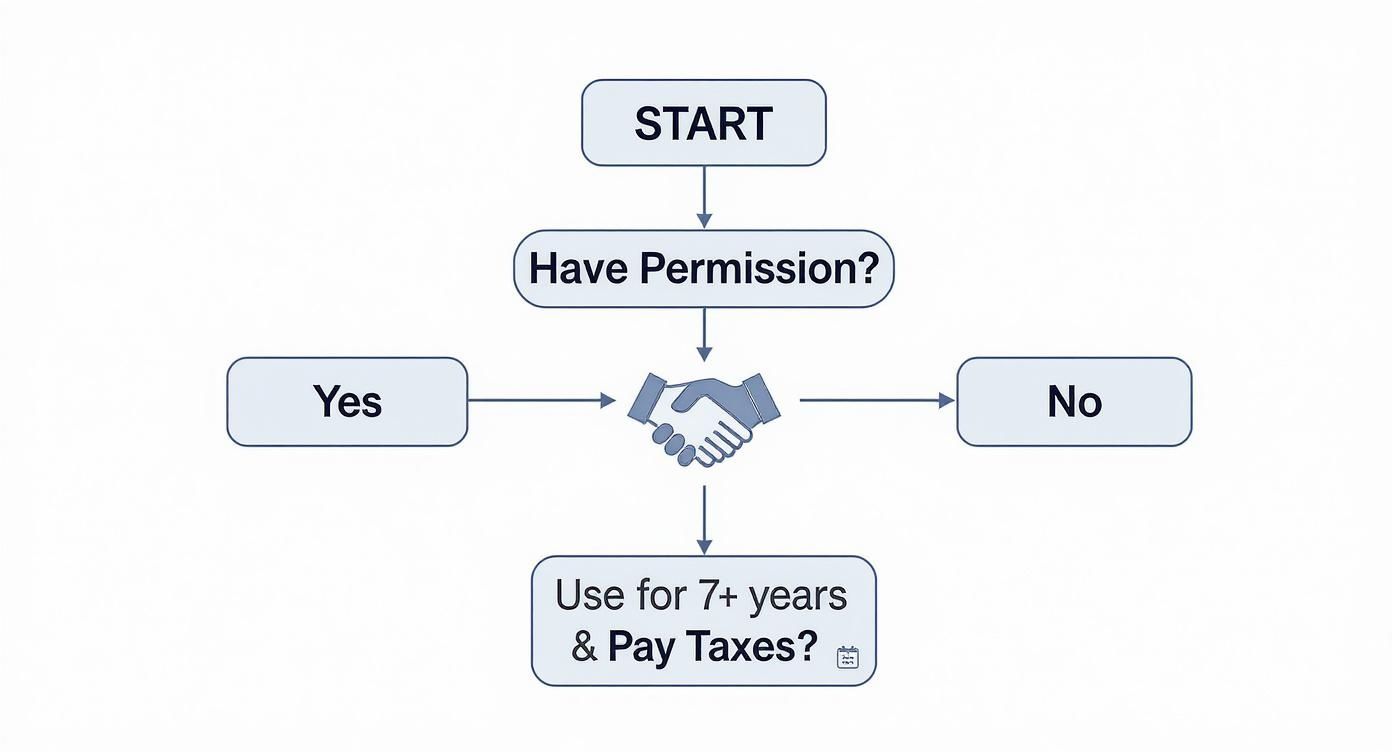
As you can see, not having permission is a key first step. After that come the tough rules about time and, most importantly, tax payments.
Exclusive and Actual: Acting Like a Real Owner
Finally, the possession must be both Exclusive and Actual. These two parts work together to prove that the claimant wasn’t just a random trespasser but was treating the property as their own.
- Exclusive Possession: This means the claimant controlled the property and was not sharing it with the public or the original owner. If a whole neighborhood uses a dirt path as a shortcut, no single person can claim it through adverse possession because their use isn’t exclusive.
- Actual Possession: This means the claimant must physically use the land in a real way. You can’t just claim a property by thinking about it; you have to do something. Common examples include building a fence, clearing trees, planting a garden, or putting up a building.
These five parts are the foundation of any adverse possession Arkansas case. A claimant must be ready to prove every single one with clear evidence. Even then, Arkansas law adds other big challenges that make these claims especially hard to win.
Arkansas’s Two Special Seven-Year Rules
While the five main parts of adverse possession are the base, Arkansas law adds two extra rules that make claims here some of the hardest in the country. Think of these not as small details, but as big legal walls a person must get over for seven straight years.
These two rules, “Color of Title” and the payment of property taxes, work together to create a strong defense for property owners. Without proving both, an adverse possession claim in Arkansas is almost guaranteed to fail.

What Is Color of Title?
The first big rule is “color of title.” It sounds tricky, but the main idea is pretty simple: a person can’t just walk onto a piece of land and decide to start the seven-year clock.
To have color of title, the claimant needs a document—like a property deed—that looks real on the outside but has some hidden legal problem. This document has to make it look like they are the proper owner, even if they aren’t.
Let’s use an example. Imagine someone sells you a piece of land and gives you a deed. Everything seems official. Later, you find out the seller never really had the legal right to sell it to you. That deed, which looks right but has a major flaw, is what gives you “color of title.”
This is a very important piece of the puzzle because it shows the claimant has a good reason to believe they own the property. They aren’t just a trespasser looking for an opportunity; they are acting based on a document that seems valid.
Here are a few common ways that color of title can happen:
- A Fake Deed: The document was made illegally but looks completely real.
- A Deed That Wasn’t Done Right: The deed is missing a signature it needs or wasn’t filed correctly with the county.
- A Deed from a Seller Who Didn’t Own the Land: The person who sold the land didn’t actually own it, but the papers they gave you looked real.
The bottom line is: without this flawed but official-looking document, a claim for adverse possession in Arkansas stops before it even starts.
The Seven-Year Tax Payment Rule
The second special rule is just as tough. The claimant must pay all the property taxes on the land for seven straight years. This is a rule that can’t be bent and serves as powerful, solid proof.
Paying property taxes is a very public way of showing ownership. It creates an official paper trail at the county tax office, proving that someone has been paying the bills for the land.
This rule makes it impossible to take over land quietly. You can’t just use a piece of land in secret and then try to claim it years later. You have to step up and pay the taxes—an action the real owner would likely see if they were checking their own tax records.
The tax payment rule is a clear test for Arkansas courts. It gives them documented proof that the claimant was openly and consistently acting as the property’s owner for the entire seven-year period.
To meet this rule, the claimant needs official receipts or certified records from the county showing a solid, unbroken string of payments. Missing even one year resets the seven-year clock back to zero.
It’s important to know that the law for adverse possession in Arkansas hasn’t always been this tough. The state’s laws have changed over time to better protect property owners. The biggest changes happened in 1995 when the Arkansas government, worried about people aggressively claiming land, made both color of title and the seven-year tax payment required. You can learn more about the history of these legal changes and how they shaped current Arkansas law.
Why These Two Rules Are So Important
When you put them together, color of title and the seven-year tax payment rule create a very high bar for anyone trying to claim adverse possession in Arkansas. They make sure that only people with a strong, document-backed reason to believe they own the land and a long-term habit of paying for it can even try to make a case.
In the end, these rules separate serious, honest disagreements from simple trespassing. For property owners, they provide a powerful defense, making it extremely hard for someone to take their land unfairly. For people who might want to make a claim, they are a clear warning: the road to ownership through adverse possession in Arkansas is tough, demanding, and requires perfect proof.
Making Your Case in Court: How Claims Are Started and Fought
When a simple talk can’t solve an adverse possession argument, the next step is usually the courthouse. This isn’t a quick process. It’s a formal legal case where both the person trying to claim the land (the claimant) and the legal owner get to tell their side of the story to a judge.
The whole reason the court gets involved is to look at the evidence and make a final, official decision on who really owns the property. If you are on either side of this situation, it’s very important to understand what’s ahead.
How a Claimant Starts a Legal Claim
So, you think you’ve met all the rules for adverse possession in Arkansas. What’s next? Your first official step is to file a lawsuit called an action to “quiet title.”
Think of it as asking a judge to settle the question for good. You’re basically telling the court, “I’ve met all the legal rules for adverse possession, and I need an official order that says I am the rightful owner. This will stop anyone else from claiming this land.”
Of course, you can’t just say the land is yours. You have to prove it with a lot of evidence. You need to show the judge that you have met every single part of the claim.
In an Arkansas adverse possession case, the person making the claim has to provide all the proof. You are the one who has to show clear evidence for each of the seven legal rules. The original owner doesn’t have to prove anything at first.
To build a strong case, you will definitely need things like:
- Proof of Tax Payments: This is a must. You need official county tax receipts for seven straight years.
- The “Color of Title” Document: You must show the court the flawed deed or other paper that made you believe you owned the land.
- Photos and Videos: Pictures are powerful. Gather photos and videos that show how you used the land over the years—fences you built, gardens you planted, or any buildings you took care of.
- Witnesses: A good witness is very helpful. Statements from neighbors, friends, or family who can confirm that you were openly and continuously on the property can win your case.
How a Landowner Defends Their Property
Once a quiet title lawsuit is filed, the original property owner has the right to fight back. To defend against an adverse possession Arkansas claim, the plan is simple: prove the claimant failed to meet at least one of the state’s strict rules.
Maybe the best defense is proving you gave them permission to be there. If you can show an email, a text message, a letter, or even have a witness who says you let the claimant use the land, their claim is over. Permission gets rid of the “hostile” part, which makes the whole argument fall apart.
Other common ways to defend your property include:
- Showing a Break in Their Use: Can you prove they left the property for a while? If you can show their use was not for seven full years without a break, their claim fails.
- Questioning Their Exclusive Use: You can show evidence that you, your family, or even the public kept using the land during their supposed seven-year period.
- Proving You Paid the Taxes: If you, the legal owner, can show you’ve been paying the property taxes all along, it ruins the claimant’s attempt to meet that key rule.
While this law exists, it’s important to know that these cases are not very common in Arkansas courts. Studies show that adverse possession is a rarely used legal tool and is even more rarely successful. The average number of these cases filed each year is less than one, which shows how small its role is in modern property law. You can find more data on how infrequently these cases succeed in Arkansas.
Simple Ways to Protect Your Land
When it comes to property arguments, being prepared is the best defense. The easiest way to handle an adverse possession claim is to make sure one can never get started. For Arkansas landowners, a few simple, proactive steps can protect your property lines and keep you safe from others trying to make a claim. These aren’t complicated legal tricks; they’re just common-sense actions that create strong proof that you are an active owner.
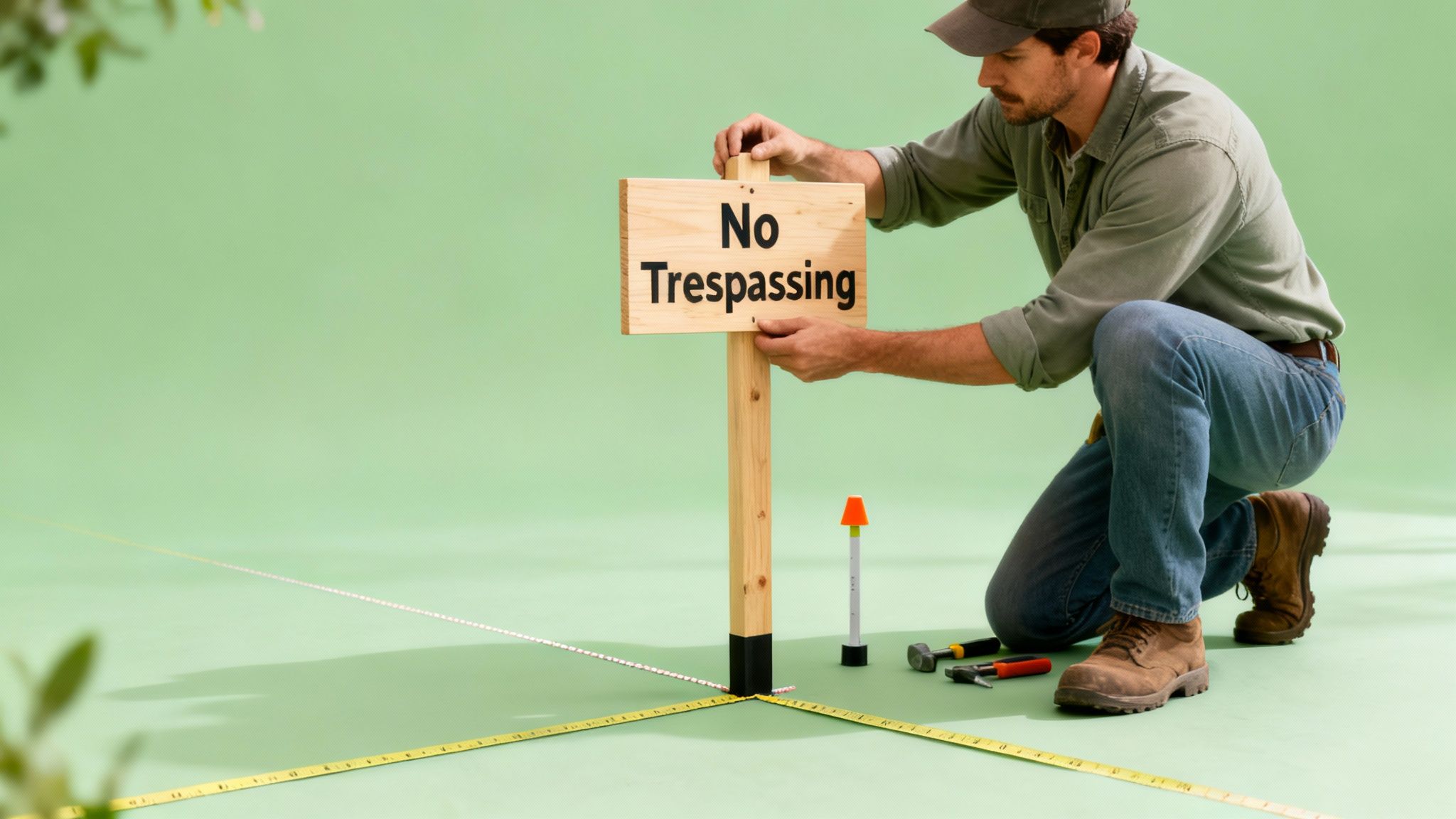
Simply put, paying attention is your best friend. By taking small, regular actions, you build a clear history of ownership that makes it incredibly difficult for someone to successfully claim your land.
Your Landowner Protection Checklist
Think of it like regular care for your home or car—a little effort now can save you from big problems later. Here’s a quick checklist to help you protect your property.
- Walk Your Property Lines: Make it a habit to walk around the edges of your land at least once a year. Look for anything that seems wrong, like a new fence, a garden that has grown over the line, or a neighbor’s shed that seems a little too close.
- Post “No Trespassing” Signs: This is more than just a warning. Visible signs are a clear, legal statement that no one is allowed on the property without permission. Putting them along your property lines makes things clear.
- Get a Professional Survey: If you’re not sure where your property begins and ends, a professional land survey is one of the best things you can pay for. It gives you an official, legal map of your exact boundaries, which is priceless if an argument ever comes up.
- Write Everything Down: When you do your yearly walk, take some photos and videos. If you see someone using your land, document it right away with dated pictures and write down exactly what you saw and when you saw it.
The Power of Giving Permission
One of the best tools you have is also one of the simplest: just give permission. Remember, a key part of any adverse possession claim is that the trespasser’s use of the land must be “hostile”—which, in this case, just means it’s without your permission. You can completely destroy this argument with one simple step.
What if you don’t mind your neighbor cutting across a corner of your yard or parking a boat on a piece of your unused land? Just put your permission in writing.
A signed letter or a simple written agreement that says you are giving temporary permission that you can take back is one of the strongest defenses you can have against an adverse possession claim. This simple document proves their use isn’t hostile, which immediately knocks out one of the main things they would need to prove in court.
With that one piece of paper, a person who might have become a squatter is now a guest. They are there with your permission, and it’s on your terms.
Keeping your own property records straight, especially your deeds, is also very important. For a deeper look at how these documents work, check out our guide on understanding deeds and property transfers. Taking these steps ahead of time is the best way to protect what is rightfully yours.
When You Definitely Need a Property Lawyer
Let’s be clear. While it’s great to understand the basics of adverse possession, trying to handle a real property argument yourself is like trying to do surgery after watching a YouTube video. The risks are just too high, and one mistake could mean losing your land for good.
Trying to handle an adverse possession issue in Arkansas by yourself is a huge risk.
Whether you’re a landowner who just found a neighbor’s fence on your property, or you’re the one who thinks you have a real claim, this is not a do-it-yourself project. The law is full of tricky details, and only an experienced property lawyer knows how to get through it safely.
Why a Lawyer Isn’t Just an Option—It’s Necessary
Think of a lawyer as your guide and protector through a legal maze that can be very confusing and stressful. They can look at the situation without emotion, figure out how strong a claim really is, and know exactly how to build a case that will succeed in court.
Here’s where a lawyer is essential:
- Understanding Arkansas Law: The laws have changed over the years. An experienced lawyer knows the current law and, more importantly, how local judges apply it.
- Gathering the Right Proof: They know what a court will accept as real evidence. This is much more than just a few photos; it involves finding the right documents and credible witnesses.
- Dealing with the Court System: The legal process has strict rules. There are deadlines for filing papers, and missing one can get your whole case thrown out.
- Negotiating an Agreement: A court battle isn’t always the best answer. A skilled lawyer can often work out a solution that protects your property without the time and cost of a full trial.
When you’re dealing with something as serious as property rights, you need a professional on your side. It’s also helpful to understand how a professional firm works; for example, learning how they handle important client calls, as explained in this complete guide to answering services for law firms, shows the level of care that goes into a good practice.
The legal rules for adverse possession in Arkansas have changed over time to match how people think about property rights. As a result, the state’s laws are now tougher than in many other states, requiring a claimant to prove seven years of possession, color of title, and tax payments. To learn more about this legal history, you can discover insights on how Arkansas law has changed.
If you find yourself in any kind of property line argument, don’t wait. The best thing you can do is get expert legal advice as soon as you think there’s a problem.
Common Questions About Arkansas Property Claims
Trying to understand property law can feel like walking through a maze. To help make things clearer, we’ve answered some of the most common questions we hear about adverse possession in Arkansas. Let’s clear up a few myths.
Can I Claim Abandoned Property in Arkansas?
This is one of the biggest misunderstandings. People see a vacant, run-down property and think it’s free for the taking. In Arkansas, that’s almost never true.
For a property to be claimed, it can’t just look abandoned. The person making the claim has to follow every legal rule, which includes having a flawed deed (called color of title) and paying the property taxes on it for seven straight years. Truly abandoned properties almost never have the kind of paperwork that would count as color of title, so a claim like this usually fails from the very beginning.
Does a Neighbor’s Fence on My Land Mean They Own It?
No, not right away. A fence that crosses onto your property is a problem, but it doesn’t automatically give ownership of your land to your neighbor.
Now, if that fence stays there for seven years and the neighbor acts like that piece of land is only theirs, they might try to make an adverse possession claim. But here’s the truth: they would still have to prove they had color of title and paid the property taxes for that small strip of land. In a simple fence argument, that’s almost impossible to do.
A misplaced fence is just one small piece of a much bigger puzzle. Without strong proof of color of title and seven years of tax payments, a fence is just a fence—not a property deed.
What Is the Difference Between Squatting and Adverse Possession?
People often use these words to mean the same thing, but legally, they are very different.
- Squatting is just living on a property you don’t have permission to be on. It’s trespassing, and it doesn’t give you any legal rights on its own.
- Adverse possession is the official, legal process that allows someone to possibly gain ownership of a property they have been living on.
Think of it this way: a squatter is just a trespasser. They could try to become the legal owner through adverse possession Arkansas law, but they would have to meet all the tough rules we’ve talked about. Without the seven-year timeline, the tax payments, and the color of title, they are always just a trespasser. For lawyers trying to find clients with these issues, understanding modern marketing through resources like expert SEO for law firms is key to being seen.