
In Arkansas, you can’t change a child custody agreement just because you feel like it. A court needs to see that something big has changed in your family’s life since the last custody order was made. The law calls this a “material change in circumstances.”
On top of that, you have to show that this change affects your child and that changing the agreement is the best thing for them.
When You Might Need to Change Custody

Life changes, and a plan that worked for your family last year might not work today. A custody schedule that was perfect for a little kid probably won’t work for a teenager who has sports, friends, and a job.
Arkansas law understands this. But courts also want kids to have a stable life, so they won’t change a legal order just because it’s annoying for a parent. You need a really good reason.
Basically, you have to prove to a judge that something important has happened since the last custody plan was approved. A small argument or a one-time schedule problem isn’t enough. The change has to be big enough to make the old agreement not work anymore, or even be bad for your child.
What Is a “Material Change”?
So, what does that legal phrase really mean? It’s not one single thing. A “material change” can be many different things, and a judge will always look at how it affects your child specifically.
Here are some common examples:
- One Parent Is Moving Far Away: If a parent gets a new job or needs to move for family reasons a long distance away, that’s a big reason to change the agreement.
- A Big Change in Work Schedules: If a parent’s job switches from a normal day shift to working all night, the old visitation schedule might be impossible to follow.
- The Child’s Needs Have Changed: A child might be diagnosed with a medical issue that needs special care, or they might become a serious athlete with a busy practice schedule that doesn’t fit the old plan.
- Safety Is a Problem: This is a very important one. If a parent’s home becomes unsafe because of drugs, alcohol, violence, or not taking care of the child, a judge will act fast to protect the child.
This idea of changing parenting plans is part of a bigger shift in how families are seen by the law. A long time ago, it was common for mothers to have the kids most of the time. For example, back in the 1980s, mothers were given custody in about 80% of cases. By 2008, that number dropped to around 42%.
So what changed? Shared custody, where kids spend a lot of time with both parents, has become much more normal. You can learn more about these shifts in custody trends to see how things have changed over time.
Key Takeaway: No matter why you want a change, the judge’s main focus is always the same: what is best for the child. What you want comes second. Your whole argument should be about why the change will help your child, not you.
Changing Custody: With or Without an Agreement
Once you know a big life event makes a change necessary, what you do next depends on one thing: if you and the other parent agree. In Arkansas, there are two very different ways to change a custody order.
The first way is uncontested, which means you and your co-parent both agree on the new plan. This is much easier, faster, and cheaper. It’s about working together to make a new plan that you both think is good for your child.
The other way is contested. This happens when you can’t agree. This path leads to court, where you will each have to tell your side of the story, and a judge will make the final decision. It’s a much harder, longer, and more stressful process for everyone.
When You Both Agree on the Changes
If you and the other parent see things the same way, you’ve already passed the biggest challenge. An uncontested change is all about working together. The idea is to sit down and figure out the new details for custody, visitation schedules, and any changes to child support. Sometimes, a person called a mediator can help you have this conversation.
After you agree on the details, you need to write it all down. This formal paper, often called an “Agreed Order” or “Consent Order,” explains every change. Once you both sign it, you file it with the court so a judge can look at it and approve it.
A judge will almost always approve an agreement that both parents have made, as long as it seems good for the child. Courts like it when parents can work together.
The picture below shows some of the common reasons why parents need to update their custody agreement.
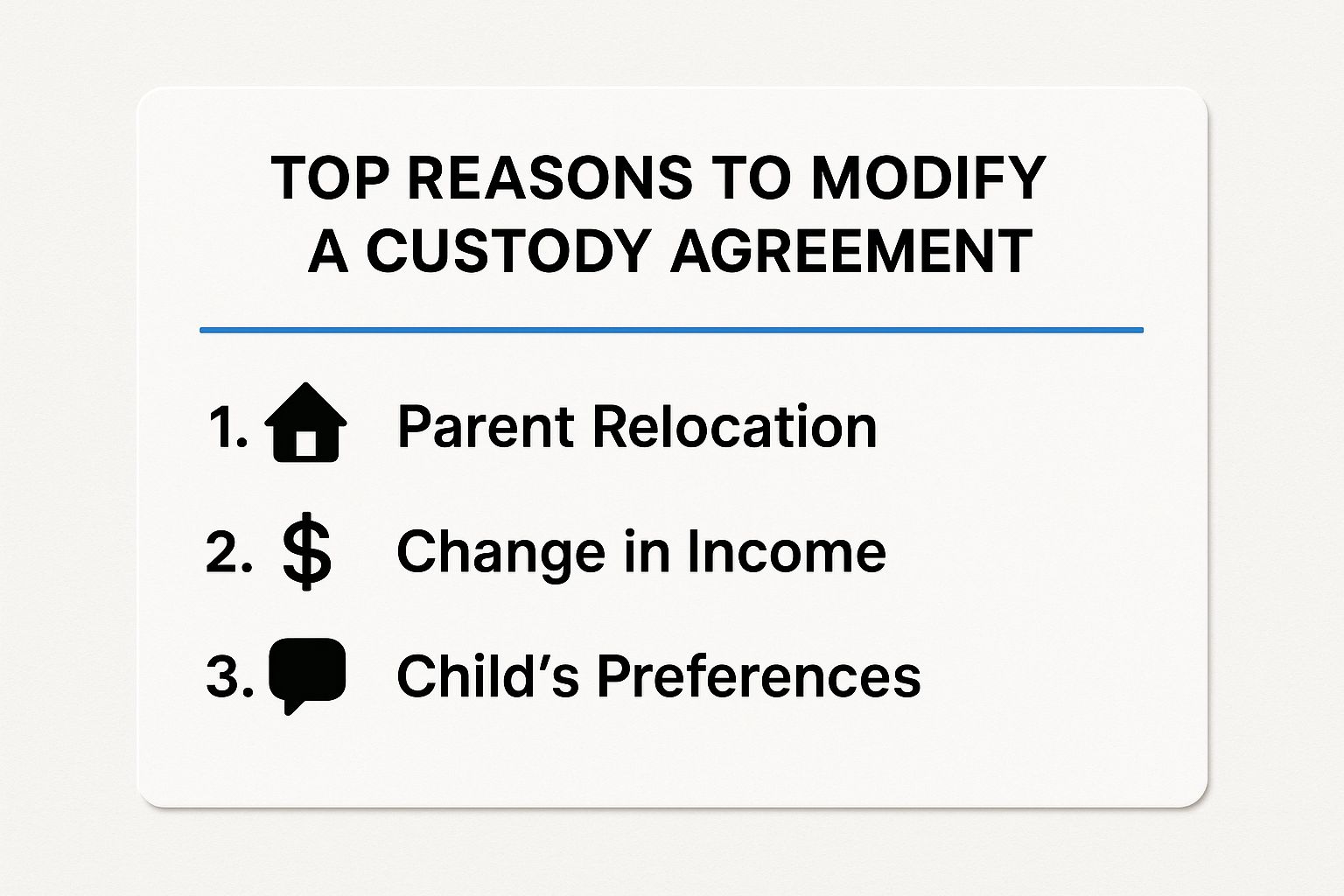
As you can see, things like a parent moving or a big change in money are often what start the conversation about a new plan.
When You Can’t Agree
What do you do when you know a change is needed, but the other parent says no? This is when things become contested, and you have to ask the court to step in and decide.
You’ll have to start by filing a formal paper called a “Petition to Modify Custody.” Then, you must have the other parent legally served with the lawsuit papers. This starts a whole legal process that can include sharing information, asking questions under oath, and going to court.
At the court hearing, both of you will show your proof, have people testify for you, and make your arguments. After listening to everything, the judge will make a final decision based on what they think is best for the child. There’s no way to soften it—this is a much more stressful and expensive way to do things.
Comparing the Two Ways to Change Custody
The differences between agreeing on a change and fighting in court are huge. Seeing them side-by-side makes it clear what you’re facing if you can’t agree.
| Factor | Uncontested (Parents Agree) | Contested (Parents Disagree) |
|---|---|---|
| The Process | You file an agreement for a judge to sign. | You file a lawsuit, go to hearings, and might have a trial. |
| How Long It Takes | Can be done in a few weeks. | Often takes many months, sometimes more than a year. |
| The Cost | Much cheaper. You have to pay court fees and maybe a lawyer to check the papers. | Much more expensive. You’ll pay for lawyers, court costs, and maybe experts. |
| Emotional Stress | A lot less stressful. It can even make your co-parenting better. | Very stressful. It can hurt your co-parenting relationship for a long time. |
| Who Decides | You and the other parent decide what happens. | A judge, who doesn’t know your family, makes the final decision. |
In the end, being able to decide for yourselves and avoid a long, painful court fight is why agreeing is always the better choice if it’s possible.
How to Build Your Case for a Custody Change

When you go to court and ask to change a custody agreement, just telling the judge things are different isn’t enough. You have to prove it. Building a strong case means getting clear proof that shows two important things: there has been a big change in circumstances, and your new plan is what’s really best for your child.
Think of yourself as a detective for your own case. Your job is to find facts and proof that show a clear picture of what’s happening and how it’s affecting your child.
For example, let’s say the other parent’s new job makes them travel all the time, and they often miss their weekends with the kids. A simple calendar where you write down every missed visit can be very strong proof. This isn’t about being mean or “keeping score”—it’s about showing a pattern that messes up your child’s life.
What Kind of Proof Works in Court?
A judge wants facts, not just feelings or what you think happened. The best proof often comes from your everyday life. You just need to know what to look for and how to keep it organized. Your goal is to tell a story that is backed up by evidence.
Here are the types of proof that can make your case stronger:
- Written Messages: Don’t delete texts and emails. A saved conversation can show that the other parent won’t cooperate, is always arguing about the schedule, or even admits that their life has changed.
- School and Doctor Records: Have your child’s grades suddenly dropped? Are they going to the school nurse more often? These records can be solid proof that your child is having a hard time with the current situation.
- Money Documents: If the change is about money—like a big promotion or losing a job—then pay stubs, bank statements, and tax papers are necessary proof.
- Witnesses: Sometimes, the best proof comes from someone who is not on either side. A teacher who has seen your child is upset, a coach who has seen visits get canceled at the last minute, or a friend who has seen negative changes can be very helpful.
Sometimes, the need for a change comes from problems in how the parents get along. It can be helpful to learn more about addressing toxic relationship patterns, especially if this is part of your problem.
Expert Tip: Get a binder or make a special folder on your computer today. Keep every piece of proof in one place. Write the date on everything and a quick note about why it’s important. Being very organized shows the court you are serious and makes your lawyer’s job much easier.
Connecting It All to Your Child’s Best Interest
This is the most important part. Every text message, every report card, every piece of proof must connect directly to what is “best for the child.”
It’s not enough to show that the other parent is always late. You have to show how being late hurts your child. Does it make them very nervous before visits? Does it make them late for their soccer game every week? That’s the connection the judge needs to see.
If you are worried about your child’s safety, writing things down is even more important. Take pictures of unsafe living areas (if you can do it safely), keep a detailed journal of what happens with dates and times, and always report anything illegal or dangerous to the police or child protective services.
Ultimately, you want to give the judge such a clear and strong case that changing the custody agreement becomes the obvious and right thing to do.
Making It Official in an Arkansas Court
Dealing with court papers can feel like learning a new language, but it’s not as confusing as it seems. Once you decide to ask for a change to your custody agreement, you will start the process in the Arkansas court system. This involves a few key steps, like filing the right papers and, most likely, meeting with a mediator.
Your first official step is to file a formal paper with the Circuit Court. This is usually called a “Petition to Modify Custody” or something similar. Think of this petition as your formal letter to the judge. It’s where you explain the big change in your life and why you think your new custody plan is what’s best for your child.
Telling the Other Parent: “Service of Process”
After you file the petition, you can’t just text the other parent to let them know. The law has a very specific, formal way of telling them that a lawsuit has started. It’s called “service of process,” and you have to do it.
This part is very important because it makes sure the other parent knows about the case and has a fair chance to answer. In Arkansas, you usually have two choices for getting this done:
- Use the Sheriff’s Office: For a small fee, a sheriff’s deputy will hand-deliver the court papers to the other parent.
- Hire a Private Process Server: You can also pay a professional who delivers these kinds of legal papers for a living.
Once the other parent has been “served,” a timer starts. They usually have about 30 days to file their own formal, written answer with the court.
The Power of Mediation in Custody Cases
Before you go in front of a judge for a final hearing, an Arkansas judge will almost always send you to mediation. It’s a normal part of the process here. Mediation is just a meeting where you and the other parent sit down with a neutral person—the mediator—to try and work out an agreement yourselves.
The mediator isn’t there to pick a side or act like a judge. Their whole job is to help you and the other parent talk to each other better, think of new solutions, and find a way to agree. Everything said in mediation is private, and it’s a much less stressful and cheaper way to solve the problem than a court battle.
Why Courts Like Mediation: Arkansas judges want you to go to mediation because it lets you, the parents, make the decisions. From my experience, an agreement you make together is almost always better and lasts longer than one a judge has to force on you.
Even if your first custody order was from another state or country, you’ll still follow the local court process now. Changing custody always means you need a new court order. The court will use laws like the Uniform Child Custody Jurisdiction and Enforcement Act (UCCJEA) to make sure it has the power to handle your case. These situations can be tricky, and you can find more details on international custody disputes on desertlegalgroup.com.
If you and the other parent make an agreement in mediation, the mediator will help you write it down. You’ll give it to the judge, who will probably sign it and make it a new official order. If you can’t agree, your case will then move toward a court hearing, where the judge will listen to both sides and make the final decision.
How an Arkansas Judge Decides Your Case
Going into a courtroom for a custody hearing can be very scary. It can feel like your whole life is being judged. But it’s important to remember that in Arkansas, the judge has one main focus: the best interest of the child.
This isn’t just a legal saying; it’s the rule that guides every decision. The judge’s entire job is to figure out which home and situation will be best for your child’s health, safety, and happiness. They are trying to see the world from your child’s point of view.
The “Best Interest of the Child” Rule
So what does “best interest” really mean? The court looks closely at each parent’s ability to give the child a stable and loving home. It’s a full review that is about more than just who has a bigger house or more money.
A judge will think about several key things to get the whole picture:
- Stability is Most Important: Judges want to keep a child’s life as steady as possible. They’ll look at which parent can help the child stay in their same school, neighborhood, and daily routine.
- Each Parent’s Ability: The court wants to know that both parents are physically and mentally able to take care of a child every day.
- Family Relationships: The relationship the child already has with each parent, and with brothers, sisters, or other important family members, matters a lot.
- Warning Signs: Any real proof of family violence, drug or alcohol abuse, or neglect will be a huge, and often final, factor in the decision.
A lot of people think that courts always pick mothers over fathers. That’s just not true anymore. Arkansas law treats mothers and fathers equally. The decision will always be based on who the judge thinks is the better parent, not their gender.
Does the Child Get a Say?
Yes, but it’s not as simple as you might think. As children get older, an Arkansas judge may consider who they want to live with. There is no magic age where their choice becomes the final word, but the older the child is, the more their opinion will matter.
The judge will be very careful to make sure the child is saying what they really want, not just repeating what a parent told them to say. Sometimes, a judge might even talk to the child alone in their office, without Mom or Dad there, to have a more open and honest talk.
This way of doing things shows how family law has changed to focus more on kids. The old days when one parent got “the kids” and the other just got “visits” are going away. Shared custody is now much more common all over the country. For example, court records from Wisconsin show that shared custody after a divorce jumped from only 12% of cases in 1989 to 50% by 2010. If you’re interested, you can read more about these trends in shared parenting arrangements to see how things have changed.
Tips for Your Day in Court
Believe it or not, how you act in court really matters. It sends a message to the judge that you respect the court and know this is a serious situation.
- Dress Nicely: You don’t need a fancy suit, but your clothes should be clean and not too casual. Treat it like the most important job interview of your life.
- Be Respectful: Always call the judge “Your Honor.” When you talk about the other parent, use their name—not just “he” or “she.” It shows you are mature.
- Stay Calm and Stick to the Facts: Custody hearings can make you emotional, but try to control your feelings. Stick to the facts and let your lawyer (and your proof) do the talking. Never have an angry outburst or start yelling.
In the end, the judge’s job is to make a final order that gives your child the best chance for a happy and healthy life. Your job is to calmly and clearly show the judge why your plan is the one that will do that.
Questions About Changing Custody in Arkansas? We Have Answers.

Thinking about changing your custody agreement can bring up a lot of questions. It’s something many parents go through, and it’s normal to feel a little lost.
Let’s answer some of the most common questions we hear from parents in Arkansas. Our goal is to give you clear, simple answers so you can feel more confident.
How Long Does This Whole Thing Take?
There’s no one answer for this. How long it takes really depends on one big thing: whether you and the other parent agree.
If you both agree on the new plan (an uncontested change), things can move pretty fast. You could have a new, signed order from the judge in just a few weeks or a couple of months.
But if you can’t agree (a contested change), you should get ready for a longer process. These cases need court hearings and a lot of back-and-forth, often taking many months, and sometimes more than a year.
What if the Other Parent Doesn’t Follow the New Custody Order?
Once a judge signs a new custody order, it’s not a suggestion—it’s the law. If the other parent keeps breaking the rules, like not bringing the kids back on time, they are violating a court order.
This is a big deal. The first thing you should do is write everything down. Keep a log with dates, times, and exactly what happened. With that proof, you can file a “Motion for Contempt” with the court. This asks the judge to step in and make the other parent follow the rules.
Key Takeaway: A judge has the power to make people follow their orders. If the other parent refuses, they could get in trouble. This could mean they have to give you make-up parenting time, pay a fine, or in very serious cases, even go to jail.
Can We Just Agree to Change Custody Without Going to Court?
No, you can’t. It’s great if you and the other parent can agree on a new plan, but just talking about it or writing it down yourselves doesn’t make it legal. The original court order is still the rule until a judge signs a new one.
To make any changes official and legal, you have to file your new agreement with the court. A judge will look at it to make sure it’s what’s best for your child. Once they sign it, the new order takes the place of the old one. This step protects both of you and makes the new rules clear for everyone.
Will Changing Custody Change Our Child Support Payments?
Yes, changing custody almost always changes child support. In Arkansas, child support is figured out using a math formula. This formula looks at how much money each parent makes and how much time the child spends with each parent.
When the parenting schedule changes a lot, it makes sense that the child support amount will be looked at again. For example, if the change means the children will be with you more of the time, the support you pay might go down, or you might start getting child support from the other parent.
You can get more details on this topic by reading about modifying child support in Arkansas.