
When you’re trying to decide between a revocable trust and an irrevocable trust, it’s like choosing between two kinds of piggy banks for your stuff. One you can open anytime, and the other is locked up for good. It really comes down to one big choice: Do you want more control, or do you want more protection?
A revocable trust is like a piggy bank with a removable rubber stopper. You can change your mind, add more money, take some out, or even smash it open and start over. But because you can always get to it, it doesn’t really protect your stuff from others. On the other hand, an irrevocable trust is like a sealed piggy bank. Once you put your money inside, you can’t get it back out. That sounds strict, but that permanent lock is what keeps your savings safe from people who might try to take it.
Understanding Trusts for Arkansas Families
So what is a trust? Imagine it’s a special box where you can keep your most important things—your house, your savings, or your land. You put your things in the box and write a list of rules for how to use them and who gets them when you’re gone. For families in Arkansas, it’s a smart way to make sure your stuff goes to the right people without a big fuss.
Every trust has three main people involved. It’s important to know who’s who.
- The Grantor: That’s you. You’re the one making the trust and putting your things in it.
- The Trustee: This is the person or company you pick to manage the box and follow your rules. A lot of times, you can even be your own trustee.
- The Beneficiary: These are the people who get the goodies from the trust, like your kids or a charity you love.
Why Would I Need a Trust?
Why go through the trouble of setting up a trust? For most folks in Arkansas, it’s about staying in control and keeping things private. The biggest reason is to stay out of a place called probate court.
Probate is the official court process for sorting out someone’s stuff after they die. It takes a long time, can cost a lot of money, and everything becomes public information for anyone to see. A trust, however, is completely private.
A good trust lets your things be passed on to your family quickly and privately, without all the delays and public nosiness of the probate court system.
Keeping your family’s business private is a big deal for many people. It protects your loved ones and makes sure your wishes are followed exactly how you wanted. This is what makes trusts so useful and leads to the big question: which type is right for you?
Key Differences at a Glance
Before we dive deep, here’s a quick cheat sheet. Your choice will depend on what’s more important to you: being able to change your mind or protecting your stuff for the long haul.
| Feature | Revocable Trust | Irrevocable Trust |
|---|---|---|
| Can you change it? | Yes, anytime while you are alive. | No, it is usually permanent. |
| Asset Protection | No protection from people you owe. | Strong protection from people you owe. |
| Control Level | You keep full control. | You give up control to the trustee. |
| Probate Avoidance | Yes, for things in the trust. | Yes, for things in the trust. |
Exploring the Flexible Revocable Living Trust

Think about building with LEGOs. You can add a piece, take one away, or knock the whole thing down and start over. A revocable living trust works a lot like that—it’s made to be totally flexible.
The clue is in the name. “Revocable” means you can change it. As long as you are able to make your own decisions, you can rewrite the rules, move your things in or out, or even get rid of the trust completely if your life changes.
This much control is why revocable trusts are so popular. They are the most common estate planning tool in the country because people feel better knowing they can change their plan if they need to.
You’re Still the Boss
When you make a revocable living trust in Arkansas, you usually play all three parts: you’re the Grantor (the creator), the first Trustee (the manager), and the main Beneficiary (the one who gets the benefit).
What does this mean for your everyday life? Not much at all. You’ll still use your bank accounts, manage your property, and live your life just like you did before. The only real difference is that the official owner of your things is the trust, not you as a person.
The Main Perk: Avoiding Probate in Arkansas
Without a doubt, the number one reason families in Arkansas create a revocable trust is to skip the probate court process. Probate is the public, court-run headache of settling an estate, and it can be a long and expensive nightmare for your family.
Things kept inside your revocable trust, however, are not part of your probate estate. When you pass away, the person you named as your successor trustee simply takes over and hands out your things according to your private rules. No court needed.
By putting your property in a revocable trust, you basically draw a private map for your family to follow. This lets them skip the time, cost, and public mess of the Arkansas probate courts.
This direct hand-off saves your family a ton of stress and keeps your money matters private. For a deeper look at how these trusts work, this is a helpful guide: What Is a Living Trust? A Guide to Estate Planning.
The Downsides: Flexibility Means No Protection
That amazing flexibility has a couple of big downsides, which become super clear when you compare a revocable trust vs. an irrevocable trust. Because you keep total control, the law still sees the trust’s property as yours.
Here’s what that really means:
- No Protection from Creditors: If you get sued or owe money, people can definitely go after the things inside your revocable trust. The trust is like a clear glass box that doesn’t protect what’s inside.
- Part of Your Taxable Estate: The government also sees everything in your revocable trust as part of your estate for tax purposes. It doesn’t give you any special breaks to lower estate taxes.
A good way to picture it is that a revocable trust is like keeping your valuables in a clear box you can open anytime. It organizes everything for your family, but it doesn’t shield the contents from outside problems. This is the main difference you’ll see when we look at the fortress-like protection of an irrevocable trust.
The Unshakeable Irrevocable Trust

If a revocable trust is like a LEGO set you can rebuild anytime, an irrevocable trust is more like a stone fort. Once you put your things inside and lock the gate, you can’t just change your mind and take them back.
That sounds a little scary, but it’s the whole point. By officially giving up control, you get a level of protection that a revocable trust can’t offer. This is the key difference that makes the revocable trust vs. irrevocable trust decision so important for anyone who wants to secure their property for the long run.
This is the big trade-off: you give up flexibility to get a powerful shield. For many families in Arkansas, it’s a smart choice to make sure what they’ve built is protected for their kids and grandkids.
Why Giving Up Control Can Be a Good Thing
When you move something—like your family’s land or a savings account—into an irrevocable trust, it’s no longer legally yours. The trust becomes the new owner. It’s this clean break that builds a protective wall around your stuff.
Since you don’t own the property anymore, it’s usually safe from your future debts or lawsuits. This makes it a very important tool for people in jobs with high risks, like doctors or business owners, who need to keep their personal savings separate from work problems.
The big idea is simple: You can’t be forced to give away something you don’t own. By putting things into the trust, you take them out of reach of your personal troubles.
This also creates some big tax benefits. Property held in a well-made irrevocable trust is usually not counted as part of your taxable estate. For families with a lot of wealth, this can lower or even get rid of federal estate taxes later on.
Asset Protection in Real Life
Let’s imagine a surgeon in Arkansas who is worried about being sued for her work. She could move things that aren’t part of her daily life, like a vacation cabin and some stocks, into an irrevocable trust for her children.
Years later, if a lawsuit is filed against her medical practice, the things inside the trust are generally safe. They belong to the trust, not to her, so they can’t be taken to pay a court judgment.
This isn’t just for rich people. Many families use a certain kind of irrevocable trust to plan for nursing home costs in the future. Moving property into the trust a long time in advance can help someone qualify for Medicaid later in life without having to spend all their savings first.
The Role of the Independent Trustee
Since you’ve given up control, someone has to manage the trust. That’s the trustee’s job, and for an irrevocable trust, it has to be someone else—a person or a bank. You can’t be your own trustee like you can with a revocable trust.
The trustee has a legal duty to manage the trust’s property exactly how you wrote in the trust’s rulebook. Everything they do must be to help the beneficiaries you named.
Irrevocable trusts are used for different reasons than revocable ones, especially for protecting property and planning for taxes. When you give up ownership of your things, they are often not counted as part of your taxable estate. This is a key strategy for people with a lot of assets. You can discover more insights about the differences between trust types to see how this all fits together.
Comparing Revocable and Irrevocable Trusts
Choosing between a revocable and an irrevocable trust is like picking between a wrench and a hammer. They are different tools for different jobs. One gives you the freedom to change things, while the other offers a strong, permanent shield for your property. To pick the right one, we need to compare them on the things that matter most to Arkansas families.
Let’s break down the revocable trust vs. irrevocable trust choice by looking at four key areas: flexibility, asset protection, taxes, and skipping probate. This will help you see the real-world trade-offs.
Flexibility and Control: Who’s in Charge?
The biggest difference between these two trusts is how flexible they are. A revocable living trust puts you in the driver’s seat. Think of it as your personal game plan—you can change the plays whenever you want.
You can put your farm in the trust one day and take it out the next. If you have another child, you can change the trust to add them as a beneficiary. Because you have all the power, it feels safe and easy to adapt to whatever happens in life.
An irrevocable trust, on the other hand, is built to be permanent. Once you put your things in it, you are giving up your right to control or take them back. This is a huge step, and it’s why this trust isn’t for everybody. Making changes is very hard and, in Arkansas, often requires you to get permission from all the beneficiaries and even go to court.
The main trade-off is this: A revocable trust gives you total control, letting you adjust to life’s surprises. An irrevocable trust requires you to give up that control to get powerful, long-term protection.
Asset Protection: Is Your Stuff Safe from Lawsuits?
This is where the irrevocable trust really shows its strength. Imagine you’re a small business owner in Bentonville. By moving your personal savings and investment properties into an irrevocable trust, you legally separate them from yourself.
If your business were ever sued or fell into debt, those things tucked away in the trust would generally be safe. Creditors can’t take property that you no longer legally own. This powerful legal shield is the number one reason people choose an irrevocable trust.
A revocable trust, sadly, offers zero asset protection. Since you keep full control and can take the assets back anytime, Arkansas law and the IRS see them as your personal property. If you’re sued, a creditor can absolutely come after the things held in your revocable trust.
Tax Implications: How It Affects Your Money
The tax rules for these trusts follow the same logic as asset protection—it all comes down to who has control.
With a revocable trust, you still own and control everything. Because of this, any money the trust makes (like interest from a savings account) is taxed on your personal income tax return. More importantly, those assets are still considered part of your estate for federal estate tax purposes, so this trust won’t help you lower that tax bill.
An irrevocable trust works differently. By giving up ownership, you effectively remove the assets from your taxable estate. For families with a lot of wealth that might be over the federal estate tax limit, this can lead to huge tax savings for their kids and grandkids. It’s a key move for keeping large family farms or businesses here in Arkansas safe.
Avoiding Probate: Does It Keep You Out of Court?
Here’s some good news: both revocable and irrevocable trusts are great for avoiding probate. This is one of the few areas where they give you the exact same benefit, which is a huge win for Arkansas families.
Any property officially put in the name of either type of trust is not part of your probate estate when you die. This means your successor trustee can step in to manage and hand out those things privately and quickly, without the delays, costs, and public records that come with probate court. Both trusts offer a clear path around that dreaded process. To learn more about this benefit, you can check out our guide on how to avoid probate nightmares.
Revocable vs. Irrevocable Trust: Key Features
To make this even clearer, here’s a quick side-by-side comparison that sums up the most important differences between these two powerful estate planning tools under Arkansas law.
| Feature | Revocable Trust (Living Trust) | Irrevocable Trust |
|---|---|---|
| Can You Change It? | Yes. You can change or cancel it anytime. | No. It is made to be permanent. |
| Asset Protection | None. Assets can be taken by creditors. | Strong. Protects assets from lawsuits. |
| Control Level | Full Control. You are the trustee. | No Control. You give up ownership. |
| Tax Benefits | None. Assets are part of your taxable estate. | Yes. Can lower or get rid of estate taxes. |
| Probate Avoidance | Yes. Assets go to family outside of court. | Yes. Assets go to family outside of court. |
As you can see, the choice isn’t about which trust is “better,” but which one is the right tool for your specific goals—whether that’s total flexibility or rock-solid protection.
Choosing the Right Trust for Your Situation
Knowing the differences between revocable and irrevocable trusts is one thing. Seeing how they help real people here in Arkansas is what makes the right choice clear. A legal tool is only good if it solves a real-life problem.
Let’s look at a few common situations. By seeing what each family is trying to do, you’ll get a better idea of which trust might match your own goals.
The Young Family Building Their Future
Picture Sarah and Tom from Fayetteville. They’re in their early 30s, have two small kids, and just bought their first home. Their goal is simple: if something terrible happens, they want their kids to be taken care of and their property to go straight to them without getting stuck in court.
For a young family like theirs, being flexible is key. Their lives are changing—they might have another kid, buy a bigger house, or start a business. They need a plan that can change with them.
Recommendation: A revocable living trust is the perfect fit.
Here’s why it works for them:
- It avoids probate. If they passed away, their house and savings would go smoothly and privately to the person they chose to raise their kids. No long court process.
- It’s completely flexible. As their family or money situation changes, they can update the trust’s rules themselves.
- They stay in control. Nothing changes in their daily life. They manage their money and property just like they always have.
Right now, they aren’t worried about big lawsuits or estate taxes. The super-strong protection of an irrevocable trust would just be an extra complication they don’t need.
The Business Owner Needing Protection
Now let’s think about David, who owns a successful construction company in Rogers. Business is good, but his job comes with a lot of risk, and the chance of a lawsuit is always there. His top priority is to protect his personal savings from any legal problems tied to his business.
David needs to build a strong wall between his business and his family’s money. If his company gets sued, he needs to know his home, personal investments, and his kids’ college funds are safe.
Recommendation: An irrevocable trust is the smart choice here.
This is why it’s the right move for him:
- It provides powerful asset protection. When David moves personal savings and a second property into an irrevocable trust, he legally separates them from himself. If his business gets sued, creditors usually can’t touch them.
- It offers possible tax benefits. As his business grows, moving property out of his personal estate now could help his family pay less in estate taxes down the road.
For anyone in a risky job, the choice between a revocable vs. irrevocable trust almost always points to irrevocable. The peace of mind from knowing your personal savings are truly safe is priceless.
The Retiree Planning for Long-Term Care
Let’s look at Linda, a 72-year-old widow in Springdale. She has a nice home and some savings, but her biggest worry is the high cost of a nursing home. She wants to be able to qualify for Medicaid to help pay for care without having to spend all her savings first.
Under Arkansas law, Medicaid has strict rules about how much you can own to get benefits.
Recommendation: A special irrevocable trust, sometimes called a Medicaid Protection Trust.
Here’s how this works:
- It protects her property. By moving her home and savings into the irrevocable trust—and doing it a long time in advance because of Medicaid’s five-year “look-back” rule—those things are no longer counted as hers when she applies for help.
- It protects her legacy. This allows her to get the care she needs while making sure the home she worked so hard for can be passed down to her children. A revocable trust wouldn’t work, since the property would still be considered hers and would have to be spent.
The Family with a Special Needs Child
Finally, think about the Johnsons in Bentonville. Their adult son has a disability and relies on government help like Supplemental Security Income (SSI) and Medicaid. They want to leave him money to make his life better, but they can’t risk getting him kicked off the programs he needs.
Recommendation: An irrevocable special needs trust.
This special trust is made to solve their exact problem. The money they leave for their son is managed by a trustee and used for things government programs don’t cover—like fun activities, special equipment, or extra medical care. Because their son never directly owns or controls the money, the inheritance doesn’t count against him for getting benefits. When dealing with the challenges of estate planning, especially in situations involving estate planning without a will, understanding how trusts can protect your loved ones is key.
Common Questions About Arkansas Trusts
Even after you understand the difference between revocable and irrevocable trusts, it’s normal to have more questions. Planning for the future is a big deal, so let’s answer some of the most common questions we hear from families in Arkansas. Getting clear answers can help you feel ready to take the next step.
This simple decision tree can help you picture the main choice based on your goal.
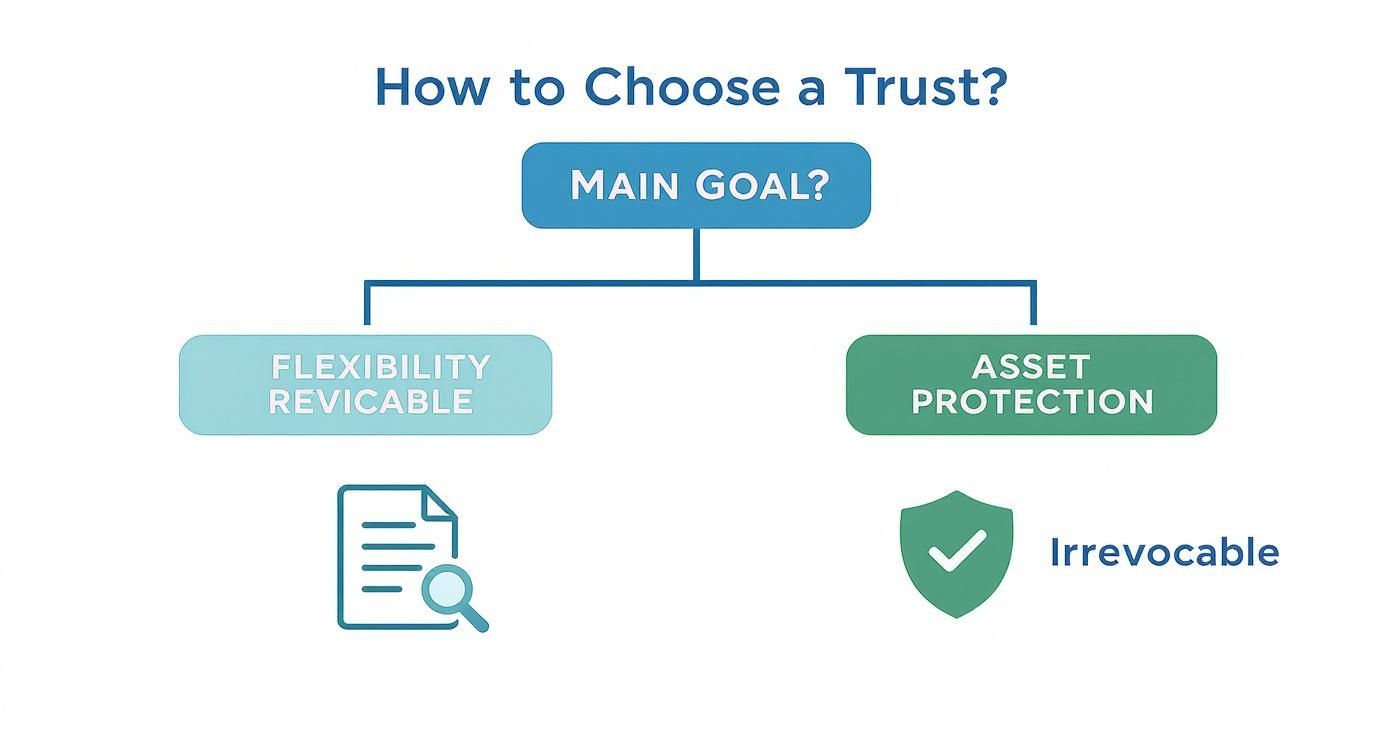
As you can see, it often comes down to this: if you need to be able to change things, a revocable trust is probably your best choice. If protecting your property is your main goal, you’ll want to look at an irrevocable trust.
Can I Have Both a Will and a Trust in Arkansas?
Yes, you can—and you definitely should. A trust is a great tool, but it only controls the things you put inside it. Anything you forget to move into the trust could be left out.
That’s where a special kind of will called a “pour-over will” comes in. Think of it as a safety net. It’s made to catch any property left outside your trust when you die and “pour” it into the trust. This simple document makes sure everything is managed under one plan and helps you avoid probate for a forgotten bank account or a car you just bought.
How Do I Put My House into a Trust in Arkansas?
Putting your house into your trust is a very important step called “funding the trust.” It means you have to legally change the owner of the property.
For a house in Arkansas, you need to sign a new deed. This new deed officially moves the house from your name to the name of your trust. For example, the title would change from “Jane Doe” to “Jane Doe, Trustee of the Jane Doe Living Trust.”
It’s not finished until the new deed is signed, notarized, and recorded with the County Clerk’s office where the house is. If you skip that last step, your house is not legally in the trust.
Is an Irrevocable Trust Really Impossible to Change?
The name “irrevocable” sounds final, and it mostly is. But, Arkansas law has a few very limited ways to make changes. This process is complicated and not something you should try to do yourself.
Changing an irrevocable trust usually requires getting everyone who benefits from it to agree, and you often need a judge’s permission from a court. It can be a long and expensive process with no promise that it will work. That’s why you should always create an irrevocable trust thinking it cannot be changed. The exceptions are rare and shouldn’t be part of your main plan.
What Happens If I Move Out of Arkansas with My Trust?
The good news is that a trust made correctly in Arkansas will almost always be accepted in other states. But that doesn’t mean you can just move and assume everything is fine.
Every state has its own laws about property, taxes, and trusts. If you move, it is very important to have a lawyer in your new state look at your trust documents. They can make sure your trust still does what you want it to and suggest any updates needed to follow the local laws.