
Think of your will as the final instruction manual you leave for your family. It’s a legal document that clearly explains what you want done with your stuff, who should be in charge of things, and most importantly, who will take care of your kids.
Why You Need a Will in Arkansas

Here in Arkansas, a lot of people think wills are only for rich or old people. That’s not true at all. A will isn’t just about money. It’s about giving your family a clear plan to follow during a very sad and difficult time.
When you die without a will, the law calls it dying intestate. If that happens, you don’t get a say in what happens next. Instead, Arkansas law steps in and makes all the decisions for you. A judge, using a set of rules, will decide who gets your house, your savings, and even your special family keepsakes.
What Happens if You Don’t Have a Will
Maybe you wanted your favorite cousin to have your video game collection or your best friend to get your cool sneakers. Without a will, the state’s plan might give those things to a relative you barely know. The law’s plan hardly ever matches what people really want, and this can lead to hurt feelings and arguments among family members.
A will puts you in charge of:
- Your Stuff: You get to decide exactly who gets what, from your house in Little Rock to your fishing gear.
- Your Kids: You can name a guardian for your children if they are under 18. This person will raise them, so it’s important to choose someone you trust. This is the biggest reason young parents need a will.
- Your Executor: You choose a person you trust to follow your instructions. This saves your family from having the court pick someone for them.
Who’s Who in a Will
The words used for wills can sound fancy, but the ideas are simple. Think of it like a list of characters in a story.
The testator is you—the person making the will. A beneficiary is anyone you name to get your stuff. The executor is your trusted helper who makes sure your wishes are followed.
These are the people who will carry out your final plan.
The truth is, most people don’t do this. A 2023 study found that only 34% of Americans have a will. That means a huge 66% of adults are letting the government make these personal choices for them. Even worse, the same study showed that 52% of people don’t even know where their parents keep their will, which makes things even more stressful for a family that is already sad.
A clear plan is about more than just stuff; it’s about making things easier for the people you love. While life insurance is a good way to leave money, it’s only one part of the plan. A will works with it to protect your family’s future. You can learn more by reading about Life Insurance Without A Will.
To see exactly how Arkansas law divides things when there’s no will, it helps to know the state’s rules. We explain it all in our guide on what happens if you die without a will in Arkansas.
Making Sure Your Arkansas Will Is Legal
You can’t just write your wishes on a piece of paper and call it a will. For your will to be a real, legal document in Arkansas, it has to follow certain rules. Think of these like the rules of a game—if you miss a step, your will could be ignored.
First, you have to be allowed to make a will. In Arkansas, this is simple. You must be at least 18 years old and “of sound mind.”
“Sound mind” just means you understand what you are doing. You know you are making a will, you have an idea of what stuff you own, and you know who your close family members are (like your spouse or kids).
The Signing Part: This is Super Important
The most important part of making your will official is how you sign it. This isn’t just a quick signature; it’s a formal event. Getting this part right is a must.
For a normal Arkansas will, the rules are very clear:
It has to be in writing. You can’t just say what you want. The whole will must be written down, which is why most are typed.
You have to sign it. As the person making the will (the “testator”), you must sign it at the very end. If you can’t physically sign, you can have someone sign for you, but they must do it while you are watching and after you’ve asked them to.
You need two witnesses. This is a big one. You have to sign your will (or tell them it’s your signature) in front of two witnesses. These witnesses cannot be people who will get anything from your will. Their only job is to watch you sign and agree that you seemed to be doing it because you wanted to.
After you sign, your witnesses also need to sign the will while you are there. The best way to do this is for everyone to be in the same room, watching each other sign. This simple step can prevent a lot of problems later.
Types of Wills in Arkansas
Not all wills are the same. Arkansas accepts a couple of different kinds, but one type is much more common and safer than the others.
Knowing the difference will help make sure your wishes are followed.
| Will Type | Arkansas Rules | Best For |
|---|---|---|
| Standard Will | Typed or printed. You sign it in front of two witnesses who don’t get anything. They also sign it. | Almost everyone. This is the safest way to make a will and the hardest one to argue against in court. |
| Holographic Will | Must be written completely in your own handwriting. You need three witnesses to later prove that the handwriting and signature are yours. | Emergencies only. This type is much easier for people to fight over in court because proving the handwriting can be hard. Think of it as a last resort, not your main plan. |
It’s important to know: a will that is partly typed and partly handwritten is not a real holographic will. For a handwritten will to count in an Arkansas court, every single word, from start to finish, has to be in your handwriting.
Naming Your Team: Executor and Guardian
Besides the legal rules, your will needs to name the people who will carry out your wishes. Two of the most important jobs are the executor of your estate and the guardian for any young children.
An executor is the person you trust to be in charge of your will after you’re gone. They will be responsible for finding all your stuff, paying your bills, and making sure your property gets to the right people. It’s a big job that requires an honest and organized person.
When you pick an executor, look for someone who is:
- Honest and responsible.
- Good at handling paperwork.
- It’s helpful if they live in Arkansas, as it can make the court process easier.
- Willing to do the job (always ask them first!).
Choosing a guardian is one of the most important choices you will make. This is the person who will raise your children if you can’t.
Don’t take this decision lightly. Your guardian should be someone who loves your kids and shares your ideas about raising them. Before you write their name down, have a serious talk with them to make sure they are ready for such a big responsibility. It’s also smart to name a backup guardian, just in case your first choice can’t do it.
Writing Your Will: What to Put In It
Okay, you know the legal rules for a will in Arkansas. Now for the fun part: actually writing it. Think of this as creating a map for your family, with each section giving clear directions for them to follow. Getting these details right now prevents a lot of confusion later.
First, you need a proper introduction. You’ll clearly state your full name, where you live (like Fayetteville, Arkansas), and say that this document is your last will. This part also needs to cancel any other wills you might have made before.
Here’s what that looks like:
“I, Jane Doe, a resident of Washington County, Arkansas, declare this to be my Last Will and Testament, and I hereby cancel all previous wills and codicils made by me.”
That one sentence is very powerful. It clears away any old plans and makes this document the only one that counts.
Naming Your Executor and Guardians
After the introduction, your first big choice is naming an executor. This is the person (or sometimes a bank) you put in charge of following your will’s instructions. It’s a huge job, so pick someone you trust completely. And always name a backup—a second choice—in case your first pick can’t do it.
If you have young kids, this next part is maybe the most important decision you’ll ever make. You need to name a guardian. This is the person who will step in to raise your kids if you are gone. Just like with the executor, it’s very important to name a backup guardian too.
The whole process has a certain order.
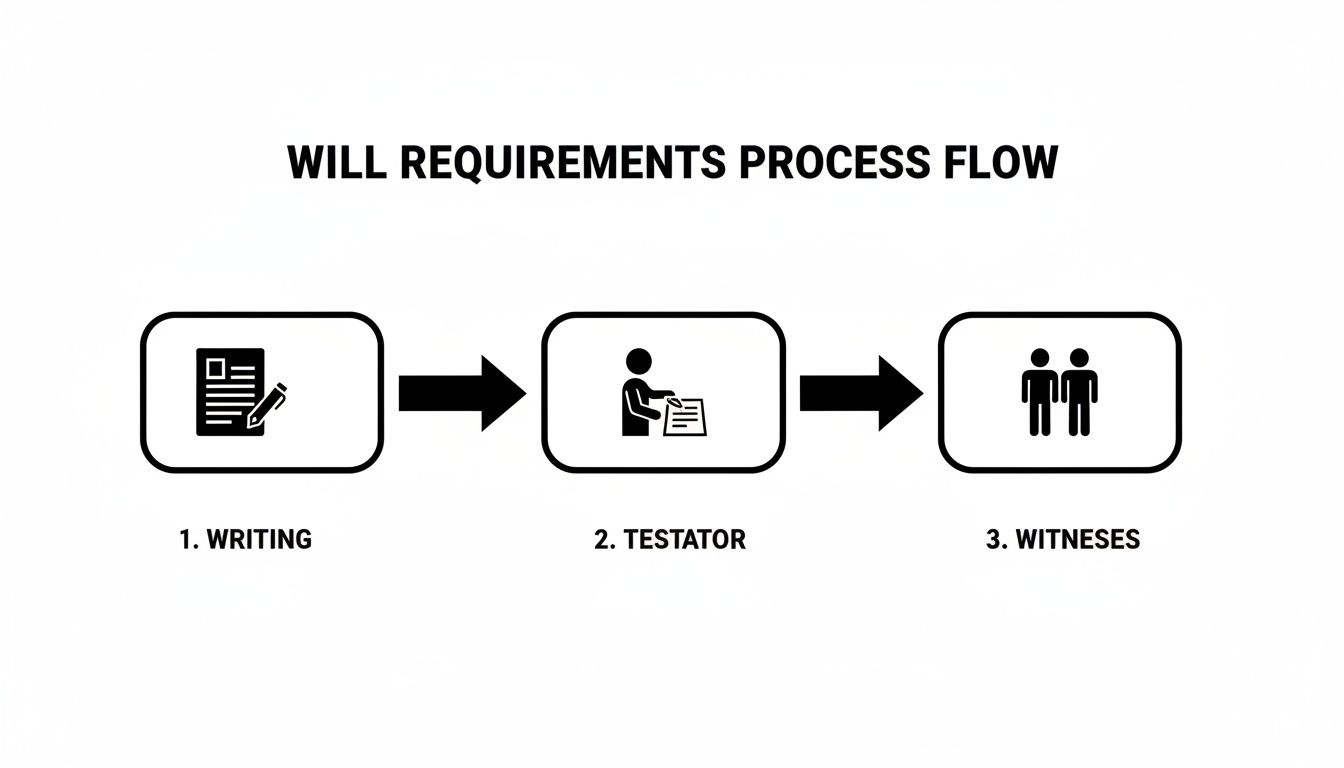
As you can see, a will isn’t just a piece of paper. It’s a formal process where you (the testator) and your witnesses work together to follow the rules.
Giving Gifts: Being Specific
Now we get to the part everyone thinks about: who gets what. The gifts you leave in a will are called “bequests.” A specific bequest is when you leave one particular item to one particular person.
Don’t be afraid to be very clear here. For example:
- “I give my 2022 Ford F-150 to my brother, John Smith.”
- “I give my collection of comic books to my niece, Emily Jones.”
- “I give my grandma’s diamond ring to my daughter, Sarah Doe.”
The most important thing is to be clear. Unclear descriptions like “my favorite chair” or “my cousin” can cause big fights. The more specific you are, the less chance there is for arguments.
Covering Everything Else: The “Rest” of Your Stuff
So what about all the things you didn’t list one by one? This is where the most important part of your will comes in: the residuary clause. Think of it as a giant safety net that catches everything else you own—the “residue.”
This includes stuff you forgot to list, things you buy after you sign the will, or even gifts that can’t be given because the person you named has already passed away.
A typical residuary clause might say:
“I give all the rest of my property, whatever it is and wherever it is, to my spouse, Robert Doe. If my spouse does not survive me, I give everything to my children, in equal shares.”
Without this part, anything left over is divided up using Arkansas’s laws, which probably won’t be what you wanted. This part is a must-have in a good will.
Thinking About Special Situations
Your life is unique, and your will can be too. You might need special rules for certain situations. For example, if you have young kids, you probably don’t want them to get a lot of money when they turn 18. You can set up a trust in your will so that a grown-up manages the money for them until they are a little older, like 21 or 25.
And don’t forget your pets! More and more people are making plans for them. Today, 77% of pet owners in the US include their pets in their plans. The recent COVID-19 pandemic even pushed 32% of people under 35 to finally make a will, showing that more people are thinking about planning for the unexpected.
Making a will means making a bunch of small but very important decisions. If you want to learn more, this guide on how to write a will is a great place to look. By thinking through each of these parts, you’re not just making a legal document—you’re creating peace of mind for yourself and for the people you love.
Common Mistakes People Make with Arkansas Wills
Writing a will is one of the kindest things you can do for your family, but it’s very easy to make a small mistake that causes big problems. A simple error can even cause a judge to throw out your entire will. Here in Arkansas, we’ve seen how tiny mistakes can lead to confusion, family fights, and extra costs.
Think of it like building with LEGOs. If you miss one important piece at the bottom, the whole thing you built can get wobbly and fall apart. Your will is the same way; every detail has to be right.
The Problem with Unclear Words
One of the most common problems we see is language that is not clear enough. Your will needs to be super clear, with no room for guessing. When it comes to planning, unclear words are your worst enemy because they just invite arguments.
Here are some phrases that cause problems:
- “I leave some money to my cousin, Bill.” (How much is “some”? It could be $100 or $100,000. This forces your family to argue about it.)
- “I want my kids to share my tools.” (Which kids? All of them? What if one wants to sell them and the other wants to keep them? This makes them argue with each other.)
- “I give my favorite car to my nephew.” (What if you own two cars? What if you sell that “favorite” car and buy a new one before you pass away?)
The fix is easy: be super specific. Name the exact item, use the person’s full name, and describe things so that no one can possibly get them mixed up.
Forgetting About the “Rest” of Your Stuff
So you’ve carefully listed who gets your house, your car, and your savings account. Great. But what about the furniture in the house? The money in your checking account? The lawnmower in the garage? This is where the residuary clause comes in. It’s the part of the will that deals with the “rest” of your stuff, and it’s very important.
Forgetting this part is like packing for a trip and only remembering your shirt and pants, but forgetting your socks, shoes, and toothbrush. It leaves a big, unplanned hole. If you don’t name someone to get the rest of your property, Arkansas law will decide for you, and its rules probably won’t match what you wanted.
A will without a residuary clause is an incomplete will. It’s one of the most important safety nets in the document, making sure every single thing you own goes where you want it to.
Messing Up the Signing
The signing process isn’t just paperwork; it’s a strict legal event. In Arkansas, your will must be signed in front of two witnesses who get nothing from your will. A common—and very bad—mistake is having witnesses sign the will later or in a different room.
For the signing to be legal, everyone—you and both witnesses—must be in the same room, at the same time, watching each other sign. If your witnesses weren’t there to see you sign, a court could easily say your entire will doesn’t count. It’s such a simple rule, but not following it can undo all of your hard work.
Not Updating Your Will After Big Life Changes
Your will isn’t something you do once and forget about. Life happens, and your will needs to change with it. When people forget to update their will after a big life event, it can lead to results they never wanted.
You should definitely look at your will again if you:
- Get married or divorced. This is a huge one. Either event completely changes your family and legal situation.
- Have or adopt a child. You’ll need to name a guardian and add your new child to the will.
- Someone in your will dies. If a person you named in your will passes away before you, you need to decide where their share should go instead.
- Have a big change in your stuff. Did you buy a house, sell a business, or get a lot of money? Your will needs to show your new financial situation.
Let’s look at a real example. Imagine Sarah from Springdale gets divorced but never updates the will she wrote when she was married. In Arkansas, a divorce usually cancels any gifts to an ex-spouse in a will. That’s good. But what if her life insurance or 401(k) retirement plan still lists her ex-husband as the person to receive the money? Those plans often ignore the will, meaning a lot of her money could go to the one person she no longer wanted to have it. Regular updates stop these kinds of sad and avoidable mistakes.
What to Do After Your Will Is Signed

You did it. Signing your will is a huge step that helps protect your family’s future. But don’t stop just yet. What you do next is just as important as writing the will itself.
The first thing to do is put the original, signed will somewhere safe where it can also be found. Your executor will need the original document—not a copy—to follow your wishes. Hiding it too well is a common mistake. If no one can find it when they need it, it’s almost like it was never made.
Safe Places to Keep Your Will
So, where should you keep it? You have a few good choices. Many people think of a safe deposit box at a bank. It sounds perfect—safe from fire or theft—but it can cause big problems for your family.
In Arkansas, banks often lock a safe deposit box when the owner dies. Your family might need to get an order from a judge just to open it, which causes delays and stress. A good fireproof safe at home is often a much better choice, as long as your executor knows where it is and has the combination. You can also ask your lawyer to store the original for you, which keeps it safe and makes sure it can be found when needed.
When to Look at and Update Your Will
Think of your will as a living document, not a one-time chore. Life changes, and your will should change with it. We always tell people to read it over every three to five years, or whenever something big happens in their life.
Think of these events as a reminder to check your will:
- Getting married or divorced.
- The birth of a child or grandchild.
- The death of a person named in your will or your executor.
- Buying something big, like a new house.
- Any major change in your money situation.
Not updating a will is a big mistake. It’s surprising, but numbers show only 23% of people update their will after a big life event like a marriage or birth. Worse, a shocking 43% of Americans over 55 still don’t have a will at all. This is happening at a time when older people are expected to pass on about $36 trillion to the next generation over the next 30 years. You can see how important planning has become by looking at recent market growth data.
What “Probate” Means in Arkansas
Finally, let’s talk about what happens after you’re gone. This is where a legal process called probate begins. In simple terms, probate is the court’s way of checking that your will is real and giving your executor the okay to handle your property.
Probate is the court process for finding and gathering the property of a person who has died, paying their debts, and giving the property to the people named in the will. Basically, it’s how your will gets “turned on.”
The word “probate” scares a lot of people, but it doesn’t have to be a bad thing. In some states, it can take a long time, but probate in Arkansas is usually pretty simple, especially if you have a clear, well-written will. Your will becomes the instruction book for the court, which makes everything easier and less stressful for your family.
Answering Your Questions About Arkansas Wills
Even after learning the steps for making a will, it’s normal to still have questions. This is a big deal, and getting clear answers is the best way to feel good about your plan.
Let’s answer some of the most common questions we hear from people right here in Arkansas.
How Much Does a Will Cost in Arkansas?
This is usually the first thing people ask, and the honest answer is: it depends. The cost changes based on how you do it. You’ve probably seen do-it-yourself forms online for just a few dollars. While that low price is nice, it can be a risky choice.
Those one-size-fits-all forms often miss the details of Arkansas law and can’t know about your unique family. A small mistake on a cheap form could cause big problems later, possibly leading a court to throw out your will and starting expensive legal fights for your family.
Hiring a good lawyer will cost more at the start. But what you’re really paying for is expert help and peace of mind. It’s an investment to make sure your final wishes are actually followed, protecting the people you love from arguments when they are already sad.
Do I Need a Lawyer to Make My Will?
The short answer is no. Arkansas law doesn’t say you have to use a lawyer to write your will. But just because you can do it yourself doesn’t always mean you should.
The legal rules for a will are very strict. It’s easy to make a small mistake—like using a witness who will get something from the will or not signing it in the right way—that could let someone challenge your will later. A lawyer’s job is to make sure every single state rule is followed perfectly, building a legal document that is as strong as possible.
A lawyer does more than just write down what you want; they make sure the will can hold up in court if someone argues against it. This is extra important if you have a mixed family, own a lot of property, or have special instructions.
What Happens If I Die Without a Will?
If you die in Arkansas without a legal will, you lose your right to decide who gets your stuff. The state takes over and makes those choices for you based on its intestacy laws. A judge will hand out your property using a strict, set formula.
This formula almost never matches what people would have wanted. For example, it gives nothing to a partner you weren’t married to and often leaves out stepchildren. Your property could end up going to a distant cousin you haven’t seen in 20 years, just because that’s what the law says.
Without a will, you lose your voice. The state gets the last word.
Can I Leave Someone Out of My Will?
This is a hard question, but some families need to ask it. In Arkansas, you usually have the right to leave a child out of your will. To do this, your will must say so very clearly, so a court can’t think it was a mistake.
It is much harder to leave out your spouse. Arkansas law protects a surviving spouse, giving them the right to a certain part of your property, no matter what your will says. This is a very tricky part of the law, and trying to handle it on your own can go wrong.
If you are thinking about leaving someone out of your will, getting advice from a lawyer isn’t just a good idea—it’s the only way to make sure your wishes can be followed legally.