
When someone you know passes away, you might be given their will. Looking at it for the first time can feel like trying to read a different language. It has a lot of fancy legal words and looks very formal. This can be tough, especially when you’re already feeling sad.
But don’t worry. You don’t need to be a lawyer to figure out what it says. Let’s break it down step-by-step.
Your First Look at the Will
Think of this first look like checking the cover of a book before you start reading. Before you get to the part about who gets what, you need to make sure you have the right paper and know who the main people are.

This first step is just about getting your bearings. You’re looking for a few important clues, usually right on the first page.
Finding the Important First Details
Look over the document for three key things:
- The Testator’s Name: The testator is the person who made the will. Is the name on the will the same as the person who passed away? This sounds simple, but it’s the most important first check.
- The Date It Was Signed: This is a very big deal. People sometimes make more than one will in their life. The will with the newest date is the one that counts. It cancels out any older ones.
- The Executor’s Name: The executor is the person chosen to make sure the will’s instructions are followed. Finding this name tells you who is in charge of handling everything.
Finding these three things helps you know what’s going on. For example, if you find a will in a desk in Fayetteville, these details tell you if it’s for the right person and who is supposed to take care of things.
It’s okay to feel confused by the legal words. Just start with the simple things. Find the date to make sure you have the final will, and look for the person’s signature. In Arkansas, that signature must have been seen by two other people.
Who Are All These People?
Every will has a few key people. Once you know their roles, the rest of the will is easier to understand. You don’t have to memorize a bunch of legal words, just learn what each person’s job is.
Think of it like a school play. The testator is the person who wrote the play. The executor is the director who makes sure the actors do what the script says. The beneficiaries are the people in the audience who get to enjoy the show.
Let’s look at who these people are. Figuring this out now will help you avoid confusion later.
Key People Mentioned in a Will
Here are the main roles you will find in a will, explained in simple terms.
| Role | Who They Are | What They Do |
|---|---|---|
| Testator | The person who made the will. | This is the person who has passed away. The will explains what they wanted to happen with their things. |
| Executor | The person in charge. | They are responsible for paying any bills and giving out the property and money as the will says. |
| Beneficiary | A person who gets something. | This is anyone named in the will to receive property, money, or other things from the testator. |
| Guardian | A person who cares for kids. | If the testator had children under 18, the will often names a guardian to take care of them. |
Knowing who does what is the first step to understanding the rest of the will.
Finding the Most Important Instructions
Okay, you know who everyone is—the testator, the executor, and the beneficiaries. Now it’s time to get to the main part: the instructions for what happens to the person’s stuff. This is where the will says who gets what.

Think of this part like a treasure map that shows where everything goes. Reading it carefully will tell you exactly what your loved one wanted.
Finding Specific Gifts
Most wills start by giving away specific things or amounts of money. These are called specific gifts. You’re looking for sentences that name an item and the person who gets it.
For someone living in Arkansas, you might see things like:
- “I give my farm in Bentonville, Arkansas, to my son, John Doe.”
- “I give my house at 123 Main Street, Rogers, Arkansas, to my daughter, Jane Smith.”
- “I give $10,000 to my nephew, Michael Jones.”
These sentences are usually very clear. As you find them, it’s a good idea to write them down. Note the item, who gets it, and any special rules.
You might also see something called a demonstrative gift. This is a gift of money from a specific place. For example, “I give $5,000 from my savings account at Arvest Bank to my sister, Emily.” It’s a little different because it names where the money should come from.
The “Everything Else” Clause
So, what happens to everything that isn’t specifically named in the will? That’s where the residuary clause comes in. You can think of it as the “everything else” part of the will. It’s one of the most important parts.
This part usually starts with words like, “I give all the rest, residue, and remainder of my estate…” It’s a safety net that covers any property the person forgot to mention. It also covers gifts that can’t be given, like if a beneficiary passed away before the testator.
The residuary clause makes sure nothing is left out. Without it, any leftover things might be given out based on state law, as if there was no will at all. This might not be what the person wanted.
For instance, if the will gives a car to a nephew and a house to a niece but doesn’t say anything about bank accounts, the residuary clause decides who gets that money.
What if a Gifted Item Is Gone?
I get this question a lot: what if something mentioned in the will wasn’t owned by the person when they died? Let’s say the will says, “I give my 2022 Ford F-150 to my brother,” but the person sold that truck last year.
In Arkansas, this is called ademption. Basically, it means if the specific item is gone, the gift is gone too. The brother doesn’t get money for the truck or a new truck instead. The gift is just cancelled, and the will is read as if that part was never written.
Knowing this rule can prevent a lot of arguments. The executor’s job is to give out what the person owned when they died, not what they owned when they wrote the will.
Is This Will even Legal in Arkansas?
Just because a paper says “Last Will and Testament” at the top doesn’t mean a court will accept it. For a will to be real, it has to follow very specific rules from Arkansas law. It’s like checking the foundation of a house—if it’s weak, the whole house could fall.
You don’t need to be a lawyer to do a quick check. You are just looking for the right signatures that make the will legal.
Finding the Right Signatures
This is the most important part. A normal, typed will in Arkansas is only good if it has the right signatures.
Here’s what to look for:
- The Testator’s Signature: The person who made the will (the testator) must have signed it. This signature is usually at the very end.
- Two Witness Signatures: This is a big one. At least two other people had to watch the testator sign the will and then sign it themselves. The most important rule here is that these witnesses cannot be people who get anything in the will.
This two-witness rule is there to help prove that the testator was thinking clearly and wasn’t forced to sign. I’ve seen cases where a family in Springdale finds two different wills; the one with the correct signatures is almost always the one the court will use.
The Self-Proving Affidavit: A Huge Time-Saver
Now, look for an extra page, often at the very back. This is called a self-proving affidavit, and it makes the court process much easier. It’s a separate page that the testator and the two witnesses all signed in front of a notary public (a person who can officially verify signatures).
A self-proving affidavit is like a will’s fast pass for court. It lets a judge accept the will without having to find the original witnesses to come to court and say they saw it being signed. This can save a lot of time.
For families in Rogers and Springdale, one of the first things I check is if the will was signed correctly. Arkansas Code § 28-25-102 says the testator must sign it with two witnesses present. A self-proving affidavit can speed up the court process a lot. For a deeper dive, see our guide on the legal requirements for a last will and testament.
Looking for Changes and Handwritten Wills
Sometimes, people make a small change to their will without writing a whole new one. This change is called a codicil. A codicil might add a new grandchild to the will or change who the executor is. Just like the will, a codicil must be signed and witnessed in the exact same way.
Finally, Arkansas has a special rule for holographic wills.
- What is it? A will written completely in the testator’s own handwriting, from start to finish.
- What makes it special? As long as you can prove the entire will and the signature are in the testator’s handwriting, it does not need any witnesses to be a legal will in Arkansas.
This is a very important rule to remember. If you find a handwritten paper that looks like a will but has no witness signatures, don’t throw it away. If it’s all in the person’s handwriting, a court in Arkansas might say it’s their real will.
Understanding the Words and Spotting Problems
Once you’ve checked the signatures, the next step is to understand what the will actually says. Legal papers can seem like they are written in a secret code, but you can figure it out.
At the same time, keep an eye out for anything that seems weird. Finding possible problems early can prevent family fights later on.
Turning “Lawyer-Speak” into Plain English
Wills often use special legal words that have very important meanings. When you see a word you don’t know, don’t just skip over it. Understanding these words is key.
Here are some of the common legal words you might see in an Arkansas will and what they mean.
Common Legal Terms in Arkansas Wills
A quick guide to confusing legal words you might see and what they mean in simple terms.
| Legal Term | What It Means for You |
|---|---|
| Testator | The person who wrote the will. |
| Executor | The person or bank named in the will to follow its instructions. They are the manager of the estate. |
| Beneficiary | Anyone who will get property or money from the will. |
| Per Stirpes | A Latin term that means “by branch.” If a beneficiary has died, their share goes to their children. It keeps the gift in that family line. |
| In Terrorem Clause | This is a “no-contest” rule. It says that if a beneficiary challenges the will in court and loses, they get nothing. It’s meant to stop people from suing. |
| Codicil | A separate legal paper that changes or adds to a will. Think of it like a P.S. note for the will. |
Knowing what these words mean is a big help. For example, it’s important to know what an executor does. A common question is, Can an executor change a will? The answer is no. Their job is to follow the will exactly as it was written, not to change it.
What if the Will Mentions a Trust?
Sometimes, you might read a sentence like, “I give my rental properties to the Smith Family Trust.” This means the will isn’t the last word on that property.
A trust is like a separate legal box that holds things for people. The will’s job is just to put the property into that box. To find out what happens next, you need to find the separate trust document. The trust will have its own set of rules for how to handle the property.
Think of it like this: the will is the delivery truck, and the trust is the storage building with its own manager and set of instructions.
Checking for Possible Problems
As you read the will, trust your gut. If something feels wrong, it’s probably worth a closer look. Here are some common red flags that could mean there’s a problem.
A will should be the clear, final wish of the person who wrote it—made without anyone forcing them. If it seems like that didn’t happen, it’s a serious problem.
Watch out for these warning signs:
- Strange Last-Minute Changes: Was the will changed just days before the person died, especially when they were sick? A big, sudden change could mean someone took advantage of them.
- Surprising Beneficiaries: Does a new friend, a helper, or a distant family member suddenly get a lot of money, while close family gets very little? For example, if a will from someone in Lowell suddenly leaves out their children, you should ask why.
- A Messy Document: Are there words crossed out, different color inks on the signature page, or pages that look like they were added later? A real will should look clean and be the same from start to finish.
- Leaving Out Close Family: A person can choose to leave someone out of their will. But if a spouse or child is left out for no reason, it is a major red flag. This can be a sign of undue influence, which means someone may have pressured the person into changing their will.
Finding these problems doesn’t mean the will is automatically bad. But it does mean you need to be very careful. This is when getting advice from a lawyer is a very good idea to protect the person’s true wishes and your family’s rights.
What to Do After You Understand the Will
Okay, you’ve read the will. You know who gets what and who is in charge. That’s a huge step, but you’re not done yet. Now it’s time to move from reading to doing. This is where the real work starts.
Your first job is simple but very important: keep the original will in a safe place. I can’t say this enough. The court needs the original document, not a copy. A bank’s safe deposit box or a fireproof box at home are good places. Protect it.
Telling the Right People
Once the will is safe, you need to start telling people. The executor must let all the beneficiaries named in the will know about it. You also need to tell any legal heirs—the people who would have gotten things if there was no will.
This isn’t just to be nice; it’s the law. A formal letter is good, but a clear phone call can also work. Talking to everyone at the start helps them know what to expect and that the process has begun.
A big part of this is understanding the executor’s responsibilities, because their job is to make sure everything moves forward correctly.
Starting the Court Process in Northwest Arkansas
The official court process to approve the will and give out the property is called probate. In Arkansas, the executor has to file the will with the circuit court in the county where the person lived.
For people here in Northwest Arkansas, that means going to the courthouse in Fayetteville (for Washington County) or Bentonville (for Benton County).
- How Long You Have to File: Arkansas law gives you five years from the date of death to start the probate process. But you should not wait that long. The sooner you start, the sooner everything can be finished. Try to file within a few weeks or a couple of months.
- What Happens: You’ll start by filing papers to open the case and giving the court the original will. The court then officially names the executor, giving them the legal power to handle the person’s money and property.
As you get ready for this, remember any problems you saw when reading the will. Things like last-minute changes or signs someone was forced to sign can mean trouble ahead.
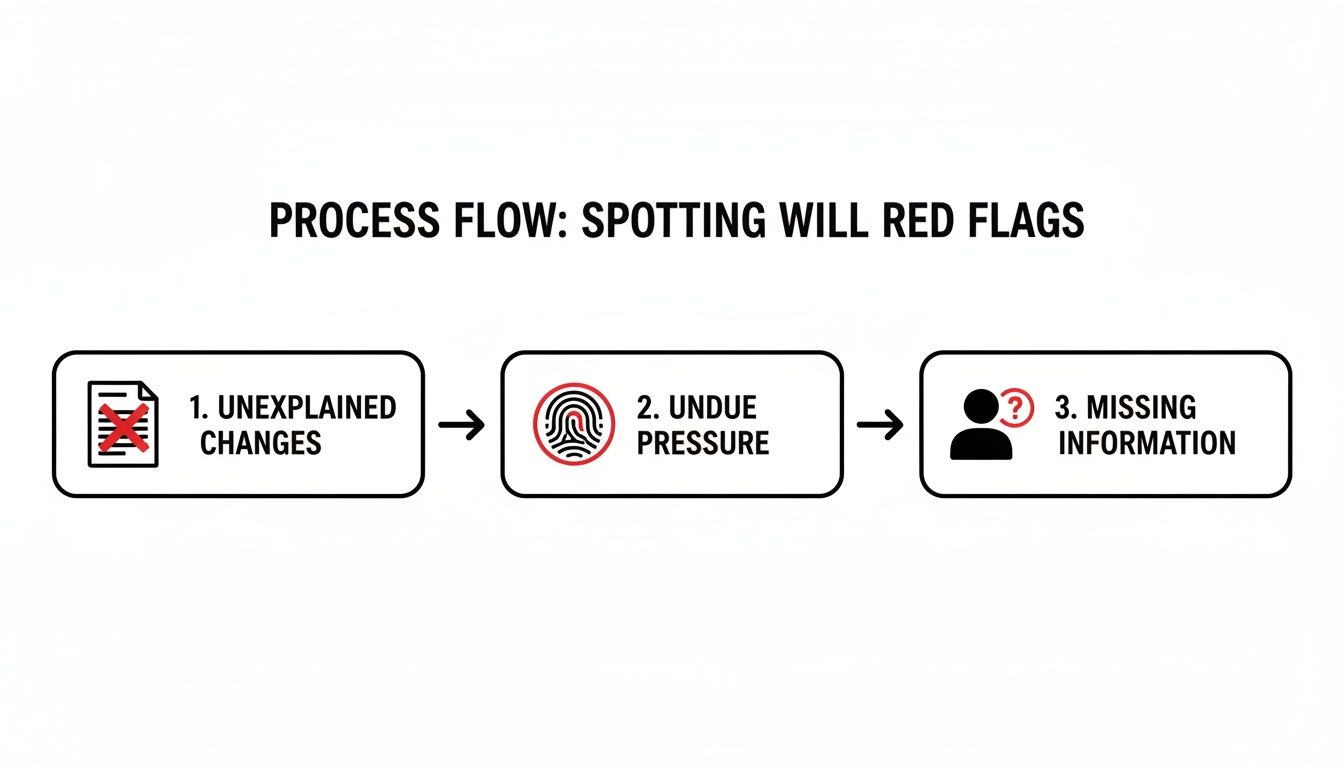
Finding these red flags early helps you get ready for problems, like someone trying to fight the will in court.
The Most Important Rule: Do Not Give Anything Away Yet
Let me be very clear about this: do not give away any money or property until the court says it’s okay. It doesn’t matter if the will says your cousin gets the old car or your sister gets the family dishes.
Giving away things before the probate court says you can is one of the biggest and most costly mistakes an executor can make. If there are bills to pay, you could end up having to pay for the items you gave away with your own money.
Think of all the person’s property as being frozen for a while. The executor’s first job is to pay the person’s final taxes, bills, and other debts using money from the estate. Only after all the bills are paid can the rest of the property be given to the beneficiaries. And you can only do that when the court gives the final okay. This protects you, the people who are owed money, and the beneficiaries.
Common Questions About Reading a Will
Even after you’ve read a will carefully, it’s normal to still have questions. The whole process can feel like a lot to handle, and every family’s situation is different. Here are answers to some of the questions we hear most often from people in Arkansas.
What Happens if We Cannot Find the Original Will?
This happens more than you might think. If the original, signed will is lost, Arkansas law usually assumes the person who made it (the testator) destroyed it on purpose to cancel it. This can cause a big problem.
But don’t give up. If you have a copy, you might be able to get the court to accept it. It can be hard, though. You will need to show the judge two things:
- The testator did not mean to cancel the original will.
- The copy you have is a perfect copy of the original.
To prove this, you may need to find the people who witnessed the will and have them tell the court what they remember. For example, if the original will was lost in a fire, proof of the fire could help you show the judge it wasn’t destroyed on purpose.
Can a Will Be Changed After Someone Dies?
Let me be very clear on this: No, a will cannot be changed after the person who wrote it has passed away. The will is a final set of instructions that are locked in. The executor’s job is to follow those instructions exactly—not to change them because it seems more “fair” or because the family wants something different.
A will is like a sealed letter of orders. The executor’s job is to follow those orders, not to rewrite them. Trying to change a will after death is not allowed and a court will not accept it.
What if the Named Executor Does Not Want the Job?
Being an executor is a big job, and not everyone wants to do it. If the person named in the will decides they don’t want the role, they can say “no” by filing a paper with the court.
So, what happens then? Many wills name a backup person, called a successor executor, to take over. If there is a backup named, that person can ask the court to let them be the executor.
If the will does not name a backup, the court will have to choose someone. This is often one of the main beneficiaries who asks to do the job, or another person who is able and willing to do it.
What Are a Beneficiary’s Basic Rights?
If you are named as a beneficiary in an Arkansas will, you have certain legal rights to protect you. These rights help make sure the executor does their job right and that you get what you are supposed to get.
Your basic rights include:
- The Right to Be Told: You must be officially told that the probate case has started and that you are a beneficiary.
- The Right to Information: You have the right to get a copy of the will. You can also ask for a list of all the property and money and, later, reports that show how money is being used.
- The Right to Get Your Gift in a Reasonable Time: Probate takes time, but you have the right to get your gift in a reasonable amount of time after all the bills and taxes have been paid.
Just knowing your rights can help you feel better. Understanding what you are entitled to is the first step in making sure everything is handled fairly.