
If you want to protect your family from a legal mess after you’re gone, your best bet is using a few smart estate planning tools. Things like living trusts, property deeds that transfer on death, and beneficiary forms are the keys to keeping your things out of court. This is how you sidestep the probate nightmares I see all too often in Arkansas.
What Is Probate and Why You Should Avoid It
Think of probate as the court’s way of sorting out a person’s stuff after they pass away. In Arkansas, it’s the official process for checking if a will is real, paying off any final bills, and then giving what’s left to the right family members. It sounds simple, but it is often a slow, public, and surprisingly expensive process.
This isn’t a rare problem; it’s what happens to most families. Nationally, about 2.6 million probate cases are filed every year. The costs can be very high, sometimes using up as much as 10% of everything a person owned. To learn more about how probate works and what you can do about it, exploring different strategies for efficient estate distribution is a great next step.
A Real-World Probate Story
Let me tell you about a family I knew from Fayetteville. Their dad passed away with what everyone thought was a simple will. They figured it would be a quick process. They were wrong.
What seemed “simple” quickly got stuck in the local court system for over a year. Suddenly, they had to hire a lawyer, put legal notices in the newspaper, and get a judge’s permission for every little thing. The long delay caused a lot of stress and thousands of dollars in legal bills they didn’t expect—money that was supposed to go to the kids.
The picture below shows the kind of emotional and money troubles that families can face when they get caught up in the probate system.
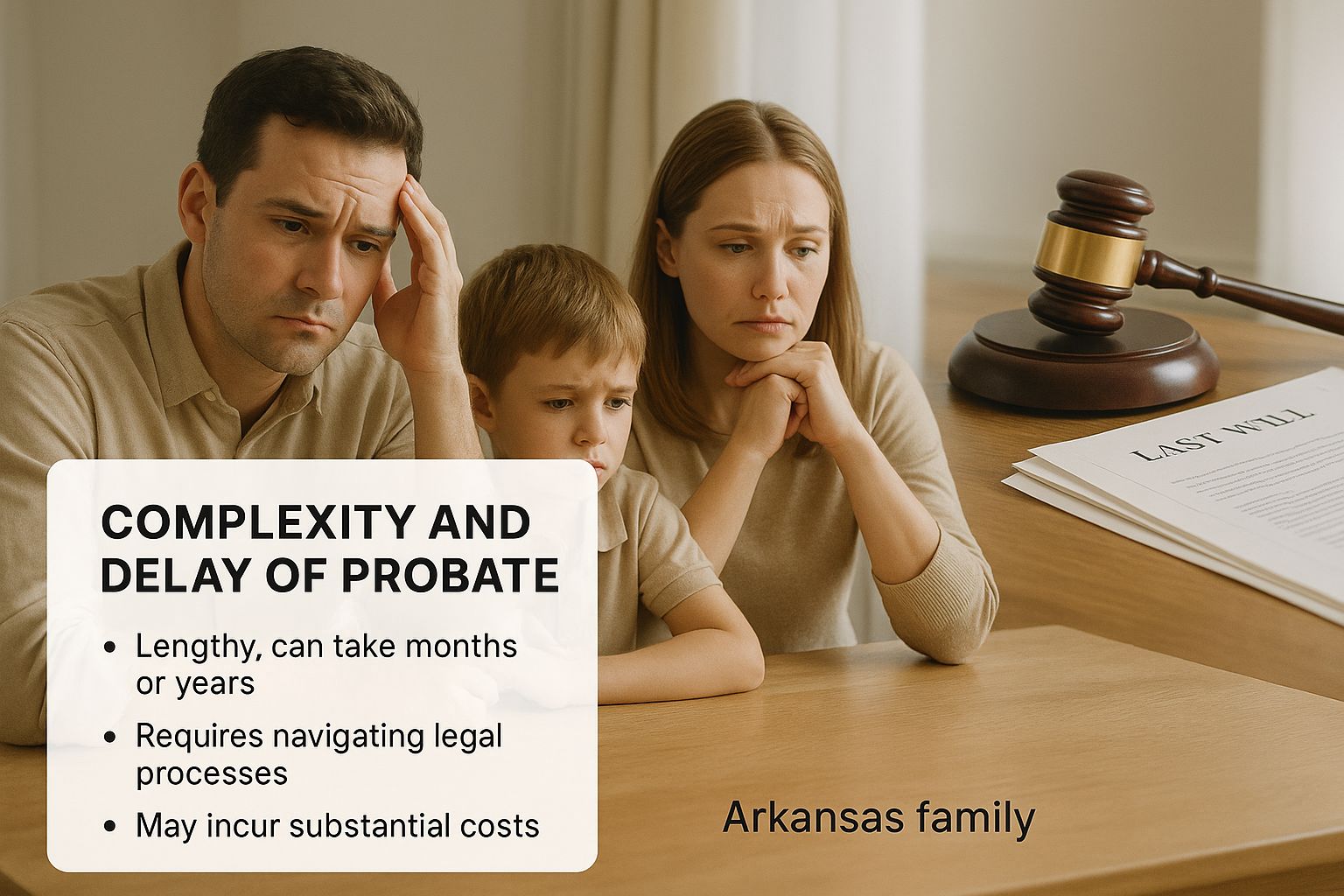
This image shows how so many Arkansas families feel—completely overwhelmed by a confusing legal process at the worst possible time.
Top Reasons to Avoid Probate
When I talk to people, their reasons for wanting to avoid probate usually come down to three big issues:
- Time: The probate process in Arkansas can drag on for six months, a year, or even longer if there are any problems. While the court is involved, your property is basically frozen, leaving your family waiting.
- Cost: The expenses add up fast. You’re looking at court fees, fees for the person in charge, and of course, lawyer costs. All of these bills are paid from the property, which means there’s less left for your loved ones.
- Privacy (or lack of it): Probate is a public process. Every paper filed with the court is a public record. That means anyone can go to the courthouse and see the details of your will, your property, your debts, and who got what.
Let’s look at the differences side-by-side.
Probate vs No Probate at a Glance
This table shows the key differences between an estate that goes through probate and one that avoids it, focusing on what matters most to families.
| Feature | Estate With Probate | Estate That Avoids Probate |
|---|---|---|
| Control | The court is in charge; a judge oversees every step. | You and your chosen family members are in control. |
| Timeline | 6 months to 2+ years; property is frozen during this time. | Immediate or very quick; property transfers in days or weeks. |
| Cost | Can cost 3% to 10% of the estate’s value in fees and expenses. | Very small costs; often a tiny fraction of what probate costs. |
| Privacy | Public record; anyone can see your will and what you owned. | Completely private; details are kept within the family. |
| Potential for Fights | Higher; being public can invite challenges from bill collectors or relatives. | Lower; disagreements are handled privately without court. |
As you can see, the benefits of planning to avoid probate are huge, giving peace of mind to both you and your family.
By understanding what probate is and the headaches it causes, you can see why taking steps to avoid it is one of the greatest gifts you can give your family. It’s about making sure the things you leave behind are passed on quickly and privately.
Keep Your Estate Out of the Public Eye with a Living Trust

If the thought of your family’s money matters becoming public during probate makes you uncomfortable, you’re not alone. This is a big reason why many people choose a revocable living trust.
Basically, a trust is like a private rulebook for your property. A will is a public document that has to go through the court. A trust, on the other hand, lets the person you choose manage and give out your property privately. This saves everyone a ton of time, stress, and money.
A living trust is one of the best ways to manage your property and skip the entire probate process. It makes things much simpler for your loved ones, especially when they have to do big tasks like selling a house held in a trust after death.
How Does a Living Trust Actually Work?
Think of creating a trust like building a private, safe box for your property. You, the grantor, create the trust and pick a trustee to manage everything inside it.
Here’s the best part: while you’re alive and well, you are usually your own trustee. This means you stay in 100% control. You can sell your home, move your money, or even get rid of the trust completely if you change your mind. Nothing is locked away from you.
The real power of a trust comes when you “fund” it. Funding the trust is just the legal step of changing the title of your property from your name to the name of the trust.
Things you would typically move into your trust include:
- Real Estate: Your home, vacation houses, and rental properties.
- Bank Accounts: Checking, savings, and money market accounts.
- Investments: Stocks, bonds, and other investments that are not in a retirement account.
- Business Ownership: Your share of a small business.
Once something is in the trust, it’s no longer part of your “probate estate.” That’s the secret. When you pass away, the person you named as the successor trustee—usually a trusted family member—takes over. They simply follow the private rules you wrote in the trust to give out your property, with no court approval needed.
A Real-World Scenario
Let’s look at a couple from Bentonville, Sarah and Tom. They set up a living trust and put their house, a savings account, and their investments into it. They name their daughter, Emily, as the successor trustee.
When Sarah and Tom are gone, Emily doesn’t have to go to court or wait for a judge’s permission. She uses the trust document as her guide to pay any final bills and then transfers the house and other property directly to herself and her brother, just like her parents wanted. The whole thing is finished in a few weeks, not years, and the family’s privacy is kept safe.
It’s a common myth that trusts are only for very rich people. In reality, a living trust is a very useful tool for any Arkansas family who owns a home and wants to make sure their property gets to their loved ones without the delay and publicity of probate court.
While a trust is a great tool for privacy and speed, it does a different job than a will. To get a clearer idea, check out this guide on the main differences between a living trust vs a will and see what makes the most sense for you.
Smart Ways to Title Property and Bank Accounts

You might be surprised to learn that one of the easiest ways to avoid probate headaches has nothing to do with a fancy will or trust. It often comes down to the specific words on the deed to your house or the paperwork for your bank account.
Here in Arkansas, there are a few simple ways to do this right now. These easy ways of titling property make sure your things go directly to your loved ones, keeping them far away from a courtroom.
It’s easy to put this stuff off. In fact, over 40% of Americans who don’t have a will say they just “haven’t gotten around to it.” Others think they don’t have enough stuff to worry about or think it’s too expensive. If that sounds like you, it’s worth learning about why people delay planning and how to get past those roadblocks.
Make Your Property Transfer Automatic with a TOD Deed
When it comes to your house, one of the best tools we have in Arkansas is a Transfer-on-Death (TOD) deed, which is sometimes also called a “beneficiary deed.” The idea is very simple.
You sign a deed today that names who you want to get your house when you pass away. You file it with your County Clerk, but nothing actually changes while you are alive. You still own your home completely. You can sell it, mortgage it, or change your mind and cancel the TOD deed. The person you named as the beneficiary has no rights to it at all until after you pass.
When you do pass away, the person you named on the deed automatically becomes the new owner.
That’s it. Probate is completely bypassed. No court papers, no long delays, and no public record of the transfer. It is a simple and powerful way to make sure your home goes to who you want without any court hassle.
A TOD deed acts like a direct command, telling the legal system exactly where the property should go, no questions asked. It’s a great way to give immediate security to your family.
Use POD and TOD to Keep Accounts Out of Court
This same “automatic transfer” idea works for your money, too. Banks and investment companies offer simple forms that can turn your accounts into non-probate property.
The two you’ll see most often in Arkansas are:
- Payable-on-Death (POD): This is for bank accounts—like checking and savings. You just fill out a quick form at your bank to name a beneficiary.
- Transfer-on-Death (TOD): This is the version for investment accounts, like stocks and bonds. It works the exact same way.
The key thing to remember is that the money is 100% yours while you’re alive. You can spend it, move it, or close the account whenever you want. The person you name has no access or rights to the money until after you’re gone.
Let’s say a grandparent in Springdale has a savings account they want their grandchild to have for college. They can go to the bank and add the grandchild as the POD beneficiary. When the grandparent passes, the grandchild can get the money directly from the bank, usually just by showing a death certificate and their ID. The whole probate process is avoided. It really is that easy.
Unlocking the Power of Beneficiary Designations
You might be surprised to learn that some of your most valuable property already has a built-in “get out of probate free” card. I’m talking about things like your life insurance policy, your 401(k), or your IRA. The magic key here is the beneficiary designation.
This is simply the form you fill out telling the bank or insurance company who gets the money when you’re gone. It acts as a direct instruction to transfer the money on your death, skipping your will and the entire court probate process. Your loved one can usually get the money directly, often with just a death certificate and some paperwork.
Why These Forms Are So Important to Keep Updated
It sounds simple, but here’s where things can go terribly wrong. Life happens—you might get divorced, married, have kids, or a loved one might pass away—and if your beneficiary forms aren’t updated, the results can be awful.
I once worked with a family in Rogers who learned this the hard way. A man had named his wife as the person to get his very large 401(k). They later divorced and were not on friendly terms, but he never got around to changing that form. When he died suddenly, his ex-wife was still legally the beneficiary. His adult children, who he wanted to leave that money to, got nothing from that account. The law was clear, and a simple, forgotten form overrode everything he would have wanted.
Forgetting to update your beneficiary forms after a big life event is one of the most common and painful mistakes in estate planning. It can accidentally cut out the people you love most.
That little piece of paper has an incredible amount of power. It’s a direct contract with the company that a will usually cannot change.
Build a Safety Net with Backup Beneficiaries
Okay, so what if the person you chose—say, your spouse—dies before you do or at the same time? If you haven’t named a backup, that property gets thrown right back into your estate. This means it has to go through probate, which is exactly what we’re trying to avoid.
This is where a contingent beneficiary becomes your best friend. Think of them as your “Plan B.”
For example, you might name your husband as the main beneficiary on your life insurance. But you should also name a backup—perhaps your children, a brother or sister, or even a trust set up for your kids.
- Primary Beneficiary: This is your first choice, the person who gets the property if they can.
- Contingent Beneficiary: This is your backup. They get the property only if the primary beneficiary cannot.
By naming both, you create a very important safety net. You’ve made a clear plan for that property, making sure it stays out of court and gets to your loved ones quickly and easily. A quick check-in on these forms every year or after any big life change is one of the smartest things you can do for your family.
Why Your Will Won’t Keep Your Family Out of Court
It’s one of the biggest myths I hear: “I have a will, so my family won’t have to deal with probate.” I wish it were that simple, but the truth is the exact opposite.
A will does not avoid probate. In fact, a will is your ticket directly into the probate system. Think of it as a letter you’ve written to the probate judge. Its whole purpose is to give that judge instructions on how to divide your property after the court process is finished.
If you die without a will, Arkansas law decides who gets what. If you have a will, you get to say what happens, but you’re still in the same courthouse process.
Your Will Becomes a Public Document
Here’s something that surprises most families. The moment your will is filed with the court, it becomes a public record. That means anyone—and I mean anyone—can walk into the courthouse and read every detail.
They can see it all:
- Who you chose to be in charge.
- A general list of what you owned.
- Exactly who you left your property to and how much they got.
- Any special rules you may have included.
This complete lack of privacy can be a real shock. Most people think their final wishes will be handled in private. A living trust, on the other hand, keeps all these details private and inside the family.
The main job of a will is to be proven as real by a court through the probate process. It’s an important document if you don’t have other tools set up, but it’s not a tool for avoiding court.
The “I Don’t Own Enough” Mistake
Another dangerous idea is that you don’t have enough property to worry about this. So many people think planning is just for the wealthy. But here in Arkansas, if you have property titled only in your name—a house, a car, even a small bank account without a beneficiary—it will almost certainly have to go through probate, no matter how much it’s worth.
It’s a huge issue. As of 2025, only about 31% of Americans even have a will, and a tiny 11% have a trust. That leaves a massive 55% of people with no plan at all, which forces their families straight into the probate process. If you want to see just how common this is, you can discover more insights about these estate planning statistics.
The truth is, probating a small estate can be just as slow and stressful as probating a large one. The real way to skip the system is by using the right tools: trusts, TOD deeds, and proper beneficiary forms. Your will is just a safety net for anything that slips through the cracks—it should never be your main plan.
Putting Your Arkansas Estate Plan Together
Now that you know the tools, it’s time to actually build your plan. Turning this knowledge into a real plan isn’t as scary as it sounds. It all starts with one simple step: figuring out what you actually own.
Think of it as creating a money snapshot of your life. The goal is to get a clear, simple list of your property. This list is the foundation of your entire estate plan, and it’s what will help you decide which tools make the most sense for you.
Your Simple Property Checklist
Grab a notebook or open a computer file and just start listing things. Don’t worry about exact dollar amounts right away—the main thing is to get a complete picture.
- Real Estate: List your home, any rental properties, or that piece of land you own.
- Bank Accounts: Write down every checking and savings account.
- Vehicles: Cars, trucks, boats—if it has a title, put it on the list.
- Retirement Accounts: This includes your 401(k), IRA, or any other retirement plans.
- Investments: Any stocks or bonds you have outside of retirement accounts.
- Life Insurance: Note the policy and how much it pays.
- Digital Property: This is a new one, but think about social media accounts or online businesses that have value.
- Personal Property: Don’t forget important items like jewelry, art, or valuable collections.
Once you have this list in front of you, you can start making smart decisions.
Deciding Between DIY and Professional Help
With your list complete, you can start to see what your estate plan needs to do. For some folks here in Arkansas, a simple, direct plan is all that’s needed.
How complicated your property is usually the biggest factor in deciding your next move. A simple estate might only need basic tools, while a more involved one really needs a professional plan.
If your main property is a home and a couple of bank accounts, you might be able to handle it yourself. A do-it-yourself plan using Transfer-on-Death (TOD) deeds and Payable-on-Death (POD) forms can work very well. These are low-cost, powerful ways to keep certain property out of probate, and you can often get the forms directly from your county clerk’s office or your bank.
However, if your situation has more parts—maybe you own a small business, have young children, or want to control how your property is given out long after you’re gone—it’s a very good idea to talk to an Arkansas estate planning lawyer. They can help you set up better tools, like a revocable living trust, to make sure every last detail is handled correctly and legally. Taking that step gives you peace of mind that your family will be protected from the stress and cost of probate.
Answering Your Questions About Avoiding Probate in Arkansas
Even after you’ve started planning, it’s normal to have a few questions. From my experience, these are some of the most common things Arkansas families ask when they’re working to protect their property and keep things simple for their loved ones.
Is It a Good Idea to Just Add My Kid’s Name to My House Deed?
I hear this one all the time. At first, it seems like an easy fix, but it’s a shortcut that can go very wrong. When you add a child as a joint owner of your house, you are tying your home to their money problems.
Imagine this: your child gets into a major car accident, gets sued, or goes through a messy divorce. Suddenly, your house could be at risk to pay their debts. It’s a huge risk most people don’t realize they’re taking.
There are also tax problems that can create a big headache for your child later. A much safer way is often a Transfer-on-Death (TOD) deed. This simple tool lets your property pass to them automatically when you die, completely avoiding probate without putting your home at risk from their problems today.
What Happens to My Debts If My Estate Avoids Probate?
This is a really important question. Setting up your estate to avoid probate doesn’t make your debts disappear. The people you owe money to still have a legal right to be paid from your property after you pass away.
The real difference is in how they get paid.
- During Probate: The court oversees a formal and very public process where bill collectors are told about your passing and bills are paid. It’s slow and everything is on the public record.
- With a Trust: The successor trustee you picked handles paying any real debts privately, using the property held in the trust. It’s a much faster process that keeps your family’s money business out of the public eye.
If I Have a Trust, Do I Still Need a Will?
Yes, absolutely. This is a very important detail that people often forget. Even if you have a great living trust, you should also have a special kind of will called a “pour-over will.” Think of it as your estate’s safety net.
A pour-over will is your backup plan. Its only job is to catch any property that you didn’t get around to putting in your trust and “pour” it into the trust after you die.
Let’s say you buy a new car or open a savings account and forget to put it in the name of your trust. Without a pour-over will, that car or account would likely get stuck in probate. But with one, the will simply directs those loose ends right into your trust, making sure your whole plan works exactly as you wanted. It’s the final piece that makes sure everything is covered.