
When a health problem makes it hard for your elderly parent to safely handle their own life, you might need to look into guardianship for elderly parents. This is a legal process where a court in Arkansas gives you the power to make important decisions for them. It’s a way to protect your parent when they can’t protect themselves. Let’s walk through what this big responsibility means.
What is Guardianship?

Imagine your parent is the captain of their own ship. If a health issue makes it so they can no longer steer, a guardian is like a trusted helper who the court chooses to guide the ship through rough waters.
This isn’t a job you just decide to take. Before a guardianship can happen in Arkansas, a court has to decide that the person is legally “incapacitated.” This is a legal term that means they can’t make safe or smart decisions about their health and money anymore.
Guardianship is a serious legal process. It’s meant to protect people who can’t protect themselves. A court watches over the relationship between the guardian and the person they are helping.
This happens more than you might think. About 1.3 million adults in the United States have a guardian. These guardians manage around $50 billion of their money. These numbers are just estimates, which shows we need to keep better track of this important legal tool. You can read more about these guardianship statistics and data reform efforts.
Understanding these basic ideas is the first step in what can be a difficult but necessary journey.
How the Arkansas Guardianship Process Works
Thinking about going to court for a parent is hard and can feel scary. But it helps to know that the Arkansas legal process for guardianship has one main goal: to protect your parent. The system has clear steps so you know what is happening.
It all starts when someone files a petition with the local court. This is the official paper that gets things started. In the petition, you explain why you think your parent needs a guardian and describe what is happening with them. This is a serious legal step, not just a simple form.
Who is Part of a Guardianship Case?
After the petition is filed, the court gets a few key people involved to make sure everything is fair. First, the court picks an independent lawyer called an ‘attorney ad litem’. This lawyer’s only job is to speak for your parent and protect their rights.
Next, a doctor or psychologist will check on your parent. This gives the court an expert medical opinion about your parent’s mind and if they can make their own decisions. Finally, everyone goes to a court hearing. A judge listens to what everyone says, looks at the proof, and makes the final decision.
The picture below shows the basic steps, from realizing help is needed to the court giving its final approval.
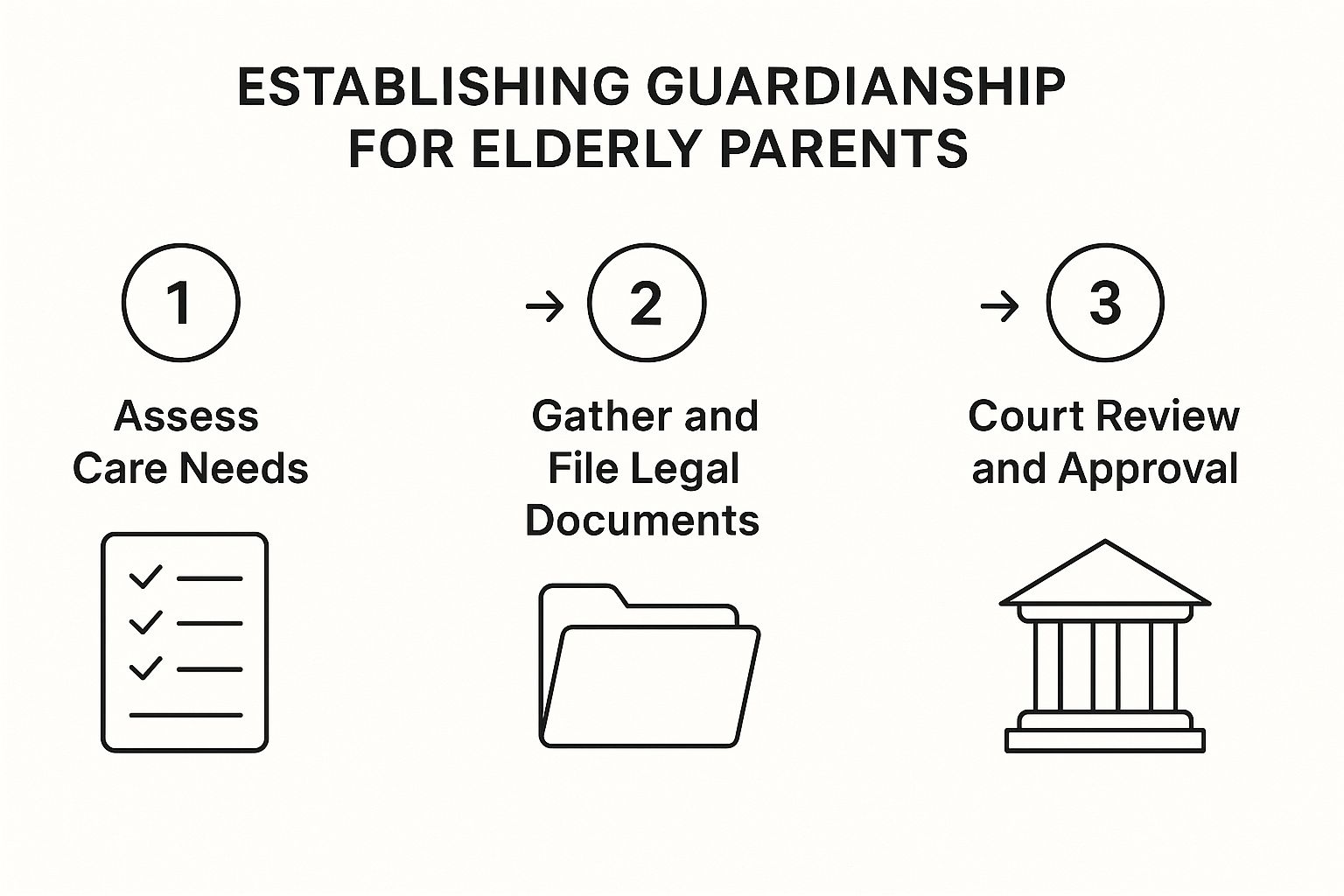
As you can see, there is a clear path. The process is made to go from seeing that help is needed to getting the legal power to give that help safely and officially.
The Jobs and Duties of a Guardian

When an Arkansas court makes you a guardian, you are taking on a role with serious legal duties. It’s a very big responsibility. You become the person who is legally in charge of making sure your parent is safe and their life is in order.
Think of it like being put in charge of two different, but connected, parts of their life: their personal well-being and their money. The court will decide if you get one or both of these jobs, depending on what your parent needs.
When it comes to the specific jobs, Arkansas law splits them into two main types.
Types of Guardian Duties in Arkansas
| Duty Area | What It Includes |
|---|---|
| Guardian of the Person | This job is about your parent’s personal and medical health. You will make decisions about their daily life, medical care, and where they live—like at home with help or in a nursing home. |
| Guardian of the Estate | This job is all about managing your parent’s money and property. You will be in charge of paying bills, handling bank accounts, managing investments, and protecting their things, like their house or car. |
Each role has its own set of important tasks, and they are all about caring for your parent.
No matter which job you have, there is one very important rule that guides everything you do.
Every single decision, big or small, must be made in your parent’s best interest. The court doesn’t just give you the power and leave. You will have to give the court regular reports to show that you are acting responsibly and honestly.
Juggling these duties can feel like a lot at first. That’s why understanding what’s involved with guardianships in Arkansas is a key first step for anyone thinking about this.
When to Look for Other Options Besides Guardianship
Let’s be very clear: guardianship means a court takes away your parent’s legal right to make their own choices. Because it is such a big step, it should always be the very last option you consider.
The good news is there are other powerful tools that are less extreme. You can set these up before there is a big problem. These tools let your parent stay in charge of their own life for as long as possible. Planning ahead is almost always cheaper, less stressful, and keeps your family’s private matters out of a public court.
Before you even think about guardianship, be sure you have looked into setting up Power of Attorney (POA) forms. This one step can make a huge difference.
The Best Choices Instead of Guardianship
Instead of going to court, you and your parents can put these legal papers in place:
Durable Power of Attorney for Finances: Think of this as giving a trusted person—the “agent”—the keys to your parent’s money. The agent can only use these keys if your parent can no longer manage their money themselves. This person can then pay bills, use bank accounts, and manage property for your parent.
Healthcare Power of Attorney: This paper lets your parent pick someone they trust to make medical decisions for them if they can’t speak for themselves. This person is sometimes called a “healthcare agent.”
Living Will: This is not about property. A living will is a paper where your parent writes down their wishes for end-of-life medical care. It says what they want for treatments like life support.
By choosing these options, you let your parents make their own decisions while they still can. It’s a way to protect them that also respects their freedom.
It turns out, most families feel this way. One study found that while about half of families (53.6%) knew about guardianship, only a very small number (3.7%) actually did it. This shows that families would much rather plan ahead than go to court. You can learn more from this study on family choices.
Thinking About the Good and Bad of Guardianship

Deciding to ask for guardianship for elderly parents is a huge step, both in the eyes of the law and for your family. It’s not a small thing, so you need to look at it from all sides before you do anything.
On one hand, guardianship gives the most legal protection for a parent who can no longer protect themselves. It gives you the clear power to stop financial scams, make important medical choices, and keep them from doing things that could hurt them. It’s a strong tool when a parent is truly in danger.
But that power takes something very important away from your parent.
Guardianship changes a person’s life by taking away their legal rights. In Arkansas, a person with a guardian may lose the right to vote, get married, or control their own money.
This isn’t just about managing their bank account; it’s a deep loss of personal freedom. This is exactly why courts see it as a last resort. The process is also public, can cost a lot of money, and often causes painful arguments in the family.
Key Things to Weigh
When you get right down to it, you are balancing two very serious things:
- Good – Safety: You get the clear legal power to protect your parent from being tricked or harmed.
- Bad – Loss of Rights: Your parent loses their basic freedoms and the independence they’ve had their whole adult life.
Thinking through these points is a must. You have to be sure that this difficult path is really the only and best choice for your parent’s safety and well-being.
Answering Your Questions About Guardianship in Arkansas
It’s normal to feel like you have a million questions when you’re thinking about something as big as guardianship. Most families looking into guardianship for elderly parents have the same worries. Let’s go over some of the most common ones.
How Much Does It Really Cost?
There isn’t one set price for getting a guardianship in Arkansas. You will have to pay for a few things: court filing fees, fees to have legal papers delivered, and lawyer’s fees. Remember, your parent will also have a lawyer appointed by the court, which is another cost. All together, it can cost from a few thousand dollars to much more, especially if things get complicated or other family members fight it.
Can My Parent Say No to Guardianship?
Yes, they absolutely can. Your parent has the right to say they don’t want a guardian. They can hire their own lawyer to fight the case in court. The judge also picks an “attorney ad litem” just to make sure their rights are protected and their side of the story is heard.
What if My Siblings and I Don’t Agree?
Arguments between brothers and sisters are very common. If you can’t agree on who should be the guardian, the court will listen to everyone. The judge will then decide who they think is the best person to act in your parent’s best interests. If there is a lot of fighting in the family, the court might even pick a neutral professional to be the guardian instead.
How Long Does This Whole Thing Take?
The timeline can be very different for each family. If everyone agrees and the case is simple, you might have an answer in a few months. But if your parent or a sibling fights the guardianship, or if other legal problems come up, the process can take much longer.
The truth is that more and more families are dealing with these issues. The business of helping seniors with legal matters was worth $3.6 billion in 2023 and is expected to grow to $7.2 billion by 2033. You can discover more about these growing trends if you want to know more about the big picture.
Facing these questions is an important part of the process, just as important as understanding why estate planning is essential in Arkansas.