
When you’re a single parent, your world revolves around your child. You’re the one juggling school runs, doctor’s visits, and bedtime stories. But what if something unexpected happened and you weren’t there to do it all?
It’s a tough question, but one we have to face. Estate planning is how you answer it. It’s not about being sad; it’s about making a solid plan to protect your kids, no matter what. Think of it as creating an instruction manual for the future. This manual makes sure a person you trust is chosen to raise your kids and that your money is handled exactly how you want. Without that manual, a judge in Arkansas has to guess, and that’s a risk no parent should take.
Why Estate Planning Is a Single Parent’s Most Important Task
As a single parent, you’re the sun in your child’s universe. You are their only provider, protector, and guide. This makes estate planning not just a good idea, but something you absolutely must do.
Your plan is the best safety net you can give them. It’s the tool you use to make sure your children are cared for by people you love and trust, in a way that matches your beliefs. It’s how you keep protecting them even if you can’t be there yourself.
The Risk of Having No Plan in Arkansas
If a single parent in Arkansas passes away without a will or trust, the law says they died “intestate.” This just means you left no instructions. When that happens, the state of Arkansas steps in, and a local judge has to make huge, life-changing decisions for your family.
The court—not you—gets to decide who raises your children. A judge who has never met you or your family will also control how your money, home, and other things are used for your child’s benefit.
This court process, known as probate, is public. It’s also known for being slow and can be very stressful for the people you want to protect from more pain. Your parents, brothers, sisters, or best friend do not have an automatic legal right to take care of your child or even use your bank account to pay for things they need right away. They would have to ask the court for permission, starting a long and expensive legal fight during a sad time.
Your Plan Is Your Voice
An estate plan is your voice, written down in a set of legal papers. It gives clear, personal directions so a judge doesn’t have to guess what you would have wanted. Taking control now gives you an incredible feeling of peace.
This is especially true for single parents, who don’t have the same automatic legal protections a married couple might. In fact, the risk of legal chaos is much higher. Recent 2024 data shows that a huge 65% of single people do not have an estate plan, compared to just 45% of married people. As you can see from research about these estate planning trends, when a single parent dies without a plan, the state’s default rules take over everything—who cares for the kids, the money, and even health decisions.
Ultimately, making your estate plan is one of the most powerful and loving things you can do as a parent. It guarantees that if you can’t be there, your voice will still be heard, guiding your child’s future and keeping them safe with the people you know will honor your memory.
Your Essential Estate Planning Toolkit
Putting together an estate plan can feel a lot like assembling a toolkit for your family’s future. Each document is a specific tool with a unique job. When they all work together, they form a complete safety net for your kids.
As a single parent, it’s very important that every part of this kit is in place. These legal documents are your official instructions, written down to remove any guesswork and—most importantly—to stop a judge from making life-altering decisions about your child and your money.
Let’s walk through the four essential tools every single parent in Arkansas needs.
This flowchart really brings the choice into focus: you can create your own plan, or you can leave it up to the legal system to decide what happens.
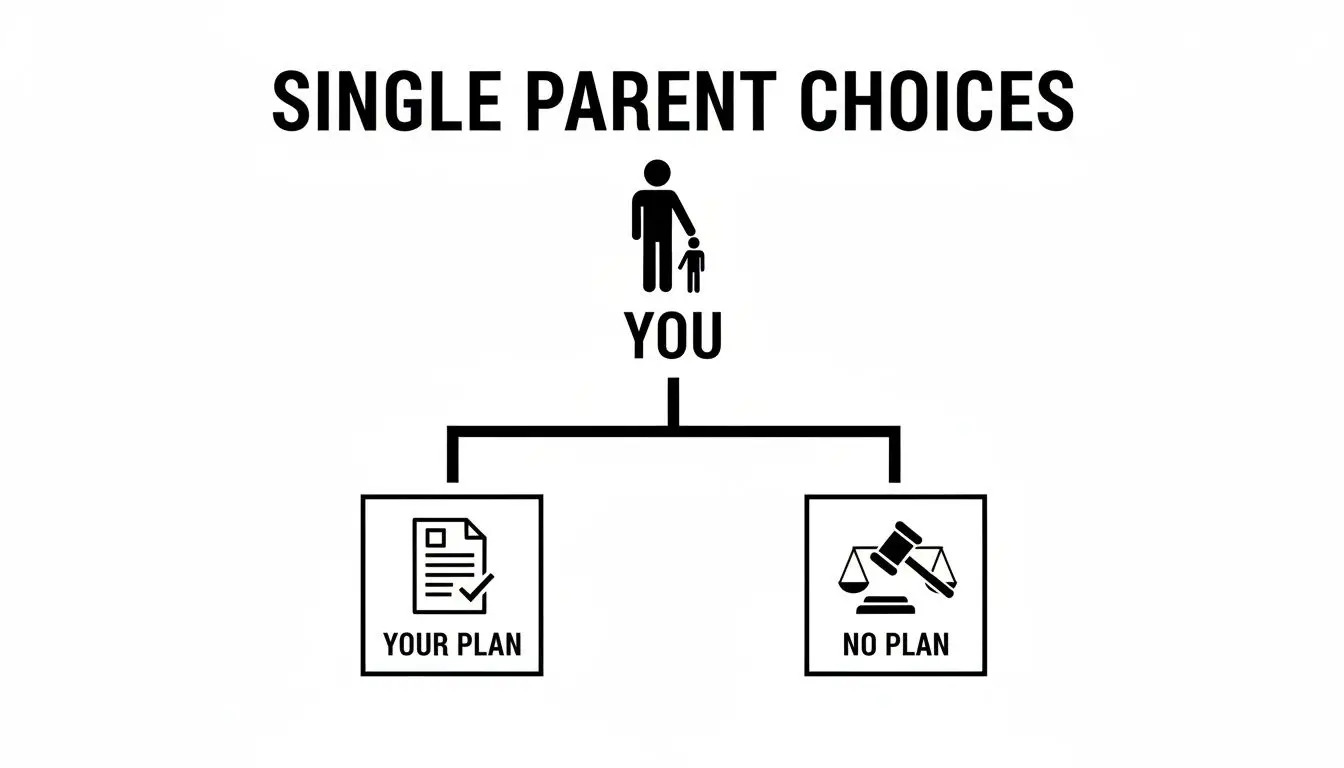
For a single parent, this isn’t just a legal step. It’s about taking control and making sure your child’s future is guided by someone you trust, not by a stranger in a courtroom.
Before we dive into the details of each document, here’s a quick summary of what each tool does and why it’s so important for your kids.
Your Estate Planning Toolkit At a Glance
| Document | What It Does in Simple Terms | Why It Matters for Your Kids |
|---|---|---|
| Last Will & Testament | Your official rulebook. It names a guardian for your kids and says who gets your stuff. | You, not a court, decide who raises them. It ensures they are cared for by the person you trust most. |
| Living Trust | A private “box” you put your stuff into. It lets your property skip probate court. | Provides quick access to money for your children’s care without long court delays. It’s private and fast. |
| Durable Power of Attorney | Names someone to manage your money if you’re alive but can’t do it yourself. | Makes sure the house payment gets paid and your kids’ costs are covered without a break if you are sick or hurt. |
| Healthcare Power of Attorney | Names someone to make medical decisions for you and explains your wishes for end-of-life care. | Prevents family fights and makes sure the focus stays on your kids, not on hard medical decisions. |
Now that you have the big picture, let's look at how each of these pieces works to protect your family.
The Last Will and Testament: Your Final Rulebook
Let's start with the big one: your Last Will and Testament. This is the foundation of your whole plan. For a single parent, its most important job is naming a guardian for your young children. This is where you legally say, with no confusion, who you trust to step in and raise your kids if you're gone.
Without a Will, an Arkansas judge has to make that choice. It might be a family member you’d never want, and the court won't know what you wanted. A Will also says who gets your property—from your house and car to things with special meaning, like photo albums. It’s your final say, made official.
The Living Trust: Your Private Safety Deposit Box
A Living Trust works like a private, secure box for your property. Think of it as creating a special box, putting your family's name on it, and then legally moving your major things—your home, bank accounts, investments—into that box. While you're alive and well, you are in complete control.
The real power of a Trust becomes clear if you pass away or become unable to care for yourself. Because your property is technically owned by the Trust, not you, it completely avoids the public, slow, and often expensive probate court process. The person you picked as your "successor trustee" can step in right away to manage and use that property to care for your children. This is all done privately and according to the exact rules you set up.
The Durable Power of Attorney: Your Financial Helper
What happens if you're in a bad car accident and are in the hospital for a few months, unable to manage your daily life? Who pays the house payment? Who gets money from your bank account to buy food for your kids? This is where a Durable Power of Attorney comes in.
This document lets you name a trusted person—your "agent"—to handle your money and legal tasks if you become unable to do so yourself. For a single parent, this isn't just a good idea; it's a must-have. Without one, your family would have to ask the court just to get the power to pay your bills. This can be a slow and stressful process when money is needed right away.
A Durable Power of Attorney is a “living” document, which means it only works while you are alive. Its power ends automatically when you die. Then, your Will or Trust takes over.
Understanding this difference is important. This tool is made to handle a crisis during your lifetime, making sure your financial world doesn't stop when your family needs stability the most.
The Healthcare Power of Attorney: Your Medical Voice
Finally, you need a clear plan for your own medical care. This actually involves two documents that work together:
- Healthcare Power of Attorney: This lets you name a healthcare agent—the person you trust to talk to doctors and make medical decisions for you if you're unconscious or can't speak. This person literally becomes your voice.
- Living Will: This is your personal instruction sheet for your agent and doctors. It explains your wishes on end-of-life care, like whether you want to be kept on life support. It’s about making sure your personal values are respected.
For a single parent, these documents do more than just protect you. They take a huge weight off your family, stopping them from having to make painful decisions under pressure. It makes sure there's a clear plan, so everyone’s focus can stay right where it should be: on your child.
How to Choose the Right Guardian for Your Children

Let's be honest. Of all the tough decisions you make as a single parent, this is probably the one that keeps you up at night. Who would raise your child if you weren't here? It’s a very emotional question, but facing it is one of the most loving and protective things you can ever do.
Your Will is the only legal document where you can officially name a guardian. If you don't, a judge who has never met you or your child will make that life-changing choice. By taking control now, you make sure your child ends up in a loving home with someone who understands your family and shares your values.
Thinking Like You're Hiring for the World's Most Important Job
It helps to change how you think about it. You're not just picking your favorite brother or sister or your best friend; you're hiring someone for the most important role you can imagine. You have to look at their real-world skills for raising your child.
Go beyond just love and ask the tough questions:
- Parenting Style and Values: Do they agree with you on the big things—education, religion, discipline? You want someone who will continue the foundation you’ve already laid, not start over.
- Financial Stability: Raising kids is expensive. Even with money from your estate, you need someone who is responsible with their own money and won't feel overwhelmed.
- Age and Health: Does this person realistically have the energy and long-term health to parent a child all the way to being an adult?
- Location and Lifestyle: Would choosing them mean your child has to leave their school, friends, and everything they know? Does their way of life match what you want for your child?
- Family Situation: If they have a spouse or other children, are they all okay with this? Your child needs to be welcomed by the whole family, not just by one person.
Your main goal is to make sure your child's life stays as stable and normal as possible. Choosing someone who can provide a familiar and supportive home is often the best choice you can make.
Understanding the Different Guardian Roles
In Arkansas, you can actually split the job of guardian into two separate roles. This can be a really smart move, especially for single parents.
- Guardian of the Person: This is the hands-on caregiver. They provide the home, the meals, the homework help, and the hugs. They basically step into your shoes as a parent.
- Guardian of the Estate: This is the money manager. They are in charge of protecting and managing the money you leave behind, paying for your child’s needs, and making sure the money is handled wisely until your child is an adult.
Think about it: the kindest person you know might not be the best with money. Separating these roles creates a natural system of checks and balances. Your fun-loving brother could be the perfect father figure, while your financially smart cousin manages the money. This way, you know both your child's heart and their financial future are in the best possible hands. If you want to explore the legal details further, you can find more in our guide on guardianship for minors in Arkansas wills.
The Importance of Having the Conversation
Once you've made your choices, you have to talk to them. This is not a surprise you want to leave in a legal document.
Set aside some time for a serious, honest talk. Explain why you've chosen them and ask—directly—if they would be willing and able to accept this huge responsibility. It gives them the chance to be honest with you and themselves about whether they can truly do it.
And finally, always name a backup guardian. Life is unpredictable. Your first choice could move, get sick, or have their own life change. Naming at least one other choice in your Will means there is always a plan B. This keeps your child’s future safe and out of a courtroom.
Protecting Your Child's Inheritance with a Trust

While your Will is the right place to name a guardian, it’s the wrong place to leave a lot of money directly to your child. It sounds simple, but doing so can create a huge legal headache. In Arkansas, a child under 18 can’t legally own property or large amounts of cash on their own.
This means the court has to get involved. A judge will pick someone to manage the money. This is a public process that can be expensive and takes control completely out of your hands.
A much smarter way is creating a Trust. Think of it as a protective vault you build for your child’s inheritance. You create the vault, and more importantly, you write the rules for how and when the things inside can be used. This is a key part of estate planning for single parents because it keeps you in control, making sure your instructions are followed, not a judge's.
Your Rules for Their Future
The real magic of a Trust is that you get to write the instruction manual for the money and property you leave behind. You get to decide what the money is used for, from big life goals to everyday needs. This makes sure the inheritance is a true gift, not a huge problem.
You can get as specific as you want. For example, your Trust can say that money should be used for:
- Education: Covering costs for college, trade school, or other programs that help them succeed.
- Major Life Events: Providing a down payment for their first house or money to start a business.
- Health and Well-being: Paying for medical bills, sports or hobbies that build character, or even a safe car to get to school and work.
A huge advantage of a Trust is its privacy. Unlike a Will, which becomes a public paper for anyone to see during probate, a Trust keeps your family's financial life private.
This privacy is very valuable. It protects your child and your money from nosy people during a very difficult time.
Preventing the "Too Much, Too Soon" Problem
One of the biggest fears for any parent is their child suddenly getting a lot of money before they're mature enough to handle it. We’ve all heard the horror stories of a young adult wasting an inheritance because they were simply too young to manage it well.
A Trust solves this common problem by letting you control when your child gets the money. Instead of giving them a large sum on their 18th birthday, you can create a schedule that makes more sense.
For example, you could set it up so your child receives:
- One-third of the inheritance at age 25.
- The next third at age 30.
- The final part at age 35.
This spaced-out approach gives your child time to learn and grow. It provides a financial safety net while they gain the real-world wisdom needed to protect their future.
Choosing Your Financial Guardian Angel
The person you put in charge of managing the Trust is called a Trustee. This person acts as a financial guardian for your child, following your instructions exactly. Their job is to invest the money wisely and use it for your child's benefit until they’re ready to take over themselves.
Choosing your Trustee is one of the most important decisions you'll make. You need someone who is not only completely trustworthy but also good with money and organized. It's vital that your chosen Trustee understands all the legal trustee responsibilities that come with managing your child's property.
Your Trustee can be a responsible family member, a trusted friend, or a professional from a bank. The right choice is someone who will always put your child’s best interests first and has the skills to do the job well.
Common Estate Planning Mistakes Single Parents Make
When it comes to protecting your kids, meaning well is a good start, but it won’t work in court. As a single parent, even a small, honest mistake in your estate plan can create huge, long-lasting problems for the very people you’re trying to protect.
Let's walk through the most common traps I see single parents fall into. These aren't just "what if" scenarios; they are real-life situations that happen every day in Arkansas, leaving kids in a bad spot when they need stability the most.
The Danger of Waiting Too Long
The biggest mistake by far? Putting it off. It’s so easy to push estate planning to the bottom of the to-do list, but as a single parent, that's a risk you just can't afford to take. The facts are worrying: many Americans guess they'll get around to writing a will by age 51, but a huge number never do. While a well-organized estate can often be finished in about nine months, having no plan at all can drag the process out for years, locking up money your child needs. You can see more about this trend in this research about estate planning in America.
Real-World Story: A young, healthy single mom in Fayetteville thought she had many years to plan. When she died unexpectedly, she had no Will. Her parents and her sister both believed they should raise her son. This led to a painful and public court battle that tore the family apart and left a little boy caught in the middle.
Forgetting to Update Your Beneficiaries
Life insurance policies and retirement accounts—like a 401(k) or an IRA—pass to whomever you name as the beneficiary. This happens completely outside of your Will. A very common mistake is forgetting to update these forms after a big life change, like a divorce.
If your ex-spouse is still listed on your life insurance policy, the law says they get the money. That's it. It doesn’t matter what your Will says. That one simple mistake could accidentally cut your child off from the very money you set aside for their future.
Naming a Minor Child Directly as a Beneficiary
It seems like the most logical thing in the world: leave your money directly to your child. The problem is, under Arkansas law, a minor can't legally own or control property. If you name your underage child on a life insurance policy or bank account, you’ve accidentally created a legal headache.
The court will have to step in and name a financial guardian to manage the money. That process is public, can be expensive, and puts a judge—not you—in control. A much, much better way is to have that money go into a Trust that you've created for your child's benefit.
Assuming a Simple Will Is Always Enough
Having a Will is a very important first step, but for most single parents, it just isn't enough by itself. A Will has to go through probate court, a public process that can be both slow and costly. It also offers no protection if you become sick or hurt and can't manage your own money or make medical decisions.
This is where it’s so important to go beyond the basics and start understanding the key differences between wills and trusts. A Trust is often a much better tool for managing your child’s inheritance privately and quickly, without any court getting involved.
Ignoring Your Digital Life
These days, so much of our lives exist online. Think about your family photos in the cloud, social media pages, online bank accounts, and even digital money like cryptocurrency. If you don't make a plan for these digital assets, your family might be locked out of them for good.
Precious memories could be lost forever, and important financial accounts could go untouched. A truly complete estate plan includes a list of your digital property and gives your executor clear instructions on how to access and handle it. It's a modern part of life that absolutely needs to be part of your plan.
Your Actionable Estate Planning Checklist

Alright, we've covered a lot. But knowing what to do is only half the battle. Now, let's get that peace of mind by turning what you've learned into a real, solid plan for your child's future.
You can get started on this right now. Don't feel like you have to do everything at once. Just focus on the first few steps to get going.
Getting Started Today
The beginning of the estate planning for single parents process is really just about getting organized and thinking through what's most important to you. The goal isn't to have perfect answers, but simply to start moving.
Here are the first things you can do to build momentum:
-
Gather Your Key Documents: Start a folder—it can be a real one or a digital one on your computer. Begin collecting the important papers: your child’s birth certificate, property deeds, recent statements from your bank and investment accounts, and your life insurance policy information.
-
Brainstorm Your "Team": Grab a notebook and start listing the people you trust. Who comes to mind as a possible guardian? Who could be a backup? Who is good with money and could be a trustee? Don't overthink it; just get the names down. This is your first draft.
-
Write Down Your Wishes: This part is less about legal stuff and more about your heart. What do you want for your child’s life? Write down your thoughts on their education, the values you hope they have, and any religious guidance. This isn't a legal paper, but it will be very helpful when you sit down with a lawyer.
While this guide is an excellent starting point, it is not a substitute for professional legal advice. To create a plan that is legally binding and will hold up in an Arkansas court, you must work with a qualified attorney.
Take the Final and Most Important Step
It can be tempting to use an online template, but those do-it-yourself options are full of risks. They often miss the important details specific to an Arkansas single parent's situation, and a small mistake can create huge problems later. The only way to be sure your plan will work when it needs to is to have a local attorney build it with you.
At DeWitt & Daniels, we help families just like yours across Northwest Arkansas, from Fayetteville to Bentonville to Rogers. We know the local courts, and more importantly, we know how to create plans that truly protect your child. Our goal is to give you simple advice in plain English so you feel confident and in control.
It's time to secure your family's future. Contact DeWitt & Daniels for a clear conversation about your next steps.
Frequently Asked Questions About Single Parent Estate Planning
It’s normal to have a lot of questions when you start thinking about estate planning. As a single parent in Arkansas, you need clear, simple answers you can trust. Let's go over some of the most common questions we hear from parents just like you.
Can I Just Use an Online Template for My Will in Arkansas?
It's tempting, right? Online templates look like a quick and cheap option. The problem is, they are a huge gamble. Arkansas has very specific rules for what makes a Will legal. A simple mistake—like not having the right number of people watch you sign it—can get the whole thing thrown out in court.
For something as important as estate planning for single parents, that’s a risk you just can’t afford to take. Working with an experienced lawyer is the only way to be sure your documents are made to last and designed to protect your kids, no matter what.
Does My Child's Other Parent Automatically Get Custody?
Usually, yes. The living biological parent is typically first in line to get custody. But it's not guaranteed, and you absolutely must still name a guardian in your Will.
Think of this as your voice in the courtroom. It tells the judge exactly who you trust to raise your child if the other parent has already passed away, isn't able to step in, or is found to be an unfit parent by the court. Without it, you leave that decision completely up to a stranger.
How Much Does an Estate Plan Really Cost?
The cost of creating a solid estate plan is just a small piece of the legal fees, court costs, and emotional pain your family would face if you pass away without one.
It helps to think about the cost differently. This isn't just another bill; it's a one-time investment in your children's future safety. A firm like DeWitt & Daniels can walk you through the costs based on your family’s unique situation, giving you a clear and predictable price for true peace of mind.