
In Arkansas, getting a DWI, which stands for Driving While Intoxicated, is a very big deal. It means the police believe you were driving a car while drunk or on drugs. This can lead to serious trouble, like paying large fines, possibly going to jail, and losing your driver’s license right away.
What Happens When You Get a DWI in Arkansas

Seeing police lights in your mirror is scary for anyone. If a police officer thinks you have been drinking, a normal traffic stop can turn into a DWI investigation. Knowing what this means under DWI Arkansas law is the first step to understanding your rights and what will happen next.
A DWI in Arkansas means you were driving—or were even just in “actual physical control” of—a car while intoxicated. This isn’t just about alcohol. It can also mean you were affected by prescription pills, illegal drugs, or any other substance that messes with your ability to drive safely.
Understanding Arkansas DWI Penalties
Getting a DWI in Arkansas is serious, and the punishments are much worse than a normal traffic ticket. The state has rules that make the punishments tougher each time someone gets a DWI. This can affect your freedom, your money, and your ability to drive.
The punishment isn’t the same for everyone. The law looks at your past, so a first DWI has different penalties than a second or third one. This is to make sure people understand how serious it is and to stop them from doing it again.
Penalties for a First DWI Offense
Even for your first time, the punishments are tough. The law tries to be fair, but the results are meant to be a big wake-up call.
If it’s your first DWI, here’s what could happen:
- Jail Time: You could spend anywhere from 24 hours to one full year in jail. Sometimes, a judge might let you do community service instead.
- Fines: The fine is between $150 and $1,000. On top of that, you have to pay court fees, which can add a lot more.
- License Suspension: You can expect to lose your license for six months.
- Alcohol Education: You will have to take a class about alcohol and driving that the state approves.
To drive again while your license is suspended, you will also need to put an Ignition Interlock Device (IID) in your car. It’s like a breathalyzer for your car. You have to blow into it and be sober for the car to start.
Escalating Penalties for Subsequent Offenses
If you get a second DWI within five years of the first one, the punishments get much worse. The courts see this as a pattern of dangerous choices, and the punishment shows they are worried about keeping other people safe.
For a second time, the results are much tougher:
- Jail Time: You must spend at least seven days in jail, and you could be there for up to a year.
- Fines: The fine goes up a lot, to between $400 and $3,000, plus court fees.
- License Suspension: Your license will be taken away for 24 months—that’s two full years.
- Ignition Interlock Device: You will have to use an IID for the whole two years if you want to be able to drive at all.
These tougher punishments show how seriously the DWI Arkansas law treats people who get DWIs more than once.
To help you see how the punishments add up, here’s a quick chart.
Arkansas DWI Penalties at a Glance
| Offense | Potential Jail Time | Fines | License Suspension | Ignition Interlock Device (IID) |
|---|---|---|---|---|
| First Offense | 24 hours to 1 year | $150 – $1,000 | 6 months | Needed to drive at all |
| Second Offense | 7 days to 1 year | $400 – $3,000 | 24 months | Needed to drive at all |
| Third Offense | 90 days to 1 year | $900 – $5,000 | 30 months | Needed to drive at all |
As you can see, the state is sending a clear message: the more times you do it, the bigger the price you will pay.
A DWI isn’t just a short-term problem; it leaves you with a permanent criminal record. In Arkansas, it’s almost impossible to get a DWI erased from your record. That means it can cause problems for you for the rest of your life, like when you apply for a job, try to rent a place to live, or get a special license for work.
Felony DWI and Aggravated Charges
A third DWI in five years has even worse punishments, and a fourth one in that same time is automatically a felony. This is a very serious type of crime. Instead of jail time for days or months, you could go to prison for years.
But it’s not just how many DWIs you have. How much alcohol was in your body can also lead to “enhanced” or worse penalties. This is measured by your Blood Alcohol Concentration (BAC).
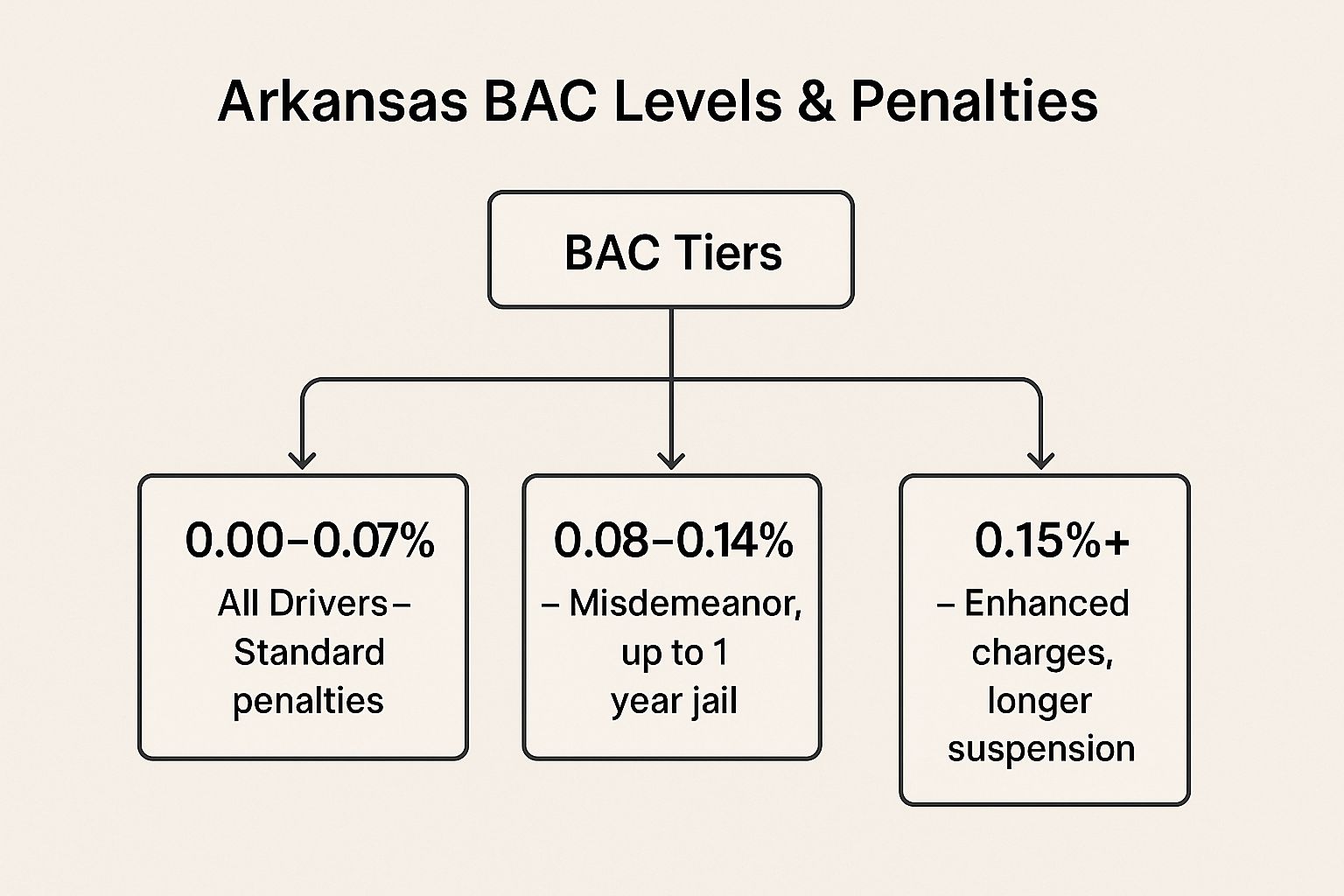
As this picture shows, if your BAC is 0.15% or higher, you will automatically face tougher punishments. This can mean more jail time and a longer license suspension, even if it’s your first time. The court takes a high BAC level very seriously.
The Reality of Drunk Driving in Arkansas

It’s easy to see the tough punishments for a DWI in Arkansas and ask why the rules are so strict. The reason is a sad one. Drunk driving is a huge safety problem in our state, and the laws are made to stop the sad accidents that happen way too often on our roads.
To understand why the police and courts are so tough, you have to look at how it affects real people. It’s not just about numbers; it’s about the real danger we all face when someone drives after drinking or using drugs. The tough DWI Arkansas law is a direct response to that danger.
Arkansas Is a Hotspot for Impaired Driving
This is hard to hear, but Arkansas is known for having a bad drunk driving problem. Our state is often ranked as one of the worst in the country for deaths caused by drunk driving. This has pushed our leaders to make strong laws. This isn’t a problem happening somewhere far away; it’s a danger on our own highways and streets every day.
A 2021 study showed just how bad it is, ranking Arkansas as the 7th worst state for driving under the influence. The report said that for every 100,000 people in Arkansas, there are about 6 deadly DWI crashes. To understand what that means, over three years, almost 500 people in Arkansas died in wrecks involving alcohol. These are not just numbers; they are real families in our state who are suffering. You can see more of these Arkansas driving statistics.
The strict punishments for a DWI are because so much is at stake. When a person who is drunk or on drugs gets behind the wheel, they are not just risking a fine or jail time—they are risking the lives of everyone else on the road.
This is important to know so you can understand why a DWI is treated so seriously. It’s a public health problem that our police are working hard to fix.
Why the Consequences Are So Severe
The government isn’t just trying to be mean. It’s trying to save lives.
Think of it this way: if a bridge was about to fall down, you would want officials to put up strong fences and warning signs to keep people safe. The strict DWI laws in Arkansas are like those fences—they are meant to keep dangerous drivers off our roads.
The big fines, jail time, and license suspensions are all meant to make people stop and think before they drive after drinking. The goal is simple: to change how people act and make our roads safer for all of us.
Every part of the DWI Arkansas law is built on the idea of keeping people safe.
- Preventing Tragedies: The most important goal is to stop people from being killed or badly hurt by drivers who are drunk or on drugs.
- Deterring Risky Behavior: By making the punishments serious, the law tries to stop people from ever taking that risk.
- Holding Offenders Accountable: The punishments make sure that people who put others in danger have to face the consequences of their choices.
When you look at the big picture, it’s clear that these laws are a needed response to a dangerous problem in Arkansas. While facing a DWI is a very personal and hard thing, understanding the safety reasons behind the law can help you see why it’s so strict.
What Happens to Your License After a DWI Arrest?
When you are arrested for a DWI in Arkansas, one of the first and most surprising things that happens affects your driver’s license. Many people don’t know that you can lose your ability to drive long before you ever go to court for the crime. This is because losing your license is a separate issue from the criminal charge.
Think of it like this: your DWI arrest starts two different processes at the same time. One is the criminal case, which decides if you are guilty of the crime. The other is an administrative license suspension. This is handled by a state office called the Arkansas Department of Finance and Administration (DFA), and it only deals with your right to drive. This second process starts as soon as you are arrested.
The Power of Implied Consent
So, how can the state take your license so fast? It’s because of a rule called “implied consent.” This is a key part of DWI Arkansas law that every driver agrees to just by having a license.
Basically, implied consent means you have already agreed to give a chemical test—like a breath, blood, or pee test—if a police officer legally arrests you for a DWI. By having a driver’s license, you’ve already said “yes.”
Saying “no” to the test does not help you. In fact, it causes its own serious problems.
- Automatic Suspension: If you refuse to take a test, your license is automatically taken away.
- Longer Suspension Period: The time you lose your license for refusing is often much longer than if you had just failed the test.
- Evidence in Court: The fact that you refused can be used against you in your criminal trial. The court may think you refused because you knew you were guilty.
Refusing the test creates an immediate and often worse problem for your license, no matter what happens with the criminal DWI charge later.
The Critical 7-Day Deadline to Save Your License
After a DWI arrest, a very important clock starts ticking. You have only seven days to ask the DFA for a special meeting, called an administrative hearing, to fight for your license. This deadline is final.
If you miss this seven-day deadline, you automatically lose your chance to fight the suspension. Your license will be suspended on the 30th day after your arrest, and you can’t do anything about it.
Asking for this hearing is your only chance to make the state prove it had a good reason to take your license. This meeting is separate from your criminal case, but it’s a very important first step to protect your ability to drive. Legal deadlines are very strict and can cause permanent problems, which is true in many parts of the law. To see how these deadlines matter in other areas, you can read about what happens if you die without a will in Arkansas.
Getting a Restricted License with an IID
So, what if your license gets suspended? Are you just out of luck? Not always. Arkansas law lets most drivers get a special restricted license, but there’s a big catch: you must put an Ignition Interlock Device (IID) in your car.
An IID is a small breathalyzer that’s connected to your car’s engine. Before you can start the car, you have to blow into the device to prove you haven’t been drinking. The device will also ask you to blow into it again at random times while you’re driving.
This device lets you keep driving for important reasons, like:
- Going to and from your job.
- Going to school.
- Going to court or your alcohol education classes.
- Going to the doctor for you or your family.
Even for a first offense, you must use an IID if you want to drive while your license is suspended. It’s the state’s way of letting you keep some parts of your life normal while making sure you are sober on the road.
Navigating the Arkansas DWI Court Process
Facing a DWI charge means you have to deal with the Arkansas court system. For most people, this is a new and scary place, like being lost in a maze without a map. But once you understand the basic steps, the journey becomes much clearer and less frightening.
This section will be your guide, showing you the legal process from your first day in court to the very end. We’ll explain each step in simple terms to help you feel more ready for what’s coming.
Your First Day in Court: The Arraignment
The first official step in your case is a meeting called the arraignment. This is usually your first time seeing a judge for the DWI charge. It’s a formal meeting where a few important things happen.
Think of the arraignment as the official start. During this short meeting:
- The judge will read the DWI charge against you out loud.
- You will be asked to enter a plea, which is your answer to the charge. You can say “guilty,” “not guilty,” or “no contest.”
- The court will tell you when your next court date is.
It is normal to plead “not guilty” at this point. This doesn’t mean you are lying. It means you are using your right to make the government prove its case against you. A “not guilty” plea gives your lawyer the time they need to get the evidence and start building your defense.
The Stages Before a Trial
After the arraignment, the case moves into a phase called “pre-trial.” This is when the real work happens. Your lawyer’s main job here is to look at every piece of evidence the other side has.
You have a legal right called “discovery.” This means the prosecutor has to give you all of their evidence. This includes police reports, breath or blood test results, videos from the police car, and what any witnesses said. The goal is to make sure there are no surprises at the trial.
With this information, your lawyer may file pre-trial motions. These are just formal requests asking the judge to make a decision before the trial starts. For example, a motion might argue that the police had no good reason to stop your car or that the breathalyzer machine wasn’t working right. If the judge agrees, that evidence can’t be used, which could really help your case. Getting through the DWI court process often takes a legal expert. For general information on what a lawyer does in similar cases, you could look up a drunk driving accident lawyer.
Plea Bargaining Versus Going to Trial
Most DWI cases in Arkansas don’t go to a full trial. Instead, they are solved through plea bargaining. This is a discussion between your lawyer and the prosecutor to agree on a deal. This saves the time, money, and stress of a trial.
A plea deal might mean you agree to plead guilty to a less serious charge (like reckless driving) or agree to a specific, often lighter, punishment for the DWI. A trial, on the other hand, is a fight where both sides show their evidence to a judge or jury, who then decides if you are guilty “beyond a reasonable doubt.”
The state works hard to catch drunk drivers, which means many people end up in court. According to the National Highway Traffic Safety Administration, the number of DWI arrests in Arkansas has been high, ranging from 1,858 in 2010 to around 3,253 in 2007 during special enforcement times. You can learn more from these Arkansas DWI enforcement statistics from NHTSA.
Knowing how these things work is half the battle. A good DWI defense lawyer can help you through every step, whether it’s deciding to take a plea deal or getting ready for a trial.
Exploring Common DWI Defenses in Arkansas
Just because you are charged with a DWI in Arkansas doesn’t mean you will be found guilty. The truth is, it’s the government’s job to prove you are guilty. A good defense lawyer will look at every single detail of your arrest, from when the police lights came on to the final test, to make sure your rights were protected.
Think of the government’s case like a chain. If you can find and break just one weak link, the whole case can fall apart.
Challenging the Initial Traffic Stop
Every DWI case starts with one thing: a traffic stop. A police officer can’t just pull you over for no reason. The law says they must have a reasonable suspicion that you broke a traffic law or are doing something illegal.
What if the officer’s reason was weak? Maybe they just had a feeling or a bad tip. If there wasn’t a good reason for the stop, then all the evidence they collected after that—the roadside tests, the breathalyzer results, everything—can be thrown out of court. If you can challenge the stop, the whole case might get thrown out before it even starts.
Questioning Field Sobriety Test Results
You have probably seen Field Sobriety Tests (FSTs) on TV. Police use them to try to prove you were drunk or on drugs. But these tests are not always accurate and can be challenged in many ways.
- Wrong Instructions: Officers have to give the instructions for tests like the walk-and-turn or one-leg stand exactly the right way. If they mess up the directions or skip a step, the results are not reliable.
- Medical Conditions: Many health problems can make it almost impossible for a sober person to pass these tests. Think about it—problems with your ears, bad knees, an old back injury, or even just being overweight can mess up anyone’s balance.
- Bad Conditions: Were you asked to do these tests on a hill, in the dark, or with bright headlights in your eyes? Bad lighting, uneven ground, and bad weather can all affect how well you do.
Because these tests depend so much on what the officer thinks, a defense lawyer can often make a judge or jury doubt if the results really prove anything.
A DWI charge is serious, but it is not a conviction. Many things can affect how a case turns out, and it’s important to look at every possible defense. An arrest is just the start of the legal process, not the end.
Scrutinizing the Breathalyzer Test
The breathalyzer result can feel like the final proof in a DWI case, but these machines are not perfect. A strong defense will look closely at the machine, the officer who used it, and even your own body when you took the test.
For example, your lawyer might start asking questions like:
- Machine Records: Was this specific machine checked and taken care of like the law says it should be? If the records are not complete, the results can’t be trusted.
- Officer Training: Was the officer who gave you the test trained to use that machine? Maybe their training was old or for a different type of machine.
- “Mouth Alcohol” Problems: Things you would never think of can mess up the results. Burping, acid reflux (GERD), recent dental work, or even some breath sprays can trap alcohol in your mouth. This can make the machine show a BAC level that is too high.
The state is very focused on stopping DWIs, and for a good reason. The Arkansas Governor’s Highway Safety Program has shown that even when fewer people were dying in car crashes overall between 2010 and 2014, deaths from alcohol were still a big problem. There was an average of 146 deaths per year from drivers with a BAC of .08 or higher. You can read more in the official Arkansas highway safety report. These numbers explain why the government is so tough, but it also shows why every piece of their evidence must be correct and legal.
Common Questions About Arkansas DWI Laws
When you are suddenly facing a DWI charge, your mind is probably full of questions. It’s a very stressful and confusing time. Getting clear, simple answers is the first step to figuring out what to do next.
Let’s go over some of the most common questions people have when they are in this situation.
What’s the Difference Between a DWI and a DUI in Arkansas?
This is something that confuses a lot of people, but the answer in Arkansas is simple: there is no difference.
The official legal name that the state and courts use is DWI, which stands for Driving While Intoxicated. This one charge covers being impaired by alcohol, illegal drugs, prescription medicine, or any mix of them.
You will often hear people say DUI (Driving Under the Influence) when they talk, but when it comes to the law in Arkansas, they are talking about a DWI.
Can I Refuse a Breathalyzer Test in Arkansas?
Technically, yes, you can refuse to take a breathalyzer or other chemical test. But, refusing comes with its own immediate and serious punishments.
This is because of Arkansas’s “implied consent” law. As soon as you get your driver’s license, the state says you have already agreed to take a chemical test if a police officer legally arrests you for a DWI. Refusing to take the test is like breaking that promise.
If you refuse, you will automatically lose your driver’s license for a long time. In many cases, you lose it for even longer than if you had just failed the test. This happens even if you are later found not guilty of the DWI charge. Also, the government can use the fact that you refused as evidence against you in court.
A DWI conviction is not a small traffic ticket; it is a crime that gives you a permanent criminal record in Arkansas. This can cause problems for a long time when you apply for jobs, look for a place to live, or try to get certain work licenses.
Will a DWI Conviction Give Me a Criminal Record?
Yes, absolutely. A DWI is a crime in Arkansas, not just a traffic ticket.