
Getting a first DWI in Arkansas can be a scary experience. It feels like your freedom and your driver’s license are suddenly in danger. The legal system can seem confusing, with talk of fines, jail, and classes. The best thing you can do is learn what’s happening and act quickly.
What Happens After a First DWI Arrest in Arkansas
After being arrested for a DWI in Arkansas, you might feel lost. You’re hearing new legal words, trying to remember dates, and worrying about your job and family. Let’s make it simple and go through the steps one by one.
The most important thing to know is that your arrest starts two different legal cases at the same time. Think of it like two different clocks started ticking at the same moment.
- Your Criminal Case: This is the court case. A lawyer for the state, called a prosecutor, will try to prove you are guilty of DWI. This case involves going to court, making deals, and facing punishments like fines or jail time.
- Your Administrative Case: This case is not about whether you are guilty or innocent. It’s handled by a state office called the Department of Finance and Administration (DFA). This case is only about one thing: your driver’s license.
These two cases are separate. They have their own rules and their own deadlines. Knowing you have to deal with both is the first step to defending yourself.
The Two Clocks of a DWI Case
Of the two clocks, the one for your driver’s license is ticking much faster. When you were arrested, the officer probably took your plastic driver’s license and gave you a piece of paper to use instead. That paper is only good for 30 days.
You have only seven days from the day of your arrest to ask the DFA for a meeting, called a hearing, to try and stop them from taking away your license. If you miss this deadline, you lose your chance to fight it, and your license will be taken away (suspended) automatically. You can find more information from the Arkansas Department of Finance and Administration.
A first-time DWI is usually a type of crime called a Class B misdemeanor. But if your blood alcohol content (BAC) was very high (0.15% or more), it becomes a more serious Class A misdemeanor, which has tougher punishments.
This two-part system can be tricky. You could win your court case months later but still lose your license right away because you missed the seven-day deadline for the hearing. That’s why what you do first is so important.
To help you, here is a simple checklist for the first week.
Immediate Steps After a DWI Arrest in Arkansas
This chart shows the most important things you need to do right after being charged with a first-time DWI. Missing these deadlines can cause big problems for your case and your ability to drive.
| What to Do | When to Do It | Why It’s Important |
|---|---|---|
| Ask for a DFA Hearing | Within 7 days of arrest | This is your only chance to fight to keep your driver’s license from being suspended right away. If you miss this, you lose that right. |
| Hire a DWI Lawyer | Right away | A lawyer can ask for the hearing for you, start looking at the evidence, and help you in both the license case and the court case. |
| Write Down Everything You Remember | Within 24 hours of being released | It’s easy to forget details. Write down everything about why you were stopped, the tests you took, and what people said. This can help your case. |
| Don’t Talk About Your Case | Always | Only talk about your arrest with your lawyer. Anything you say to other people could be used against you in court. |
Following these steps gives you the best chance to build a strong defense and protect your future. Now, let’s look at the punishments you might face and how you can fight for a better result.
Protecting Your Driver’s License Immediately
After a DWI arrest, you’re probably worried about court, fines, and maybe even jail. But there is another problem that needs your attention right away, and the clock is already ticking. You are now fighting two different battles at once.
One battle is the court case, which decides if you are guilty of DWI. The other, more urgent battle is the license case. This is handled by the Arkansas Department of Finance and Administration (DFA), and its only job is to suspend (take away) your driver’s license.
This chart shows how your case splits into two paths right after you are arrested.
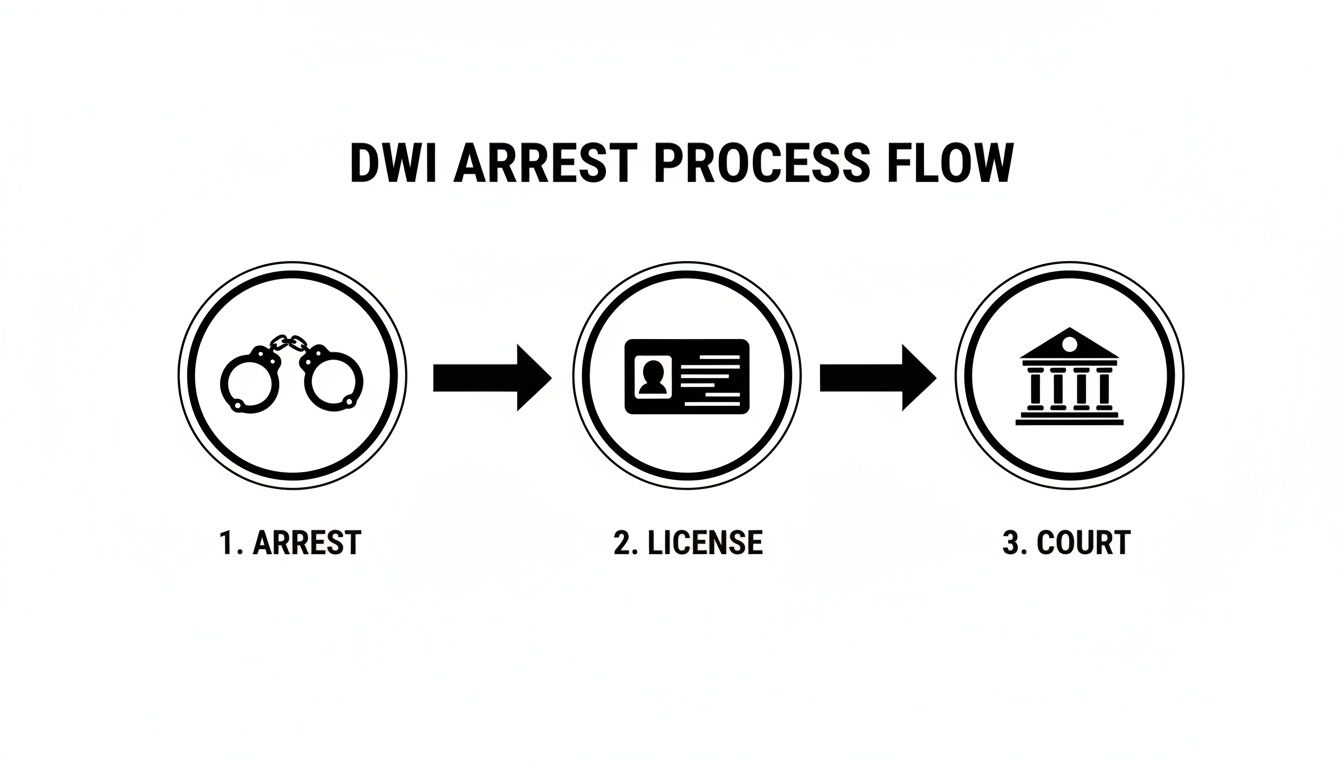
As you can see, the process to suspend your license starts right away, at the same time as the court case. You have to fight both at the same time.
The Seven-Day Rule You Absolutely Cannot Ignore
Think of losing your license as an automatic punishment. In Arkansas, the state can take your license just for being arrested for DWI. The good news is you have the right to fight this. The bad news? You have very little time to do it.
You have exactly seven days from the date of your arrest to ask for a DFA hearing. If you miss this deadline, you lose your right to have a hearing, and your license will be suspended automatically. There are no excuses or second chances.
This deadline is strict. It doesn’t matter if your court case is later dropped or you are found not guilty—if you miss the seven-day window, you have already lost the fight for your license. This is the biggest and most costly mistake people make after a dwi 1st offense arkansas arrest.
What Is a DFA Hearing?
This hearing is not a trial to see if you broke the law. The goal is not to prove you are guilty of a crime. Instead, a person called a hearing officer looks at a few specific questions about your arrest.
Here is what the hearing officer wants to know:
- Good Reason to Stop You: Did the police officer have a good reason to think you were driving drunk in the first place?
- Legal Arrest: Was the arrest done correctly according to the rules?
- Alcohol Test: Did a test show your blood alcohol content (BAC) was 0.08% or higher, or did you refuse to take the test?
This hearing is your first and best chance to question the state’s reasons for taking your license. A good DWI lawyer can go to the hearing for you, ask the officer questions, and point out any mistakes that could get the suspension stopped.
Why This Hearing Is So Important
Winning the DFA hearing is a very big deal. It means you get to keep your license while your court case is going on. This can keep your life from getting turned upside down. You can still drive to work, school, and do your daily tasks.
Even if you don’t win, the hearing is still very helpful. It makes the police officer tell their side of the story while under oath. This gives your lawyer a “sneak peek” of what they will say in court. It’s a chance to lock them into their story and find weak spots that can be used to help you later in your court case.
Because this is so important and the rules are so strict, you must act fast. Your very first step after a DWI arrest should be to call a lawyer who can ask for the hearing for you and start building your defense.
Understanding First DWI Penalties
If you’ve been charged with a DWI in Arkansas, it’s important to know you are fighting two battles at once. It’s like getting in trouble at school—you face punishment from the principal (the court) and also from your parents at home (the Department of Finance and Administration, or DFA).
One side deals with punishments from a judge in court. The other side deals with what happens to your driver’s license. These two things happen at the same time, and the punishments can add up, making things confusing and expensive. Let’s break down what you are facing.
Punishments from the Court
If you are found guilty in court, a judge will give you a sentence based on Arkansas law. These punishments are meant to make you pay for the mistake and stop it from happening again.
Think of these as rules you must follow. If you don’t complete every part of the judge’s sentence—like not paying a fine or skipping a class—you can get into bigger trouble, like being sent to jail.
Here is what a judge can give you for a typical first-time DWI:
- Jail Time: The idea of jail is scary, but it doesn’t always happen. The law says a judge can sentence you to anywhere from 24 hours to one full year in jail. However, a good lawyer can often find other options instead of jail, especially if nothing extra bad happened in your case.
- Fines and Court Costs: This will cost you money. Fines are between $150 and $1,000, but that’s just the start. You also have to pay court costs, which can easily double that amount.
- Required Alcohol Classes: You will be ordered to go to and finish a special class about alcohol and driving safety. You have to pay for this class yourself. It is meant to teach you about the dangers of drunk driving.
It’s important to know that some things can make these punishments much worse. For example, if your Blood Alcohol Content (BAC) was very high (0.15% or higher) or if you had a child under 16 in the car, the smallest punishments you face will be tougher.
Punishments from the DFA
Separate from the court, the Arkansas DFA has its own set of punishments that are all about your ability to drive. These punishments start almost right after you are arrested—long before you go to court. They happen if you either fail an alcohol test or refuse to take one.
The DFA’s main job is to keep the roads safe. Their goal is to get drivers who might be drunk off the road quickly, without waiting for the court case to finish.
To help you see the difference, here is a quick look at where the punishments come from.
Arkansas First DWI Punishments at a Glance
| Type of Punishment | What It Usually Is | Who Gives It? |
|---|---|---|
| Jail Time | Up to one year in county jail. | The Court |
| Fines | $150 – $1,000 plus court costs. | The Court |
| License Suspension | Six-month suspension for a failed test. | The DFA |
| Ignition Interlock | You must use this device to drive while suspended. | The DFA |
| Alcohol Classes | You must go to a state-approved class. | The Court |
As you can see, you have to follow the rules from both the court and the DFA to move on from this.
Understanding a Suspended Driver’s License
The first punishment from the DFA you will face is having your driver’s license suspended. For a first DWI where you fail an alcohol test (a BAC of 0.08% or higher), your license will automatically be suspended for six months.
This is more than just a hassle; it can mess up your whole life. Suddenly, getting to work, picking up your kids, or going to the grocery store becomes a big problem. It’s a punishment that affects your whole family.
The Ignition Interlock Device Rule
So, how can you drive during those six months? Arkansas law says you must put an Ignition Interlock Device (IID) in your car to get a special license to drive. This device is like a breathalyzer that is connected to your car’s engine.
Here’s how it works:
- Starting the Car: Before you can start your car, you have to blow into the IID. If it senses any alcohol, your car will not start.
- Tests While Driving: The device will also ask you to blow into it at random times while you are driving to make sure you are still sober.
You have to pay for everything related to the IID, from putting it in your car and renting it each month to having it taken out. These costs can add up to hundreds or even thousands of dollars. For a first-offense DWI in Arkansas, using an IID is not a choice—it’s something you must do if you want to drive at all during your suspension.
The True Cost of a First DWI Conviction
When a court gives out the punishment for a first DWI, most people focus on the fine, which is between $150 and $1,000. But that’s just the beginning. The real cost of a first DWI in Arkansas is like a snowball rolling downhill—it gets bigger and bigger, much faster than most people think.
Those court fines are just the start. Being found guilty starts a chain of other costs you must pay. It’s like buying a ticket to a concert—the price on the ticket looks okay, but after you add all the extra fees and taxes, the final price is much higher.
Looking at the Hidden Costs
To really understand how much money this will cost you, you have to look beyond the court fine. A conviction means you will be paying for many different required services and programs.
Here’s a better idea of what you will likely have to pay for:
- Lawyer Fees: Hiring a good DWI lawyer is an important investment, but it costs a lot of money upfront.
- Alcohol Education Classes: The court will order you to finish an alcohol class or treatment program, and you have to pay for it yourself.
- License Fees: After your license suspension is over, you have to pay fees to the DFA to get your real driver’s license back.
- Ignition Interlock Device (IID): If you are allowed to drive, you have to pay to have an IID put in your car, pay for it every month, and pay to have it taken out. This alone can cost more than a thousand dollars a year.
These costs add up fast. What looked like a small fine has now turned into a problem that costs thousands of dollars. And we haven’t even talked about the biggest long-term cost yet: your car insurance.
The Huge Jump in Your Car Insurance
Once you have a DWI on your record, your insurance company will see you as a “high-risk” driver. This is where the real money trouble begins, and it lasts for years. It is very common for insurance payments to double or even triple and stay that high for a long, long time.
That price hike alone can cost you thousands of extra dollars over the next three to five years. For many people, this becomes the most expensive part of the whole thing.
What Is the Grand Total?
When you add everything up—the fines, lawyer fees, class costs, and much higher insurance payments—the total cost is huge. It is not a lie to say that a single DWI arrest and conviction in Arkansas can cost between $5,000 and $20,000. This amount doesn’t even include money you might lose from missing work for court dates. This is a big deal in a state that has had problems with drunk driving. In fact, some reports have put Arkansas in the top ten states for deaths caused by drunk driving. You can learn more about how Arkansas is trying to make roads safer on the Toward Zero Deaths Arkansas website.
The lesson is simple: A DWI conviction is one of the most expensive mistakes you can make. The long-term money problems show why it’s so important to get a strong legal defense right from the start.
To avoid future legal trouble and costs, you can take real steps like these expert tips on how to stop drinking alcohol. Understanding the true cost makes it clear that fighting the charge is not just about staying out of jail; it’s about protecting your money for years to come.
Finding Your Way Through the Arkansas Court System
Going to court for the first time can feel like being in a new country without a map. The words are different, the rules are confusing, and what happens there is very important. Let’s break down the journey of an Arkansas DWI case into simple, clear steps.
It all starts with your first day in court, which is called an arraignment. This is not your trial. It’s a short, official meeting where a judge reads the charges against you and you give your first answer, called a plea. For a DWI 1st offense in Arkansas, your lawyer will almost always enter a plea of “not guilty” for you. This is an important step—it doesn’t mean you’re lying. It just protects all your legal rights and gives your lawyer the time they need to study your case and build a defense.
After the arraignment is over, your case moves into the pre-trial part. This is where the real work begins.
The Pre-Trial Part: Where Your Case Is Built
Think of the pre-trial stage like a team watching game videos before a big game. This is where your lawyer and the prosecutor share all their information in a process called “discovery.” Your lawyer will get every piece of evidence the state plans to use against you—the police report, the officer’s notes, and any videos from the police car or officer’s camera.
During this time, your lawyer looks at every detail, searching for weak spots in the prosecutor’s case. This is also when deals are made. A good lawyer can often work out a good deal that might lower the charges or the punishments, all without having to go through a stressful trial.
A big part of the pre-trial plan is filing legal papers called motions. These are official requests made to the judge. For example, if the breathalyzer machine wasn’t working right or if the officer had no legal reason to stop you, your lawyer will file a “motion to suppress” to ask the judge to throw that evidence out.
It is very, very important to show up for every court date. Understanding the serious consequences of missing a court date is a must. If you miss a court date, a warrant can be put out for your arrest, and you could face new charges, making your problems even worse.
Common Ways to Defend an Arkansas DWI Case
Remember, being arrested is not the same as being found guilty. The prosecutor has the very hard job of proving every single part of their case “beyond a reasonable doubt.” A good defense lawyer knows exactly how to find holes in the state’s evidence to create that doubt.
Here are a few common ways to fight the charges:
- Questioning the Traffic Stop: A police officer can’t just pull you over for no reason. They need a real, legal reason. If they can’t explain why they stopped you, any evidence they found after that could be thrown out of court.
- Questioning the Roadside Tests: These roadside tests are not always accurate. Being nervous, having bad balance, a medical problem, or even standing on a sloped road can make a sober person “fail.” We can argue about how the tests were given and what the results really mean.
- Questioning the Alcohol Test Results: Breathalyzers are tricky machines that need to be checked, cared for, and used in a very specific way. If the police department missed a step or the officer wasn’t trained correctly to use the machine, the results might not be allowed in court.
What Happens If Your Case Goes to Trial
If you and your lawyer can’t make a fair deal with the prosecutor, your case will be set for a trial. This is when both sides present their case to a judge or a jury. The prosecutor will have witnesses, usually the police officer who arrested you, speak against you. Your lawyer gets to ask them questions to find parts of their story that don’t match up and to challenge what they did.
After all the evidence has been shown, the judge or jury will think about it and decide if the prosecutor has proven their case. This whole process, from the first court date to the final decision, can take several months. Having an experienced guide to help you and protect you every step of the way is extremely important.
How a DWI Defense Attorney Can Help You
Trying to handle a DWI charge by yourself is a very big risk. The legal system is confusing, and one wrong move can cause problems that follow you for years. This is why having a good DWI defense lawyer on your side is so important—they become your guide and your protector through the whole thing.
A good lawyer does much more than just speak for you in court. Right away, they start working on things that have short deadlines, like filing the paperwork for your license hearing within that very short seven-day window. Missing this deadline means you could lose your license automatically, so this first step is very important.
After that, the real work begins as they start a full investigation into your case.
Looking at Every Detail
Your lawyer acts like a private detective, looking for any weak spots in the case the prosecutor is building against you. They never just believe what the police report says. Instead, they take apart every piece of evidence.
This deep look includes:
- Looking at the traffic stop: Did the officer have a good, legal reason to pull you over in the first place?
- Watching the camera footage: Does the officer’s story match what the video really shows?
- Checking the breathalyzer records: Was the machine working correctly and checked regularly? Arkansas has very strict rules for this.
This is where many DWI cases are won. If your lawyer can find just one big mistake in how the police handled things, it could get important evidence thrown out, which makes your chances much better.
A local lawyer who knows the courts, judges, and prosecutors in the area has a big advantage. They know how things usually work and can build a defense that makes sense to the people who will decide your case.
Protecting Your Freedom and Future
Besides the investigation, your lawyer’s main job is to fight for the best possible result for you. For a dwi 1st offense arkansas, this often means working to get the punishments lowered. You can learn more about what a DWI defense attorney does in our detailed guide.
A lawyer can argue for other options instead of jail, like doing work for the community or going to an alcohol education class. They might also be able to make a deal with the prosecutor to change the DWI charge to something less serious. This would mean lighter punishments and a much smaller mark on your record.
Hiring the right lawyer isn’t just another bill to pay—it’s an investment in protecting your freedom, your money, and your future.
Common Questions About a First DWI in Arkansas
Getting arrested for a dwi 1st offense arkansas can make your head spin with questions. It’s a confusing and scary time, but getting clear answers to your biggest questions is the first step to getting back on track. Let’s answer some of the most common worries we hear from our clients.
Will I Definitely Go to Jail?
The thought of going to jail is often the first thing people think about, and it’s scary. But for a first-time offense, it doesn’t happen automatically. The law says a judge can give a sentence of up to one year in jail, but judges have many choices. This is especially true if nothing extra bad happened, like a car crash or having a very high Blood Alcohol Content (BAC).
A good lawyer’s job is to argue for other options instead of jail. We can often make a deal for things like community service, required alcohol education classes, or an alcohol safety check-up. The goal is to show the court that you understand how serious this is and that you are not a danger to others.
Can I Refuse a Breathalyzer Test?
You can say no to blowing into a breathalyzer, but this choice causes its own serious and immediate problems. This is because of Arkansas’s “implied consent” law. This law basically means that just by having an Arkansas driver’s license, you have already agreed to take an alcohol test if a police officer has a good reason to think you are driving drunk.
If you refuse the test, your license will be taken away right away for much longer than if you had just failed it. Plus, it doesn’t mean you won’t be charged. The prosecutor can still charge you with DWI using other evidence, like what the officer saw, how you looked and acted, and how you did on the roadside tests.
In Arkansas, a DWI conviction is permanent. Unlike some other crimes, it cannot be hidden or removed from your record. It will show up on background checks for the rest of your life.
How Long Will a DWI Stay on My Record?
This is a tough question, and it shows just how serious these charges are. In Arkansas, a DWI conviction stays on your criminal record forever. It is not a crime that can be sealed (hidden) or expunged (removed) later on.
This permanent record can follow you for years. It can cause problems when you are trying to get a job, a special license for work, or even rent an apartment. Because the results last for life, it is extremely important to build the strongest defense you can from the very beginning and do everything possible to avoid being convicted.