
If you get in trouble for driving under the influence in Arkansas, it can feel scary and confusing. But the main idea is simple. A DWI, which means Driving While Intoxicated, is when you get caught driving a car while drunk or high. This includes alcohol, drugs, or anything else that makes it unsafe for you to drive.
Getting a DWI is a big deal in Arkansas and can cause problems for a long time.
What a DWI Means in Arkansas

When people hear “DWI,” they usually think of drunk driving. That’s a big part of it, but the law in Arkansas is actually about being intoxicated. This doesn’t just mean you had too much to drink. It means any substance that messes up your brain, your ability to move, or how fast you react when you’re driving.
This is one of the most important things to know about AR DWI laws. It means even things you’re allowed to have, like medicine from a doctor, can get you in serious trouble if they make you a bad driver.
It’s More Than Just Alcohol
Think of your driving skill like a clean window. Everyone knows alcohol can make that window blurry. But lots of other things can make it blurry too, and Arkansas law is very serious about that.
You can get a DWI if you are impaired by:
- Illegal Drugs: This is the easy one to understand, like marijuana or cocaine.
- Prescription Medicine: Just because a doctor gave it to you doesn’t mean it’s okay to drive. If your medicine for pain, sleep, or anxiety affects your driving, you can get a DWI.
- Store-Bought Medicine: Even simple allergy or cold medicine can be a problem. If it makes you sleepy and you can’t drive safely, it can lead to a DWI.
The police don’t have to prove the drug was illegal. They just have to prove it made you unable to drive your car safely.
In Arkansas, the law cares most about being impaired. If something you took—anything—made it hard for you to control your car, you can be found guilty of DWI.
To make it simple, here’s a quick look at the main ideas.
Arkansas DWI Basics
| Word | What It Means in Simple English |
|---|---|
| DWI | Driving While Intoxicated. This is the official name for the charge in Arkansas. |
| Intoxicated | Being affected by alcohol or drugs so that it’s not safe for you to drive. |
| Impaired | When your body and brain don’t work right, making it hard to drive safely. |
Understanding these simple words is the first step to figuring out what’s happening.
DWI vs. DUI: What’s the Difference?
You might hear people use “DWI” and “DUI” (Driving Under the Influence) like they’re the same thing. In some states, they are different charges with different punishments.
But in Arkansas, it’s much simpler.
For adults, the only official legal name is DWI (Driving While Intoxicated). You might see “DUI” on a sign or hear a friend say it, but the charge on your police papers will be a DWI. This makes things less confusing for everyone.
Understanding BAC and the Legal Limits
When people talk about DWI laws in Arkansas, you’ll hear the letters BAC a lot. This stands for Blood Alcohol Concentration. If you want to know how the state decides if you’re “intoxicated,” you have to understand BAC.
Think about putting a drop of food coloring in a glass of water. The color spreads through the water. Alcohol does the same thing in your blood. BAC is just a way to measure how much alcohol is in your blood. It’s shown as a percentage. The higher the number, the more alcohol is affecting your brain and making it unsafe for you to drive.
The Numbers That Matter
Arkansas law is very clear about the BAC limits. These aren’t just ideas; they are the rules. If your BAC is at or over these limits, the law says you are intoxicated. This means the police don’t need much more proof that you were impaired.
The limits are different depending on your age and what you’re driving:
- 0.08% for Most Adults: This is the magic number for anyone 21 or older driving a regular car.
- 0.04% for Commercial Drivers: If you drive a big truck for work, the limit is half as much. The rule is tougher because an impaired driver in a giant truck is extremely dangerous.
- 0.02% for Drivers Under 21: Arkansas has a “zero tolerance” rule for young drivers. This limit is so low that even one beer could put a young person over the legal limit.
These numbers are important because they give police a clear, scientific way to measure intoxication.
Can You Get a DWI Below the Limit?
This is one of the biggest and most dangerous mistakes people make about Arkansas DWI laws. Many people think, “As long as I’m under 0.08%, I’m safe.” That is completely wrong.
The real question in a DWI case is whether you were impaired. A BAC of 0.08% or higher is just a fast way to prove it. You can still be arrested and found guilty of DWI with a much lower BAC, or even with no alcohol test at all if you used other drugs.
A police officer can arrest you for DWI just based on what they see. If you’re swerving, talking funny, or can’t pass a walking test, that can be enough. The law is made to punish people who are too impaired to drive safely, no matter what a machine says.
The reason for this is simple: the results are terrible. Across the country, about 34 people die every single day in drunk-driving crashes. That’s one person killed every 42 minutes. In 2023, there were 12,429 deaths from drunk driving in the U.S. In fact, drivers with a BAC of 0.08% or higher are in about 30% of all deadly car crashes.
Sadly, young drivers between 21-24 are in 29% of all deadly drunk driving crashes. You can see more of these sad numbers about driving safety at JMW.co.uk. This is exactly why Arkansas law looks at how you’re acting, not just a number from a machine.
What Happens if You’re Found Guilty of DWI
Getting charged with a DWI is one thing, but being found guilty is where the real trouble starts. The punishments in Arkansas law aren’t small; they get much worse each time you get a DWI. It’s like climbing a ladder, and every step up makes the fall worse.
A guilty verdict starts a long and expensive journey. You’ll have to pay big fines, you might go to jail, and you’ll lose your freedom to drive. Understanding what could happen is the first step in dealing with a DWI under AR DWI laws.
This picture shows how the legal BAC limit is different for different drivers.
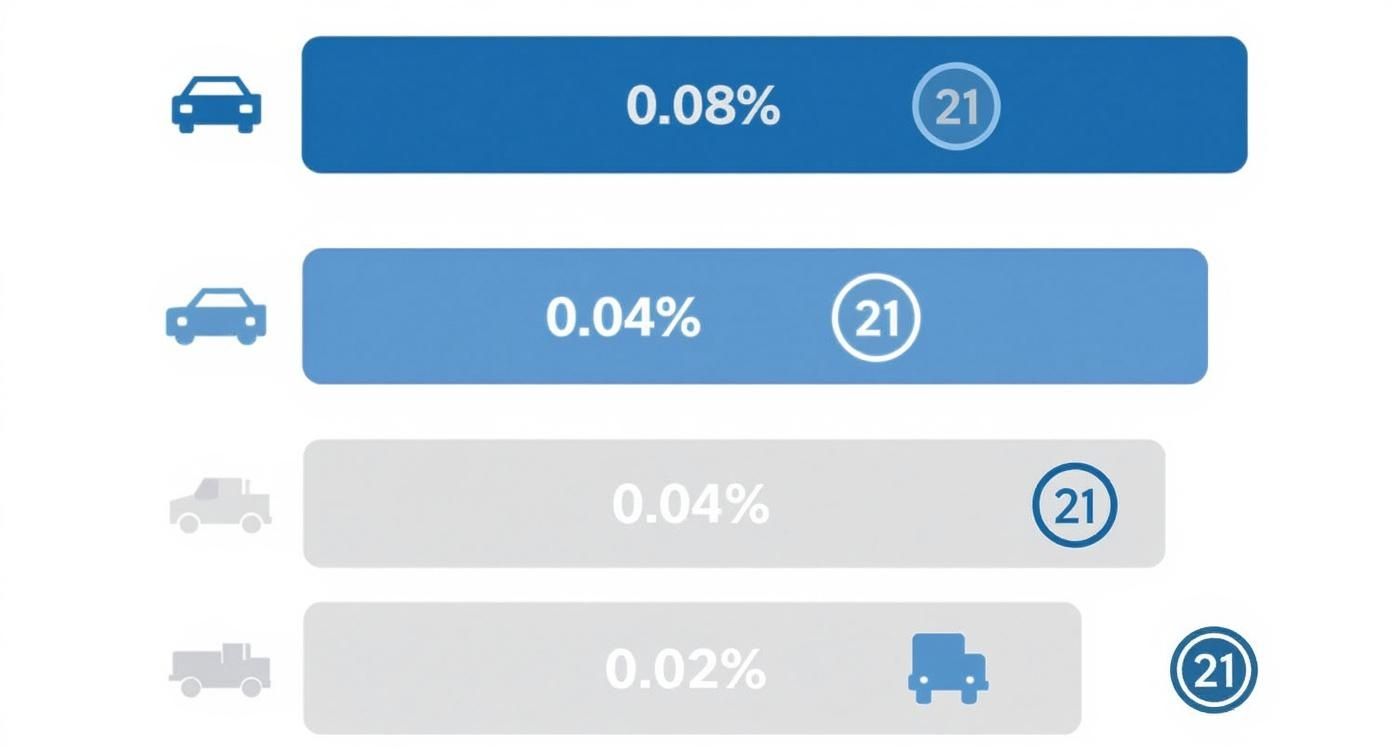
As you can see, the limit isn’t the same for everybody. The rules are much stricter for professional drivers and anyone under 21.
Punishment for a First DWI
A first-time DWI is a serious wake-up call. A judge can decide on the exact punishment, but the rules are meant to make sure it doesn’t happen again.
Here’s what you can expect for a first DWI:
- Jail Time: You could go to jail for 24 hours up to one year. Sometimes, a judge might let you do community service instead of jail.
- Fines: The fines are between $150 and $1,000. On top of that, you’ll have to pay court fees, which can add hundreds more.
- License Suspension: You will lose your driver’s license for six months.
- Classes: The state will make you take a class about alcohol and driving safety.
Also, most people will have to get an Ignition Interlock Device (IID) put in their car. This is like a breathalyzer for your car. You have to blow into it to prove you’re sober before the car will start.
Harsher Punishment for a Second DWI
Getting a second DWI within five years of the first one changes everything. The law sees this as a pattern of dangerous behavior, and the punishments get much tougher.
A second DWI conviction tells the judge that the first punishment didn’t work. The results are much more serious, designed to stop you from driving and cost you a lot of money so it doesn’t happen a third time.
This is what a second conviction usually means:
- Jail Time: The shortest jail time is now seven days, and it can be up to one year.
- Fines: The fines get much bigger, from $400 to $3,000, plus court fees.
- License Suspension: Your license will be taken away for 24 months—that’s two full years.
- Community Service: You will be ordered to do at least 30 days of community service.
You will still need an Ignition Interlock Device, and you’ll probably have it for a much longer time. Getting your life back to normal becomes very hard.
Severe Punishment for a Third DWI
A third DWI in five years is a huge problem that can change your life forever. The courts now see you as a big risk to other people’s safety. The punishments are designed to get you off the road for good.
For a third DWI, the punishments are huge:
- Jail Time: You have to spend at least 90 days in jail, and it could be up to a year.
- Fines: The fines are very high, from $900 to $5,000.
- License Suspension: You lose your license for 30 months, which is two and a half years.
- Community Service: The court will order at least 90 days of community service.
At this point, you’ll also have to go to a special program to treat alcohol problems. The state might even take your car away. The table below shows how quickly the punishments get worse.
Arkansas DWI Punishments by Offense
Here’s a simple chart to see how much worse the punishments get for a DWI in Arkansas.
| Number of DWIs | Possible Jail Time | Range of Fines | How Long You Lose Your License |
|---|---|---|---|
| First Time | 24 hours to 1 year | $150 – $1,000 | 6 months |
| Second Time | 7 days to 1 year | $400 – $3,000 | 24 months |
| Third Time | 90 days to 1 year | $900 – $5,000 | 30 months |
As the chart shows, the state gets very serious when people get more than one DWI. Each time, the punishment is more severe and makes life much harder.
How Implied Consent Affects Your License
When you drive a car in Arkansas, you’re not just agreeing to follow the traffic signs. You’re also agreeing to something called Implied Consent. This is a rule that surprises a lot of people when they get pulled over for a DWI.
Think of it like this: getting your driver’s license is like signing a contract. A part of that contract says that by driving on Arkansas roads, you automatically agree to take a chemical test (like a breath, blood, or pee test) if a police officer thinks you’re driving drunk.
You don’t get to read this contract again on the side of the road. Just by driving, you’ve already agreed to it.
The Two Separate Fights You Have
This is where a DWI arrest gets tricky. It starts two different legal fights that happen at the same time. It’s like getting sued by two different people for the same thing.
The Criminal Case: This is the one you see on TV. It happens in a criminal court, where a lawyer for the state has to prove you are guilty of DWI. The punishments here are big: jail time, large fines, and a criminal record that follows you forever.
The Administrative Case: This fight isn’t in a courtroom. It’s handled by the Arkansas Office of Motor Vehicle (OMV). They only care about your permission to drive. This isn’t about whether you’re guilty or innocent; it’s about what happens to your license.
These two cases happen at the same time. Winning one doesn’t mean you’ll win the other.
Saying No to the Test: A Choice with a Punishment
So, can you say “no” to the breathalyzer test? Yes, you can. But saying no has its own serious and automatic punishments that have nothing to do with whether you were actually drunk.
When you refuse to take a chemical test, you’re breaking that “Implied Consent” agreement you made when you got your license. As a punishment for breaking that promise, the OMV will take away your license. This often lasts for longer than if you had just taken the test and been found guilty of a first-time DWI.
This is very important to understand. You could be found not guilty of the DWI in court and still lose your license just because you refused the test. The license suspension from the OMV isn’t for the DWI—it’s for saying no to the test.
What Happens if You Refuse the Test
The punishments for refusing a test are quick and guaranteed. For a first-time refusal in Arkansas, you will automatically lose your driver’s license for 180 days.
On top of that, your refusal can be used against you in your criminal case. The state’s lawyer will likely tell the jury that you said no to the test because you knew you were drunk and were trying to hide it. That can make it much harder to defend yourself against the DWI charge.
It’s a tough situation. Taking the test might give the police the proof they need to say you’re guilty, but refusing it comes with its own guaranteed punishments. This is why understanding the AR DWI laws about Implied Consent is so important for every driver in Arkansas.
When a DWI Becomes a Felony in Arkansas
Most DWI charges in Arkansas are called misdemeanors. While these are very serious, they don’t have the same life-changing impact as a felony. But it is possible for a DWI to become a felony, and when that happens, the punishments get much, much worse.
Think of it this way: a misdemeanor DWI is a big warning sign. A felony DWI means the legal system sees you as a major danger to other people, and the punishments show that. There are two main ways a DWI can become a felony in Arkansas: by having too many past DWIs or by hurting or killing someone.
Too Many DWIs and the Felony Line
Arkansas law has a clear rule for repeat DWIs. The punishments get worse with each one, but the fourth one is a game-changer.
A fourth DWI within a ten-year period is automatically a felony. This is the big one. The law is basically saying that after three convictions, the punishments didn’t stop the bad behavior, so it’s time for a much more serious consequence.
The felony level gets worse from there:
- Fourth DWI: This is a felony.
- Fifth DWI: This becomes a Class D Felony.
- Sixth (or more) DWI: This becomes a Class C Felony.
It’s important to know that they look back ten years. The state’s lawyer will check your driving record for the last decade to see how many DWIs you have.
A felony conviction is more than just jail time. It’s a label that stays with you forever and can take away rights like owning a gun or voting. It makes it harder to get a good job, find a place to live, or even get a loan for the rest of your life.
Causing a Crash That Hurts or Kills Someone
You don’t need to have past DWIs for it to become a felony. If you cause a crash while you are intoxicated and it seriously hurts or kills someone, even a first-time DWI can become a felony right away.
At this point, the case isn’t just about drunk driving—it’s treated like a violent crime.
- Serious Injury: If your drunk driving causes a crash that seriously hurts someone, you could be charged with a Class D Felony.
- Death: If someone is killed, the charge can become Negligent Homicide, a Class B Felony, which can mean a long time in prison.
This isn’t just an Arkansas rule; countries all over the world agree that drunk driving is dangerous. Some places are even tougher. For example, South Korea has laws that can send a person to prison for life if they kill someone in a drunk-driving crash. You can learn more about how different places handle this by reading about drunk driving law by country.
A felony DWI charge changes everything. It’s no longer about fines and a lost license; it’s about your future being changed forever by a criminal record and possibly losing your freedom for years.
What to Do After a DWI Arrest
The first few moments after being arrested for a DWI are scary and confusing. It feels like your world is spinning, but what you do in the next few hours and days can make a big difference. The most important thing to do is stay calm, be polite, and remember your rights.
You have the right to stay quiet, and you should use it. Anything you say—even if you’re trying to be helpful or explain what happened—can be used to hurt your case later. Just politely say that you want to talk to a lawyer before you answer any questions. This doesn’t mean you’re guilty; it’s just a smart thing to do.
The Clock on Your Driver’s License Is Ticking
As soon as you are arrested, a very important timer starts. This deadline has nothing to do with your criminal case in court; it’s all about your license.
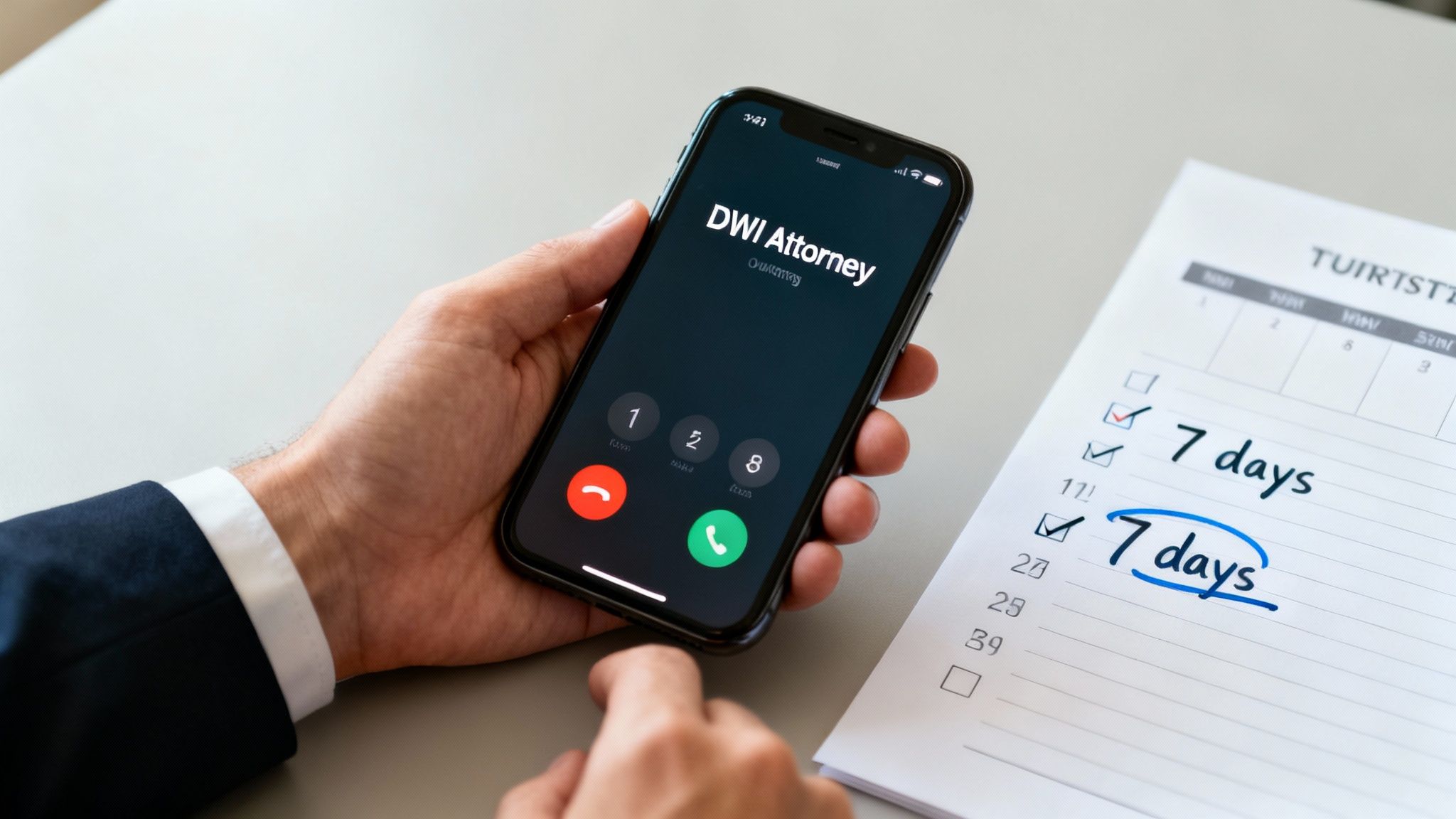
In Arkansas, a DWI arrest automatically starts the process of suspending your driver’s license. From the day you are arrested, you have only seven days to ask for a hearing with the Office of Motor Vehicle (OMV) to fight for your license.
If you miss this seven-day deadline, you automatically lose your license for the whole suspension time. It doesn’t matter if you are later found not guilty of the DWI—the license punishment will still happen.
This is a key detail many people miss. The OMV hearing is a totally separate fight from your criminal case. You could win in court and still not have a license just because you didn’t file the right papers in time.
What to Do in the First 24 Hours
After the arrest, you’ll be taken to the police station. They will take your fingerprints, your picture (mugshot), and your personal information. Then you will either be let go or have to pay money (bail) to get out.
Here’s what you need to do right away:
- Call a Lawyer: This is the first and most important thing to do. A good DWI lawyer can start working right away to protect you and, most importantly, ask for the OMV hearing for you.
- Ask for the OMV Hearing: Your lawyer will do the paperwork, but you need to tell them this is your top priority. Missing this deadline is a mistake you can’t fix.
- Write Everything Down: As soon as you can, write down every single detail you remember. What did the officer say? What did you do that day? What was the road like? Your memory can fade fast, and a small detail you remember now could be very important for your defense later.
When dealing with a DWI charge, getting help from a lawyer is a must; lawyers often use tools like legal dictation software to keep track of all the case details.
Why You Need a Lawyer Right Away
The legal system is like a maze, and AR DWI laws have many rules and deadlines that are easy to miss. Trying to handle it by yourself is a huge risk. A good lawyer knows how to check the police’s evidence, talk with the state’s lawyer, and protect your future.
They can explain your choices and start building a strong defense from the very beginning. Finding the right lawyer quickly is something you have to do. To learn more about how to find one, you can read about finding a DWI defense attorney near you. The faster you get help, the better your chances will be.
Common Questions About Arkansas DWI Laws
When you’re dealing with the law in Arkansas, the small details are important. Even after you learn the basics of DWI law, you will probably have more questions. Let’s answer some of the most common ones to help you understand things better.
Can I Get a DWI for My Prescription Medicine?
Yes, you definitely can. This is a surprise to a lot of people. In Arkansas, a DWI isn’t just about alcohol; it’s about being “impaired” by any substance. That includes medicine your doctor gave you that is perfectly legal.
Think about it like this: the law cares about if you can drive a car safely. If that new pain medicine, anxiety pill, or even a strong sleeping pill messes with your brain, your movements, or your reaction time, you are impaired. Having a prescription from a doctor won’t save you if you’re not safe to be driving.
What Is an Ignition Interlock Device?
An Ignition Interlock Device (IID) is like a small breathalyzer that is connected to your car’s engine. It’s pretty simple. Before the car will start, you have to blow into it to prove you haven’t been drinking. If it senses any alcohol, your car won’t start. It’s that simple.
In Arkansas, an IID is a common punishment for most DWI convictions, even for a first time. The judge will almost certainly make you get one if your BAC was high, if you refused to take a breath test at the police station, or if you have other DWIs. It’s the state’s way of letting you keep driving for work or school while making sure you are doing it sober.
An IID is a daily reminder of what happens when you get a DWI. It limits your freedom and costs you money every month, showing how serious the state is about stopping drunk driving.
Can a DWI Be Taken Off My Record?
This is one of the hardest things to accept. Getting a DWI removed from your record in Arkansas is a very long and hard process. This process is called expungement or sealing. You can’t even ask for it until five full years after you have finished everything—your probation, paying fines, finishing classes, all of it.
There’s a good reason it’s so hard. The state uses old convictions to make the punishments for new DWIs even worse. That conviction stays with you for a long time. For people who want to understand complicated legal papers more easily, using new tools like AI legal document analysis can be helpful. This is exactly why it is so important to fight the charge from the very beginning with a good lawyer.