
In Arkansas, driving after drinking too much is called a DWI, which stands for Driving While Intoxicated. The laws are very strict, and getting in trouble for it can change your life. If a police officer pulls you over and finds that the amount of alcohol in your body is 0.08% or more, you will be arrested. That moment starts two different legal problems for you: one in a criminal court and another with the state to try and keep your driver’s license.
What Happens Right After a DWI Arrest in Arkansas

Seeing police lights flashing in your mirror is a scary feeling. It can make you nervous and confused. But if you know what is going to happen next, it can help you handle the situation better. These first few minutes are very important for everything that comes after.
It all starts when a police car pulls you over. An officer can’t just stop you for no reason. They need a good reason, called “reasonable suspicion.” This could be something like you were speeding, weaving in your lane, or didn’t stop at a stop sign. Once you are stopped, if the officer thinks you have been drinking, they will start a DWI investigation.
The Roadside Investigation
This is when things get serious. The officer will ask you questions, like “Where are you coming from?” or “Have you been drinking tonight?” They are also trained to look for signs that you might be intoxicated, like slurred speech, the smell of alcohol, or trouble getting your license and registration.
Next, the officer will probably ask you to get out of your car to do some Standardized Field Sobriety Tests (SFSTs). These are like physical challenges to see if you are impaired.
You will likely be asked to do three tests:
- Horizontal Gaze Nystagmus (HGN): The officer will hold up something small, like a pen, and ask you to follow it with your eyes. They are checking to see if your eyes jerk.
- Walk-and-Turn: You will be told to walk nine steps, touching your heel to your toe on each step, along a straight line. Then you have to turn around and walk back the same way.
- One-Leg Stand: This is just what it sounds like. You will have to stand on one foot for about 30 seconds.
The officer uses how you do on these tests, plus anything else they noticed, to decide if they have enough reason, or “probable cause,” to arrest you for DWI.
The Arrest and Chemical Testing
If the officer believes they have enough proof, you will be arrested and taken to the police station. There, they will ask you to take a chemical test to measure the exact amount of alcohol in your blood. In Arkansas, this is usually a breath test, sometimes called a Breathalyzer.
It’s very important to know about Arkansas’s “Implied Consent” law. Just by having a driver’s license, you have already agreed to take a chemical test if you are arrested for DWI. If you refuse to take the test, you will face a tough penalty: your driver’s license will be suspended right away.
The legal limit for Blood Alcohol Concentration (BAC) is 0.08%. It’s interesting to know that this is higher than in many other countries. For example, most places in Europe have a lower limit of 0.05%. This shows how seriously Arkansas takes a DWI charge.
After the test, you will be “booked,” which means they will take your fingerprints and a mugshot. Then, you’ll work on getting released and getting ready for your first day in court. While the process is a little different in every state, you can find some helpful general guidance for immediate post-arrest situations to understand what to do next.
When you’re facing a DWI charge, all the legal words can sound like a different language. Here’s a simple chart to help you understand the words you’ll hear.
Arkansas DWI First Steps At a Glance
| Key Term | What It Means in Simple Terms |
|---|---|
| DWI | Driving While Intoxicated. This is the legal name in Arkansas for what many people call a DUI. |
| BAC | Blood Alcohol Concentration. This is the amount of alcohol in your blood. The legal limit is 0.08%. |
| Implied Consent | The rule that says because you have a driver’s license, you agree to take a chemical test if you’re arrested. Saying no means you lose your license. |
| SFSTs | Standardized Field Sobriety Tests. These are the balance and coordination tests the officer gives you on the side of the road. |
| Probable Cause | The good reason an officer needs to believe a crime has been committed before they can arrest you. |
Knowing these basics is a good start, but it’s just the beginning of a long legal process.
Facing Two Separate Cases After a DWI Arrest
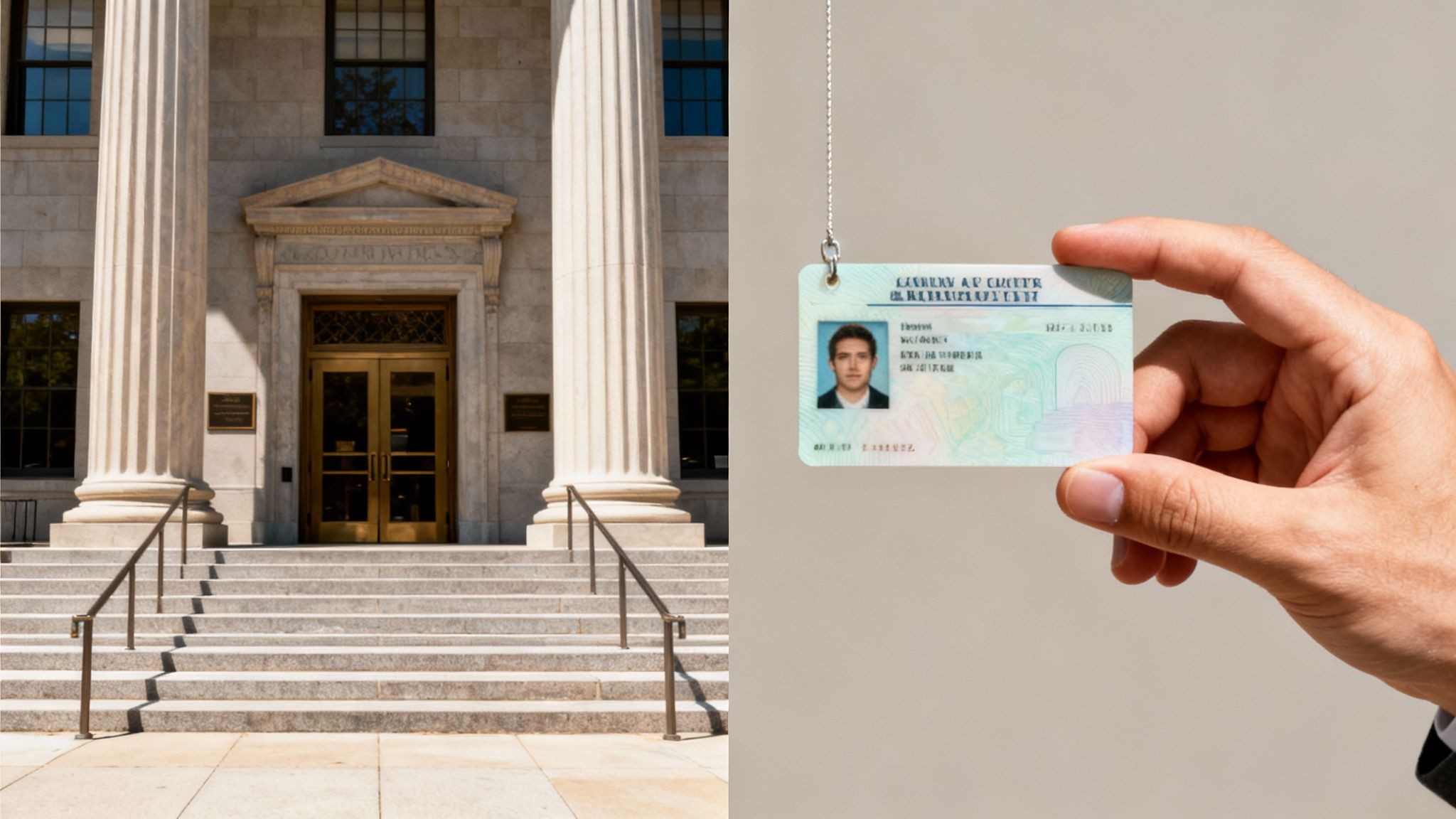
One of the most confusing things after a DWI arrest in Arkansas is finding out you have to fight two battles, not just one. The moment you are arrested, your case is split into two separate parts.
Think of it like this: you have the criminal court on one side and the state’s license agency on the other. Each one has its own rules, its own deadlines, and its own serious punishments. It’s very important to understand how to handle both of these problems from the start.
These two cases happen at the same time, and what happens in one doesn’t decide what happens in the other. It’s possible to win your criminal case in court but still lose your driver’s license. This is a very important point that shapes how a good DWI defense works.
The Criminal Case: Your Day in Court
The criminal case is what most people think of with a DWI charge. This is where you go to court, and a prosecutor tries to prove that you were driving while intoxicated.
The punishments can be serious and depend on your past record. If it’s your first time, the penalties will be different than if you’ve had a DWI before. Arkansas law has tougher punishments for each DWI you get, which is why having a strong defense is so important.
If you are found guilty, you could face punishments like:
- Jail Time: Yes, even for a first offense, you could spend time in jail.
- Big Fines: These can cost you hundreds or even thousands of dollars.
- Required Classes: You will likely have to take a class about alcohol and drug safety.
- Ignition Interlock Device: You might have to put a device in your car that tests your breath for alcohol before it will start. You have to pay for this yourself.
This is where your lawyer fights for you. They will challenge the proof against you and talk with the prosecutor to protect you and your record.
The Administrative Case: The Fight for Your License
While the criminal case is starting, another urgent fight is already happening over your driver’s license. This isn’t handled by a judge in court. It’s handled by a state office called the Arkansas Department of Finance and Administration (DFA). The DFA’s only job is to decide if you get to keep your license.
This process starts because of the Implied Consent Law.
In Arkansas, when you get a driver’s license, you automatically agree to take a chemical test (like a breath test) if a police officer has a good reason to arrest you for DWI.
If you refuse to take the test, or if you take it and your BAC is over the legal limit, the process to suspend your license starts right away. It doesn’t matter what happens later in your criminal case. This is a separate penalty.
Here is the most important part: you only have seven days from the day you were arrested to ask the DFA for a hearing to fight for your license. If you miss this deadline, your license will be suspended automatically.
Why This Two-Front Battle Matters
Not understanding that there are two separate cases is a big mistake many people make. They focus on their court date and forget that their driver’s license is in danger right now.
A good DWI lawyer knows how to handle both cases at the same time. The first thing they will do is file the paperwork to ask for your license hearing within that short 7-day time limit. At the same time, they start building a strong defense for your criminal case.
Winning in both the criminal court and with the DFA takes a special plan, because the rules are different in each place. Protecting your future means you have to fight on both fronts from the very beginning.
What the Cops Are Looking For: BAC and Chemical Tests
In almost every Arkansas DWI case, everything depends on one number: your Blood Alcohol Concentration, or BAC. This is the number that comes from a police chemical test. It’s the most important piece of evidence the prosecutor will have.
So, what is it? Your BAC is just the percentage of alcohol in your blood. Think about it this way: if you had 1,000 drops of blood, and just one of those drops was alcohol, your BAC would be 0.10%. The legal limit in Arkansas for most drivers is 0.08%. If your test shows that number or higher, you will be charged with a DWI.
But your BAC is not a simple number. It’s always changing based on many things about you. That’s why two people can drink the exact same number of drinks and have very different BAC levels.
Why Your BAC is Unique to You
Your body handles alcohol in its own way. Understanding this is often the key to a good DWI defense. Several things can change your BAC reading.
Here are some of the most common things that affect it:
- Body Weight: A smaller person has less body tissue to soak up alcohol. So, their BAC will usually be higher than a larger person’s after the same number of drinks.
- Gender: Men and women process alcohol differently because of things like body fat and certain body chemicals. This can make a woman’s BAC go up faster and stay high for longer.
- Food in Your Stomach: If you just ate a big meal, the food in your stomach will slow down how fast alcohol gets into your blood. This can keep your BAC lower. An empty stomach does the opposite.
- How Quickly You Drank: Your body starts to break down alcohol as soon as you drink it, but it’s not instant. Gulping down drinks will make your BAC shoot up much faster than sipping one drink over an hour.
These things are why “counting your drinks” is a bad way to guess if you are safe to drive. There are just too many factors.
Not All Drivers Have the Same Limit
While 0.08% is the limit most people know, Arkansas law is much stricter for some drivers. The state does this to keep people safe in situations that are more dangerous.
What is legal for a normal driver on a Saturday night could get someone else a DWI in a different car. The law has different standards for different people.
You need to know these special BAC limits in Arkansas:
- Commercial Drivers: If you are driving a large truck or another big commercial vehicle, the rule is much tougher. The legal limit for you is only 0.04%.
- Drivers Under 21: Arkansas has a zero-tolerance rule for young drivers. For anyone under 21, the legal limit is a very low 0.02%. A single drink could easily put a young person over this limit.
The Tests Police Use to Get a Number
To measure your BAC, an officer will use one of three main chemical tests. Each test has its own rules and, more importantly, can have its own mistakes. A good defense often involves challenging whether these tests were done correctly.
These are the tests you might have to take:
- Breath Tests: This is the test everyone calls the “Breathalyzer.” You blow into a machine that checks the alcohol in your breath to guess your BAC. But these machines can be tricky. They have to be set up perfectly, and things like mouthwash or even some health problems can mess up the results.
- Blood Tests: A blood test is usually seen as the most accurate because it directly measures the alcohol in your blood. But for it to be accurate, everything has to be done perfectly. The blood has to be taken the right way, stored correctly, and tested without any mistakes.
- Urine Tests: This is the least common and least accurate test of the three, especially for alcohol. It’s better at finding drugs than it is at showing a specific alcohol level at the time you were driving.
Looking at the big picture, you can see why these limits are so serious. Data from around the world shows that the U.S. has one of the worst records for deadly crashes involving alcohol. You can discover more insights about these global DUI statistics. For anyone in Northwest Arkansas facing a charge, this shows why a strong defense that questions every piece of evidence is so important.
Navigating the Arkansas Court Process Step by Step
Walking into a courtroom for the first time is scary. The whole process can feel like a confusing maze. But it doesn’t have to be that way. If you understand the steps your DWI case will take, a lot of that fear can go away.
Think of it as a series of stages, and each one has a purpose. Your case moves from one stage to the next, starting with your first court date and ending with either an agreement or a trial. Knowing what happens at each step helps you and your lawyer get ready for what’s next.
Let’s look at a clear map of this journey, from your first appearance to a possible trial, so you know exactly what to expect.
Your First Court Appearance: The Arraignment
The first official stop in your criminal case is the arraignment. This is a short but important court hearing where the judge officially tells you the charges against you.
At the arraignment, the judge will read the DWI charge and ask you how you plead: “guilty,” “not guilty,” or “no contest.” In almost every case, the right thing to say at this point is “not guilty.”
Pleading “not guilty” does not mean you are lying. It’s an important legal step that protects your rights and gives your lawyer time to look into your case. It tells the court that you want the state to prove you are guilty.
The Pre-Trial Phase: Investigation and Negotiation
After the arraignment, your case goes into the pre-trial stage. This is where the real work of building your defense happens. Your lawyer will ask the prosecutor for all the evidence they have against you. This is called discovery. It includes the police report, body camera video, and even the repair records for the breathalyzer machine.
During this time, your lawyer will look closely at all the evidence for any weaknesses. Did the officer have a good reason to pull you over? Were the sobriety tests done correctly? Your lawyer might file papers called motions to challenge the evidence. For example, they could ask the court to throw out the breath test results if the machine wasn’t working right.
A plea bargain is an agreement between your lawyer and the prosecutor to solve the case without a trial. For example, the prosecutor might agree to change the DWI charge to a less serious one, like Reckless Driving, if you agree to plead guilty.
This is also when talks with the prosecutor happen. Depending on how strong the evidence is, your lawyer might talk about a plea bargain. This is a big decision that could lead to a better result than a trial, but you should discuss it carefully with your lawyer.
Understanding the Blood Alcohol Concentration (BAC) limits is key in most DWI cases, as it is often the main piece of evidence.
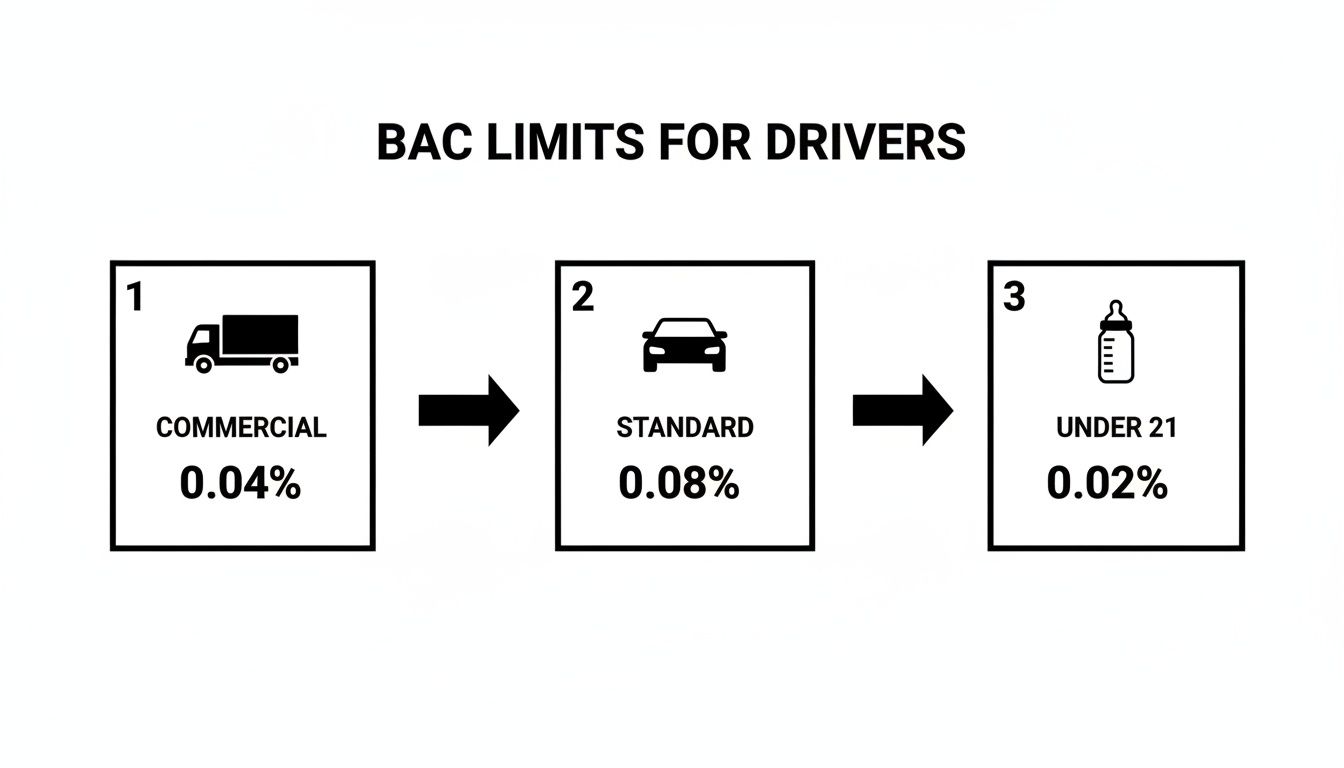
As you can see, 0.08% is the normal limit. But the law is much tougher for commercial drivers and anyone under 21. For those groups, it’s almost a zero-tolerance rule.
What Happens if Your Case Goes to Trial
If you and your lawyer decide not to take a plea deal, your case will be set for a trial. This is your chance to have your case heard by a judge or a group of people called a jury. It is the prosecutor’s job to prove that you are guilty “beyond a reasonable doubt.”
Here’s a quick look at the people in the courtroom:
- The Judge: The judge is like a referee. They make sure everyone follows the rules and decides on legal questions.
- The Jury: A group of people from your community who listen to the evidence and decide if you are guilty or not guilty.
- The Prosecutor: The lawyer for the state of Arkansas. Their job is to show the jury that you are guilty.
- Your Defense Attorney: Your lawyer. They will ask questions of the state’s witnesses, tell your side of the story, and fight for you.
Your lawyer will challenge the prosecutor’s evidence and may have people testify for you. After all the evidence is shown, both sides give their final speeches. The jury then talks privately to make a decision. To do well in these steps, you need a lawyer who really understands local AR DUI laws.
How to Build a Strong DWI Defense in Arkansas
Getting arrested for a DWI can make you feel like your world is upside down. It’s scary, but it’s important to remember one thing: being arrested doesn’t mean you’re guilty. The state has to prove you are guilty. A good lawyer’s job is to check every single piece of their evidence.
Building a strong defense is like taking an engine apart to find a broken piece. We look at every detail, from the moment the police officer first saw your car to the final chemical test. This isn’t about finding a secret “loophole.” It’s about making sure the police followed their own rules and that your rights were protected.
Questioning the Initial Traffic Stop
Every DWI case starts with a traffic stop. If that stop was not legal, everything that happened after—the questions, the tests, the arrest—could be thrown out of court. An officer can’t just pull you over on a hunch. They need a “reasonable suspicion” that you broke a traffic law.
This means they must have seen you do something specific, like speeding, weaving, or not using your turn signal. If their reason is weak, we can ask a judge to throw out the evidence. If the judge agrees the stop was bad, the case is often over.
Think of it like a tree. If the root (the traffic stop) is bad, the whole tree (the DWI case) can’t survive. A defense lawyer’s first job is often to challenge the reason for the stop.
Scrutinizing the Field Sobriety Tests
Let’s be honest: field sobriety tests are not easy. They are physical challenges that many sober people would find hard to do, especially on a dark road with police lights flashing. A big part of a good defense is to look at how these tests were given.
A good lawyer will check several things:
- Were the instructions given correctly? Officers are trained to give instructions in a very specific way. If they make a mistake, the test results may not be valid.
- Did you have any medical issues? Old injuries, problems with balance, or even your age and weight can make it hard to do these tests well.
- Was the test location fair? Trying to walk a straight line on a sloped road or with bright headlights in your eyes is not a fair test.
These tests depend a lot on the officer’s opinion. Our job is to show a judge or jury that they can’t always be trusted.
Challenging the Breathalyzer and Chemical Tests
The number from a breathalyzer—the BAC reading—can feel like final proof. But these machines are not perfect. They are complicated tools that need to be checked and cleaned all the time. The person using them also has to be properly trained.
A defense lawyer will ask for the records for the machine used in your arrest. Has it been checked regularly? Has it had problems before? Was the officer who used it certified? A “no” to any of these questions can make that BAC number seem less reliable.
For blood or urine tests, we look at the “chain of custody.” This is the paper trail that shows every person who touched your sample. If there’s a mistake in that chain, it opens the door to arguments that the sample was mixed up or contaminated.
Drunk driving laws are serious everywhere. You can explore how these laws compare on an international scale to understand how serious these charges are. In Arkansas, a skilled criminal defense lawyer can challenge breath tests, sobriety test results, or mistakes made by the police to help you get a better outcome.
Why a Local DWI Lawyer Is Your Best Defense

Trying to handle a DWI charge yourself is like trying to do surgery after watching a few videos online. You might understand the basics, but you are more likely to make things much worse. That’s why hiring a local lawyer who specializes in DWI cases is the most important thing you can do.
The outcome of your case is not just about what the law says. It’s also about the local court system—the specific people and the way things are done there. A lawyer who is in the Northwest Arkansas courts every day already knows the area very well.
The Advantage of Local Knowledge
Think of it like this: anyone with a map can find their way around a city, but only a local knows the shortcuts to avoid traffic. In the legal world, that kind of inside knowledge is a huge help.
A local DWI lawyer knows the judges and prosecutors in Rogers, Bentonville, and Springdale. They have built relationships with them over the years. This isn’t about special favors; it’s about being known as a professional who is always prepared.
This local knowledge can help your defense in real ways:
- Better Negotiations: A prosecutor is more likely to make a fair deal with a defense lawyer they know and respect.
- Smarter Arguments: A local lawyer knows which arguments work best with a certain judge.
- Smoother Process: They know the local court’s deadlines and rules, which helps avoid simple mistakes that could hurt your case.
More Than Just a Lawyer They’re a Strategist
A good DWI lawyer does more than just talk for you in court. They create a plan for both your criminal case and your driver’s license hearing. They know exactly what evidence to ask for and how to find weaknesses in the state’s case, from the traffic stop to the breathalyzer test.
An experienced local lawyer makes a scary and confusing process easier to handle. They give you a clear plan, protect your rights, and fight for the best possible result to protect your freedom, your license, and your future.
Hiring an expert who specializes in AR DUI laws is the smartest choice you can make. They have the special knowledge and local experience you need. To help you choose, you can learn more about the qualities of a top DWI defense attorney.
Common Questions About AR DUI Laws
If you’ve just been charged with a DWI, your mind is probably racing with questions. It can be scary, but getting clear answers is the first step to feeling more in control. Here are the answers to the most common questions we hear about Arkansas DWI laws.
Let’s get you the information you need right now.
Will I Go to Jail for a First DWI in Arkansas?
It’s possible, but it doesn’t always happen. Arkansas law says you can go to jail for up to one year for a first offense, but judges have other choices.
Things like how high your BAC was, whether there was an accident, and how you behaved with the police can all make a difference. A good lawyer knows how to argue for other options, like community service, to convince the judge not to send you to jail.
Can I Get a DWI Removed From My Record?
Yes, but you have to wait. The process is called expungement. This seals the DWI conviction so most people can’t see it. For most job and apartment applications, it will be like it never happened.
In Arkansas, you have to wait five years after you finish your sentence before you can ask the court to seal your DWI record. You also can’t get into any other trouble during that time. The rules are strict, so getting help from a lawyer is a good idea to make sure it’s done right.
The most important thing to do after a DWI arrest is to call a defense lawyer right away. You have a very short time to act to protect your rights, especially your driver’s license.
What Is the First Thing to Do After a DWI Arrest?
Call a DWI defense lawyer. Right away. This is not just because of the criminal charges. You have only seven days from your arrest to ask for a special hearing. This hearing is your only chance to stop the state from automatically suspending your driver’s license.
If you miss that seven-day deadline, you lose your license. It doesn’t matter what happens in court later on. A lawyer can file the request for you and start protecting you from the very beginning.
This is also why it’s important for a lawyer’s office to be ready to help. When you are on a tight deadline, you need a quick response. Things like knowing how law firm answering services can enhance client communication help make sure that urgent calls like yours get answered quickly, any time of day.