
When a marriage in Arkansas hits a rough patch, you’re faced with a big decision: legal separation or divorce? The terms can be confusing, but the distinction is crucial.
In Arkansas, there is no formal legal status called “legal separation.” Instead, the state offers two primary avenues for couples who decide to live apart: an Absolute Divorce, which permanently ends the marriage, or a Divorce from Bed and Board, which is a court order allowing spouses to live separately while remaining legally married. For the purposes of this guide, we will refer to a Divorce from Bed and Board as Arkansas’s version of legal separation.
This choice isn’t just a matter of semantics. It’s a deeply personal decision, often made by couples who aren’t ready to close the door on their marriage, need to keep a spouse on a health insurance plan, or have religious or personal reasons for avoiding a final divorce.
Choosing Your Path: Divorce from Bed and Board or Absolute Divorce

Navigating marital difficulties is tough, and knowing your options under Arkansas law is the first real step toward clarity. The path you choose—a Divorce from Bed and Board or an Absolute Divorce—will have lasting effects on your life, both legally and personally.
To help you see the differences at a glance, here’s a straightforward breakdown of how these two legal actions stack up against each other in Arkansas.
Quick Comparison: Divorce from Bed and Board vs. Absolute Divorce in Arkansas
|
Factor |
Divorce from Bed and Board (Legal Separation) |
Absolute Divorce |
|---|---|---|
|
Marital Status |
You are still legally married. |
Your marriage is legally ended. |
|
Ability to Remarry |
No, you cannot marry someone else. |
Yes, you are free to remarry. |
|
Health Insurance |
Often allows a spouse to remain on a plan (policy permitting). |
Spousal benefits are terminated. |
|
Court Orders |
Sets temporary rules for custody, support, and property. |
Finalizes all custody, support, and property division. |
Think of a Divorce from Bed and Board as hitting the pause button, giving you a legally protected space to figure things out. An Absolute Divorce, in contrast, is the final stop. Each path serves a different purpose, and understanding these core differences is essential before you proceed.
What Legal Separation Means in Arkansas

In Arkansas, the concept of “legal separation” is handled through a Divorce from Bed and Board. This is a formal, court-ordered arrangement that allows spouses to live apart but does not legally end the marriage. It is not the same as a casual agreement to live separately.
A Decree of Divorce from Bed and Board addresses all the same major issues you’d handle in an absolute divorce—such as dividing property, determining spousal support (alimony), and establishing child custody and support arrangements.
But here’s the key distinction: with a Divorce from Bed and Board, you remain legally married.
While you are legally separated under a Divorce from Bed and Board, you cannot remarry. This option is often chosen for strategic reasons, such as preserving health insurance benefits or for deeply personal or religious objections to a final divorce.
This legal status creates clear rules and boundaries for a couple living apart while keeping the marriage technically intact. It’s a significant alternative for couples who need to separate but aren’t ready or willing to dissolve their marriage. In fact, some data suggests nearly 1 in 10 separated couples in the U.S. initially go this route. You can find more global statistics and trends on Divorce.com.
The Finality of the Arkansas Divorce Process
When you’re looking for a clean, permanent break, an Absolute Divorce in Arkansas is the most definitive path forward. Unlike a Divorce from Bed and Board, which can be reversed if the couple reconciles, a decree of Absolute Divorce legally dissolves the marriage for good. This permanence is often the biggest factor when couples weigh legal separation vs. divorce.
Once a judge signs that final decree, you and your former spouse are legally single again and free to remarry. The process also draws a firm line in the sand, legally and financially. Any benefits tied to your marriage—like being on your spouse’s health insurance or automatic inheritance rights—are completely and permanently cut off.
A divorce delivers a permanent conclusion. It establishes a clear point after which your lives are no longer legally tied together. This includes a final division of all marital property and the creation of lasting child custody and support orders.
To start the divorce process, you must state your grounds. Arkansas law recognizes specific fault-based reasons (such as adultery, cruelty, or felony conviction) and a common no-fault ground that requires you to live separate and apart for 18 consecutive months. You can dig into the specifics by reviewing the divorce laws in Arkansas.
While divorce rates change over time, the U.S. rate was about 2.4 per 1,000 people in 2022. For a broader perspective, you can find more global divorce statistics on unifiedlawyers.com.au.
Comparing Key Financial and Legal Impacts
When you’re deciding between a Divorce from Bed and Board and an Absolute Divorce in Arkansas, you’re looking at two very different paths with significant legal and financial consequences. The small details can have a huge impact on your future.
One of the biggest, and often most critical, differences is health insurance. In many cases, a spouse separated under a Divorce from Bed and Board can stay on the other’s health insurance plan, though this depends on the specific policy’s terms. This benefit is immediately terminated the moment an Absolute Divorce is finalized. For couples where one spouse relies on the other for healthcare, this single point can make separation the only practical option, at least temporarily.
Inheritance rights also change drastically. Under Arkansas law, a separated spouse can typically still inherit from the other. A divorce, on the other hand, severs those rights completely. Whether you separate or divorce, if children are involved, you’ll need a solid plan. Working on creating a legal parenting plan is a mandatory step for both processes and ensures clarity for everyone.
Let’s dive deeper into how these two paths diverge in the eyes of Arkansas law. The table below breaks down the most critical areas you’ll need to consider.
In-Depth Impact Analysis: Separation vs. Divorce in Arkansas
|
Area of Impact |
Effect of Divorce from Bed and Board |
Effect of Absolute Divorce |
|---|---|---|
|
Marital Status |
You are still legally married. |
Your marriage is legally dissolved. |
|
Right to Remarry |
No. You cannot marry someone else. |
Yes. You are free to remarry. |
|
Health Insurance |
Often, one spouse can remain on the other’s policy (policy dependent). |
Coverage for the ex-spouse is terminated. |
|
Inheritance Rights |
You generally retain the right to inherit. |
All inheritance rights are severed. |
|
Property Division |
Marital property is divided, but some assets acquired after separation may still be considered marital. |
All marital property is divided and finalized. |
|
Filing Taxes |
You can still file taxes jointly as “married.” |
You must file as “single” or “head of household.” |
|
Reconciliation |
The separation order can be reversed if you reconcile. |
You would have to get married again. |
As you can see, a Divorce from Bed and Board acts as a sort of structured pause, while an Absolute Divorce is a final, irreversible end to the marriage.
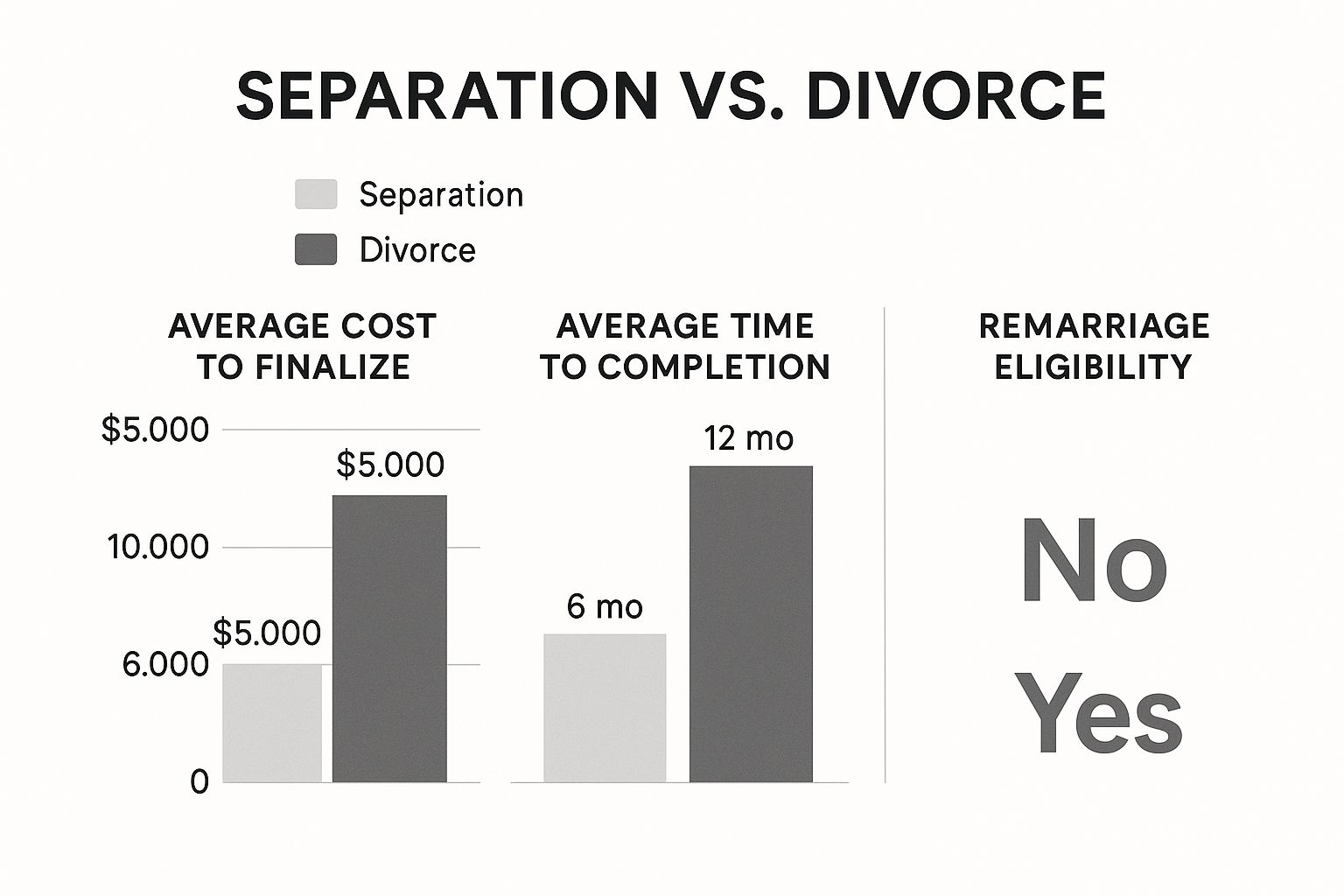
Ultimately, the infographic and the details show a clear picture: divorce is a more permanent, often more expensive, and longer process. Separation provides a legal framework to live apart without fully cutting ties, but it comes with its own major limitation—you cannot get remarried.
When to Choose Divorce from Bed and Board

So, when does a Divorce from Bed and Board make more sense than an Absolute Divorce? In Arkansas, it often comes down to very specific, practical needs. It’s a way to get court-ordered structure for living apart without taking the final, permanent step of dissolving the marriage.
Key Situations Favoring a Divorce from Bed and Board
For many couples, the decision boils down to one critical benefit: health insurance. A decree of Absolute Divorce almost always terminates spousal coverage, but many employer-sponsored health plans allow a legally separated spouse to stay on the policy. This can be a financial lifesaver for a dependent spouse who needs to maintain coverage.
Sometimes, a couple isn’t entirely sure they want to end the marriage. A Divorce from Bed and Board provides a structured cooling-off period. It allows you to establish legal boundaries and financial arrangements while leaving the door open for reconciliation. It’s also a common choice for those whose personal or religious beliefs make a final divorce a difficult or undesirable option.
For some, a Divorce from Bed and Board is a necessary step toward a no-fault divorce. The time spent living apart under a separation decree counts toward the 18-month requirement in Arkansas for an Absolute Divorce on no-fault grounds.
It’s also important to remember that this choice has significant financial implications down the line. It’s wise to understand how divorce affects my estate plan, as many of the same considerations apply to legal separation.
Your Top Questions About Separation and Divorce in Arkansas
When you’re trying to figure out the difference between a Divorce from Bed and Board and an Absolute Divorce in Arkansas, a lot of questions pop up. It can feel overwhelming, but getting clear answers is the first step toward making the right choice for your future. Let’s tackle some of the most common ones.
Can I Convert a Divorce from Bed and Board to an Absolute Divorce?
Yes, absolutely. Think of a Divorce from Bed and Board as a potential stepping stone to an Absolute Divorce. Any court orders you established for property, support, and custody during the separation can usually be incorporated into the final Divorce Decree.
Here’s a key benefit: the time you spend living apart under that separation counts toward the mandatory 18-month waiting period for a no-fault divorce in Arkansas. This can make the final divorce process much quicker down the road.
Is a Divorce from Bed and Board Cheaper Than an Absolute Divorce?
You might think so, but it’s often not the case. The legal process for getting a Decree of Divorce from Bed and Board is very similar to an Absolute Divorce—you still have to file paperwork and reach agreements on all the major issues like property, debt, and custody.
If you decide to file for an Absolute Divorce later, you’re essentially starting a second legal action. This means paying court costs and potential legal fees all over again, which could make the two-step process more expensive than just filing for divorce from the outset.
Do I Need a Lawyer for This Process in Arkansas?
Legally, no, you are not required to hire a lawyer for either process in Arkansas. Many people explore the idea of how to get divorced without a lawyer in Arkansas.
However, both separation and divorce are packed with complex legal rights and long-term financial consequences. Working with an experienced family law attorney is the best way to ensure your interests are protected now and in the future.
Key Insight: A legal separation doesn’t create a clean financial break. Debt that your spouse takes on after the Decree of Divorce from Bed and Board is signed could still be considered marital debt. A divorce, on the other hand, provides a firm financial cutoff, meaning new debt is almost always considered separate.
It’s also wise to think about how your marital status affects other legal documents you may have. For example, understanding how a prenuptial agreement in Arkansas comes into play during these proceedings is critical.
While every situation is unique, it’s helpful to know the broader context. In the United States, roughly 40-50% of first marriages end in divorce, a statistic that shifts based on factors like age and educational background.