
If you and your spouse are thinking about living apart, one way to do that in Arkansas is through a legal separation. To start, you file a paper with the court called a Complaint for Separate Maintenance. This lets a judge help you and your spouse sort out important things like money, property, and who the kids will live with. Even though you’re living apart, you are still married. Think of it as hitting the pause button on your marriage, not the stop button.
Understanding Legal Separation in Arkansas

A legal separation is like a rulebook for how you and your spouse will live separately. It answers the same big questions as a divorce—like who lives in the house, how bills get paid, and where the kids will be on weekends—but you stay legally married.
People choose this for different reasons. Some couples need time and space apart to see if they can fix their problems. For others, getting a divorce might go against their religious beliefs, so a separation is a better choice.
Why Choose Legal Separation Over Divorce
One common reason people choose separation is for health insurance. Often, one spouse can stay on the other’s health plan from work if they are legally separated. This is a big help with money, but that benefit goes away once a divorce is final.
Another reason is that it gives you a trial run of living apart. You get to see what it’s really like, but with clear rules from the court so things don’t get messy. This can make a future divorce easier because you’ve already figured out a lot of the hard stuff.
A legal separation gives couples a formal plan to live apart while still being married. This can be very helpful for people who need to keep things stable with money or who need time to think about their future without ending the marriage.
Key Things a Separation Decides
A legal separation order in Arkansas will clearly state each person’s duties and split up your things. The court will make clear rules on several important issues:
- Child Custody and Visitation: This is a detailed plan that says where the children will live and when they will see each parent.
- Child Support: The court will figure out how much money is needed to take care of the children, based on state rules.
- Property and Debt Division: Everything you own together (like a house or cars) and any money you owe (like credit cards or loans) will be divided fairly.
- Spousal Support (Alimony): Sometimes, the court may order one spouse to give money to the other for a certain amount of time.
While Arkansas has its own laws, it’s good to know that about 40 states in the U.S. have some form of legal separation. Some states even make you separate for a while before you can get a divorce. You can see how different states compare on the World Population Review website.
To make it easier to see the difference, here is a simple chart comparing legal separation and divorce in Arkansas.
Legal Separation vs Divorce: A Quick Comparison
| What It Is | Legal Separation | Divorce |
|---|---|---|
| Are You Married? | Yes, you are still legally married. | No, the marriage is legally over. |
| Can You Marry Someone Else? | No, you cannot get married again. | Yes, you are free to remarry. |
| Health Insurance | Your spouse can often stay on your plan. | Your spouse must get their own plan. |
| Getting Back Together | It is easy to undo if you work things out. | You have to get married all over again. |
| Splitting Property | Your property is divided. | Your property is divided. |
| What the Court Does | The court makes an order for living apart. | The court makes an order that ends the marriage. |
Choosing between these two is a big decision that will affect your future.
For more help deciding what is right for your family, you can read our guide on legal separation vs. divorce in Arkansas.
Confirming You Can File in Arkansas

Before you fill out any papers, you need to make sure you are allowed to file for legal separation in Arkansas. The court has rules, and if you don’t follow them, your case can’t move forward.
These rules are not just suggestions; you have to meet them. The two biggest rules are about where you live (residency) and why you are separating (grounds).
Meeting the Arkansas Residency Requirement
First, you have to be a resident of Arkansas. The rule is simple: at least one of you must have lived in Arkansas for 60 days before you can file the paperwork.
So, if you moved to Arkansas last month, you will have to wait a little longer. The court needs to know you have a real connection to the state.
There is another time rule to remember. You have to keep living in Arkansas for at least three more months before a judge can make your separation final. This shows you’re not just here to use the court system and then leave.
You will have to prove you live here. It’s a good idea to have papers ready, like an Arkansas driver’s license, a power bill with your name on it, or a rental agreement. The court needs real proof.
Understanding the Legal Grounds for Separation
Besides living here, you also need a legal reason, or “grounds,” for the separation. Arkansas law lists reasons like cheating or if one spouse committed a serious crime. But most people use a different reason.
The most common reason is called general indignities. This is a legal term that means the marriage has become so bad that one person finds it impossible to keep living with the other.
So what does “general indignities” really mean? It’s not just one bad thing. It’s a pattern of actions that makes the marriage too hard to continue.
- Constant fighting: You argue all the time and can’t solve your problems.
- Disrespect: One spouse is always putting the other down, criticizing them, or ignoring them.
- Emotional distance: You live together like roommates with no real friendship or love.
- Controlling behavior: One person’s actions make the other feel like they have no freedom or say in things.
For example, imagine a couple where one person is always jealous and accuses the other of things, destroying all trust. Or a situation where one person won’t talk about problems, leading to a total breakdown in communication. You don’t need one big fight; you just need to show a pattern of behavior that has made the marriage impossible to fix.
Preparing Your Legal Separation Paperwork
Doing the paperwork for a legal separation can feel like a lot of work. The best way to handle it is to break it down into smaller steps. Every form has a job, and if you understand what each one is for, it’s not so confusing.
Think of it as building your case for the judge. By gathering everything you need and filling out the forms correctly and honestly, you are giving the court the information it needs to make fair decisions.
Finding and Understanding the Core Documents
In Arkansas, the first main paper you will need is the Complaint for Separate Maintenance. This is the official form that starts the legal process. It tells the court who you are, who your spouse is, that you live in Arkansas, and why you want to separate.
Along with the Complaint, you will also need to fill out a Financial Affidavit. This is just a list of all your money, property, and debts.
You can usually find these forms in a few places:
- Your Local Circuit Clerk’s Office: You can go to the courthouse in your county (like Washington County or Benton County) and ask for the forms for a legal separation.
- Arkansas Law Help: This group sometimes has forms online for people who are filing without a lawyer.
- A Family Law Attorney: When you hire a lawyer, they take care of all the paperwork for you. They will make sure it is filled out right and fits your situation.
A good tip is to have a simple way to keep your papers organized from the start, like using a document management workflow. Having a folder for your forms and money statements will save you a lot of stress.
Mastering the Financial Affidavit
The Financial Affidavit can seem scary, but its job is simple: to give the court a clear and honest look at your money situation. You must be truthful on this form.
It’s like making a big budget for your whole life. You will need to gather papers like recent pay stubs, bank statements, tax returns, and credit card bills.
When you list what you own (assets) and what you owe (debts), be very clear:
- Assets: Don’t just write “car.” Write the year, make, and model (for example, “2019 Honda CR-V“). For bank accounts, write the name of the bank and the last four numbers of the account.
- Debts: Instead of “credit card debt,” write who you owe (for example, “Capital One Visa“) and the exact amount you owe. Being this clear helps stop arguments later.
I see this a lot: people guess how much they spend each month and are usually wrong. My advice is to track your spending for a whole month to get a real number for food, gas, bills, and other small things. They add up, and the judge needs to see your real financial needs.
Creating an Effective Parenting Plan
If you have children under 18, the Parenting Plan is the most important paper you will fill out. It’s a roadmap for how you and your spouse will raise your children after you separate. If the plan is not clear, it can lead to constant arguments later.
A good parenting plan should answer questions before they become fights. It needs to be more than just saying who has the kids on the weekends.
Make sure you include details on things like:
- Holiday Schedules: Who will the children be with for Thanksgiving in even years and odd years? What about Christmas break or spring break? Write it all down.
- Transportation: Who will pick up and drop off the children for visits? Where will this happen?
- Communication: How will you and your spouse talk about the kids? Agree on how you will do it, like through a special app, email, or text.
- Decision-Making: How will you make big decisions together about school, health care, and religion?
Legal processes like this have changed over time. Since the 1970s, more people around the world are getting divorced. The U.S. divorce rate was 2.3 per 1,000 people in 2020 and went up to 2.5 per 1,000 in 2021. This means about 44% of marriages end in divorce. That’s why having clear, legal papers like a good parenting plan is so important.
When you prepare your paperwork carefully, you are doing more than just following the rules. You are building a strong plan for your new life that will help avoid fights in the future.
Getting Your Paperwork Filed and Served
You have done the hard work of getting your papers ready. Now it’s time to make it official. The next step has two parts: filing the papers with the court to start your case, and serving your spouse with copies of those papers to let them know what is happening.
Filing the papers is like firing the starting gun in a race. You take your documents—the Complaint, financial form, and parenting plan—and give them to the Circuit Clerk. This turns your private decision into an official court case, so it’s very important to do it right.
The process is about giving the court the right information from the very beginning, similar to distributing information to regulatory authorities securely and efficiently.
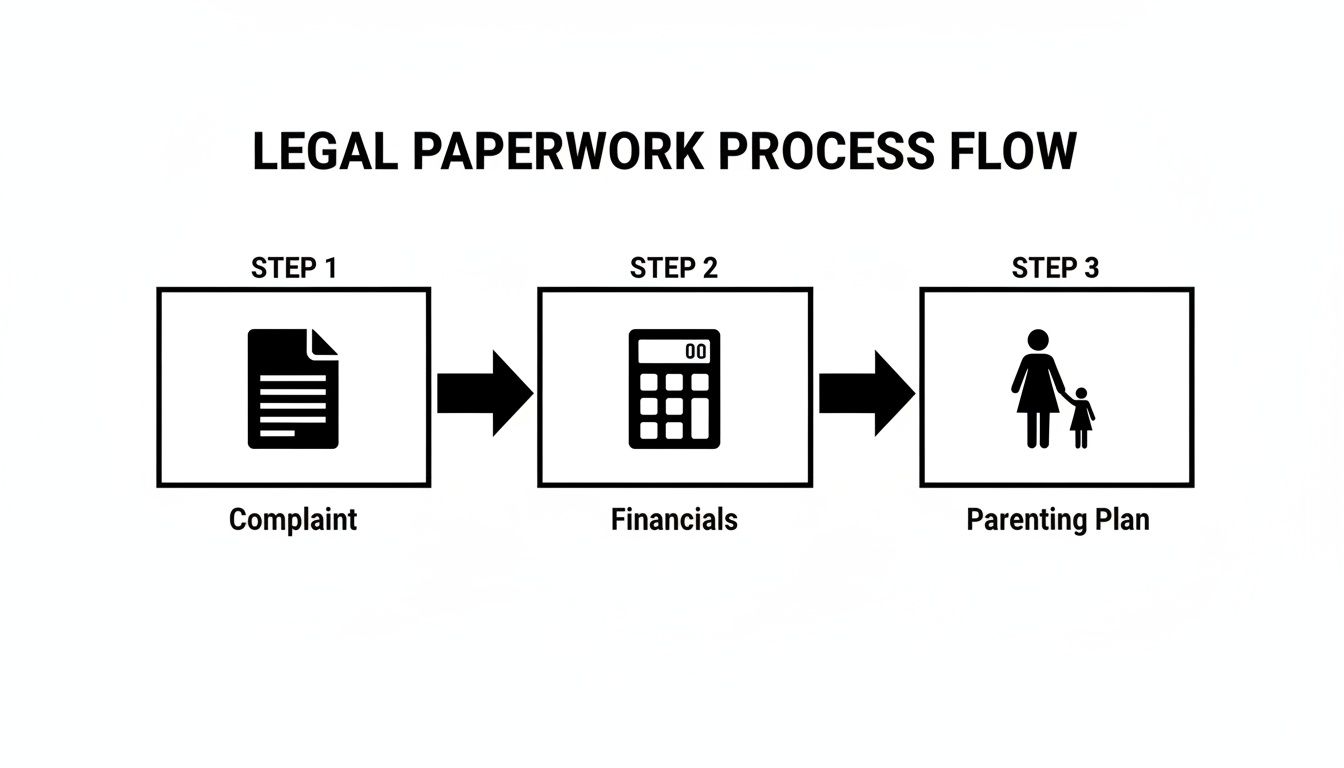
This picture shows how it works. The complaint starts the case, the financial papers give the details, and the parenting plan takes care of the kids. Together, they give the judge the full story.
Taking Your Documents to the Circuit Clerk
Your first stop is the Circuit Clerk’s office at the courthouse in the county where you or your spouse live. In Northwest Arkansas, that means going to Fayetteville for Washington County or Bentonville for Benton County.
Here is a good tip: bring at least three copies of every paper. The court keeps one, you get one with a stamp on it for your records, and the third copy is for your spouse.
When you file, you will have to pay a filing fee, which is usually around $165 to $185. If you cannot afford this fee, you can ask the clerk for a form called an Affidavit to Proceed In Forma Pauperis. This is a request to the judge to let you file for free because you don’t have enough money. You will have to show proof of your income to get the fee waived.
The Critical Step of Serving Your Spouse
After the clerk stamps your papers and gives you a case number, you have to legally tell your spouse about the case. This is called service of process, and you can’t skip it. The court will not do anything else until you can prove that your spouse officially got the papers.
You cannot just hand the papers to them yourself, even if you are on good terms. Arkansas law says that another adult who is not involved in the case must be the one to serve the papers.
You have a few good choices for this:
- Sheriff’s Service: This is the most common way. You pay a fee (about $50) at the sheriff’s office where your spouse lives or works. A deputy will then deliver the papers in person.
- Certified Mail: You can mail the papers using certified mail with restricted delivery. This means your spouse has to be the one to sign for the mail. The signed green card you get back is your proof for the court.
- Private Process Server: These are professionals you can hire to deliver legal papers. They can sometimes be faster or find people who are hard to locate.
I have seen many cases get stuck because someone thinks, “My spouse already knows I’m filing, so I don’t need to do all this.” That is a big mistake. The court must have official proof of service. Without it, your case goes nowhere.
Why Proper Service is Non-Negotiable
Why is the court so strict about this? It is to protect your spouse’s rights. Serving the papers makes sure they know about the lawsuit and have a fair chance to answer.
Once they are served, a timer starts. In Arkansas, your spouse has 30 days to file a response, called an “Answer,” with the court. In their Answer, they will say if they agree or disagree with what you have asked for in your Complaint.
If they don’t answer in time after being served correctly, you may be able to ask the judge for a default judgment. This means you could get what you asked for without them having a say. Filing your papers the right way and serving them correctly are the first steps to protecting yourself and moving your case forward.
What to Expect With Hearings and Temporary Court Orders
Once your papers are filed, the legal process begins. The first big step for many couples is a hearing to get a temporary order. This is not the final decision. It’s a set of temporary rules from a judge to keep things fair and calm while you work out the final details of your separation.
Think of it as a set of rules for the next few months. These orders answer the most important questions right away: Who stays in the house? When do the kids see each parent? Who pays the bills? The goal is to create a routine that everyone can follow, especially for children, during a confusing time.
Why You Might Need a Temporary Hearing
To get these temporary rules, you or your spouse will probably have to ask for a temporary hearing. This is a quick meeting with a judge. It’s not a long trial like you see in movies. It’s meant to solve the biggest problems right away.
The judge’s only goal is to make decisions that will work for now. The judge will listen to both of you, look at your financial papers, and make a decision based on the information they have.
A temporary hearing usually focuses on a few key areas:
- Child Custody: A temporary schedule for where the kids will live.
- Child Support: Deciding who pays what for the children’s needs right now.
- Spousal Support (Alimony): Seeing if one spouse needs money to help them get by.
- Who Stays in the House: Deciding who will live in the family home for now.
- Paying Bills: Deciding who will pay the mortgage, power bills, and credit cards.
I see this all the time: people come to a temporary hearing ready to argue about everything that went wrong in their marriage. That’s a mistake. The judge doesn’t want to hear about that. They need to know what is needed right now to keep life stable for you and your kids. Stay calm and stick to the facts about today.
A Glimpse Inside the Courtroom
Going to court for the first time can be scary. The good news is that temporary hearings are usually not as formal as a final trial. If you have a lawyer, they will do most of the talking. They will tell the judge what you are asking for and why.
The judge will ask questions and will look very closely at the Financial Affidavit you filled out. This is why it’s so important to be honest and complete on that form. How truthful you are on that paper can affect what the judge decides about child support and who pays the bills.
It is also interesting to know that legal separation is becoming more common before a final divorce. The UN found that the number of adults between 35 and 39 who are divorced or separated has doubled from 2% in the 1970s to 4% in the 2000s. This shows that people need these steps to help them through the process. You can see more about these global marriage and divorce trends to get a bigger picture.
Is There a Way to Avoid a Court Battle?
Yes. Going to court is one way to get a temporary order, but it’s not your only choice. Many times, you and your spouse can agree on these things yourselves, which saves a lot of stress and money. The most common way to do this is through mediation.
In mediation, you both meet with a neutral person called a mediator. The mediator’s job is to help you talk to each other and find answers. A mediator does not pick sides or make decisions for you. They just help you have a productive conversation.
Why think about mediation?
- You Are in Control: You get to make a plan that works for your family, instead of having a judge decide for you.
- It’s Less Stressful: The goal is to work together, which can help you stay on better terms, especially if you have kids.
- It’s Usually Faster & Cheaper: Making a deal in mediation almost always costs less in lawyer fees and gets you a solution more quickly.
If you reach an agreement in mediation, your lawyers will write it down in an “Agreed Temporary Order.” You give this to the judge, who will usually approve it. You get the same legal court order, but you made it by agreeing instead of fighting.
Answering Your Questions About Legal Separation in Arkansas
Okay, you know the basics—the rules about where you live, the paperwork, and how it all works. But now you probably have some “what if” questions. Let’s talk about the common questions people have when they start this process.
Our goal is to give you simple answers so you can see how these rules work in real life. Understanding these things will help you make good choices for you and your family.
Can We Still Live in the Same House?
This is a very common question. The short answer is yes, you can live in the same house while you are legally separated in Arkansas. The longer answer? It’s usually a bad idea and can make your case much harder.
The whole point of a legal separation is to show a judge that you are living “separate and apart.” If you are still in the same house, that is hard to prove. To make it work, you would have to live like roommates: sleeping in different bedrooms, having separate bank accounts, and not doing things together as a couple.
Honestly, it is almost always better for one person to move out. This creates a clear separation that the court can easily see.
How Long Does a Legal Separation Last?
A legal separation in Arkansas does not have an end date. It can be for a short time, like a few months, or it can last for years. The court’s order will stay in place for as long as you need it.
The separation only ends in two ways:
- You get back together. If you work things out, you can both ask the court to cancel the separation order.
- One of you files for divorce. A legal separation is often a step toward divorce. The good news is that the agreements you made in your separation can usually be used in your final divorce, which makes the divorce process much faster and easier.
Think of your separation agreement as a strong starting point. If you decide to get a divorce later, you’re not starting from the beginning. You’ve already done the hard work of dividing your money and making a parenting plan.
What Happens to Our Property and Debt?
Just like in a divorce, the court will divide your property and debts fairly. In Arkansas, marital property is anything you got from the day you were married until the day you separated. This includes the house, cars, bank accounts, and retirement savings.
The same rule applies to debt. Any credit card debt, home loans, or car loans you got while married are considered marital debts. You will both have to pay for a part of them.
Your Separate Maintenance Agreement will list all of this clearly. It will say who gets what property and who has to pay which debts. This is very important because it protects you from any new debt your spouse gets after you separate.
Do I Really Need to Hire a Lawyer for This?
Legally, you do not have to. You can file for separation on your own in Arkansas. This is called filing “pro se.” But just because you can does not mean you should. Family law is very complicated, and small mistakes can affect your money and your kids for years.
We strongly suggest hiring a good family law lawyer, especially if:
- You and your spouse disagree on big things like who the kids will live with or who gets the house.
- You own a lot of things together (like a house, a business, or retirement accounts).
- There has been any kind of abuse or one spouse has much more power than the other.
- You have children and need to make a solid parenting plan.
A good lawyer does more than just fill out forms. They help you make a smart plan, protect your rights, and work to get a fair agreement for you. At DeWitt & Daniels, we can guide you through the court system in Northwest Arkansas and fight for the best result so you can move forward with your life.