
When you are thinking about divorce, one of the first questions you might have is, “How long will this take?” It’s a very good question, but the answer is different for everyone, especially here in Arkansas.
The real answer is, it depends. Some simple divorces where both people agree on everything can be finished in about two months. But if the divorce is complicated and people are arguing, it can take more than a year. The timeline really depends on one big thing: how much you and your spouse can agree on without a judge having to decide for you.
Your Arkansas Divorce Timeline at a Glance

Think of a divorce like a journey. An uncontested divorce, where you both agree on the big things, is like a quick, straight road. But a contested divorce, where you disagree, is like a long road trip with lots of stops and wrong turns. It takes longer, is more stressful, and someone else—the judge—decides where you end up.
Your journey follows Arkansas law, but it’s mostly shaped by your family’s situation and how well you and your spouse can work together. The path you take will decide if this is over in a few months or if it takes much longer.
Understanding What Makes a Divorce Faster or Slower
Before we look at the steps, it helps to know what things can speed up or slow down a divorce. These are the main things that set the pace.
- Agreement vs. Disagreement: This is the most important one. If you and your spouse can agree on how to split your things, who the kids will live with, and how to handle money, your divorce will be much faster. If you can’t agree, every argument can cause a delay.
- How Much Stuff You Have: A couple with one bank account and two cars will have an easier time than a couple with a family business, several houses, and different retirement accounts to figure out.
- Having Kids: When you have children, things get more serious. Deciding on custody, visitation schedules, and child support takes time and careful thought. This often adds months to the process.
While we’re talking about Arkansas, it’s interesting to see how this compares to other places. For example, some marriages that end in divorce in Rome, Italy, last 15 to 18 years. But in Doha, Qatar, marriages often end after just 5.5 years, partly because their legal process is faster. These global marriage and divorce statistics show that even though every divorce is personal, the same basic issues of law and disagreement are found everywhere.
The Simple Truth: The biggest thing that affects how long your divorce takes isn’t the law; it’s whether you and your spouse can find a way to agree. Working together is the shortcut to a faster, cheaper, and less stressful divorce.
To give you a better idea, here’s a quick look at how long different kinds of divorces usually take in Arkansas.
Arkansas Divorce Timeline Estimates
| Type of Divorce | Estimated Timeline | What It Means |
|---|---|---|
| Uncontested Divorce | 2–4 Months | You both agree on everything (property, debt, kids, support). |
| Mediated Divorce | 4–8 Months | You work with a helper (a mediator) to reach an agreement. |
| Collaborative Divorce | 5–9 Months | You and your lawyers agree to settle without going to court. |
| Contested Divorce | 8 Months to 1.5+ Years | You can’t agree, so a judge has to make the final decisions. |
This table is a good place to start. It helps you see where your divorce might fit before we explain what each step is like.
The Two Paths: Uncontested vs. Contested Divorce

When people ask how long a divorce takes, the first thing I explain is that every divorce goes down one of two roads. The road your divorce takes is the biggest thing that decides your timeline, your costs, and how much stress you feel.
One road is the fast lane: an uncontested divorce. This is when you and your spouse agree on everything before you ask a judge to make it final.
The Uncontested Divorce: The Fast Track
Think of an uncontested divorce like you and your spouse having a plan to build something together. You both know what it should look like in the end and you both want to get it done quickly.
You have already figured out the big questions on your own:
- Splitting Property: Deciding who gets the house, cars, and retirement money.
- Splitting Debts: Agreeing on who will pay the mortgage, credit card bills, and other loans.
- Child Custody & Support: Making a plan for where your children will live and how they will be supported with money.
- Alimony (Spousal Support): Deciding if one person will give money to the other and for how long.
Because you have made all the hard choices, the court’s job is much easier. A judge just needs to look at your agreement to make sure it is fair and follows Arkansas law.
Even when you agree, it’s not instant. Arkansas has a mandatory 30-day waiting period that starts the day the first divorce paper is filed. So, the fastest a divorce can be is 30 days. In reality, most uncontested divorces in Northwest Arkansas are finished in about 60 to 90 days. This gives us time to write the legal papers, file them, and set a date for the final meeting with the judge.
In an uncontested divorce, you and your spouse are in charge of your own agreement. The court just approves the plan you already made together. This makes it much faster and easier to predict.
Working together like this saves a lot of time, money, and heartache.
The Contested Divorce: The Long Road
But what happens if you can’t agree? That’s when you end up on the other road: a contested divorce. This is the much longer, less predictable road where a judge has to step in and make decisions for you.
If an uncontested divorce is like building with a plan, a contested divorce is like being given a box of parts with no instructions. You and your spouse have very different ideas about what to build. Since you can’t agree, you have to show your side to a judge, who will decide for you.
This path involves many more legal steps, like discovery (where you formally share information and proof), meetings with the judge, mediation, and sometimes, a full trial. Each of these steps is another stop on the journey.
With all the back-and-forth and needing the court to help, a contested divorce just takes longer. The timeline here is usually six months to over a year. For very complicated or angry divorces, it can take even longer. The more you disagree on, the more delays you can expect.
The Legal Journey From Filing to Final Decree
When you’re facing a divorce, the legal process can feel like a mystery. It helps to have a map. Knowing what’s coming next—and about how long it will take—can make the whole journey feel easier to handle. We’ve helped many people down this road and have mapped out the key steps for you.
The path your divorce takes really comes down to one thing: cooperation. The flowchart below shows the two main routes. An uncontested case is the fast lane, while a contested one is the scenic—and much longer—route.
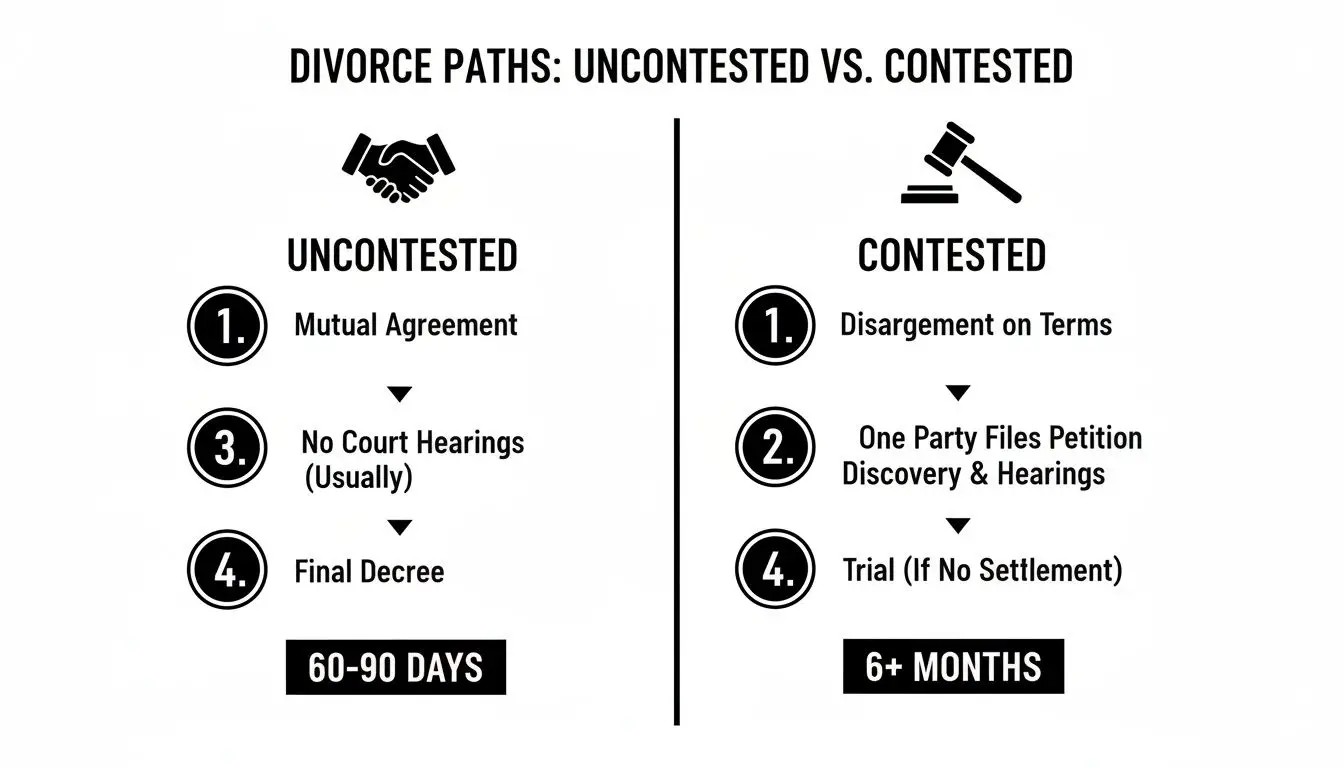
As you can see, the time difference is huge—we’re talking a few months versus maybe a year or more. It all depends on how much you and your spouse can agree on without the court’s help.
Step 1: Filing and Serving the Divorce Papers (1 to 4 weeks)
Every divorce in Arkansas starts the same way. One spouse, called the Plaintiff, files a Complaint for Divorce with the Circuit Court. This is the official paper that gets the process started.
Next, the court gives out a Summons. Both of these papers have to be officially delivered to the other spouse, the Defendant. This step is called “service of process,” and it’s the law’s way of making sure the other person has been told about the divorce. A sheriff’s deputy or a private server usually does this. It can take a few weeks, depending on how easy it is to find the other spouse.
Step 2: The Answer and Waiting Period (Around 30 days)
Once the papers are served, the clock starts for the Defendant. They have 30 days to file a response, called an Answer, with the court. This paper is their official reply, saying what they agree or disagree with in the Complaint.
At the same time, another clock is also running: Arkansas’s mandatory 30-day “cooling-off” period. This waiting period is for every single divorce in the state, with no exceptions. It starts the day the Complaint is filed. A judge cannot finish your divorce until this time has passed.
Step 3: Discovery and Information Gathering (2 to 6+ months)
This is where contested and uncontested divorces become very different. If you and your spouse don’t agree on everything, you will enter the discovery phase. This is usually the longest and busiest part of the process. Think of it as both sides being forced to show all their financial cards.
We use a few legal tools to get the information we need:
- Interrogatories: These are written questions that must be answered truthfully under oath.
- Requests for Production of Documents: This is a formal request for things like bank statements, tax returns, emails, and other important papers.
- Depositions: We interview spouses and important witnesses under oath, and a court reporter writes down everything that is said.
In this step, proof is very important. Something as simple as a text message conversation can be a key piece of proof. That’s why knowing how to do things like exporting legally admissible texts for court is so important for making a strong case. The more complicated your money is or the more you disagree, the longer discovery will take.
Step 4: Temporary Hearings and Mediation (Varies)
Just because you’ve filed for divorce doesn’t mean life stops. You might need a judge to set some rules for now. A temporary hearing can make short-term decisions on child custody, who lives in the house, or who pays certain bills. This can help make things more stable while the divorce moves forward.
Before you can ever have a trial, most Arkansas courts will also make you and your spouse go to mediation. Here, a neutral person called a mediator works with both of you to try and find a solution. If mediation works, it can make your divorce months shorter.
Step 5: Final Hearing or Trial (1 day to several days)
This is the finish line. If you have agreed on everything, you will have a short and simple uncontested final hearing. The judge looks at your agreement, asks a few questions to make sure everything is okay, and signs your Divorce Decree.
If you couldn’t agree, your case will go to a trial. This is where both sides show their proof and arguments to the judge, who will then make the final decisions for you. After the trial, the judge signs the Divorce Decree, which officially ends the marriage. This final paper is the most important one you’ll get, and you can learn more about what a Divorce Decree in Arkansas includes in our detailed guide.
What Speeds Up or Slows Down Your Divorce
When someone first comes to my office, one of their first questions is always, “How long is this going to take?” The honest answer is: it depends. Think of your divorce timeline like a road trip. You can control your speed, but there can be unexpected traffic jams you can’t always predict.
The good news is that you have more control over the speed than you might think. Being organized, willing to agree, and talking in a calm way are the best tools you have to make the process faster and smoother.
Things That Speed Up Divorce
The fastest divorces I’ve ever handled all have one thing in common: both people decided to work together to get it done. When that happens, things move surprisingly fast.
Here’s what helps you finish sooner:
- Full Agreement on the Big Stuff: This is the biggest thing. If you and your spouse have already agreed on how to split property, handle child custody, and manage support, you are on the fast track for an uncontested divorce.
- Being Willing to Compromise: You don’t have to agree on everything at the start. But if you’re both willing to negotiate—to give a little to get a little—you can solve problems without needing a judge.
- Good Organization: Having your money papers in order is a huge help. Having tax returns, bank statements, and pay stubs ready saves a lot of time and stops delays.
- Calm Communication: Keeping your talks focused on the issues, not your feelings, is very important. It’s not easy, but talking respectfully helps you stay out of court.
Things That Slow Down Divorce
On the other hand, some things can make your divorce stop in its tracks, turning a few months into a few years.
The biggest problem is a lot of fighting. A stubborn refusal to work together or wanting to “win” at all costs is a sure way to have a long, expensive, and stressful divorce. Every disagreement becomes a legal fight that adds months to the calendar.
The Hard Truth: The longer a divorce takes, the more it costs. Delays aren’t just annoying—they mean more lawyer fees, expert costs, and court costs. In a divorce, time really is money.
Other major problems we see all the time include:
- Disagreements Over Child Custody: This is often the saddest and most complicated part of a divorce. If you can’t agree on a plan for the kids, the court may need to order special studies or even get a separate lawyer just for the children. These steps can easily add 6 to 12 months to your case.
- Complicated Money Issues: Splitting a family business, multiple houses, or tangled investments is never easy. We often have to hire special accountants to get a clear picture, which adds a lot of time and money.
- A Spouse Who Won’t Cooperate: If one person hides papers, misses deadlines, or tries to slow things down on purpose, the process stops. We have legal ways to make them cooperate, but it takes time to use them.
It helps to have a clear idea of what can help or hurt your progress. Below is a quick comparison of the most common things we see affecting divorce timelines in Arkansas.
Factors Affecting Your Divorce Timeline
| Things That Speed Up Divorce | Things That Slow Down Divorce |
|---|---|
| Agreeing on big issues early | Lots of fighting and not compromising |
| Being willing to negotiate | Big disagreements over child custody |
| Having financial papers organized | Complicated things like a business |
| Talking calmly about the issues | One spouse does not respond or cooperate |
| Choosing mediation or collaborative divorce | Hiding money or financial papers |
| Both spouses hiring helpful lawyers | Changing lawyers often |
In the end, while you can’t control what your spouse does, focusing on what you can control—your own preparation and willingness to be reasonable—makes a huge difference.
While laws that allow divorce without blaming someone have helped make things faster, a contested case can still take a long time. Across the country, an uncontested divorce might take 8 months on average, but we’ve seen contested cases, especially with children, last up to 3 years. This research about marriage duration and divorce timelines gives more information on these trends. Knowing about these possible delays helps you get ready for the road ahead, no matter which path your divorce takes.
Smarter Paths: Mediation and Collaborative Divorce
When people ask, “how long a divorce takes,” they are usually thinking of a long court battle. But that doesn’t have to be your story. Going to court isn’t your only choice, and it’s almost never the fastest.
Luckily, there are much better ways to handle things. Two of the best are mediation and collaborative divorce. Both are meant to keep you and your family out of the courtroom. This gives you much more control over the result and, just as important, the timeline. They are faster, cheaper, and more private than letting a judge decide your future.
How Mediation Can Speed Up Your Divorce
Think of mediation as a guided conversation. We bring in a mediator, who is a neutral person trained to solve problems. Their job isn’t to pick sides or make decisions for you. It’s to help you and your spouse talk through the hard stuff and find an agreement.
Instead of arguing in a public courtroom, you meet in a private office to work things out. The mediator keeps the talk helpful and on track.
The biggest plus here is speed, for a few key reasons:
- You control the schedule. Court dates are given to you, often months away. With mediation, you schedule meetings when it works for you, which can save a lot of time.
- It’s all about working together. The whole point is to find solutions together, which is the opposite of the “me vs. you” feeling of a trial.
- Everything is private. Your money and personal business stay out of public records. This privacy often makes it easier for everyone to be honest and find a solution more quickly.
A divorce that could take a year or more in court can often be finished in just a few mediation meetings over a couple of months. While a judge still has to sign the final agreement, you get there on your own terms and much faster.
Mediation puts you and your spouse in charge. You decide where you are going and how to get there, with the mediator acting as your guide, helping you find the most direct path to an agreement.
By working together, you skip the long delays that come with backed-up courts and angry legal fights.
What Is a Collaborative Divorce?
Another great choice is collaborative divorce. This idea takes cooperation a step further. It’s like putting together a special team whose only job is to reach a fair agreement without ever going to court.
Here’s how it works: you, your spouse, and your lawyers all sign a paper at the start. You all promise to work together in a respectful way and share all information. The most important part of this promise is to stay out of court. If the process doesn’t work and one person decides to go to court, both people must get brand-new lawyers. This gives everyone a strong reason to finish the process together.
Your collaborative team can also bring in other neutral experts if needed, such as:
- A financial expert to help sort through complicated money, debts, and taxes.
- A divorce coach or family helper to help with feelings and improve talking.
This team approach keeps everyone focused on solving problems, not winning fights. Just like mediation, it’s completely private, and you set the speed. Because everyone agrees from the start to avoid court, the process is efficient. A collaborative divorce is usually finished in a matter of months, making it a much faster and less stressful path than a normal contested case.
How an Experienced Attorney Can Help
Trying to handle a divorce by yourself can feel like too much. The legal world has its own language, its own deadlines, and its own rules. Having a good local lawyer on your side is like having an expert guide who already knows the way through the Fayetteville and Bentonville courts.
Our job is to make this journey much less stressful and confusing for you.
A good divorce lawyer does much more than just fill out papers. Think of us as your planner and your shield. We make sure all the money information is shared, protect you from being treated unfairly, and work hard to get a fair split of your things and a good, solid plan for your children.
Finding the Fastest Path
One of our most important jobs is helping you find the fastest way forward. After hearing your story, we can explain the choices—a simple uncontested divorce, mediation, or a collaborative divorce—and tell you which one makes the most sense for you. This helps set real expectations for how long a divorce takes.
At DeWitt & Daniels, we give clear, direct advice. We’ve seen the common mistakes that make divorces take months longer, like giving incomplete money papers or letting feelings lead to bad decisions. We handle the legal work so you can focus on what matters most: your family and your future.
A lawyer’s real value is in seeing what’s coming. We see problems before you run into them, handle the legal process from start to finish, and work to make the timeline much shorter and reduce the stress and cost of your divorce.
We’ll manage talks with your spouse’s lawyer to keep things moving toward a solution. If you disagree, we are ready to negotiate for you from a strong position. And if a fair agreement can’t be made, we are always ready to fight for you in court.
Our goal is to help you move on to the next chapter of your life, not just quickly, but feeling secure and at peace.
Common Questions About Arkansas Divorce Timelines
Even after you get a general idea of the divorce process, it’s normal to have specific questions about how it all works for your life. In our experience, most people going through this have many of the same worries.
Here are some of the questions we hear most often, with our simple answers.
What Is the Mandatory Waiting Period for a Divorce in Arkansas?
In Arkansas, every divorce has a 30-day mandatory waiting period. Think of it as a “cooling-off” period required by the law.
This clock starts ticking the moment your Complaint for Divorce is officially filed with the court. It doesn’t matter how perfectly you and your spouse agree on everything; a judge legally cannot finalize your divorce until those 30 days have passed. It’s a built-in pause to make sure both people have time to think before the decision is final.
Is Divorce Faster if We Don’t Have Kids?
Yes, a divorce without young children is almost always faster and less complicated. The reason is simple: you get to skip the most emotional and time-consuming talks.
When kids are involved, the law says you have to solve three big issues:
- Child Custody: Who will make big decisions for the kids and where will they live most of the time?
- Visitation: What will the schedule be for each parent to spend time with the kids?
- Child Support: How will you both pay for the children’s needs?
Working through these issues is often what makes a simple divorce take a long time. Taking them out of the picture removes the biggest possible slowdown, saving a lot of time and emotional stress.
The Bottom Line: Time is money in a divorce. Every month that goes by means more lawyer fees, possible court costs, and ongoing emotional stress. The longer it takes, the more expensive it will be.
How Much More Does a Longer Divorce Cost?
It’s not a small difference. A contested divorce that takes a year or more can easily cost many times what a simple, uncontested divorce would. The legal fees in a long case just keep adding up.
You’re not only paying your lawyer for their time but also for other possible costs like financial experts or child custody experts. Today’s smart lawyers also use modern tools, like an AI Legal Case Researcher, to quickly study similar cases and build a stronger, faster plan, which can help keep things moving.
In the end, finishing faster means fewer hours your lawyer has to bill for, less time in court, and a quicker start to your new life. Keeping your divorce as short as possible is one of the smartest things you can do to protect both your money and your peace of mind.