
Let’s get right to the heart of your biggest question. While Arkansas law doesn’t force you to hire a divorce lawyer, going it alone can be very risky. It’s a bit like trying to cross a dangerous river with nothing but a map you found online. You might get through it, but one wrong step could have serious, long-term consequences.
Should I Hire an Arkansas Divorce Lawyer?
Deciding whether to hire a lawyer is often the first big challenge in a divorce. It’s easy to think that if you and your spouse are getting along, you can just fill out the paperwork yourselves and save some money. And while that might work for the simplest divorces with no property and no children, divorce is a legal process that permanently changes your money situation and your rights as a parent.
A good lawyer does more than just argue for you in court. They act as your guide and your protector. Their job is to protect your future—your home, your retirement savings, and your rights as a parent—all under the specific rules of Arkansas law. They make sure the final agreement is fair, legally correct, and won’t leave you with expensive problems years from now.
When to Seriously Consider Getting a Lawyer
Think of hiring a lawyer not as just a cost, but as an investment in your future. As soon as your situation gets a little complicated, the risks of going it alone start to be bigger than the money you might save. If any of the following sound like your situation, it’s a strong sign you need professional legal advice.
Here’s a quick guide to help you decide.
Quick Guide: When to Consider a Lawyer
This table can help you quickly see if your situation has issues that really call for an attorney.
| Your Situation | Recommendation | Why It Matters |
|---|---|---|
| You and your spouse have children under 18. | Strongly Recommended | A lawyer makes sure the parenting plan, visitation schedule, and child support numbers are fair, detailed, and can be enforced by a court, protecting your children’s best interests. |
| You own a home, have retirement accounts, or share debt. | Strongly Recommended | Splitting up property and debts is complicated. A lawyer ensures the division is fair under Arkansas law and that no property is hidden or forgotten. |
| Your spouse has already hired their own attorney. | Essential | You will be at a big legal disadvantage if your spouse has an expert advising them and you don’t. It’s very important to make things even. |
| There is a history of abuse or a big power difference. | Essential | Your safety and rights are the top priority. A lawyer can get protective orders and will handle all communication, protecting you from being scared or manipulated. |
| The divorce is simple, with no kids and very little shared property. | Could DIY, but a consult is wise | Even in simple cases, a one-time meeting with a lawyer can help you understand the process and make sure you’re not missing any important steps or rights. |
Basically, the more you have to protect—whether it’s your children’s well-being or your money—the more you need an expert on your side.
The goal of hiring an attorney isn’t just to “win.” It’s to make sure the final divorce paper is legally correct, protects your rights, and gives you a solid foundation to start your new life.
This flowchart gives you a simple visual for making the decision.
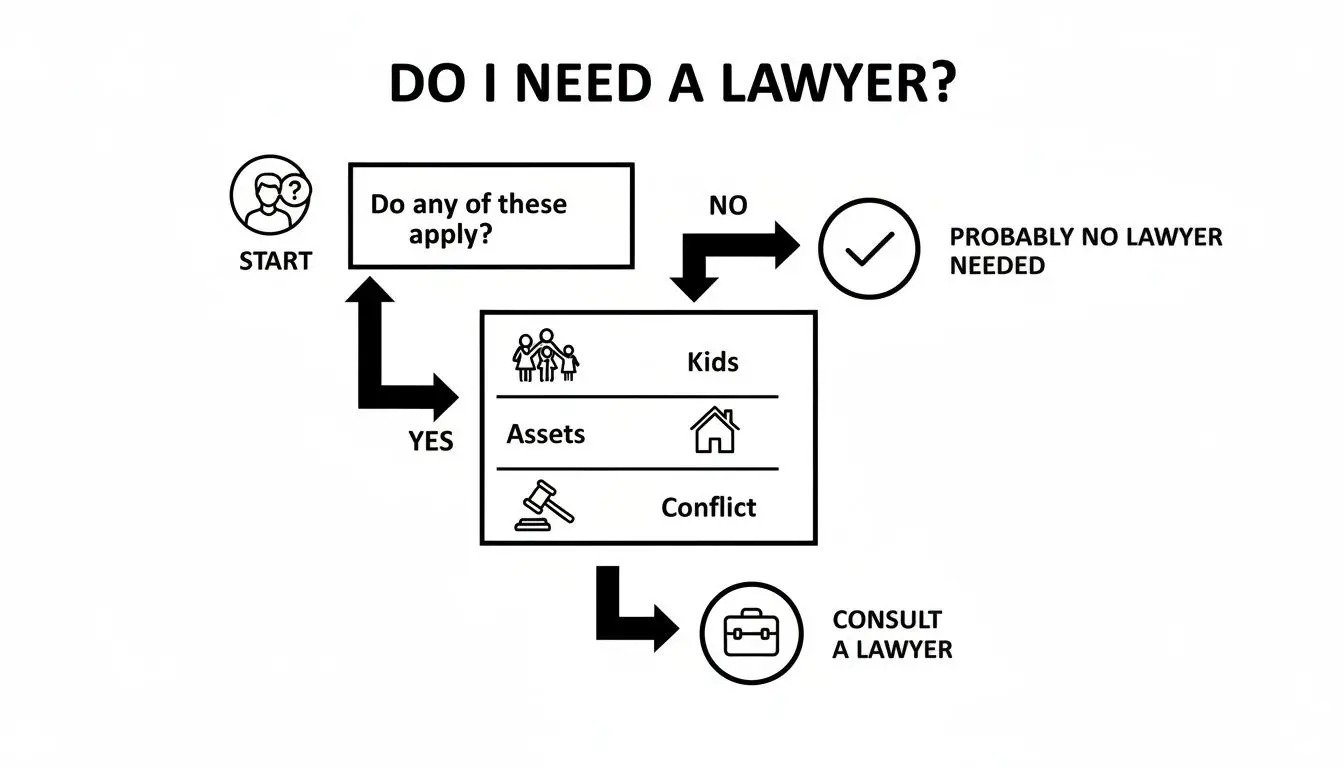
As you can see, the moment you add children, valuable property, or any kind of argument, the path forward becomes much clearer. Having a professional guide you through the process is almost always the smartest choice.
When You Absolutely, Positively Need a Lawyer
Look, I get it. The thought of saving money on lawyer fees is tempting. But some situations are just too dangerous to handle on your own. These are the big red flags, the moments when trying to handle your own divorce goes from a calculated risk to a possibly terrible mistake.
Going it alone in these cases is like trying to fix a major electrical problem using a YouTube video. The chances of it ending badly are just too high.

So let’s talk about the situations where the answer to “Do I need a lawyer?” is a firm “Yes.”
Your Spouse Has a Lawyer
This one is simple. If your spouse has a lawyer, you need one too. Immediately.
Think about it this way: their lawyer’s only job is to get the best possible result for them, not to make sure things are fair for you. You’d be stepping into a legal contest where one side has a professional coach who knows every rule and strategy, while you’re trying to figure out the game as you go.
Without an expert on your side, you are at a huge disadvantage. You could easily be talked into an unfair agreement that could hurt you for years.
There’s a History of Domestic Abuse or Control
If your relationship has involved any form of abuse, threats, or a serious power difference, your safety is the number one priority. Period. Trying to negotiate directly with a controlling or abusive person is not only a bad idea, it’s unsafe.
A lawyer is more than just legal help here; they are your shield.
- They will handle all communication so you are not forced to speak with your ex-partner.
- They can file for orders of protection to keep you and your children safe.
- They stop your spouse from using fear, threats, or manipulation to bully you into a bad deal.
In these cases, an attorney is your supporter and protector. They create a safe space, making sure the process is handled without you being put in more danger or under pressure just to make it all stop.
Facing an abuser alone in court can be very emotionally damaging and often leads to people giving up their rights just to escape the fight. Please don’t put yourself in that position.
You Have Complicated Finances or Think Assets Are Hidden
Money is almost always one of the trickiest parts of a divorce. If your money situation is anything more complicated than a single bank account, you need a professional to sort it out. Your lawyer acts like a money detective who knows exactly where to look for the truth.
Hiring an attorney is a must if your divorce involves:
- A Family Business: Figuring out what a business is worth and how to divide it is very complex.
- Retirement Accounts: Splitting 401(k)s, IRAs, and pensions requires special court orders that are almost impossible to get right on your own.
- Hidden Money: If you even suspect that your spouse is hiding money or not being honest about their income, a lawyer has the legal tools to find out.
- A Lot of Debt: Deciding who pays for the mortgage, credit cards, and other loans is often a major battle.
This idea of getting professional help also applies to other complex money situations. For example, knowing when to hire a debt settlement attorney shows how expert help becomes necessary when a lot is at stake. In a divorce, an attorney makes sure all property you got during the marriage in Arkansas is found and divided “equitably”—which means fairly, not always a straight 50/50 split.
You and Your Spouse Disagree About the Kids
When you can’t agree on who the kids will live with (custody), visitation schedules, or child support, the stakes are as high as they get. These decisions will have a huge impact on your children’s lives and your relationship with them for many years.
In Arkansas, every custody decision is made based on the “best interests of the child.” It’s a lawyer’s job to gather the facts and present a clear case to the judge showing why your plan is what’s best for your children.
They fight to make sure the final custody order is clear, detailed, and legally solid, covering everything from holidays and summer vacations to who makes important decisions about school and healthcare. Without that legal expertise, you risk ending up with a confusing or unworkable agreement that simply isn’t what’s best for your kids.
Comparing Your Divorce Options: Lawyer vs. DIY
When you’re facing a divorce in Arkansas, one of the first big decisions you’ll have to make is how to handle the legal process. There’s no single right answer. Your choice really depends on your specific situation—how complicated your case is, your budget, and how much time and energy you can really give.
Think of it like a big project at home. Are you just painting a room, or are you tearing down walls and re-doing the electricity? Let’s walk through your main options: hiring a lawyer for everything, doing it all yourself, and an option in the middle.
Full-Service Legal Representation
This is the most common path, like hiring a contractor for that big home project. You’re bringing in an expert to manage the whole thing from start to finish, making sure everything is done correctly and is built to last.
When you hire a full-service divorce attorney, they take the weight off your shoulders. They are responsible for:
- Writing and filing all the necessary legal papers with the court.
- Giving you smart advice based on years of experience with Arkansas law.
- Acting as the main contact with your spouse or their lawyer.
- Negotiating a settlement covering everything from property and debt to child custody.
- Fighting for you in court if a fair agreement can’t be reached.
The biggest benefit here is having a professional working to protect your rights and helping you avoid mistakes that could cost you a lot down the road. Of course, this complete support comes at a price, making it the most expensive option up front.
DIY Divorce (Going It Alone)
A DIY divorce, which legally means you represent yourself pro se, means you do everything without a lawyer. In our home project example, this is you deciding to handle the whole job yourself, from plumbing to electrical work, with only online tutorials to help. It’s possible if the job is very simple, but the risk of a major mistake is high.
This path really only makes sense if your divorce is truly simple and you agree on everything. We’re talking about situations where:
- The marriage was very short.
- You have no minor children.
- There’s no house or major debt to divide.
- You and your spouse are in complete agreement on every single detail.
Many people think their situation is “simple” only to discover hidden problems later. While a large number of family law cases—72% in the U.S.—have at least one person representing themselves, that number doesn’t tell the whole story. Studies show that cases with attorneys often get finished more quickly and are more likely to result in getting financial support. You can discover more insights about these family law trends and see how professional help makes a real difference.
Going pro se means you are 100% responsible for understanding Arkansas law, filling out every form perfectly, meeting all court deadlines, and negotiating for yourself. A single mistake on a form can get your case thrown out, forcing you to start over.
Limited-Scope Representation: A Middle Ground
There’s a third option that’s becoming more common: limited-scope representation. Think of this as hiring an electrician just to handle the dangerous wiring, while you take care of the painting. You get expert help for the most important or confusing parts of your case.
With this middle-ground approach, you hire an attorney for specific tasks. For example, you could pay them just to:
- Review a settlement agreement before you sign it to look for any problems.
- Write a complex legal paper, like a special order needed to divide a 401(k).
- Coach you on what to do and say in court before a hearing.
This can be a great way to get important legal advice without paying for full-service help. It lets you handle the easier tasks yourself while making sure you don’t make a big mistake on the most important issues. Not all attorneys offer this, so it’s a great question to ask when you first talk to one.
Understanding the Cost and Timeline for an Arkansas Divorce
When people are facing divorce, two questions always come up first: “How much is this going to cost me?” and “How long will this take?”
There’s no single answer, but both questions depend on one thing: how much you and your spouse argue. The more you disagree, the more time and money it will take to finish your case. It really is that simple.
Let’s walk through what you can expect. Most divorce attorneys charge with a retainer and an hourly rate.
- Retainer Fee: This is an upfront payment that works like a deposit for legal services. The time your lawyer spends on your case is paid for from this initial amount.
- Hourly Rate: This is what the attorney charges per hour for working on your case. All the work—from writing papers to going to court—is tracked and subtracted from the retainer.
A lawyer’s goal is always to find the quickest way forward. But if you and your spouse are fighting over everything from who gets the house to who has the kids on weekends, it naturally takes more hours to negotiate or go to court.
How Much Does a Divorce Really Cost in Arkansas?
The final bill for a divorce can range from a few thousand dollars to tens of thousands. The single biggest factor isn’t the lawyer you hire—it’s the amount of fighting involved.
An uncontested divorce, where you both agree on everything from the start, will always be the fastest and cheapest option. A contested divorce, on the other hand, involves disagreements that require a lawyer to step in and will cost a lot more. We cover this in more detail in our guide where you can learn more about the specific costs of divorce in Arkansas.
Here’s a general idea to give you a clearer picture:
- Simple, Uncontested Divorce: If you have no children and little property to divide, and you both agree on the settlement, the cost might be a few thousand dollars.
- Complex or Contested Divorce: If your case involves fighting over child custody, figuring out the value of a family business, or splitting up retirement money, the costs can quickly climb. Trials and long negotiations simply require more time and legal work.
The most important thing to remember about cost is this: hiring a good lawyer is an investment in a fair result. A “cheap” DIY divorce that ends with an unfair property split or a bad custody plan will cost you far more in the long run.
The Typical Timeline for an Arkansas Divorce
Just like the cost, the timeline depends a lot on cooperation. Arkansas law includes a mandatory 30-day waiting period that begins only after the first divorce papers have been filed. In reality, very few divorces are finished in just 30 days.
Here’s a more realistic timeline:
- Uncontested Divorce (3-4 Months): Even when everyone agrees, it still takes time to write all the legal papers correctly, get them signed, and wait for a judge to review and sign the final divorce papers.
- Moderately Contested Divorce (6-12 Months): If you have a few key disagreements that need to be worked out through negotiation, you can expect the process to take a bit longer as you work toward a solution.
- Highly Contested Divorce (1 Year+): When your case is headed for a trial, you are on the court’s schedule, not your own. Court backlogs and hearing schedules can easily stretch a divorce case past the one-year mark.
Interestingly, while some people think about representing themselves to save money, the need for professional legal advice remains strong. The Family Law & Divorce Lawyers industry is expected to reach $13.2 billion in revenue by 2024. As you can read more about these legal industry findings, this shows that more people are realizing that expert help is a smart move, not just a cost. Answering the question “do I need a divorce lawyer?” often comes down to deciding how much your future is worth protecting.
How a Lawyer Guides You Through the Divorce Process
Trying to decide if you need a divorce lawyer? A big part of that decision comes down to what, exactly, an attorney does for you. Think of a lawyer as an experienced guide on a tough mountain trail. They know the path, can point out hidden dangers, and carry the map so you can focus on the journey.
Let’s walk through what that journey looks like, step by step. You’ll see how a lawyer takes you from that first, often stressful, meeting to a final, legally correct divorce decree.

Step 1: The First Meeting and Filing Papers
It all starts with the first meeting, called a consultation. This is a private meeting where you can finally explain your whole situation. A good lawyer will listen to your story, explain your rights under Arkansas law, and give you an honest, realistic idea of what to expect.
If you decide to hire them, the first official move is filing a Complaint for Divorce. This paper formally starts the process and tells the court what you’re asking for with property, custody, and support. Your lawyer takes care of writing and filing this complex paperwork, making sure it goes to the right county court.
Step 2: Temporary Orders and Gathering Information
Life doesn’t stop just because a divorce has been filed. You and your spouse need immediate rules. Your lawyer can ask the court for temporary orders to create a stable, predictable situation while the divorce is happening. These orders can decide:
- Child Custody: Who the kids will live with for now.
- Child and Spousal Support: How bills and living costs get paid.
- Possession of the Home: Who stays in the family house for now.
After that, you move into the “discovery” phase. It sounds a little scary, but it’s really just the formal process of gathering all the needed information. Your lawyer helps you exchange key financial papers—like tax returns, bank statements, and retirement account information—with your spouse. This step makes sure everything is out in the open and prevents anyone from hiding money.
Step 3: Negotiation and Mediation
This is where a skilled attorney really shows their value. The truth is, very few divorces in Arkansas end up in a dramatic courtroom battle. Most are settled through negotiation. Your lawyer becomes your professional negotiator, working with your spouse’s attorney to agree on a fair settlement agreement.
A huge part of this process is often mediation, where a neutral person helps you and your spouse find a solution you both can live with. It’s a far more private and controlled way to solve things than a public trial.
In fact, 46% of family law experts say other methods like mediation are “highly effective.” It gives you and your spouse control over the result instead of leaving it to a judge. Having an attorney guide you through these talks makes sure your rights are protected while you work toward a peaceful solution. You can read more about trends in family law negotiations and see why this method is so popular.
Step 4: Finalizing the Divorce Decree
Once you’ve reached an agreement on everything—property, debts, custody, and support—your lawyer writes the final Divorce Decree. This is the single most important document in your case. It’s the legally binding court order that spells out every last detail of your agreement.
Your lawyer’s job is to make sure the words are clear, exact, and can be enforced, leaving no room for future fights. Once you and your spouse sign it, your attorney gives it to the judge. The moment the judge signs it, your marriage is legally over.
By handling the deadlines, paperwork, and difficult talks, a lawyer frees you up to focus on your emotional health and start building your future. They are your planner, your supporter, and your guide through one of life’s most difficult times.
Your Next Steps for a Divorce in Northwest Arkansas
If you’re reading this from Fayetteville, Bentonville, Rogers, or anywhere else in Northwest Arkansas, the thought of divorce can be completely overwhelming. You might feel stuck, and just figuring out where to start is often the hardest part. The good news is you don’t have to figure it all out at once. You can take small, manageable steps right now to get prepared.
This isn’t about jumping into a decision. It’s about carefully getting your affairs in order so you can protect yourself. Taking control of these first tasks will put you in a much stronger position, no matter what you decide to do.
Create Your Action Plan
Think of this as your pre-divorce checklist. Going through these steps will give you a sense of clarity and allow you to make decisions from a place of knowledge, not fear.
-
Gather Key Financial Documents: Start pulling together the paperwork. Any lawyer you speak with will need these anyway. Focus on finding your last two years of tax returns, recent pay stubs for both you and your spouse, and at least six months of bank and credit card statements.
-
Create a Post-Divorce Budget: Sit down and be honest about what your life will cost when you’re on your own. Make a real list of expenses: rent or a new mortgage, utilities, groceries, childcare, car payments. This gives you a clear look at the income you’ll need to be financially independent.
-
Avoid Common Social Media Mistakes: Please be very careful with what you post online. Complaining about your spouse, even on a private page, or posting photos with a new partner can be used against you in court. The safest choice is to stay off social media completely or at least lock down all your privacy settings.
Divorce is emotionally draining, and legal help is just one piece of the puzzle. Many people find that working with local counselling services provides the important emotional support to get through this difficult time.
Schedule a Confidential Consultation
Once you have some of your documents and thoughts organized, the single most important step you can take is to talk with a local family law attorney. I can’t stress this enough: even if you and your spouse seem to agree on everything, this meeting is very important. It’s your chance to get answers that apply specifically to your life.
A confidential consultation is not a promise to file for divorce. It’s a chance to understand your rights, get a clear view of your options, and get professional advice on how to protect yourself and your family.
Hiring an experienced Northwest Arkansas attorney gives you a home-field advantage. They understand the specific procedures in the Washington and Benton County courts and often know the local judges. That’s a level of knowledge you simply can’t get from a website or a DIY legal form.
A good lawyer will listen to your story, explain your options without pressure, and use their local experience to help you get the best possible result. Making that call is the first real step toward taking back control of your future.
Frequently Asked Questions About Arkansas Divorce
Getting divorced in Arkansas brings up a lot of questions. It’s a confusing time, and having clear answers can make a world of difference. Let’s walk through some of the most common questions I hear from clients to give you a better idea of the road ahead.
Can I Get a Divorce If My Spouse Does Not Agree?
Yes. You don’t need your spouse’s permission to file for divorce in Arkansas.
Arkansas is a “no-fault” divorce state. This means you only have to say that you and your spouse have “irreconcilable differences,” which is the legal way of saying the marriage has broken down and can’t be fixed. While your spouse can’t stop you from getting a divorce, if they refuse to cooperate, it can make things more complicated and take longer.
How Is Property Divided in an Arkansas Divorce?
When it comes to splitting up property, Arkansas follows a rule called “equitable distribution.” Many people think this means everything gets split 50/50 right down the middle. That’s not always how it works.
“Equitable” means fair, not always equal. A judge will look at everything you and your spouse got during the marriage—from the house and cars to retirement accounts and debt—and divide it in a way they believe is just. Things like the length of your marriage, who earned what, and even work done at home can affect the final decision. This is one of the most important reasons people hire a divorce lawyer—to make sure their financial future is protected.
Do I Have to Go to Court to Get Divorced?
Probably not. Most divorce cases in Arkansas are settled long before they ever go to a trial.
If you and your spouse can agree on all the major issues—property, child custody, support, and debt—your attorney can put it all into a formal settlement document. Once you both sign it, a judge can finalize your divorce without you ever having to go to court for a trial. A trial is really the last resort for when you just can’t agree.
How Long Do I Have to Live in Arkansas to File for Divorce?
Arkansas has a residency requirement to get a divorce. This means either you or your spouse must have lived in the state for at least 60 days before you can file the first divorce papers.
There is also a waiting period. After you file for divorce, Arkansas law requires you to wait at least 30 days before the judge can sign the final divorce decree. A good lawyer will handle all these timelines and filing rules so you don’t have to worry about a small mistake stopping your case.