
Going through a divorce is tough, and the first big step is finding the right person to help you. When you start looking for a divorce lawyer nearby, you’re not just looking for someone in your town. You need a guide who really knows the family court system in Arkansas.
Starting Your Search for a Local Divorce Attorney

Let’s be clear: your goal right now isn’t to hire someone today. It’s just to make a short list of good names. Think of it like looking for a guide who can help you through a new and tricky place. You’re just gathering ideas.
If you feel alone, remember that many people have gone through this. National numbers show that about 50% of first marriages end in divorce. People between 25 and 39 years old make up about 60% of all divorces. The U.S. has one of the highest divorce rates in the world. That means a lot of people in your own community have been where you are now. You can learn more about these marriage and divorce trends to see the big picture.
Why a Nearby Lawyer Matters in Arkansas
Hiring a lawyer who works close to you is about more than just easy meetings. A lawyer who is a regular in your county’s courthouse—like in Washington, Benton, or another county in Northwest Arkansas—has a big advantage. They know the people who work at the court, understand the local way of doing things, and know how the judges tend to think.
This local knowledge is a game-changer. A lawyer who has been in front of your judge many times has a much better idea of how that judge might decide on important things like:
- Who the kids will live with and when the other parent sees them (custody and visitation)
- If one spouse has to pay the other money for support (alimony)
- How your things and your debts will be split up
Knowing this helps them make a smart plan for you from the very beginning. This can save you a lot of time, money, and worry.
Choosing a local lawyer isn’t just about where their office is. It’s about hiring someone who knows the exact courthouse where your case will be. Their knowledge of local rules and people can make a big difference.
Smart Ways to Find Potential Attorneys
So, where do you start? The first step is to make a list of three to five names. You don’t need a huge list, just a few good people to look into.
A great and safe place to start is the Arkansas Bar Association. Their website has a list of all licensed lawyers. You can search by town and what kind of law they do. This way, you know anyone you find is qualified and has a good record.
Another good idea is to ask other professionals you trust. Your accountant, therapist, or financial advisor might know good family lawyers because they have sent other clients to them. These kinds of suggestions are often the best because they come from someone you already trust.
Use this quick guide to see the most important things to look for when making your list of lawyers.
Key Qualities in a Divorce Lawyer
| Quality You Need | Why It Matters in Arkansas | How to Spot It |
|---|---|---|
| Local Court Experience | They know the judges and staff in your county’s court and how things work there. | Ask them how often they work in your county’s court and with the judges. |
| Focus on Family Law | This part of the law is tricky and emotional. It’s better to have a specialist than a lawyer who does a little of everything. | Look for a law firm that spends most of its time on family law cases. |
| Clear Communication | You need someone who can explain things in a simple way and keeps you updated. | In your first meeting, do they listen to you and answer your questions directly? |
| Calm and Sensible | A lawyer who is too aggressive can make things worse and cost more money. | Look for a lawyer who is confident and calm, not just someone who seems tough. |
Once you have a few names, you’ll be ready to learn more and see who feels like the right person to help you.
How to Research Your Potential Lawyers

Okay, you have your short list of names. Now it’s time to do some homework. This step is important because it helps you cross off lawyers who aren’t a good fit before you even call them. Think of it as a quick background check that saves you time and stress.
Your first step should be a fast, official check. In Arkansas, every lawyer must have a license and follow strict rules of behavior. It’s important to make sure the lawyers on your list are in good standing and don’t have any public complaints against them.
Check Their Professional Standing
This part is simple, but don’t skip it. You’re just making sure the lawyer is fully qualified and has a clean record. This quick check gives you peace of mind before you go any further.
The easiest way to do this is to go to the Arkansas Judiciary’s website. They have a public search tool where you can look up a lawyer by name. This will immediately tell you if they are licensed to practice law in the state and show you if they have ever been in trouble professionally.
Key Takeaway: A few minutes of online research can save you from a big problem later. Always check a lawyer’s license and any complaint history before you set up a meeting.
Decode Online Reviews and Websites
After you’ve confirmed they are licensed, it’s time to see what past clients have to say. Reading reviews on sites like Google or Avvo can give you a feel for a lawyer’s style, but you have to read them carefully.
Remember, divorce is a very emotional process. A very bad one-star review might be from an ex-spouse who is angry about how the case turned out, not from a client who was treated badly. Instead of believing one or two very dramatic reviews, look for patterns.
- Do many people say the lawyer is a great listener?
- Do a lot of people complain that the lawyer “never returned my calls”?
- Do the good reviews mention specific skills, like being tough in court or being great at explaining confusing legal words?
For example, a review that says, “My ex wrote this because he was mad he had to pay child support,” doesn’t tell you much. But one that says, “Attorney Smith’s assistant was amazing and always kept me updated,” gives you a real idea of how the office works. Look for the details.
Finally, look at their website. A professional website for a divorce lawyer nearby should make you feel confident. It should be easy to use, look good, and clearly say that they focus on family law. If their site lists ten different types of law and family law is just one of them, they probably handle all kinds of cases. For a divorce, you really want someone who specializes in it. This research will help you narrow your list to the top two or three lawyers you’ll actually meet with.
Making the Most of Your First Consultation
Think of this first meeting like an interview where you are both interviewing each other. You are trying to see if this lawyer is the right person for you, and they are trying to see if they can help you. It’s your chance to see what they are like, how they talk, and what they think about your case. A little preparation helps a lot.
You don’t need to bring a huge box of papers to this first meeting. Just bringing a few important pieces of information can help the lawyer understand your situation quickly and give you better advice.
What to Bring to Your Meeting
Showing up with some basic information makes the conversation much more helpful. It also shows the lawyer that you are organized and serious.
Here’s a quick checklist of what to gather:
- A simple timeline of your marriage. Write down important dates: when you got married, when you separated, and your children’s birthdays.
- A basic idea of your finances. You don’t need exact numbers yet. Just list big assets (like a house or retirement accounts) and large debts (like a mortgage or car loans).
- Your list of questions. This is very important. It’s easy to forget what you want to ask when you’re in the meeting. Write everything down ahead of time.
This first meeting is also a good time to understand what’s happening in the world of divorce. Family law changes over time. For example, divorce rates went down to 630,505 in 2020 during the pandemic, but they went back up the next year. We have also seen more “gray divorces” for couples over 50, which have their own special challenges. You can read more about these recent divorce statistics and facts to see what is trending.
This infographic simplifies how to handle the first meeting in three easy steps.
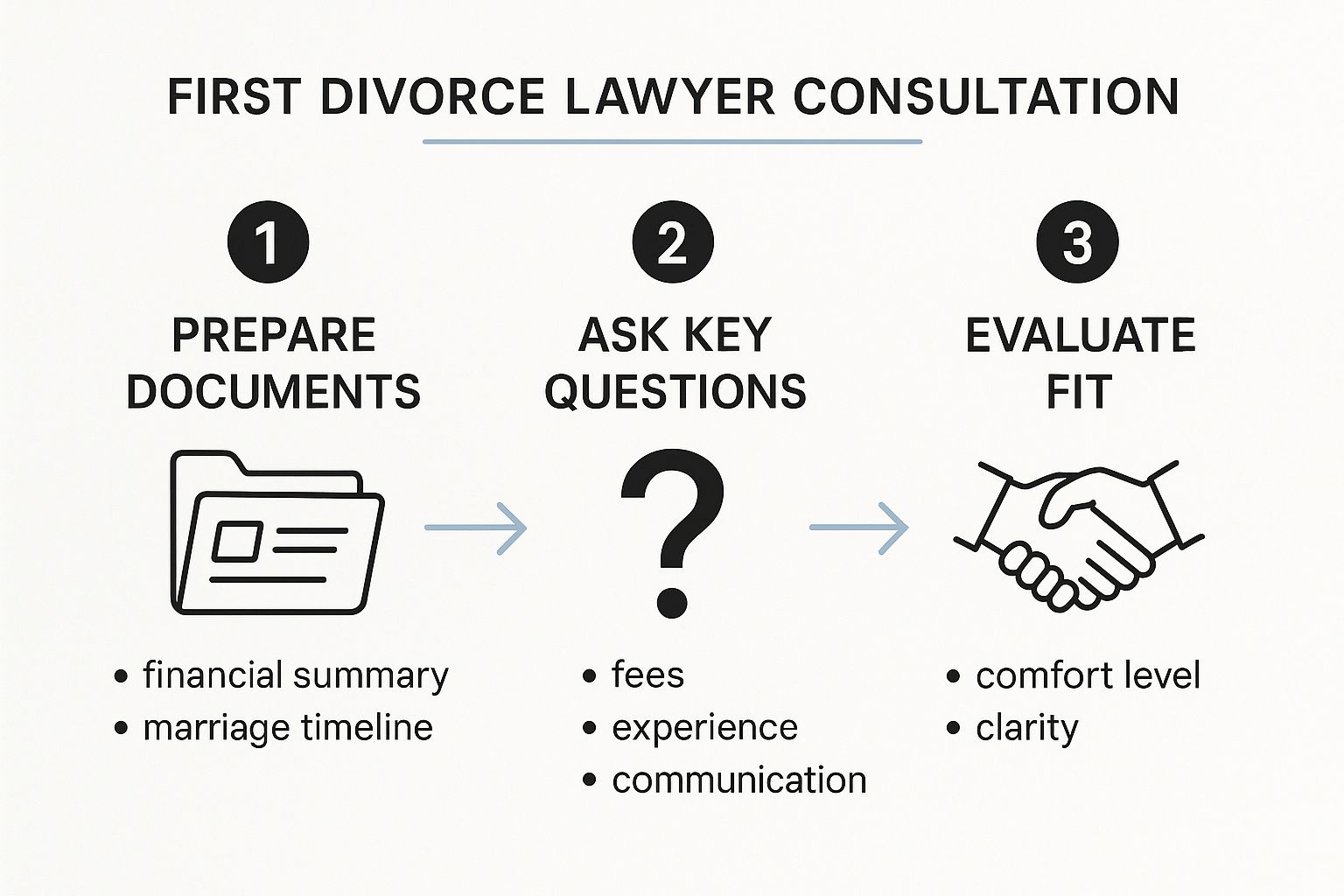
As you can see, it’s a simple process: get ready, ask good questions, and then trust your gut feeling. It really is that straightforward.
Smart Questions to Ask Your Potential Lawyer
You need to ask more than just, “How much do you charge per hour?” You are trying to understand their style and what it would be like to work with them during a very stressful time.
A good lawyer tells you what you need to hear, not just what you want to hear. Their advice should be based on what they’ve seen in local courts with local judges. You want honesty, not empty promises.
Here are a few questions I always suggest asking to get a real idea of who you’re talking to:
- How much of your work is family law, especially in this county? You want a local expert who knows the area well, not someone who does a little of everything.
- Based on what you’ve heard, what do you first think about my case? This shows you how they think and what problems they see coming.
- How will you communicate with me? Will you get updates by email? How long does it usually take to get a reply to a call or message?
- Who will I be talking to most of the time? Will you be working with the main lawyer, or with a legal assistant or a newer lawyer?
- Can you explain your fees and how the retainer works? You should leave the meeting with no confusion about how you will be charged.
When you leave that meeting, you should feel more clear and confident. Even if the news isn’t all good, you should have a better idea of what to do next and know if you’ve found the right divorce lawyer nearby to help you.
Understanding How Lawyer Fees Work
Money is often the biggest cause of stress in a divorce, and legal bills can seem scary. Let’s look at how a divorce lawyer nearby usually charges for their work in Arkansas, so you know what to expect.
Most family lawyers in our area charge by the hour. This means you pay for their time—every email they write, every paper they prepare, and every minute they spend in court for you. It’s a good idea to learn about different lawyer fee structures like flat fees versus hourly rates to understand how it all works.
What Is a Retainer Fee?
To get started, you will almost always have to pay a retainer. Think of it like a down payment for your lawyer’s future work. It’s not the total cost of your divorce. It’s a chunk of money that is kept in a special bank account just for your case. For example, you might pay a $5,000 retainer to start.
As your lawyer works, they will take their fees from that money. Let’s say their hourly rate is $300, and they spend two hours working on your first legal papers. They will take $600 from your retainer to pay for that time. Each month, you should get a detailed bill that shows every task they did and how much of your retainer was used.
When the money in your retainer account gets low, the law firm will ask you to add more money to it. This makes sure there are no breaks in your legal help.
Key Takeaway: A retainer is a deposit, not the final cost. The fee agreement you sign is the most important paper here. Read it carefully to understand the hourly rates and when you’ll need to add more money to your retainer.
Practical Tips to Manage Your Legal Costs
While you need good legal help, you have more control over the final bill than you might think. A few smart habits can make your retainer last longer.
- Get Organized First. Before you call your lawyer, organize your thoughts and papers. One organized call with a list of questions is much cheaper than five short, scattered calls during the week.
- Communicate Smartly. Keep your talks with your lawyer focused on the legal facts. Your lawyer can be supportive, but they charge for their time. Save the longer, emotional talks for a therapist or a trusted friend.
- Ask About Using a Paralegal. A paralegal is a legal assistant. They can often handle tasks like organizing financial papers for a much lower hourly rate than a senior lawyer. Ask if this is an option to help save money.
Understanding the billing process from the start helps avoid surprises and puts you in control. For a more detailed look at what to expect, check out our guide on how much a divorce costs in Arkansas.
Choosing the Right Attorney for You

You’ve met with the lawyers on your list, and now it’s time to decide. This choice is about more than just their hourly rate or how many years they’ve been a lawyer. You are looking for a true partner to help you through one of the hardest times in your life.
Take some time to think about each meeting. How did you feel during the conversation? Did one lawyer make you feel like they really heard and understood you, while another seemed busy or rushed? Trusting your gut feeling is a big part of this.
Comparing Your Options
When you’re trying to find the right divorce lawyer nearby, you have to think about a few key things that will shape your whole experience. As you look at your notes for each lawyer, ask yourself these questions:
- Communication Style: Did they explain complicated Arkansas laws in a way you could actually understand? Or did they use a lot of legal words that just confused you?
- Comfort Level: Did you feel like you could be completely honest with them? Remember, this person will learn private details about your money and your family. You need to be able to trust them.
- Strategic Approach: Did they give you a clear, realistic plan for what to do next? Be careful of any lawyer who makes big promises before they even know all the facts of your case.
This is a very personal choice, but needing good local legal help is common. Divorce rates change in different places, but in the United States, the rate is about 2.3 for every 1,000 people. Because divorce is common, you should have a good number of local lawyers to choose from. If you want to see the bigger picture, you can explore more family law statistics to see how these trends work.
Making It Official
Once you’ve decided on the right lawyer, the last steps are pretty simple. The lawyer’s office will send you a fee agreement. This paper explains everything—from how they bill you to how they will communicate with you. Make sure you read the whole thing before you sign anything or pay the retainer.
Trust Your Intuition: Legal skill is important, but so is how comfortable you feel. The best lawyer for you is someone who has the right skills and also makes you feel confident and supported.
After you have officially hired your lawyer, it is polite to let the other lawyers you met with know that you have made a choice. A quick, polite email is all it takes. This simple step finishes the process and lets you move forward with your chosen lawyer, ready for what comes next.
Still Have Questions? Let’s Cover the Basics
It’s totally normal to have a lot of questions when you’re thinking about hiring a divorce lawyer. Let’s go over a few of the most common ones that people in Arkansas ask. Getting clear answers can make the whole thing feel a lot less scary.
“My Spouse and I Are Friendly. Do We Really Need Lawyers?”
This is a great question. If you and your spouse are getting along, you are already in a much better place than many people. But even the friendliest divorces can have legal problems you don’t expect.
In Arkansas, the law has very specific rules for dividing everything you got while you were married—from the house and cars to credit card debt. This is all called “marital property,” and a judge needs to see a fair split. “Fair” doesn’t always mean exactly 50/50, and it’s easy to forget about things like retirement accounts or a small business.
If you have kids, it’s even more important. A judge must approve your plans for child support, custody, and visitation, and those plans have to follow state rules. A lawyer’s job isn’t to start a fight. Their job is to make sure the agreement you both made is legal and will hold up in court. They handle the confusing paperwork and make sure it’s all filed right, which can save you from big, expensive problems later.
Think of it like this: You’re not hiring a lawyer to cause trouble. You’re hiring one to protect your agreement and make sure it becomes final without any surprises down the road. It’s an investment in a clean ending.
“What’s the Difference Between a Mediator and a Lawyer Anyway?”
It’s easy to get these two mixed up, but they do very different jobs. It’s important to know which one you need.
A mediator is a neutral person, like a referee. Their only job is to help you and your spouse talk to each other to find a solution that you both agree on. A mediator does not work for either of you and cannot give you legal advice. They are there to guide the conversation, not to fight for you.
A divorce lawyer, on the other hand, is your champion. They are 100% on your side. Their only job is to protect your rights and fight for what is best for you based on Arkansas law. Your lawyer is your guide, your advisor, and your defender, making sure you get a fair result. While mediation can be a great way to solve problems, your lawyer is the person who is truly in your corner.
“So, How Long Is This Actually Going to Take?”
This is the big question everyone asks. The honest, but maybe frustrating, answer is: it depends.
Arkansas has a required 30-day waiting period that starts the day the divorce is first filed with the court. A judge cannot legally finalize your divorce before that time is up. If you and your spouse have already agreed on everything—we call this an “uncontested” divorce—you might be done in just a couple of months.
But things take longer if you disagree on important issues. Fights over things like these can really slow down the process:
- Who gets to keep the family house
- How to split a 401(k) or other retirement money
- Making a fair schedule for the kids
- Whether one person has to pay spousal support (alimony)
When you have to argue, share financial information, or go to court, a divorce can easily take more than a year to finish. The best way to get a good idea of the timeline is to talk to a local lawyer who can look at your specific situation.