
When a judge finalizes your divorce in Arkansas, they give you a divorce decree. This isn’t just a piece of paper. It’s the official court order that legally ends your marriage. It also gives you a set of rules for your life after the divorce.
What a Divorce Decree Really Means for You
Think of the divorce decree as the last page of one book and the first page of a new one. It does more than just say you’re single again. It’s a detailed, legally binding set of rules, signed by a judge, that you and your ex-spouse must follow.
It’s like ending a business partnership. You wouldn’t just shake hands and leave. You’d need a formal paper saying who gets the equipment, who pays the bills, and how you split the money. A divorce decree does the same thing for a marriage.
More Than Just a Document
It’s very important to understand how serious this document is. This is a powerful legal order. It is not a list of suggestions you can choose to follow or ignore. If you ignore what it says, you can get into serious legal trouble.
The decree takes all the agreements you made (or the decisions a judge made for you) and turns them into commands you must obey. For example, if the decree says the house goes to your ex-spouse, they are now the only legal owner. If it sets up a schedule for when the kids see each parent, that schedule is the law for both of you.
The whole point of a divorce decree is to make everything final and clear. It officially ends the marriage. It also creates a clear plan that can be enforced in court. This helps you and your ex move forward without endless fights over property, money, and parenting.
Understanding its importance from the start helps you see why every single detail is important. This document will shape your money and family life for years.
A typical divorce decree in Arkansas will cover several key areas to make sure it’s a clean break:
- Official End of the Marriage: This is the part that legally ends your marriage. It makes you both single and free to marry someone else.
- Property and Debt Division: It gives a complete list of how your things (like the house, cars, and retirement money) and debts (like home loans and credit cards) will be split.
- Child Custody and Support: For parents, this is the most important part. It explains who has legal and physical custody of the children, sets a detailed schedule for visits, and says how much child support must be paid.
- Alimony (Spousal Support): If one person has to pay money to help the other, the decree will say how much, how often, and for how long.
The Path to Receiving Your Final Divorce Decree
Getting your official divorce decree in Arkansas is the finish line of a long process. When you understand how it works from start to finish, you know what to expect and can be ready.
It all starts when one spouse, called the plaintiff, files a paper called a Complaint for Divorce with the local court. This is the official legal step that tells the court and your spouse that you want a divorce and why.
Uncontested vs. Contested: Choosing Your Path
From here, the process usually goes one of two ways. The path you take makes a big difference in how long the divorce takes and how hard it is on you. To learn more, you can read about the divorce process in Arkansas and its costs in our guide.
The two main paths are:
- Uncontested Divorce: This is the easier, faster way. It’s possible when you and your spouse agree on all the big things—how to split your property, who the kids will live with, and if anyone needs money for support. You create a settlement agreement together for the judge to look at and approve.
- Contested Divorce: This path is harder and takes longer. It happens when you can’t agree on one or more of those key issues. You will probably have to go through talks, mediation, or even a trial to let a judge make the final decisions.
This infographic breaks down the three main jobs of that final divorce decree.
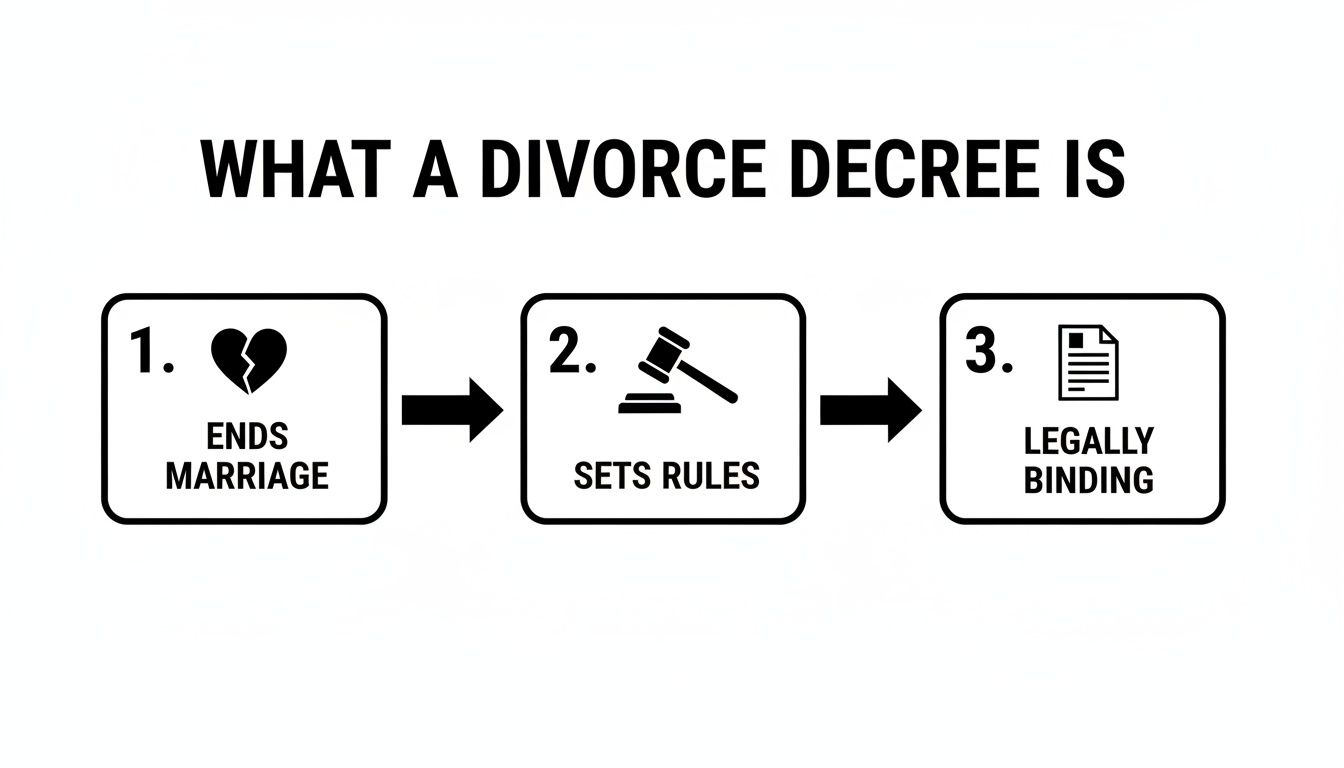
It’s a great reminder that the decree isn’t just a piece of paper. It’s a powerful legal order that officially ends your marriage and sets new, enforceable rules for your life after divorce.
Key Steps and Timelines
No matter which path your divorce takes, there are a few key steps everyone goes through. The table below shows the typical journey from filing the first paper to getting that final order from the court.
| Key Steps Leading to an Arkansas Divorce Decree |
| :— | :— | :— |
| Step | What Happens | How Long It Takes |
| 1. Filing the Complaint | One spouse files a Complaint for Divorce with the court. | Day 1 |
| 2. Serving the Other Spouse | The other spouse is officially given a copy of the complaint and a summons. | Days to weeks |
| 3. Response & Waiting Period | The spouse who was served files an answer. A required 30-day waiting period begins. | 30+ days |
| 4. Negotiation/Mediation | Spouses and their lawyers work to agree on things like property, debt, and kids. | Weeks to months |
| 5. Final Agreement or Trial | If you agree, it’s written down. If not, a judge decides at a trial. | Months to over a year |
| 6. Decree is Issued | The final agreement or judge’s decision is written into a decree and signed by the judge. | Final step |
As you can see, Arkansas law requires a “cooling-off” period. A judge cannot finalize your divorce for at least 30 days after the complaint is filed. This is true even if you agree on everything from the first day.
Of course, for most people, the process takes much longer. The real timeline depends on how complicated your situation is and how quickly you and your spouse can agree.
From Agreement to Final Order
Once every issue is settled—either by you and your spouse or by a judge after a trial—your lawyer will write the final divorce decree. This document spells out every single decision that was made. It covers everything from who gets the house to the exact schedule for holidays with the kids.
Both you and your spouse (and your lawyers) will read this document carefully to make sure it is exactly right. Once everyone signs it, it goes to the judge for their signature.
The moment the judge signs that decree and it’s filed with the court, it becomes a final, legal order. That’s it. Your divorce is officially over, and your new life begins under the rules in that document.
Understanding the Key Parts of Your Decree
Getting that final divorce decree in Arkansas can bring both relief and worry. It’s a long legal paper, and at first, it just looks like a lot of words. But if you take a breath and break it down, it’s really just a guide for your new life, built around four key sections.
Think of it as the main instruction book for moving forward. Each part covers a different piece of separating—the money, the property, the kids. You need to understand every rule to follow the plan correctly. Let’s look at the four main parts you’ll find inside.
Division of Property and Debt
This is the “who gets what” part of the decree. It lists everything you and your spouse got during your marriage. This includes the house, retirement accounts, and even credit card debt. It’s like moving out of an apartment you shared with a friend. You have to decide who keeps the couch, who takes the TV, and who has to pay that last electric bill.
In Arkansas, the rule for this is called equitable distribution. That’s an important term. “Equitable” means fair, which doesn’t always mean a perfect 50/50 split.
A judge looks at several things to decide what’s fair in your case:
- How long you were married
- Your ages, health, and how much money you each make
- What each person did for the marriage, including things without a paycheck like being a homemaker
- How much money each person is likely to make in the future
For example, if one spouse stayed home for 15 years to raise kids while the other built a career, a judge might give the stay-at-home spouse a larger share of the property. This helps make sure they have a stable financial future. The goal is to get to a fair result based on what your marriage was really like.
Child Custody and Visitation
For any parent, this is often the hardest, most emotional section of the whole paper. It gives the complete plan for how you and your ex will raise your children together. These sections are written in great detail to create a stable and predictable life for your children, which is the most important thing.
Arkansas courts make every custody decision with one main idea in mind: the best interest of the child. Your decree will explain two different kinds of custody:
- Legal Custody: This is about who gets to make big decisions. It says who decides about your child’s school, medical care, and religion. It is very common for both parents to share legal custody.
- Physical Custody: This just says where the child will live most of the time. The decree names one parent as the main physical custodian. Then it sets up a very specific visitation schedule for the other parent. This schedule covers everything from weekends and holidays to summer breaks.
The visitation schedule isn’t just a friendly suggestion—it’s a court order. It’s made to prevent future arguments by making the parenting plan super clear. This ensures both parents get predictable, quality time with their kids.
This level of detail is extremely important here. For a long time, Arkansas has sadly had one of the highest divorce rates in the country. In 2022, the state’s rate was 11.5 divorces for every 1,000 residents over age 15. That’s almost 67% higher than the U.S. average. This serious number shows why having a clear, court-ordered parenting plan is so important for families in places like Springdale or Rogers.
Child Support Obligations
Right next to the custody plan, the decree explains child support. This is the money part where the parent who doesn’t have the kids most of the time pays a set amount to the other parent. This money helps cover the everyday costs of raising a child—things like food, clothes, school supplies, and a place to live.
Arkansas uses a strict math formula to figure this out, which is found in a court rule called Administrative Order No. 10. The formula is mainly based on how much money the paying parent makes. The decree will not be fuzzy. It will state the exact amount of money, the exact date it’s due each month, and how the payment must be made.
Alimony or Spousal Support
The last big section you might find covers alimony, which is also known as spousal support. Alimony is not given in every Arkansas divorce. It’s usually for cases where there’s a big difference in how much money the spouses make. This often happens because one person stopped their career to support the family.
The whole point of alimony is to give the lower-earning spouse some money to help them get back on their feet. If it is ordered, the decree will say:
- The Amount: The exact dollar amount to be paid.
- The Duration: How long the payments have to continue (it could be for a few years or longer).
- The Type: It might be temporary support to help someone go back to school or get job training.
This final piece of the divorce decree in Arkansas puzzle is all about making sure both people can move forward from a stable financial place. If you want to better understand the dense legal words in your own document, a tool like an AI Legal Contract Analyzer can offer some helpful first ideas about what the terms really mean.
What to Do After Your Divorce Is Final
The moment the judge signs your divorce decree, your marriage is legally over. While that’s a huge relief and a big moment, the work isn’t quite done. Think of the decree not as the finish line, but as the official rulebook for separating your life from your ex-spouse’s.
Taking care of these small details now will save you from big headaches later. It’s a lot like unpacking after a trip. You have to unpack and put everything in the right place before you can really feel settled. This checklist will walk you through the most important tasks to do right away.
Get Certified Copies of Your Decree
First, you’ll need official proof that you’re divorced. A simple photocopy won’t work for most places. You need certified copies of your divorce decree. You can get these from the Circuit Clerk’s office where your divorce was filed. These copies have a special stamp or seal that proves they’re real.
It’s a good idea to get several certified copies, as you’ll need them for a surprising number of things. Keep them ready for:
- Changing your name on your Social Security card and driver’s license.
- Updating ownership papers for property, like your car or home.
- Removing your ex-spouse from bank accounts, credit cards, or insurance.
- Proving you are single to a bank if you apply for a new home loan.
Update Your Legal Name and Documents
If your decree says you can go back to your old name, you’ll need to start updating it everywhere. The best way to do this is to start with the big government offices. Take a certified copy of your decree to the Social Security Administration first, then go to the Arkansas DMV.
With those two updated, you can work your way down the list:
- Banks and credit card companies
- The human resources (HR) department where you work
- Your passport and voter registration
- Utility companies and your landlord or home loan company
Doing these steps right after your divorce is final is very important. It makes sure your legal name is clear and the same on all official records. This is key for things like paying taxes, traveling, and managing your money.
Adjust Your Financial Life
Your divorce decree explains how your money should be divided, but it doesn’t happen by itself. You have to take action to make it real. One of the most important and often forgotten tasks is updating the beneficiaries on your accounts.
A beneficiary is the person who gets the money from an account when you die. You absolutely need to contact the companies for your:
- Life insurance policies
- Retirement accounts (like a 401(k) or IRA)
- Pensions
- Bank accounts that have a “Payable on Death” (POD) person named
If you forget this step, your ex-spouse could end up getting your money, which is probably not what you want. Finally, and this is a big one, update your will. In Arkansas, a divorce doesn’t automatically cancel your old will. Making a new one that shows your new life and wishes is the only way to be sure your property is protected and goes where you want it to.
What If Things Change? Modifying or Enforcing Your Divorce Decree
Once the judge signs your divorce decree in Arkansas, it becomes a final court order. But life keeps going, and things can change in big ways. What happens when the rules no longer fit your life, or your ex-spouse just decides to ignore them? The legal system has two main tools for these situations: modification and enforcement.
Think of your decree as the official rulebook for your life after divorce. If a major life event makes one of the rules outdated or unfair, you can ask the court for a modification to update the book. But if your ex is just ignoring the rules, you’ll need to ask for enforcement to make them follow it.
Changing the Rules: How to Modify Your Decree
A modification is an official legal process to change parts of your divorce decree. It’s not for small problems or minor disagreements. To get a judge to change the decree, you have to prove a “material change in circumstances.”
That’s a legal term for a big, ongoing change that has happened since the original decree was signed. It has to be something large enough to make the original rules unfair or impossible to follow.
Here are some common reasons people ask for a change:
- Big income changes: One parent gets a huge promotion and a big raise, or maybe they lose their job and can no longer afford the support payments.
- A necessary move: The parent who has the kids most of the time gets a great job offer in another city or needs to move to be closer to sick parents.
- The children’s needs change: As kids grow into teenagers, their schedules, activities, and even their own wishes can be a good reason for a new custody plan.
- A parent’s life changes: A parent might get married again, have more children, or get a serious illness that affects their ability to follow the original parenting plan.
It is very important to understand that you can’t go back and re-divide property or debt. Those decisions are final. Modifications are almost always about child custody, visit schedules, or support payments.
When Someone Breaks the Rules: How to Enforce Your Decree
While modification is about updating the rules, enforcement is about making sure everyone follows them. Your divorce decree isn’t a list of friendly suggestions. It’s a court order that can have serious results if you break it. If your ex-spouse isn’t doing what they’re supposed to, you can ask the court to step in.
This is done by filing a motion for contempt. In simple terms, you are telling the judge that your ex is knowingly disobeying a direct order from the court.
You might need to ask for enforcement for issues like:
- Missed support payments: Child support or alimony payments are always late, not the full amount, or have stopped completely.
- Blocked visits: Your ex is stopping you from having your court-ordered time with your children.
- Failure to give you property: They refuse to sign the title of the car over to you or won’t sign the paper for the house as the decree said.
If a judge agrees and finds your ex in contempt, they have a lot of power to make them obey. This can mean taking money directly from their paycheck, making them pay large fines, or in the most serious cases, even sending them to jail until they follow the order.
Why Remarriage Is a Common Reason for Modifications
Life after divorce often includes new relationships. Blending families can cause new issues that the original decree did not plan for. Information shows this is a common issue in Arkansas, which has the highest rate of people married three or more times—double the national average for both men and women. These situations often lead to people asking to change divorce decrees from old marriages. You can learn more by looking at these divorce statistics and facts.
For example, if your ex-spouse gets married again and has another child, that could be a major change that affects how much money they have to pay child support. Or, if you want to get married again and move to another state with your new partner, you would absolutely need to ask for a modification of your custody order to get the court’s permission. These new family situations are a top reason why a divorce decree in Arkansas often needs to be looked at again and updated.
When You Need a Legal Partner for Your Divorce
Let’s be honest: some divorces are simple enough to handle on your own. But when things get complicated, trying to go through the legal system without an expert is like trying to climb a mountain without a guide. The path to a divorce decree in Arkansas can have hidden dangers, especially when children or a lot of money are involved.
That’s when you need a good lawyer.
Think of it this way: your future financial health and your relationship with your children are at stake. A good lawyer isn’t just a luxury. They are your helper, your planner, and your support system all in one.
Situations That Absolutely Require an Attorney
You should really think about getting legal help if your divorce involves any of the following. Each of these makes things more complex and can be very hard—and expensive—to handle without a professional. A good first step is exploring legal services for divorce to understand your choices.
Here are a few times when a lawyer is a must-have:
- High-Value Property: Things like family businesses, rental properties, or large investment and retirement accounts need a sharp legal and financial eye to make sure the split is fair.
- Child Custody Fights: When you and your spouse can’t agree on a parenting plan, a lawyer is key to fight for your rights as a parent and, most importantly, for what’s best for your child.
- Domestic Abuse: If there has been violence or one person has all the power in the relationship, a lawyer is vital for your safety and to make sure the legal process is fair.
A good lawyer does much more than just fill out forms. They create a plan, handle tough talks, and offer steady, kind support through one of life’s hardest times. Their job is to make sure you get a fair result.
At DeWitt & Daniels, we know the Northwest Arkansas court system inside and out. We help clients in Fayetteville, Bentonville, Rogers, and Springdale with clear advice and strong support, all focused on protecting your future.
Common Questions About Divorce Decrees in Arkansas
When you’re facing the end of a marriage, a lot of questions pop up. Let’s go through some of the most common things people ask about getting a divorce decree in Arkansas to give you the clear answers you need.
How Long Does It Take to Get a Final Divorce Decree?
The honest answer is: it depends. The time it takes to get that final, signed decree can be very different from one case to another.
If you and your spouse agree on every single thing (we call this an uncontested divorce), things can move pretty fast. Once you have passed the state’s required waiting period, it’s possible to have the final decree in as little as 30 to 60 days after you file.
But if your divorce is contested—meaning you can’t agree on big things like who gets the house, how to split debts, or the custody schedule—the process will take much longer. Contested divorces can easily last for many months, and sometimes even more than a year. This is because you have to go through talks, mediation, or finally a trial where a judge has to make the final decisions.
Is a Decree the Same as a Certificate?
This is a great question, and no, they are two completely different papers. It’s easy to get them mixed up.
- Divorce Decree: This is the detailed, official court order signed by the judge. It’s a paper with many pages that explains all the specific rules of your divorce—who gets what property, how custody is set up, and the amount of any support payments. It’s the legally binding rulebook for your life after divorce.
- Divorce Certificate: Think of this as a simple, one-page record. It just confirms that you and your ex-spouse are legally divorced. You’ll usually use this certificate for things like applying for a new marriage license or officially changing your name.
A good way to think about it is that the decree is the entire, detailed story of your divorce agreement. The certificate is just the headline that says the story is over.
What Happens if My Ex Violates the Decree?
A divorce decree isn’t a suggestion. It’s a court order with the full power of the law behind it. If your ex-spouse isn’t following the rules—for example, if they refuse to pay child support or won’t give you property they were ordered to—you have legal options.
The first step is usually to file a motion for contempt with the court. This asks the judge to step in and enforce the order. If the judge agrees that your ex has knowingly ignored the decree, they can use serious punishments, like taking money from their paycheck, making them pay fines, or in some cases, even sending them to jail until they follow the original divorce decree in Arkansas.
Can the Decree Be Changed After It Is Final?
Yes, but it’s not a simple process, and only certain parts of the decree can be changed. To even ask the court for a change, you have to show that there has been a “significant and material change in circumstances” since the decree was first signed.
Usually, the parts of a decree that can be changed are about the children, because their needs change over time. These include:
- Child custody and visitation plans
- Child support payments
The division of property and debt, on the other hand, is almost always final. Once the judge signs the decree, that part of the agreement is permanent and cannot be changed. Any request to change a decree must be officially filed with the court and approved by a judge.