
When parents decide to live apart, one of the biggest questions is: “How will we share time with our kids?” The answer is a child visitation schedule.
Think of it as a clear roadmap for how you and the other parent will raise your child together. It’s a calendar that lays out when your child will be with each of you. It covers everything from normal school weeks and weekends to holidays, birthdays, and summer vacation.
What Is a Child Visitation Schedule?
A visitation schedule is more than just a calendar on the fridge. It’s an official plan, either agreed on by parents or ordered by a judge, that lists the specific times each parent will have with the child. Its main job is to make a child’s life feel steady and predictable during a time of big changes.
When a child knows what to expect, it helps them feel less stressed and confused. A good schedule helps them feel safe and keep a strong, healthy bond with both parents. This schedule is a key part of a bigger document called a parenting plan, which covers all parts of raising a child from two homes. Arkansas law wants parents to work together on this plan, because no one knows your family better than you do.
To help you understand the words you might hear from a judge or a lawyer, here are some common terms explained simply.
Key Terms in Arkansas Visitation Explained
| Term | Simple Explanation |
|---|---|
| Visitation | The time the parent who the child doesn’t live with most of the time gets to spend with them. It’s also called “parenting time.” |
| Parenting Plan | The full agreement or court order that covers custody, visitation, and who makes big decisions for the child. |
| Best Interest of the Child | The main rule judges use to make all decisions about custody and visitation. It means putting the child’s happiness and safety first. |
| Joint Custody | A plan where both parents share the power to make legal decisions and often have close to equal time with the child. |
| Primary Custodian | The parent the child lives with most of the time. This parent usually gets child support payments. |
| Non-Custodial Parent | The parent the child spends less time with. This parent usually pays child support and has visitation rights. |
Understanding these words is the first step to creating a schedule that really works for your family.
The Focus on a Child’s Best Interest
In every talk, agreement, or court meeting about visitation, one rule is more important than all the others: the best interest of the child. This isn’t just a nice idea; it’s the law. Everything must be set up to support the child’s:
- Feelings: Making sure they feel safe, loved, and connected to both parents.
- Health: Having a stable home where their daily needs are met.
- Growth: Making sure their school, friendships, and fun activities aren’t messed up.
The judge’s main goal is to make a custody plan that helps the child’s body, feelings, and growth, while keeping a healthy relationship with both parents if possible.
Joint Custody Is the Starting Point
Arkansas law has changed a lot in the last few years. A law from 2019 says that judges should assume joint custody is the best plan. This means judges now start with the idea that kids do best when they get to spend a lot of time with both parents.
This doesn’t mean it will always be a perfect 50/50 split, but it does make shared parenting the normal starting point. A judge will only give one parent much more time if the other parent can show clear proof that an equal schedule would be bad for the child. You can learn more about how Arkansas law prioritizes shared parenting and what that means for custody cases. This law shows that both parents have a very important, ongoing job in their child’s life.
Common Visitation Schedules in Arkansas: Finding the Right Fit for Your Family
Once you understand the basics of Arkansas visitation rules, the real work starts: figuring out what a schedule actually looks like. There is no one perfect plan that works for every family. The best schedule is one that fits your child’s age, your family’s unique situation, and practical things like how far apart you live.
Think of it like building with LEGOs. You wouldn’t use the same plan to build a car that you’d use for a house. The goal is to make a routine that feels steady, predictable, and supportive for your child.
The picture below shows how the main idea of a ‘schedule’ connects to the most important things: your child’s stable life, good time with each parent, and the legal rules that guide everything.
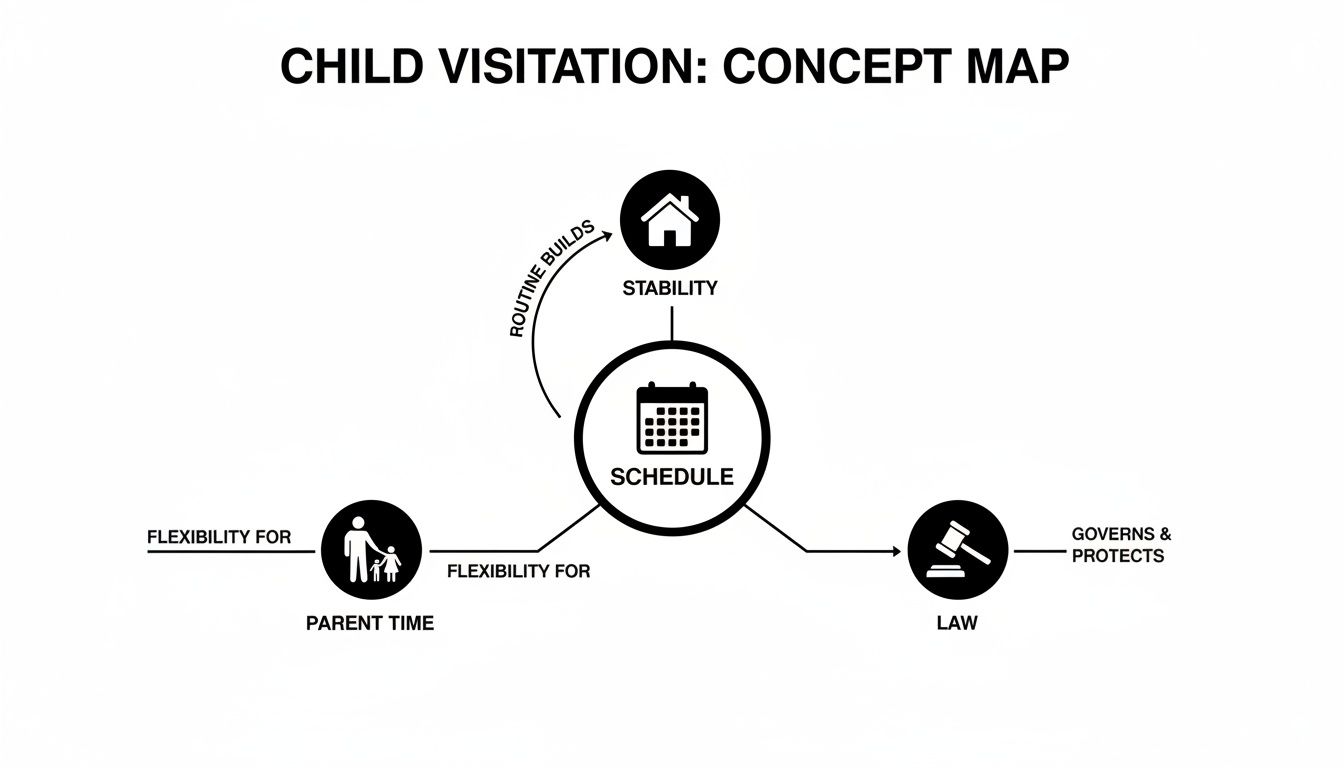
As you can see, a good schedule is a balance. It’s about creating a stable home while making sure both parents get real time with the child, all while following the court’s rules. Let’s look at some of the most common schedules families use.
1. The Classic: Alternating Weekends
This is the schedule most people think of. The child lives with one parent (the custodial parent) during the week for school and spends every other weekend with the other parent. It’s a classic for a reason and is often the first idea parents talk about.
In fact, Arkansas judges often use a standard visitation schedule when parents don’t have a 50/50 plan. This basic plan usually gives the non-custodial parent every other weekend from 5:00 p.m. Friday to 5:00 p.m. Sunday. Of course, parents can agree to a different plan, and a judge can always order a special schedule. You can learn more about these kinds of legal rules by looking at Arkansas family law trends and developments on chambers.com.
This plan is popular for kids in school because it creates a very steady routine during the week, which helps with homework and school activities. Many families also add a dinner visit or one overnight stay in the middle of the week to break up the long time between weekends.
Who It Works Best For:
- Kids in school who do well with a predictable weekly routine.
- Parents who live far enough apart that swapping the child back and forth a lot would be difficult.
- Families where one parent has a much busier job during the workweek.
2. The High-Contact Option: The 2-2-3 Schedule
For younger kids, like toddlers, a whole week without seeing a parent can feel like forever. The 2-2-3 schedule was made to fix this, making sure a child is never more than a few days away from either parent.
It works in a two-week cycle that sounds harder than it is:
- Week 1: The child is with Parent A for 2 days, then Parent B for 2 days, and then finishes with Parent A for a 3-day weekend (Friday-Sunday).
- Week 2: The parents switch roles. The child is with Parent B for 2 days, Parent A for 2 days, and then has a 3-day weekend with Parent B.
This schedule feels more like a shared rhythm than a strict split. It keeps both parents involved in the small, everyday parts of their child’s life, from potty training to bedtime stories.
Seeing both parents often is great for helping little kids not feel scared when they are away from one parent. The downside? All the switching can be hard for some kids and needs parents who can talk to each other well and live close enough to make the handoffs easy.
3. For Older Kids: The Week On, Week Off Schedule
As kids get older and can do more for themselves, a 50/50 schedule like the week on/week off plan is a great choice. It’s simple: your child spends one whole week with Parent A, then the next whole week with Parent B.
This schedule helps a child feel like they have two real homes. It cuts down on how many times they have to switch houses, which can lower stress and give teens a nice feeling of stability. They can really get settled in at each house for a full seven days.
The only catch is that this plan usually needs both parents to live in the same school area. It also requires parents to have flexible work schedules, since they are the only parent for a full week at a time. While it’s a great goal, a whole week away from one parent can still be hard for some kids, so it’s important to be sure they’re ready for it.
Choosing the right Arkansas child visitation schedule means taking an honest look at your child’s personality and your family’s real-life situation.
Comparing Popular Visitation Schedules
To make things clearer, here’s a table that breaks down these common schedules. Think of it as a quick guide to help you see the good and bad sides of each plan based on what’s most important for your family.
| Schedule Name | Best For (Child’s Age/Situation) | Pros | Cons |
|---|---|---|---|
| Alternating Weekends | School-aged children (6-12) who need a stable weekly school routine. | • Very steady during the school week. • Fewer switches, which is less disruptive. • Easier to do if parents live farther apart. | • Long breaks between seeing one parent. • One parent does all the weekday tasks. • Can feel less like parenting together. |
| 2-2-3 Schedule | Toddlers and preschoolers (1-5) who do better seeing both parents often. | • Child never goes long without seeing a parent. • Both parents are involved in daily routines. • Helps young kids feel less worried. | • Many exchanges can be hard for kids and parents. • Parents need to live close and talk well. • Can mess up a steady weekly schedule. |
| Week On / Week Off | Older children and teenagers (10+) who are more independent. | • Fewer exchanges and less chance for arguments. • Gives the child a strong feeling of having two homes. • Provides a true 50/50 parenting split. | • A full week away from a parent can be hard. • Parents must live in the same school area. • Needs flexible work schedules for both parents. |
No single schedule is perfect, and a plan that works today might need to be changed as your child gets older. The key is to start with a plan that puts your child’s well-being first and be ready to change it in the future.
How Arkansas Judges Make Visitation Decisions

When parents can’t agree on a schedule, a judge has to make the decision. In Arkansas, judges don’t just pick a random plan. Every single decision is guided by one very important rule: the best interest of the child.
This isn’t just a fancy legal phrase; it’s the rule that every judge uses to create a visitation schedule. It means the judge’s main goal is to create a living situation that helps a child feel safe, supported, and loved. While parents’ wishes are important, the child’s needs always come first.
To figure out what is in the child’s “best interest,” the judge acts like a detective. They get information from everyone to understand the family’s situation before making a decision.
The Child’s Age and Needs
A child’s age is a very big part of the decision. A plan that works for a teenager would be a bad idea for a baby. For example, babies and toddlers need to see both parents often and on a regular schedule to feel safe and build strong bonds.
A judge will also think carefully about the child’s physical and emotional health. If a child has special medical needs, the schedule might be made to make sure they are with the parent who can best handle their care. A child’s feelings are just as important, and supporting children through separation anxiety is a common problem that the court takes seriously.
Each Parent’s Role and Home Life
The court will look closely at each parent’s ability to give the child a safe and stable home. This is about more than just having a house and food. It includes looking at each parent’s character, past behavior, and how stable their life is.
Judges often want to know who has been the main caregiver—the parent who usually takes the child to the doctor, helps with homework, and handles the daily routine. This history can show who knows the child’s daily needs the best. The quality of the child’s relationship with each parent, their brothers and sisters, and even grandparents also matters.
The judge’s main goal is to make a custody plan that helps the child’s body, feelings, and growth, while keeping a healthy relationship with both parents if possible.
In the end, a parent with a steady job, a safe home, and a willingness to work with the other parent will look better to the judge than one whose life seems messy or unpredictable.
Listening to the Child’s Preference
As kids get older, their own thoughts and feelings start to matter more. In Arkansas, there is no “magic age” where a child gets to pick which parent they live with. However, a judge must consider what a child wants if they are old enough to have a smart opinion.
The judge will try to understand why the child has a preference. Is it because they have a stronger bond with one parent, or is it because that parent has fewer rules or buys better video games? The older and more mature the child is, the more their opinion will be considered. This is just one of many important parts of the state’s family laws, and you can learn more by reading about child custody laws in Arkansas.
At the end of the day, a judge puts all of these pieces of information together to create a schedule they believe is best for the child above all else. Knowing what the court looks for can help you focus on what’s important as you work on your case or your parenting plan.
How to Create Your Arkansas Parenting Plan

Think of a parenting plan as the instruction manual for raising your child from two homes. A detailed plan is the best way to avoid arguments later, because it makes you figure out the small details before they become big problems. It becomes the rulebook for your family, making sure everyone knows what to do and what to expect.
The goal is to create a plan so complete that it answers questions you haven’t even thought of yet. Since this plan will become an official court order, taking the time to make it good now will save you a lot of trouble later. You are basically turning possible fights into simple, agreed-upon rules.
The Residential Schedule: Your Daily Blueprint
The most important part of any parenting plan is the residential schedule. This is the calendar that shows where your child will be during a normal week or month. It’s the foundation that everything else is built on.
You’ll need to pick one of the common schedules—like alternating weekends or a 2-2-3 plan—or create a custom schedule that works for your family. The key is to be very specific. Don’t just write “every other weekend.” Instead, write it out clearly: “every other Friday at 6:00 PM until Sunday at 6:00 PM.”
The more details you include, the fewer things there are to argue about later. For kids, this kind of clear, predictable schedule gives them the safety and steadiness they need to do well.
Planning for Holidays and Special Occasions
Holidays and school breaks are where many simple parenting plans fail. It’s easy to forget about these special days when you’re focused on the weekly routine, but they can cause big arguments if they aren’t planned out ahead of time. A good parenting plan should have a separate, detailed calendar just for these events.
You should try to map out a plan for several years that covers all the major holidays and school vacations. This simple step stops one parent from always missing out on the same special days year after year.
Here are a few fair and common ways to handle it:
- Alternating Years: One parent has the child for Thanksgiving in odd-numbered years (2025, 2027), and the other parent gets it in even-numbered years (2026, 2028). You can do the same thing for Christmas, Spring Break, and other big holidays.
- Splitting the Holiday: Some families split the holiday itself. For example, one parent might have the child on Christmas Eve and the other on Christmas Day.
- Defining Times: Be very clear about start and end times. Does “Christmas Day” visitation start at 9:00 AM on December 25th, or does it start after dinner on Christmas Eve? Being clear is your best friend.
Your holiday schedule should be its own part of the plan, completely separate from the regular weekly schedule. This makes sure that when a holiday comes, there are no last-minute fights because everyone already knows the plan.
Logistics and Communication Rules
Once the calendar is set, it’s time to figure out the “how.” This part of the plan covers all the real-world details of co-parenting and helps keep communication polite and focused on your child.
Take some time to think through the daily details and write down clear rules for them. Your plan should definitely include these key areas:
Transportation and Exchanges
- Who drives? Will one parent do all the drop-offs, or will you meet somewhere in the middle?
- Where do you exchange the child? Will you switch at home, at school, or at a neutral public place like a library or police station?
- What happens if someone is late? Agree on a grace period (like 15 minutes) and a rule for what happens if a parent is later than that.
Communication Guidelines
- How will you talk about the child? Pick the best way—like text, email, or a special co-parenting app—and stick to it.
- How often can the child call the other parent? Set reasonable rules, like allowing one phone or video call each evening.
- How will you make big decisions? Create a clear process for talking about and agreeing on important choices about school, health care, and other major life events.
As you build your plan, using helpful tools can make a big difference. A shared digital calendar is a great start, and this complete guide to coparenting calendars has some great tips for using them. Figuring out these details is what turns a basic schedule into a strong, successful Arkansas child visitation schedule.
Changing or Enforcing Your Visitation Order
Life changes. Kids grow up, jobs change, and people move. The visitation schedule that was perfect for a toddler might not work at all for a teenager with a busy sports schedule. That’s why an Arkansas child visitation schedule is not set in stone. Think of it as a living document that can and should change as your family’s life changes.
But it’s also a court order—a command from a judge that you must follow. When one parent stops following the plan, it can cause problems for everyone, creating stress for your child. Knowing how to legally change the schedule when you need to, and how to enforce it when you have to, is very important for keeping life stable.
How to Change a Visitation Order
If you and the other parent agree that the old schedule is not working anymore, you can’t just change it with a simple agreement. To make the change official, you need to go back to court and ask a judge to “modify” the order.
In Arkansas, to get a judge to change an order, you have to prove there has been a material change in circumstances. This is a legal term that just means something big and probably permanent has happened since the judge signed the last order. The change has to be big enough that the current schedule is no longer what’s best for your child.
So, what counts as a big change? It’s not about small problems. It’s about major life events like:
- A Parent Moves: One parent gets a new job but has to move to a different city or state, which makes the old weekend schedule impossible.
- The Child’s Needs Change: A young child’s needs are very different from a teenager’s. A schedule with lots of short visits might need to change to a week-on/week-off plan to fit a teen’s school and social life.
- A Parent’s Situation Changes: A parent’s work hours might change from a normal 9-to-5 job to an overnight shift. This completely changes their ability to handle school drop-offs or bedtimes.
- Safety Becomes a Worry: This is a very serious one. If a parent’s home becomes unsafe because of problems like drug use or not taking care of the child, the court will act right away to protect the child by changing the order.
To start the process, you will file a “Motion to Modify” with the court. This paper explains exactly what has changed and why the old schedule needs to be updated to be better for your child.
What to Do When the Schedule Is Ignored
It is very frustrating when the other parent does not follow the court-ordered schedule. Maybe they are always late for exchanges, cancel at the last minute, or don’t bring the child back on time. When this happens, it’s easy to get angry, but it is very important that you don’t try to fix it yourself.
Refusing to let the other parent see the child to “get back” at them is a big mistake and can get you in trouble with the judge. The only right way to handle it is through the court system.
Here are the steps to take:
- Write Everything Down: Start a journal. For every time the schedule is not followed, write down the date, time, and what happened. Save any texts or emails that prove the other parent is not following the plan.
- Try to Communicate (in Writing): If you feel safe doing so, send a polite but firm email or text reminding the other parent of what the court order says. This creates a written record that shows you tried to solve the problem yourself.
- File a Motion for Contempt: If the problems don’t stop, it’s time to file a “Motion for Contempt.” This is the official way you tell the judge, “The other parent is breaking your order on purpose.”
A Motion for Contempt isn’t about punishing the other parent—it’s about protecting your child’s right to have a stable and predictable routine. It asks the judge to step in and fix the problem.
When a judge finds a parent in contempt, they can do several things. They might order make-up visitation time for the time you lost, make the other parent pay for your lawyer’s fees, or, in serious cases, even reduce that parent’s future visitation time.
Common Questions About Visitation in Arkansas
When you’re trying to figure out a parenting plan, a lot of questions come up. It’s normal to feel unsure about the details, especially when your main goal is to create a stable life for your child. Think of this as your guide for clear answers to the problems we see parents deal with most often.
Understanding your rights and what you are responsible for is the first step toward making your parenting schedule work. Let’s go through some common questions, from what a child can say to the tricky link between visitation and child support.
Can My Child Decide Who They Want to Live With?
This is one of the most common questions we hear, and the simple answer is no. In Arkansas, a child cannot legally make the final decision about where they live.
However, that doesn’t mean their opinion doesn’t matter. A judge has to listen to and think about a child’s preference, as long as the child is old enough to have a good reason for their choice. There isn’t a magic age—like 12 or 14—where their choice suddenly becomes the rule. The judge looks at each child’s situation. The older the child is and the more sensible their reasons are, the more their preference will matter in the final decision on their Arkansas child visitation schedule.
What Happens If the Other Parent Ignores the Schedule?
It is very frustrating and upsetting when a parent doesn’t follow the court-ordered visitation schedule. When this happens, the most important thing is not to try to solve it yourself. Keeping the child from the other parent might feel right, but it can get you in legal trouble.
Instead, here’s the right way to handle it:
- Document everything. Keep a detailed record of every missed visit, late arrival, or change from the plan. Write down the dates, times, and any conversations you had about it.
- File a Motion for Contempt. This is the official legal step where you ask a judge to get involved and enforce the order.
If the court agrees that the other parent is in contempt, a judge has several options. They can order make-up parenting time, make the other parent pay your lawyer’s fees, or in very serious cases, even change the custody order.
In Arkansas, the court sees child visitation and child support as two completely separate legal duties. One doesn’t depend on the other.
Do I Still Have to Allow Visits If Child Support Isn’t Being Paid?
Yes, absolutely. You must continue to follow the visitation order exactly, even if the other parent is behind on child support payments. The court sees these as two separate responsibilities. A parent not paying support is not a legal reason to stop them from having their court-ordered time with their child.
If you stop visitation, you could be the one in trouble with the court. The right thing to do is to deal with the unpaid support separately. You can contact the Office of Child Support Enforcement or file a separate request with the court.
Can I Move Out of State with My Child?
Moving with your child, especially to another state, is a big legal process in Arkansas. If you have a custody order, you can’t just pack up and leave. You must have one of two things: the other parent’s written and signed permission, or an order from the court that allows you to move.
To get the court’s permission, you have to prove that the move is really in your child’s best interest. A judge will look very carefully at your reasons for moving, how the move would affect the child’s relationship with the other parent, and if a good long-distance visitation schedule can be created.