
When a child support payment is missed, it’s easy to feel stressed and worried. You might wonder how you will pay for things your child needs. In Arkansas, you have two main ways to get the child support you are owed. You can get free help from a state office called the Office of Child Support Enforcement (OCSE). Or, you can hire your own lawyer to go to court for you.
Each way works differently. The best choice for you depends on your own situation.
What to Do When Child Support Payments Stop
When you notice a payment hasn’t been made, it’s time to do something. The good news is that you have a court order on your side, which is a very powerful tool. The first thing you need to decide is how you want to make the other parent pay.
Will you use the state office that was created for this exact problem? Or will you hire your own lawyer to fight for you? There is no one right answer. It depends on how fast you need money, how much you can spend, and if your case is tricky.
Choosing Your Path
The two ways to get the money you are owed are very different. The Office of Child Support Enforcement (OCSE) is a state group that helps you for free. They have many ways to collect money that don’t need a judge. But, they are very busy, so it can take a long time to get help.
Hiring your own lawyer means you have someone who is only working on your case. A lawyer costs money, but they can often get things done faster. A lawyer is very helpful if the other parent works for themselves, gets paid in cash, or is trying to hide their money. These kinds of problems are part of family law, and having an expert on your team can really help.
This chart shows the two main paths you can take when a parent stops paying child support.
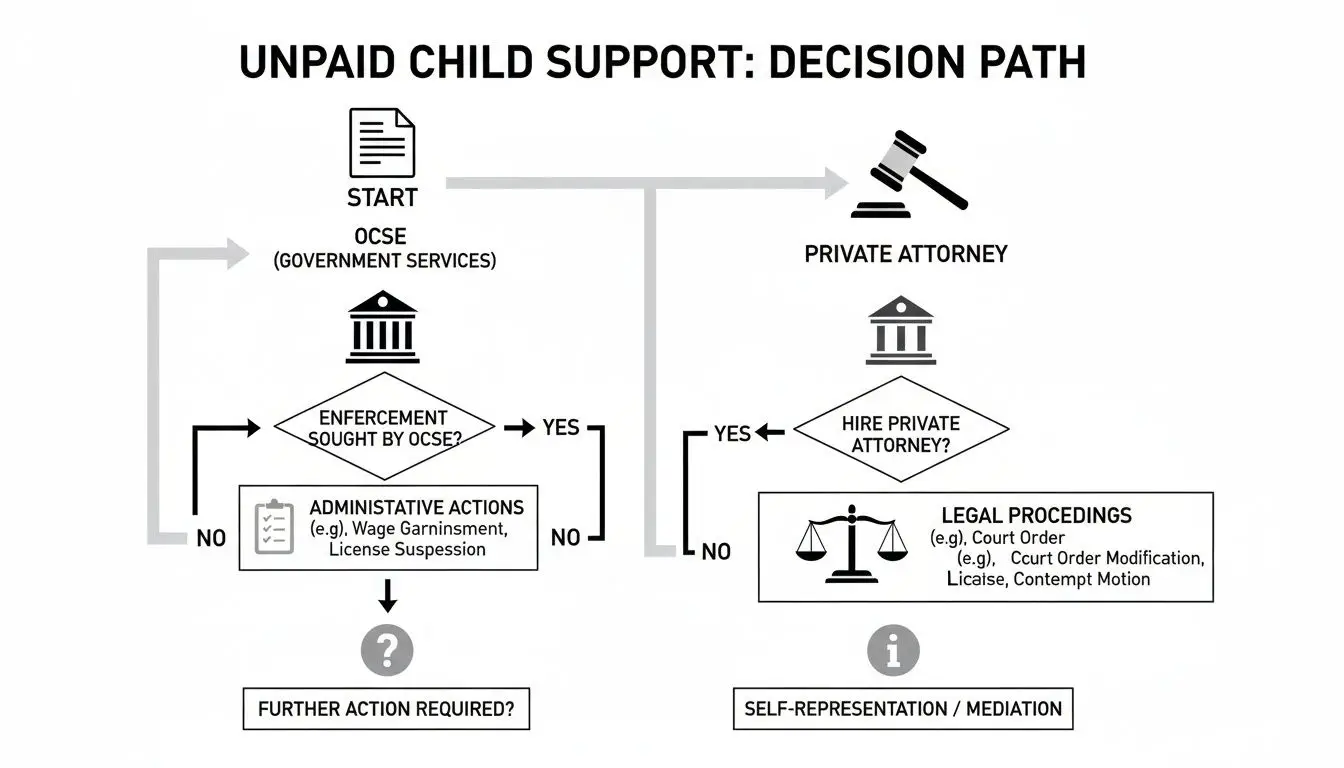
As you can see, both paths begin with gathering your information. But they quickly split into either using the state’s help or hiring a private lawyer to go to court. Each path has its own tools and timelines.
Your First Step: Get Your Papers Ready
Before you call anyone, get your paperwork together. Being organized will make everything go faster, no matter which path you choose.
Your most powerful tool is the child support order that was signed by a judge. This paper is the legal proof that the other parent must pay.
Get a folder and put these things inside:
- Your Child Support Court Order: This is the most important paper. Find the final copy that the judge signed.
- A Payment List: You don’t need anything fancy. Just make a list of when payments were supposed to be made, how much was paid, and how much is still owed. This list clearly shows what is missing.
- The Other Parent’s Information: Write down everything you know about the other parent. This includes their last known address, where they work, their phone number, and their birthday. Every small detail can help.
When you have these papers ready, it shows you are serious. It helps a caseworker or a lawyer start working on your case right away.
How the OCSE Collects Child Support for You

When you ask the Office of Child Support Enforcement (OCSE) for help, it’s like adding a powerful state agency to your team. They have special tools to collect money that you can’t use on your own. Their only job is to make sure your child gets the money they are supposed to get, often without you ever going to court.
This is a big program. In 2018, the OCSE in Arkansas was working on 96,993 cases for 104,178 children. That year, they collected almost $227 million. You can learn more about Arkansas child support guidelines and their impact in this detailed review.
Taking Money from Paychecks
The most common way OCSE collects money is called income withholding. It’s simple. The OCSE sends a legal paper to the other parent’s boss. This paper tells the boss to take the child support money right out of the parent’s paycheck. The boss then sends the money to the state.
If the parent has a normal job, this works very well. The parent doesn’t handle the money, so you don’t have to worry about them paying late or not at all. Once the money is taken out of their paycheck, it’s automatic.
The best thing about taking money from a paycheck is that it’s steady. It turns a payment you can’t count on into a regular source of money for your child.
Taking Other Kinds of Money
What if the other parent doesn’t have a normal job or gets paid in cash? OCSE has other strong ways to help with Arkansas child support enforcement. The OCSE can take other money that is supposed to go to the parent who owes support.
These tools include:
- Taking Tax Refunds: If the parent is supposed to get a tax refund from the government, OCSE can take it to pay for child support.
- Taking Lottery Winnings: If the parent wins the lottery, OCSE can take the money to pay off the child support they owe.
- Taking Unemployment Money: If the parent is getting money because they are out of work, some of that money can be taken for child support.
These things happen automatically when you have a case with OCSE and the other parent is behind on payments. It’s a way to make sure that any big amount of money the other parent gets goes to their child first.
Taking Stronger Actions
When a parent is trying hard not to pay, the OCSE can do more to pressure them. These actions are meant to make life difficult for the parent, so they are pushed to pay what they owe.
For example, the OCSE can ask to have the parent’s driver’s license taken away. This means the parent can’t legally drive a car. OCSE can also go after work licenses, like those for a nurse, a hairdresser, or a construction worker. This can stop the parent from being able to do their job.
Another powerful step is to put a lien on the parent’s property, like a house or a car. This means the parent can’t sell that property until the child support is all paid off. It freezes their biggest assets until they do what they are supposed to do.
Using the Courts to Enforce Your Order
Sometimes, even with the state’s help, the child support payments still don’t show up. Maybe the other parent works for themselves, gets paid in cash, or is just ignoring the OCSE. When the state’s efforts don’t work, it’s time to go to a judge.
To do this, you file a paper with the court called a “motion for contempt.” You are telling the judge that the other parent is breaking a court order on purpose. This is a serious step that can get big results.
What Happens at a Contempt Hearing
A contempt hearing is your chance to prove to the judge that the other parent isn’t paying. Your job is to show clear proof, like your payment list and bank records. This proof should show exactly how much money is owed.
The judge wants to know if the parent failed to pay on purpose. Did they have the money to pay but chose not to? The other parent gets to tell their side of the story. But if the judge decides they are in contempt, the punishment can be tough.
A judge can order things like:
- A one-time payment to cover all the missed child support.
- Making the other parent pay for your lawyer.
- Jail time.
Jail is the last choice, but it’s a real tool judges can use for a parent who keeps breaking their orders. It shows that supporting your children is not a choice. Understanding how courts work is important, especially during a divorce in Arkansas with children.
Powerful Court Tools Like Taking Bank Money
Besides fines or jail, judges have other ways to get the money. One of the strongest is a bank account levy. This is a court order that freezes the other parent’s bank accounts. The money needed to pay the child support is then taken directly from the account.
This can’t be done just for fun. The state finds bank accounts using a special system. A levy can usually only happen if the parent owes at least $500 or is three months behind. There are some rules to protect people. For example, accounts can’t be taken if the person is in bankruptcy.
A bank levy ordered by a court is a big deal. It shows that you can’t hide your money when your child needs support.
Whether you use the OCSE or go to court depends on your situation. Each path has good and bad points when it comes to how fast it works, how much it costs, and what tools are available.
The table below shows the main differences to help you decide.
Comparing OCSE vs. Court Actions
| Feature | OCSE (State Help) | Court Action |
|---|---|---|
| How It Works | Automatic tools like taking from paychecks, taking tax refunds, and taking away licenses. | You go before a judge to ask for help. |
| How Much It Costs | Usually free. The OCSE does the work. | You have to pay court fees and maybe pay for a lawyer. |
| How Long It Takes | Can be slow, especially if the other parent is hard to find. | Can be faster to see a judge. Results can happen right away. |
| Main Powers | Taking from paychecks, taking tax refunds, stopping passports, taking away licenses. | All the OCSE’s powers, PLUS the power to order jail time, take bank money, and make the other parent pay for your lawyer. |
| Best For… | Cases where the parent has a normal job and is easy to find. | Tricky cases, parents who work for themselves, or parents who are hiding money. |
Going to court gives a judge more direct power. The threat of jail can be a very strong reason for a parent to pay. OCSE is a great, free place to start, but going to court is often needed for the hardest cases.
Court hearings can be confusing. Many courts now let you attend online. It helps to be ready. You can look at these essential guidelines on remote legal proceedings to know what to expect.
Enforcing Child Support Across State Lines
Parents often worry and ask: What happens if the other parent moves out of Arkansas? This is a good question, but you can relax. A state border doesn’t stop a child support order.
The court order from Arkansas is strong. It follows the paying parent wherever they go. Thanks to a special law, your order can be enforced in any state, just like it is in Arkansas.
How States Work Together
The law that makes this happen is called the Uniform Interstate Family Support Act (UIFSA). It’s a long name for a simple idea: all states have agreed to help each other enforce child support orders. This means a parent can’t just move away to avoid paying.
Here’s how it works. If the other parent moves to a different state, the Arkansas Office of Child Support Enforcement (OCSE) will work with the child support office in that parent’s new state. Together, they will find the parent, check where they work, and use that state’s tools to collect the money. This can include taking money from their paycheck or taking away their driver’s license.
An important part of UIFSA is that only one state at a time has the power to change the child support order. This is great because it stops courts in different states from making different and confusing orders.
This teamwork between states is a key part of Arkansas child support enforcement. It helps you collect money even when the other parent is far away.
What You Need to Start a Case Between States
When you ask OCSE for help, they will be like a detective for you. The more clues you can give them, the faster they can find the other parent.
Try to find as much of this information as you can:
- The parent’s full name and birthday
- Their Social Security number (this is very helpful)
- Their last known address and phone number
- The name and address of their last job
- A recent photo can also help
Don’t worry if you don’t have all of this. Even one small piece of information can help OCSE get started. Once they have enough to go on, they will send the case to the other state. That state’s office will then take over and enforce the order.
When the U.S. Government Gets Involved
In the most difficult cases, the U.S. government can step in. This usually only happens when a parent is on the run and trying not to pay support for a child in another state.
For example, there is a federal law that makes it a crime to not pay child support if you owe more than $5,000 or have not paid for more than a year. This is not the first step, but it is a very strong tool. It can lead to a federal case, fines, and even jail time. It sends a clear message that paying for your child is a serious duty.
When you’re trying to get unpaid child support, you don’t need more confusion. The good news is that if you live in Northwest Arkansas, you can get help right in your community. Knowing who to call can get things started much faster.
The process almost always starts with the Office of Child Support Enforcement, or OCSE. Think of them as the team that does the daily work, like taking money from paychecks and tax refunds.
Your Local OCSE Offices
Your first call for Arkansas child support enforcement should be to the OCSE office that helps your county. It is free to open a case with them.
If you live in or near Fayetteville and Springdale, you will work with the Washington County office.
- Washington County OCSE
- Address: 613 W. Emma Ave, Suite 201, Springdale, AR 72764
- Phone: (833) 940-2521
If you’re in Bentonville, Rogers, Lowell, or nearby towns, the Benton County office is where you should start.
- Benton County OCSE
- Address: 900 S.E. 13th Ct., Bentonville, AR 72712
- Phone: (833) 940-2521
These local offices are your partners. They will help you set up your case and handle the collection of money.
Where Court Hearings Happen
Sometimes, the OCSE’s tools are not enough to make a parent pay. If you need to go to court, your case will move from the OCSE office to a courtroom.
This is where a judge gets involved. A judge can make much more serious orders, like taking money from bank accounts or even sending someone to jail. Knowing where the court is can make the whole thing feel less scary.
It’s easy to feel lost, but just having the right phone number and address is a big first step. It turns a bad situation into a plan you can act on today.
For cases in Washington County, hearings are held at one of two places in Fayetteville.
- Washington County Courthouse: 280 N College Ave, Fayetteville, AR 72701
- Washington County Juvenile Justice Center: 885 W Clydesdale Dr, Fayetteville, AR 72701
If you live in Benton County, your court case will be at the main courthouse in downtown Bentonville.
- Benton County Courthouse: 102 NE A St, Bentonville, AR 72712
Getting your child the support they need starts with a local phone call. Whether you start with OCSE or need to go to court, the help you need is right here in Fayetteville, Springdale, and Bentonville.
Your Top Enforcement Questions, Answered
When you’re trying to get child support, you will probably have questions. The law can seem hard to understand, but getting clear answers can help. Let’s answer some of the most common questions from parents like you.
How Much Does It Cost to Use the OCSE?
Here is some good news: asking the Arkansas Office of Child Support Enforcement (OCSE) for help is free. The state wants to make sure every parent can get help to collect support, no matter how much money they have.
It’s free to apply, but there might be very small fees for certain services later. For the most part, you can get started without spending any money. The OCSE’s job is to get money for your child, not to cost you more money.
How Long Will It Take to Get Payments?
This is a very common question, and the honest answer is “it depends.” There is no set timeline, so it’s good to know what to expect.
- Best Case: If the other parent has a normal job and you know where they work, the OCSE can start taking money from their paycheck pretty fast. You might see payments in just a few weeks.
- Worst Case: It gets harder if the other parent works for themselves, moves a lot, or tries to hide. Tools like taking a tax refund are strong, but they only happen once a year.
The most important thing is to be patient but not give up. Keep in touch with your OCSE caseworker. A friendly call can help keep your case moving.
Can I Get Child Support If the Other Parent Is in Jail?
Yes, you can, but it is not easy. The duty to pay child support does not go away just because a parent is in jail. The money they owe will keep adding up for every month they are behind. This is called arrears.
But, the parent in jail will probably have no money to make payments. The full amount of unpaid support will be waiting for them when they get out. A parent in jail can ask a judge to lower or pause their monthly payment for a while, but they cannot get rid of the debt they already owe.
What If They Get Paid ‘Under the Table’ in Cash?
This is one of the hardest problems to solve, but it’s not impossible. When someone is paid in cash, normal tools like taking money from a paycheck don’t work. In this situation, you will almost always need to go to court.
Your best option is to file a motion for contempt. This makes the other parent go before a judge. In court, you can show proof that their lifestyle does not match what they say they earn. Think like a detective. You can use:
- Social media posts that show them on expensive trips or with new cars.
- Photos of a new boat, ATV, or other expensive things.
- What friends, family, or old coworkers say about their work or spending.
A judge can look at all of this information. If the proof shows they are earning more than they say, the judge can order them to pay based on that reality, not just what is on paper.