
When you are accused of a crime, it can feel like you are lost and alone. A Fayetteville criminal defense attorney is the expert you need to help you. They will protect your rights and fight for you. The most important thing you can do for your future is to hire a good local lawyer right away.
Why You Need a Local Defense Attorney Immediately

As soon as you are arrested or charged with a crime in Arkansas, a clock starts ticking. The time between your arrest and your first day in court is very important. Without a lawyer to guide you, you might say something by mistake that hurts your case. You could also lose the chance to find proof that you are innocent.
Think about it like this: the other side, called the prosecution, starts building its case against you from the very first day. Hiring a Fayetteville criminal defense attorney makes things fair. We make sure your side of the story is heard and that your rights are protected every step of the way.
The Power of Local Knowledge
Hiring a lawyer who knows the Fayetteville and Washington County court system gives you a big advantage. Each courthouse works a little differently. The judges and prosecutors all have their own ways of doing things. A good local lawyer already knows these unwritten rules and the people involved.
This special knowledge can change everything. A local lawyer knows which arguments work best with certain judges. They also know how certain prosecutors usually handle deals to lower charges. You can’t get that kind of knowledge from a lawyer who doesn’t work here.
A lawyer’s real value isn’t just knowing the law; it’s knowing the people and rules of the courthouse. Working there every day helps them understand the best way to get a good result for a client.
This local knowledge helps in a few important ways:
- Making Deals: Knowing how a prosecutor thinks can lead to much better offers, which can mean lesser charges or a smaller penalty.
- Filing Papers with the Court: A local lawyer knows which legal requests are most likely to succeed with a specific judge.
- Building Your Defense: They can often guess the prosecution’s plan based on other cases and build a stronger defense for you from the start.
Taking the First Crucial Steps
The first few hours and days after an arrest are confusing. Having a skilled lawyer by your side can give you peace of mind and, more importantly, a clear plan. Your lawyer’s first job is to protect you from common mistakes and start building your defense right away.
Your lawyer can advise you to stay quiet and help save important evidence before it disappears. We will look at all the details of your arrest, check for any mistakes the police made, and start creating a defense plan just for you. This way, you’re not just reacting to what the other side does—you’re actively fighting for your future. The first call you make to a Fayetteville criminal defense attorney is your first step toward getting back in control.
Understanding Common Charges in Fayetteville, Arkansas
When you are charged with a crime, the legal world can seem like a strange place with its own confusing language. You might hear words like “misdemeanor,” “felony,” and “prosecution.” It’s easy to feel worried and overwhelmed.
Let’s look at some of the most common charges we see here in Fayetteville. The goal is to explain them in a simple way so you can understand what you are facing. Remember, every case is different, but knowing the basics is the first step to building a strong defense.
Driving While Intoxicated (DWI)
A Driving While Intoxicated (DWI) charge is one of the most common crimes in our area. Under Arkansas law, you can get a DWI if you are caught driving with a Blood Alcohol Content (BAC) of 0.08% or higher. It also applies if you are affected by any substance—like alcohol or drugs—so much that you can’t drive safely.
Think of a DWI case like a checklist that the police have to follow perfectly. They need a good reason to pull you over. They must do the roadside tests, like walking a straight line, exactly the right way. The machine they use to test your breath has to be working correctly. If they make any mistakes, it can create problems for their case.
A good defense lawyer knows how to look for these mistakes. Was the ground you stood on for the tests bumpy? Was the police officer’s training up to date? These small details can make a big difference.
The penalties for being found guilty of a DWI in Arkansas can be serious and may include:
- Jail Time: Yes, even for the first time. The possible jail time goes up if you have been convicted before.
- Big Fines: You will almost always have to pay large fines.
- Losing Your License: Your driver’s license will likely be taken away for a period of time.
- Ignition Interlock Device: You may have to put a device in your car that makes you blow into it to prove you haven’t been drinking before the car will start.
Because these charges are so common, DWI defense has become a special area of law in Northwest Arkansas. In fact, some local law firms have defended over 11,000 DWI cases right here. That number shows how important it is to have a lawyer with a lot of specific experience in this area. It’s why having a focused team is so important; you can learn more about how our Fayetteville DWI lawyer can protect your rights.
Common Charges and Possible Penalties in Arkansas
To help you understand better, here is a simple chart of common crimes in Fayetteville and what could happen if you are found guilty under Arkansas law. Remember, this is just a general guide—what happens in your case will depend on the specific details.
| Crime Type | Example | Misdemeanor or Felony | Possible Consequences |
|---|---|---|---|
| DWI/DUI | Driving with a BAC of 0.08% or higher | Usually a Misdemeanor (can be a Felony if it happens again) | Fines, jail time, losing your license, special car device |
| Drug Possession | Having a small amount of marijuana | Misdemeanor or Felony (depends on the drug and how much) | Fines, being supervised by the court (probation), possible jail, drug classes |
| Assault | Threatening to hurt someone | Misdemeanor | Fines, probation, anger management classes, jail time |
| Battery | Actually hurting someone physically | Misdemeanor or Felony (depends on how badly they’re hurt) | Fines, paying the victim back, jail or prison time |
| Theft | Taking something from a store without paying | Misdemeanor or Felony (depends on how much the item is worth) | Fines, paying the store back, community service, possible jail time |
Every charge on this list can be defended. A good lawyer knows how to question the evidence and bargain for a better outcome, like getting the charges lowered, dropped, or winning your case in court.
Drug Possession Charges
Drug possession is another common charge we see. In Arkansas, it is against the law to have a controlled drug without a doctor’s prescription. How serious the charge is depends on two main things: the type of drug and the amount you had.
Having a small amount of marijuana for yourself is treated very differently than having a lot of a drug like cocaine or meth. Having a larger amount could lead to a much more serious charge called “possession with intent to deliver.”
The prosecution has to prove you knew the drug was there and that you had control over it. Just because you were in the same car or room as a drug doesn’t always mean you are guilty.
When we defend someone on a drug charge, we often look at how the police found the drugs. Did they have a legal reason to search your car, your home, or you? If the search was not legal, any evidence they found can be thrown out of court. This can often ruin the prosecution’s case.
Assault and Battery Charges
Assault and battery have to do with hurting someone—or threatening to hurt them. People often use these words to mean the same thing, but in Arkansas law, they are different.
- Assault: This is when you make someone afraid of being hurt. If you threaten someone and make them believe they are in danger, that’s assault. You don’t have to actually touch them.
- Battery: This is when you actually cause physical harm to someone. A battery charge can be small or very serious, depending on how badly the person was hurt and if a weapon was used.
Defending these cases often depends on the situation. Did you act in self-defense? Were you protecting someone else? Was it a case of mistaken identity? A good lawyer will look into all the details, find people who saw what happened, and challenge the other side’s story to show the truth.
Navigating the Arkansas Criminal Justice System
Facing the Arkansas criminal justice system can feel like being lost in a maze. The words are weird, the rules are confusing, and what happens to you is very important. Our job is to give you a map and guide you through it all, from the moment you are arrested until the case is over.
Think of it like a journey. At every step, there are important choices to make. An experienced Fayetteville criminal defense attorney is like a guide who knows the way, including all the shortcuts and traps.
This picture shows the three main parts of any criminal case: the charge, the prosecution trying to prove you are guilty, and our defense plan to challenge them.
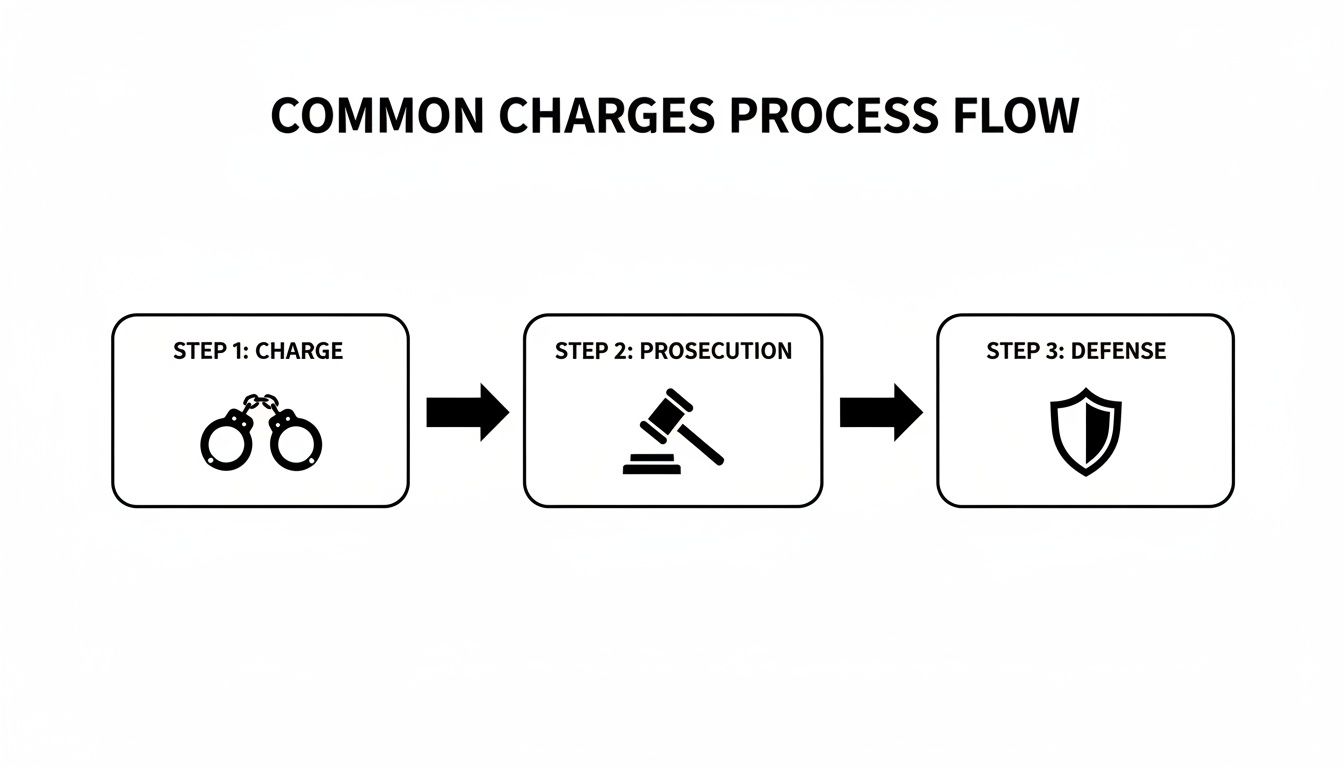
It’s a constant back-and-forth. For every move the other side makes, a strong defense must be ready with a powerful answer.
The Journey From Arrest to Resolution
The criminal process is not random; it follows a set of steps. While every case is different, most go through the same stages. Knowing what to expect can make it less scary and help you make smart decisions.
Here is a simple look at what that journey looks like:
- Arrest and Booking: This is where it starts. After an arrest, you are taken to the police station or jail. They take your fingerprints, a photo, and your personal information.
- First Court Appearance: Soon after you are arrested, you will see a judge. The judge will read the charges against you and set bail. Bail is the money you pay to get out of jail while your case continues.
- Arraignment: This is your first official chance to answer the charges. You will be asked to plead guilty, not guilty, or no contest. It is almost always best to plead “not guilty” at this stage, even if you think you might make a deal later. This simple step gives your lawyer time to look at the evidence and build your defense.
Understanding Pre-Trial Procedures
After the arraignment, the real legal work begins. This is the “pre-trial” time, and it’s where many cases are won or lost, long before a trial starts. It’s all about investigating, planning, and challenging the other side’s case.
The two best tools we have at this stage are discovery and pre-trial motions.
Discovery is the legal process that makes the prosecution give us all the evidence they have against you. This includes police reports, what witnesses said, lab results, and any video or audio recordings. Our job is to look through every single piece of it for mistakes or weak spots.
For example, a police report might say they found evidence in your car. But what if the police car’s camera shows they didn’t have a legal reason to search your car? That’s when we file a motion to suppress. This is a request asking the judge to throw out that evidence. If the judge agrees, the prosecution can’t use it, which can sometimes be enough to get the case dropped.
Plea Negotiations and Trial
The truth is that most criminal cases in Arkansas—over 90%—never go to a full trial. They are solved through plea negotiations. This is when your lawyer talks with the prosecutor to agree on a deal. This could mean changing the charges to something less serious or agreeing on a better sentence.
A good Fayetteville criminal defense attorney uses the weak spots found during discovery to bargain. We negotiate from a strong position, not a weak one.
Of course, if a fair deal can’t be made or if you decide to fight the charges, your case will go to trial. At trial, both sides will present their arguments to a judge or jury, who will decide if you are guilty or not guilty.
How to Choose the Right Defense Attorney for You
Facing criminal charges is scary, and finding the right lawyer can feel just as hard. How do you find someone you can trust with your future? It all comes down to a few important things that make a great lawyer stand out.
You are not just hiring a lawyer; you are looking for a partner. You need someone who knows the Washington County courts very well, who talks to you in simple terms, and who is honest about the cost.
Focus on Local Experience First
Experience is not just about how many years someone has been a lawyer—it’s about where they have been a lawyer. A Fayetteville criminal defense attorney who is in our local courts every day has a huge advantage.
They know the prosecutors and judges, and they know what arguments work best here. This local knowledge is not a small thing; it’s a powerful tool that helps them plan a defense that works for your specific court.
Qualities of a Strong Legal Partner
When you meet with a potential lawyer, you are looking for more than just a law degree. you need to know if this is someone you can work with during a very hard time in your life.
Here are a few things that really matter:
- Clear Communication: Do they explain things in a way you can understand? You should leave a meeting feeling more sure of things, not more confused.
- Honesty: A good lawyer tells you the truth—the good and the bad. They should also be clear about their fees so you don’t get any surprises later.
- Real Commitment: You need to feel like your case is important to them. A good lawyer listens to you, answers your calls, and truly wants to get the best result for you.
What past clients say can tell you a lot. Fayetteville has over 100 criminal defense lawyers, and there are more than 1,300 client reviews you can read online. This shows how much people depend on what others have experienced. You can find more details about local attorney reviews and endorsements on Avvo.com.
Questions to Ask During Your Consultation
Your first meeting with a lawyer is your chance to interview them. Don’t be afraid to ask questions. This is a big decision, and you have the right to get all the information you need.
Your relationship with your attorney is built on trust. That trust begins with an open, honest talk in your first meeting. Make sure you feel heard, respected, and sure they can fight for you.
Come with a list of questions to make sure you cover everything. While every case is different, the basics of choosing a good lawyer are the same; learn more in this expert guide on choosing a personal injury attorney.
Here’s a simple checklist to get you started:
- What is your experience with charges like mine here in Washington County?
- How will you keep me updated on my case?
- Will you be the lawyer handling my case, or will it be someone else?
- Can you explain your fees and what they include?
- Based on what you know now, what are the possible results for my case?
Asking these questions will help you find a skilled Fayetteville criminal defense attorney who is also the right person to guide you.
Why Acting Fast Is Your Strongest Defense

When you are facing criminal charges, the one thing you can’t get back is time. Every minute that passes is another minute the other side can use to build its case against you. That’s why hiring a lawyer right away isn’t just a good idea—it’s the best thing you can do to protect yourself.
Think of it like a small fire. If you catch it early, you can put it out easily. But if you wait, it can grow into a huge fire that destroys everything. Getting a lawyer involved early is about controlling the situation before it gets worse.
A good Fayetteville criminal defense attorney doesn’t just defend you; they go on the attack. By getting involved right away, sometimes before charges are even filed, a lawyer can start telling your side of the story and protecting your rights from the very start.
The Critical Pre-Charge Stage
Most people think a lawyer’s job starts after an arrest. That’s not true. The most important time is often during the first police investigation, before the prosecutor decides what to do.
During this early time, a skilled lawyer can do things that are much harder—or impossible—to do later:
- Save Important Evidence: Security camera videos get recorded over. Text messages get deleted. A lawyer knows how to send official letters to make sure this evidence is saved before it’s gone forever.
- Talk to Witnesses: We want to talk to people who saw what happened before the police do. This way, we can get their true story before an investigator’s questions can change how they remember things.
- Handle Police Communication: Your lawyer will be the only one who talks to the police for you. This stops you from accidentally saying something that could be used against you.
Waiting to hire a lawyer is like giving the other side a head start in a race you have to win. The sooner you have someone on your side, the better your chances are.
Influencing the Prosecutor’s Decision
In the end, the prosecutor is the one who decides whether to file charges. When a defense lawyer gets involved early, they can talk directly to the prosecutor’s office. This gives us a chance to present your side of the story and point out any problems with the police’s case.
Sometimes, this is enough to convince a prosecutor to file a lesser charge. In the best cases, we can convince them not to file any charges at all. This early action is your best defense. For example, some legal experts have shown that getting involved early in a federal case makes it much more likely you can avoid being charged. Some federal defense firms that serve Fayetteville report success rates over 90% in preventing charges when hired early. You can see more on how early engagement impacts federal cases on federal-lawyer.com.
By acting fast, you are no longer just waiting for something to happen. You become an active part of your own defense. That is why the very first call you make after dealing with the police should be to a lawyer who can start protecting you right away.
Common Questions About Criminal Defense in Fayetteville
When you are charged with a crime, you probably have a lot of questions. It’s normal to feel worried about what is going to happen. We have put together simple answers to the most common questions we hear from people in Fayetteville. The goal is to help you understand your situation and feel more ready for what’s next.
We believe that knowing the process is the first step to feeling more in control. A good Fayetteville criminal defense attorney will always take the time to answer your questions and make sure you feel sure of your choices.
How Much Does a Criminal Defense Attorney Cost?
This is often the first question people ask. The honest answer is: it depends on your case. There is no single price because every case is different. The final cost depends on how serious the charge is and how much work will be needed.
Think of it like fixing a house. A small leak costs less to fix than rebuilding a whole room. In the same way, a simple misdemeanor case that can be solved quickly will cost less than a serious felony case that might go to trial.
We believe you should know what to expect. That’s why we usually use two ways to charge for our work:
- Flat Fee: This is one single price that covers all the work on your case. We often use this for cases that are easier to predict, like a first-time DWI. You will know the total cost from the start, with no surprises.
- Hourly Rate from a Retainer: For more difficult cases, we might charge by the hour. You would pay an amount up front called a retainer, and we subtract our time from that money. This is common for serious felony charges that need a lot of investigation and time in court.
When you meet with us for free, we will listen to your story and clearly explain how our fees would work for you. You will leave our office knowing exactly how we handle payment, so you can make a good decision without any pressure.
Should I Talk to the Police Before Hiring a Lawyer?
The answer is simple and firm: No. You should never answer questions from the police about a crime without your lawyer with you. The Constitution gives you the right to stay silent, and it is the most important right you can use to protect yourself.
If the police want to talk to you, all you have to do is say, “I am using my right to remain silent, and I want to talk to my lawyer.” Then, say nothing else.
It is a big mistake to think you can talk your way out of it or that being “helpful” will make things better. Police officers are trained to gather evidence for the other side. Anything you say—even if you think it proves you are innocent—can be twisted and used against you in court.
Your lawyer is the only person in the legal system whose job is to protect you. The police and the prosecutor work for the state. Your lawyer works only for you.
What if I Can’t Afford a Private Lawyer?
If the court decides you don’t have enough money to hire a private Fayetteville criminal defense attorney, you have the right to a public defender. Public defenders are very dedicated lawyers who do an important job for our community. They are fully qualified lawyers who handle many different kinds of criminal cases.
However, public defenders’ offices often don’t have enough money, and their lawyers have to handle a very large number of cases at one time. While they do their best, this can make it hard for them to give a lot of personal attention to each case.
Hiring a private law firm like ours allows for a more focused defense. We choose to take on fewer cases so that we can:
- Spend more time looking into the specific details of your case.
- Talk with you more often about what is happening.
- Look at every possible legal defense to build a plan that is just for you.
Will My Case Definitely Go to Trial?
It is actually not very likely. TV shows love to show big courtroom fights, but the truth is that more than 90% of all criminal cases in the U.S. are solved before a trial ever starts.
Most cases end through plea negotiation. This is when your lawyer talks with the prosecutor to agree on a better result. A good deal might mean the charges are changed to something less serious or that you agree to a lighter punishment.
Our main goal is always to get the best result for you, and that often happens without going to court. We find the weak spots in the other side’s evidence and use them to bargain for a good deal. But if a fair deal can’t be made, we are always ready to fight hard for you at trial.
What Is Bail and How Does It Work?
After an arrest, a judge will usually set a bail amount. Bail is money you pay to the court to get out of jail while your case is going on. It’s like a promise that you will show up for all of your court dates.
If you can’t pay the full bail amount, you can hire a bail bondsman. You usually pay the bondsman a fee that you don’t get back (about 10% of the total bail), and they will pay the full amount for you. For people who don’t know, it’s helpful to learn the difference between different types of bonds; for example, you can learn more by understanding the distinction between criminal bail bonds and immigration bonds.
A good lawyer can argue for a lower bail amount—or even for you to be let out on your “own recognizance” (which is just a promise to show up)—at your very first court appearance. This can save you and your family a lot of money and worry from the very beginning.