
When someone doesn’t do what they promised to do in a deal, we call that a breach of contract. It’s like a broken promise that the law can help fix.
If someone agrees to sell you something but never gives it to you, or if you hire someone to do a job and they don’t do it, they have broken, or “breached,” the contract.
What Is a Contract Breach in Simple Terms?
Let’s use a simple example. Imagine you hire someone to paint your house for $3,000. You both agree on the color, when they will finish, and how much you will pay. That agreement is a contract, even if you just shook hands on it.
If the painter uses the wrong color or only paints half the house, they have not done what they promised. That is a breach of contract. On the other hand, if they do a perfect job but you refuse to pay them the $3,000, then you are the one who has breached the contract.
A contract is just a set of promises that the law will enforce. It’s an agreement where each person gives something to get something else. When one person doesn’t follow through, Arkansas law has ways to make things fair again.
The Core Idea of a Promise
At its heart, a contract is about trust. You trust that the other person will do what they said they would, and they trust you to do the same. This happens in many situations, like:
- Hiring someone to fix your kitchen.
- Buying a used bike from a neighbor.
- Agreeing to a new job.
In all of these examples, promises are made. A breach happens as soon as one of those promises is broken without a good legal reason.
A breach doesn’t always happen on purpose. Sometimes someone makes a mistake, like forgetting to send a bill on time. But whether it was on purpose or not, the main thing is that the promise wasn’t kept. Why it happened often matters less than what happened.
It’s also important to know that not all broken promises are the same. Some are small problems, while others are big deals that ruin the whole agreement. Figuring out which is which helps you know what you can do next.
Proving a Breach of Contract in Arkansas
When a contract goes wrong, you can’t just tell a judge, “They didn’t do their part.” In Arkansas, the law says you must prove four specific things to have a good case. Think of it like a chair with four legs—if one leg is missing, the chair falls over.
To win a breach of contract case, you have to prove all four of these legal points, or “elements.” Let’s look at them.
The Four Essential Elements
To build a strong case, you need to show proof for each of these points. If you can show all four, you have a good chance of winning.
A Valid Contract Existed: First, you have to prove there was a real, legal agreement. This means you need to show there was a clear offer, someone accepted that offer, and both sides agreed to give up something of value (lawyers call this “consideration”).
You Did Your Part: Next, you need to show the judge that you did everything you promised to do. This is called your performance. You can’t sue someone for breaking their promise if you didn’t keep yours.
The Other Person Failed to Do Their Part: This is the most important part. You must prove that the other person or company did not do what the contract said they would. Their failure to do their part is the breach.
You Were Harmed Because of the Breach: Finally, you have to show that their broken promise caused you some kind of harm, usually a financial loss. These are your damages. This could be money you lost, extra costs you had to pay, or other problems that happened because they broke their promise.
That first point—having a valid contract—is the foundation for everything. This picture shows the three key things needed to make one.
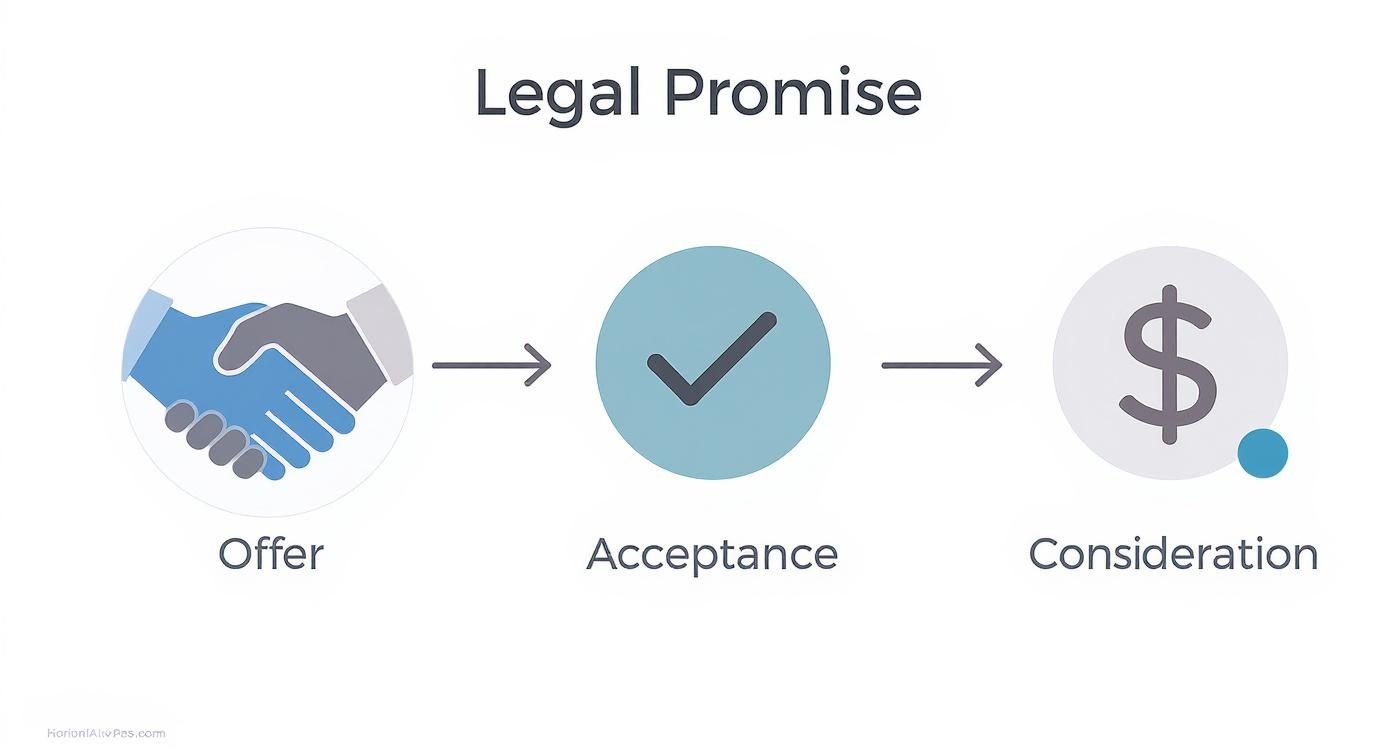
As you can see, when you have an offer, acceptance, and consideration all together, a simple promise becomes a real contract that the law can enforce.
Putting It All Together with an Example
Let’s use an example. Imagine you hire “Perfect Party Caterers” for your graduation party in Fayetteville for $1,000. You both sign a paper that says what food they will bring and on what day.
What if they don’t show up? Let’s use our four-part test:
- Valid Contract? Yes. You have a signed paper showing their offer (catering), your acceptance (your signature), and consideration ($1,000 for food). That’s a valid contract.
- Your Performance? You paid the $500 deposit they asked for, just like the contract said. You did your part.
- Their Breach? The day of the party comes, but the caterer is gone. They completely failed to do what they promised.
- Your Damages? You had to quickly order a bunch of pizzas that cost you $750. Your damages are the $500 deposit you lost plus the extra $250 you had to spend.
In this situation, you can clearly show all four things the Arkansas law requires. You had a real agreement, you did your part, they broke their promise, and it cost you money.
This is exactly how a court would look at your case. It’s a process that is very important, especially for businesses. One study showed that problems with suppliers breaking promises are a big issue. You can read more about these breach of contract findings to understand how serious this can be.
Understanding Different Types of Contract Breaches
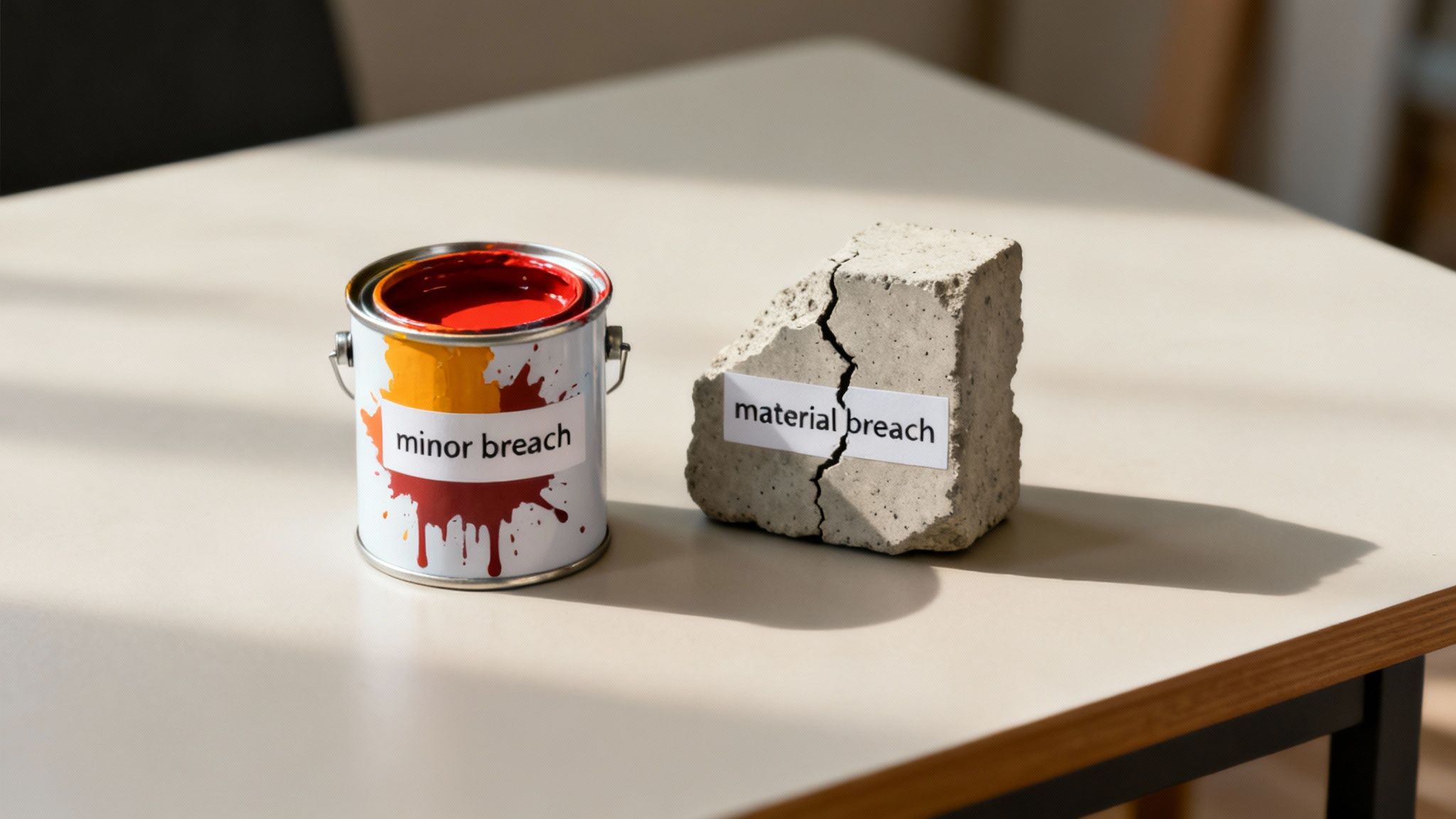
When a contract is broken, the law doesn’t treat every broken promise the same. Think about it like this: spilling a little water on a paper is a small problem, but ripping the whole paper up is a disaster. In Arkansas, the law looks at how much damage the broken promise caused.
Knowing the difference is important because it tells you what you can do. Some breaches are just small problems that can be fixed, while others can end the whole deal. This difference decides what legal options, or “remedies,” you have.
The seriousness of the breach is key. It’s the difference between asking someone to fix a small mistake and having the right to walk away from the whole deal.
Material Breach: The Deal-Breaker
This is a big one. A material breach is a failure so big that it ruins the main point of the contract. It’s when the other person does something (or doesn’t do something) that changes the whole deal, leaving you with something very different from what you agreed to.
Imagine you hire a builder to build a new three-bedroom house in Rogers. They finish the job, but when you go to see it, it’s a two-bedroom house. That’s a material breach. The main thing you agreed to—a three-bedroom home—wasn’t delivered.
Because a material breach breaks the heart of the deal, the person who was harmed can do more than just ask for money. They are also freed from doing their part of the deal. In our example, you wouldn’t have to pay the full price for a house that is not what you ordered.
Minor Breach: The Small Problem
On the other hand, there is a minor breach. This happens when someone messes up a smaller, less important part of the contract. The main goal of the agreement is still met, but with a small problem.
Let’s use the house-building example again. Say the contract said the builder would use a special, expensive brand of paint for the walls. Instead, the builder used a slightly cheaper—but still good—brand of paint.
- You still got your three-bedroom house.
- The house is safe and you can live in it.
- The main point of the contract was completed.
This is a good example of a minor breach. The mistake didn’t ruin the deal. In this case, you can’t just cancel the contract and refuse to pay. But you can ask the builder to pay you for the difference in cost between the paint you paid for and the paint you got.
Anticipatory Breach: The Early Warning
Then there is a special type of breach called an anticipatory breach. This is when one person makes it very clear—with words or actions—that they are not going to do what they promised, even before it’s time for them to do it.
For example, you hire a popular band for your wedding in Fayetteville six months from now. Three months before the wedding, they call and tell you they took another job and won’t be there. That’s an anticipatory breach. They told you ahead of time that they were going to break the contract.
The law understands that this early warning is helpful. You don’t have to wait until your wedding day to find out you have no music. As soon as they tell you they won’t be there, Arkansas law lets you treat the contract as officially broken. You can immediately look for a new band and ask the first band to pay for any extra costs.
What Happens When a Contract Is Broken? Legal Remedies Explained
When a contract breaks down, it’s more than just a broken promise—it’s something the law is set up to fix. In Arkansas, these fixes are called remedies. The goal is not to punish the person who broke the contract, but to put the other person back in the spot they would have been in if the deal had been done right.
Most of the time, this is done with money. The courts call this money damages. It’s a way to pay for the harm caused by the broken promise. There are a few different types of damages for different kinds of problems.
The Main Solution: Money Damages
For most broken promises, the simplest and most common fix is money. A court in Arkansas will look at what you lost and decide which type of damages will help you the most.
Compensatory Damages: This is the most direct type of payment. It’s money meant to cover the exact losses you had. For example, if you paid a roofer $5,000 and they never did the work, compensatory damages would be used to get that $5,000 back to you.
Consequential Damages: These are for the “ripple effect” problems caused by a breach. They cover losses that happened as a predictable result of the other person’s failure. Let’s say because the roofer never showed up, a leak in your roof got worse and caused $2,000 in water damage to your ceiling. That $2,000 could be claimed as consequential damages.
Liquidated Damages: Sometimes, a contract will say exactly how much money must be paid if one person breaks the deal. This is called a liquidated damages clause. You see this a lot in building projects, where being late by even one day can cause huge problems that are hard to put a price on. This part of the contract removes the guesswork.
The money problems from a broken promise can be huge. Just think about how much is at stake when a promise isn’t kept.
When Money Is Not Enough
Sometimes, money can’t fix the problem. This is usually when the contract was for something one-of-a-kind, like a rare painting, an old car, or a special piece of land. You can’t just go out and buy another one.
In these situations, a judge might use a remedy called specific performance. This isn’t about money. It’s an order from the judge that forces the person who broke the contract to do exactly what they promised to do. They must finish their part of the deal.
Imagine you have a contract to buy your dream house, but the seller changes their mind and tries to back out. A judge could order specific performance, forcing them to sell you the house because that specific house is unique and can’t be replaced.
Of course, knowing your options is just the start. Many contract problems are solved without ever going to court. They are often fixed with a settlement agreement, which is like a new contract made to end the first argument.
Finally, remember that you don’t have forever to act. The law has strict deadlines, called “statutes of limitations,” for filing a lawsuit. To learn more, it’s a good idea to understand the importance of understanding statutes of limitations, because they tell you how long you have to take legal action after a promise is broken.
Common Examples of Contract Breaches

Legal ideas like “material breach” and “damages” can seem confusing. The best way to understand what a breach of contract looks like is to see real-world examples.
Let’s look at a few common examples that happen all the time in Arkansas. These stories make the legal words easier to understand and show how a broken promise can cause real money problems.
The Sloppy Roofing Job
Imagine this: you live in Bentonville and hire a local company to put a new roof on your house for $10,000. The contract clearly says they will use special high-quality shingles and finish by Friday.
They finish on time, but when you look closer, you see they used cheap, basic shingles instead.
- Who Broke the Contract? The roofing company. They didn’t use the materials they promised.
- What Kind of Breach? This is probably a minor breach. You still got a new, working roof, so the main point of the contract was done. The problem is, you didn’t get the quality you paid for.
- Possible Remedy: You can’t just refuse to pay the full $10,000. Instead, you could ask them to pay you for the difference in cost between the good shingles you were promised and the cheap ones they used. This is a common case for compensatory damages.
This shows that not every mistake ends the whole deal. Sometimes, the solution is just about making things fair with money.
The Late Product Delivery
Let’s try another one. Imagine you own a small shop in Fayetteville and you order a special shipment of Razorback gear for a big game weekend. The contract says it will be delivered one week before the game, guaranteed.
Your supplier in Little Rock makes a mistake. The shipment doesn’t arrive until the Monday after the game.
- Who Broke the Contract? The supplier, because they missed the delivery deadline.
- What Kind of Breach? This is a material breach. Why? Because the whole reason you ordered the gear was to sell it to fans during the game weekend. Since it arrived late, the main purpose of the contract was ruined.
- Possible Remedy: You would probably not have to pay for the gear, since it’s not as valuable to you anymore. You could also ask them to pay for consequential damages, like the money you expected to make from selling the gear that weekend.
This example shows an important point: sometimes, timing is everything. When a deadline is a key part of a contract’s purpose, missing it can turn a small delay into a big breach.
The Unpaid Freelancer
For our last example, think of a freelance artist in Springdale. A new company hires her to design a logo. The contract is simple: she delivers the final logo files, and the company pays her $1,500 within 30 days.
She delivers a great logo on time, but 30 days pass and the company never pays her.
- Who Broke the Contract? The company broke its promise to pay for the work.
- What Kind of Breach? This is a clear material breach. Paying for the logo was the company’s main responsibility in the agreement.
- Possible Remedy: The artist can ask for compensatory damages to get the $1,500 she is owed. It’s a simple situation where one person did their part of the deal and the other did not.
Common Questions About Arkansas Contract Law
Dealing with a broken contract can be confusing and stressful, so it’s normal to have questions. To help you understand, let’s answer some of the most common questions people have about contract law in Arkansas.
Think of this as a quick guide. We’ve gathered the most common questions and answered them simply to give you a better idea of your situation.
Do I Need a Written Contract to Sue in Arkansas?
Not always. While writing down an agreement is always the safest way to prove it exists, Arkansas courts do accept and enforce verbal agreements. A deal made with a handshake can be a real, legal contract.
But there is a big exception. A rule called the Statute of Frauds says that certain types of contracts must be in writing to be legal. This includes big agreements like contracts to sell land or any deal that cannot be finished in less than one year.
The best advice is to always get it in writing. A written contract protects you from arguments later and is strong proof if something goes wrong. It helps everyone involved.
How Long Do I Have to File a Lawsuit in Arkansas?
Every state has a deadline for filing a lawsuit. This is called the statute of limitations. In Arkansas, you cannot miss these deadlines. If you wait too long, you could lose your right to go to court, even if you have a very strong case.
For most contract problems, the deadlines are:
- Written Contracts: You have five years from the day the contract was broken to file a lawsuit.
- Verbal Contracts: You have less time—just three years from the day the promise was broken.
Time is very important. As soon as you think a contract has been broken, the clock starts ticking. Don’t wait to figure out what to do next.
What Is the First Step if Someone Breaks a Contract?
Your first step should be a calm one. Before you get upset, find the original contract and read it carefully. Make sure you understand exactly what was promised.
Next, try to talk to the other person—and do it in writing. A simple email or letter is great because it creates a record. In your message, clearly and politely explain how you believe they broke their promise and what you want them to do to fix it.
Sometimes, a broken promise is just a misunderstanding that a quick chat can solve. But if that doesn’t work, your next step should be to talk to a lawyer who can explain your legal options and help you decide what to do.