
Have you ever had a disagreement that felt like it was getting out of hand? A settlement agreement is the legal world’s way of hitting the pause button and finding a solution without ever going to court. Think of it as a formal peace treaty between two people or groups, where you both agree on how to solve a problem and move on.
What Is a Settlement Agreement in Simple Terms
Let’s use a simple example. Imagine your neighbor’s tree branch falls and breaks your fence. You could sue them, but that means lawyers, going to court, and a lot of stress and money. Instead, you sit down and talk. You agree that your neighbor will pay for the new fence posts, and you’ll buy the wood and fix it yourself.
A settlement agreement is just putting that handshake deal into writing. It’s a private, legal contract that can stop a lawsuit from ever starting or end one that’s already going.
The Core Idea: Solving It Yourselves
The great thing about a settlement is that you—not a judge—get to decide what happens. This is a big plus for many people in Arkansas. Instead of hoping a judge sees things your way, you and the other person find a solution you can both live with.
This has some great benefits:
- You Save Time: Court cases can take months or even years. A settlement is almost always faster.
- You Save Money: Going to court is expensive. Settling helps you avoid big lawyer bills and court fees.
- You Keep Things Private: Court cases are public. Settlements keep your personal business private.
- You Know the Outcome: A trial is a gamble. With a settlement, you know exactly what the result will be.
For a quick look, here’s a simple chart of what a settlement agreement is.
Settlement Agreement at a Glance
| Concept | Simple Explanation |
|---|---|
| What it is | A private, written contract to end a legal fight. |
| Who’s involved | The people in the disagreement. |
| Why it’s used | To avoid the time, cost, and risk of a court trial. |
| Is it binding? | Yes, it’s a legal contract once it’s signed. |
| Key outcome | Both sides agree to give up something to solve the problem. |
Basically, a settlement puts the power back in your hands, letting you solve the problem in a controlled, private, and predictable way.
From Small Fights to Big Cases
Settlement agreements are used for all sorts of problems. They can solve everything from a small car accident in Fayetteville to a big business argument in Little Rock. They are a common tool for ending fights. On a huge scale, these agreements solve massive problems, like the nationwide opioid lawsuits, which have led to over $57.1 billion in settlements. You can see how big these deals are on the Opioid Settlement Tracker.
At its core, a settlement agreement is a promise to let go. Both sides agree to release each other from any future fights about the same problem. This creates a clean break and lets everyone move forward.
Why Choose a Settlement Instead of Court?
When you’re facing a legal problem, the thought of going to court can be scary. We see dramatic trials on TV, but the truth is, most cases in Arkansas never get to that point. Instead, people often choose a settlement agreement for very good reasons.
Deciding to settle isn’t giving up; it’s choosing a smarter, easier, and less stressful way to solve a problem. It’s how you take back control of a tough situation and find an answer you’re okay with.
This picture shows it perfectly—two sides reaching an agreement together, which is what settling a problem is all about.
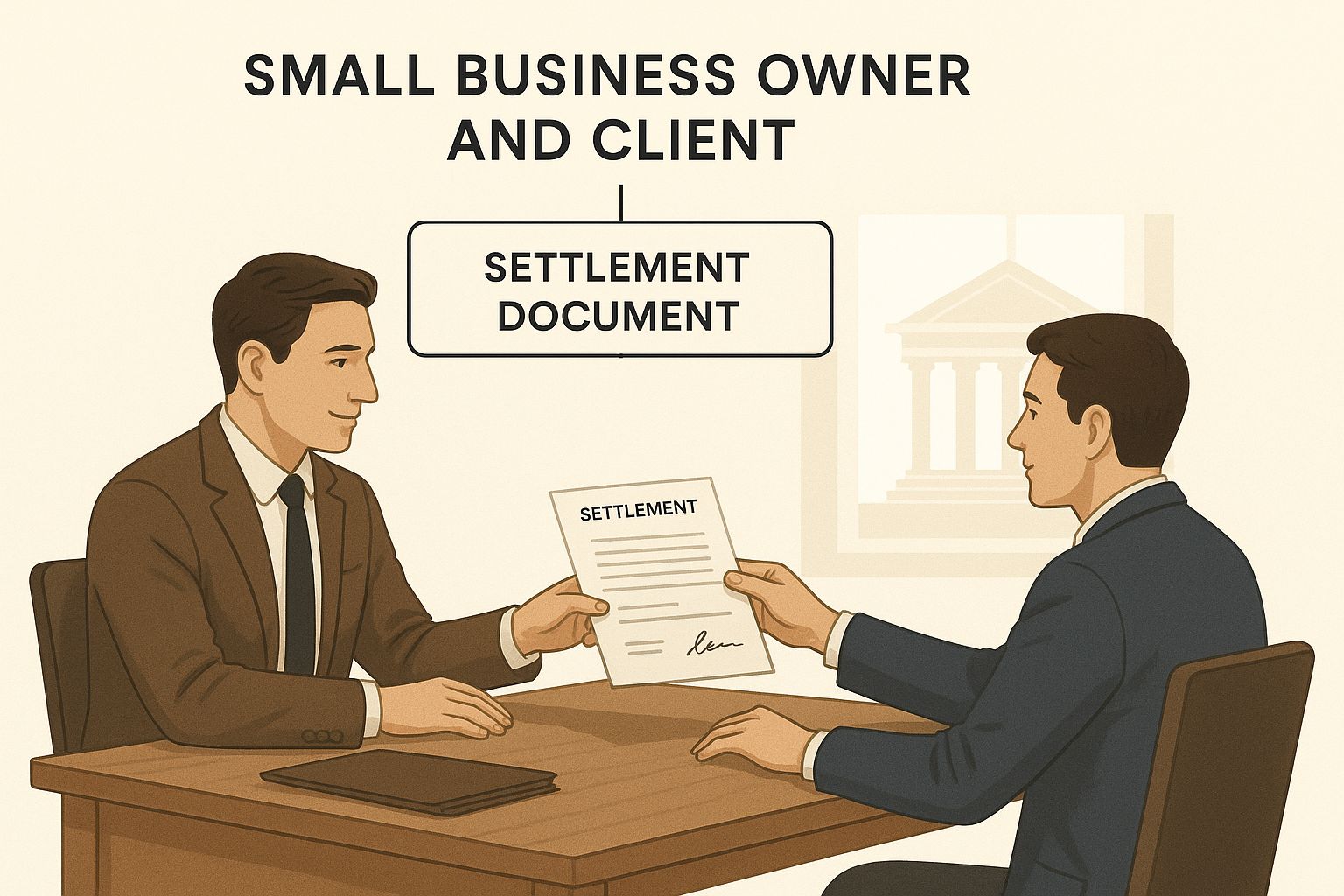
In the end, settling is about finding a peaceful solution away from the drama and public eye of a courtroom.
The Major Advantages of Settling
So, why do so many people pick this path? It really comes down to four big benefits that affect your money, your privacy, your time, and your stress level. Let’s look at why a settlement is often the best move.
- Saving Money: Let’s be honest: court cases are expensive. The costs for lawyers, court papers, and experts can add up very quickly. A settlement stops those costs from growing, often saving you a lot of money.
- Keeping Matters Private: Once a case goes to court, its details become public information. That means anyone can look them up. A settlement agreement, however, is a private document, keeping your personal or business life out of the public spotlight.
- Getting a Faster Solution: The legal system can be very slow. It’s common for court cases to last for months, or even years. A settlement can often be worked out and finished much faster, letting you close the book and move on.
- Controlling the Outcome: In a trial, a judge or jury makes the final decision. It’s a risk. With a settlement, you and the other person are in charge, working together to create a solution you can both accept. You get to help decide the final result.
Settlements in Action in Arkansas
Think about a small business owner in Fort Smith who finds out an employee has been sharing secret client information. A public lawsuit could ruin the company’s reputation. By settling, the owner can handle the problem quietly, protect their business secrets, and avoid bad publicity.
Or imagine a minor car accident in Bentonville. The drivers could spend the next year fighting in court over who was at fault. Instead, they can sign a settlement where one person’s insurance covers the repairs, and both agree to walk away. It saves everyone from a long, stressful, and expensive legal fight.
A settlement isn’t about giving up; it’s about making a smart and efficient choice. You get to decide what a “win” looks like instead of leaving that decision to someone else.
For a better look at the process and its benefits, understanding out-of-court settlements is a great place to start. It explains how this method puts the power to solve the problem back where it belongs—with the people involved.
Key Parts of a Settlement Agreement Explained
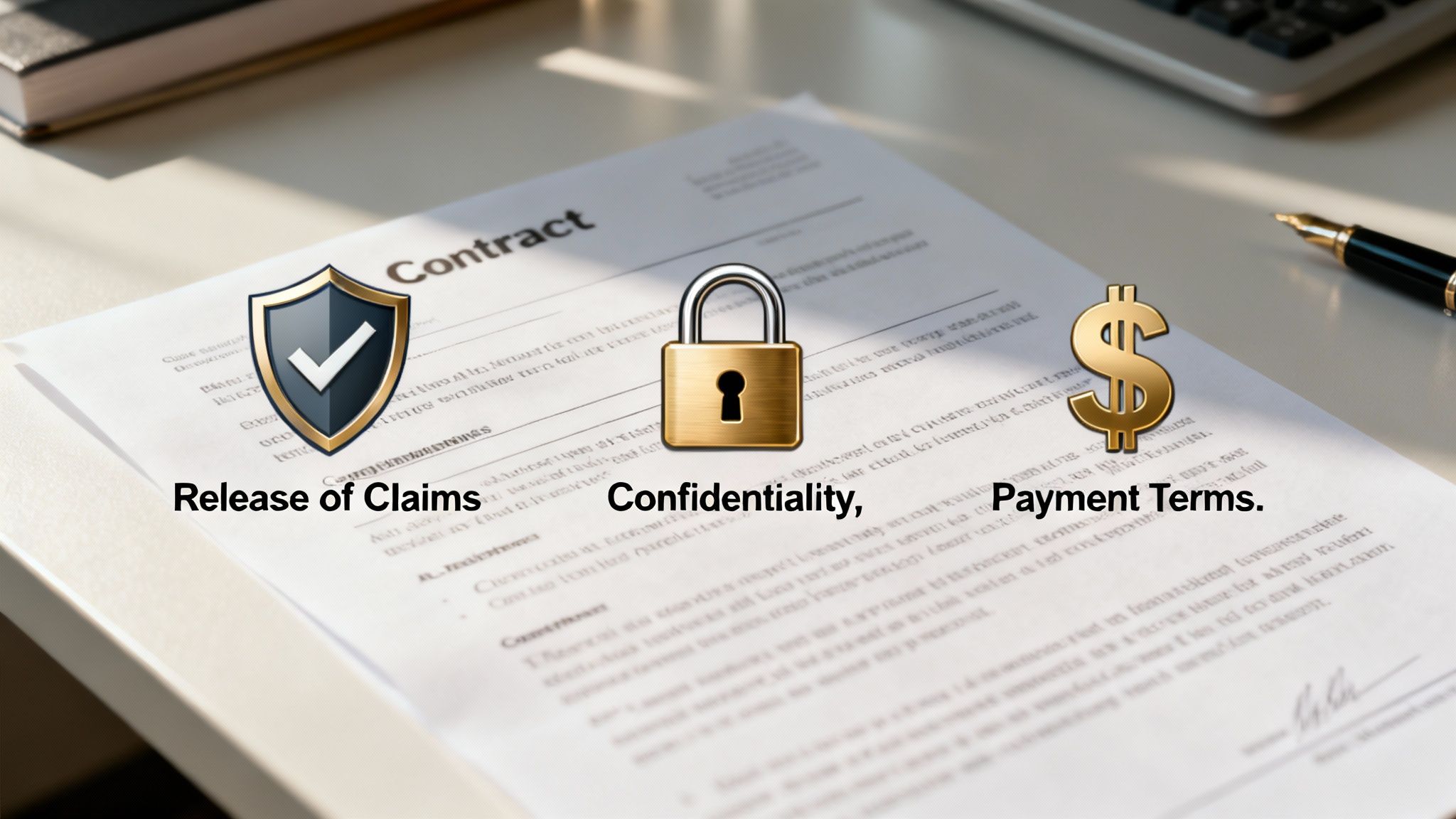
At first, a settlement agreement can look like a bunch of confusing legal words. But once you understand its basic parts, it starts to make more sense. Think of it like a recipe—each part, or “clause,” has a special job to do to create the final, legal deal.
Knowing what these key parts mean is the first step to truly understanding what is a settlement agreement and what you’re agreeing to. Let’s look at the most common parts you’ll see in an Arkansas settlement paper.
The Release of Claims Clause
This part is the most important piece of the agreement. A Release of Claims is a formal promise from everyone to just “drop it” and walk away for good. When you sign, you’re agreeing not to sue the other person over the same problem ever again.
Imagine you slip and fall in a store. The store offers to pay your medical bills to settle it. That release clause is your promise that you won’t sue them again for that same fall a year later. It puts a final end to the disagreement.
The Payment Terms Clause
This is where the money is discussed. The payment terms section explains every detail about the money, so there’s no confusion. It answers the who, what, when, and how of the settlement money.
Specifically, the payment clause will say:
- Who pays who: It clearly says which person or company is paying and who is getting the money.
- The exact amount: The total amount of money is written out.
- When the payment is due: This sets a final date for payment, whether it’s one big payment within 30 days or a few smaller payments over time.
- How the payment will be made: It explains the method, like a check or a direct bank transfer.
Getting this part right is very important. Unclear payment terms can lead to more arguments later.
In the legal world, this trade—money for a promise not to sue—is called “consideration.” Under Arkansas law, every legal contract, including a settlement, needs consideration from both sides. It’s the proof that this is a fair deal, not a one-sided demand.
The Confidentiality Clause
This part is all about keeping things quiet. When a settlement has a confidentiality clause, both sides agree not to talk about the agreement with anyone. This usually includes the details of the original problem and, most importantly, how much money was paid.
This is very important in business or work cases where a company wants to protect its reputation. If a business settles with a former worker, it will almost always demand confidentiality to stop the story from getting out.
Breaking this promise is a big deal. It can have serious results, sometimes even making the person who talked give back all the settlement money.
To help you see it more clearly, here’s a quick guide to these clauses and a few others you might see.
Common Clauses in a Settlement and What They Mean
The table below explains some of the most important legal terms you’ll find in a settlement agreement in simple English, so you know exactly what they do.
| Clause Name | Plain English Meaning | Why It’s Important |
|---|---|---|
| Release of Claims | A promise to drop the case and never sue for this again. | It officially ends the fight and stops future lawsuits. |
| Payment Terms | Who pays what, when, and how. | It makes sure everyone is clear on the money part of the deal. |
| Confidentiality | An agreement to keep the settlement details secret. | It protects reputations and keeps private information secret. |
| No Admission of Fault | A statement that settling isn’t admitting you were wrong. | It lets someone solve the problem without saying they did anything wrong. |
Each of these parts works together like puzzle pieces to create a strong, legal contract that finally puts the problem to an end.
When Are Settlement Agreements Used in Arkansas?
Settlement agreements are more common in Arkansas than you might think, and they aren’t just for big companies. They’re useful, everyday tools for solving problems that could affect anyone, from Little Rock to Fayetteville. Think of them as an organized, peaceful way to close the book on a stressful situation.
Instead of fighting it out in a long, public, and expensive court battle, people choose this path to find a fair solution. The whole point is to reach an agreement that lets everyone get on with their lives.
Real-Life Scenarios in Arkansas
Let’s look at some real-life examples. Here are a few simple stories that show how settlement agreements work across the state.
Personal Injury Claims: Imagine you slip on a wet floor in a Bentonville grocery store and break your arm. You could sue, but that takes time. Instead, the store’s insurance company offers to pay your medical bills and give you money for your pain. You sign a settlement agreement, promising not to sue, and the problem is over.
Employment Disputes: A worker in Jonesboro is fired but thinks the company still owes them one last paycheck. Instead of going to the labor board, the old boss agrees to pay the money to avoid a long fight. The worker signs a settlement, gets their money, and both go their separate ways.
Contract Disagreements: A farmer in the Delta has a problem with a supplier over a late delivery of seeds that messed up their planting schedule. Instead of going to court, they talk it out. The supplier agrees to a big discount, and the farmer agrees not to sue. They put it in writing, and their business relationship is saved.
From Local Handshakes to Global Deals
While these local stories show how settlement agreements solve everyday problems, the same ideas are used for huge deals. In fact, these agreements are key for settling fights between international companies and even entire countries.
Around the world, about 45% of big legal fights between investors and countries are solved through settlement. This shows how well this method works, no matter how much is at stake. You can learn more about this in the ICSID Caseload Statistics.
A settlement agreement is a tool that can solve many different problems. Whether it’s a fight between neighbors or a business partnership that’s ending, it provides a clear way to a final solution.
These agreements are especially helpful when business partnerships end. Settling things privately can protect the business’s good name and the personal money of everyone involved. For anyone in this situation, understanding the formal process for the dissolution of a partnership is a great first step. It’s a perfect example of how a legal plan—much like a settlement agreement—can guide people to a clean, final, and private end to a problem.
How to Negotiate a Fair Settlement Agreement
Talking about a settlement can feel like a serious game, but you don’t need to be an expert to get a good result. The secret is simple: be prepared and stay calm. With the right plan, you can stand up for what you need and get a fair deal.
Being prepared is the most important part. Before you even start talking, you need to have a clear idea of what you want. This will be your guide through the whole process.
Set Your Goals and Gather Your Proof
First, figure out what the best result would be for you, and just as important, what is the least you are willing to accept. Knowing this sets your goals for the discussion. What does a “win” look like for you? Is it a certain amount of money, something the other person must do, or just being done with the problem?
Once you have your goals, it’s time to find your proof. Gather every paper, email, photo, or piece of information that supports your side of the story. The more organized you are, the stronger your argument will be. You’re not just asking for something; you’re showing why it’s a fair solution.
Talking about a settlement isn’t about winning a shouting match. It’s about calmly and professionally explaining your side. Your proof does the hard work for you by showing your position is based on facts, not just feelings.
Communication Is Everything
How you talk can make or break the deal. It is very important to stay calm, professional, and focused on the problem—not on the people or your feelings. A big part of this is knowing that the final settlement is a formal contract. Knowing the basics of how to draft contracts can help you a lot, as it makes you think about how the points you agree on will become legal rules.
Remember, the goal is to find a solution that works, not to win an argument. Really listen to what the other side is saying and be open to good ideas. A good negotiation is often one where both people feel they gave a little to get what was most important to them.
Negotiation Do’s and Don’ts
To make it easy, here’s a quick guide to keep you on the right track during your talks in Arkansas. Following these simple rules can help you avoid common mistakes.
- DO know your best-case result and your walk-away point before you start.
- DON’T let anger make your decisions; stick to the facts.
- DO have all your proof organized and ready.
- DON’T let anyone push you into a quick decision. Always take time to think.
- DO speak calmly, clearly, and respectfully, even when you disagree.
- DON’T sign anything until you’ve read and understood every single word.
Finally, and this is a big one, don’t be afraid to ask for help. If the talks get too hard or if the other side is being unfair, it’s time to talk to an Arkansas lawyer. A lawyer can step in, give you expert advice, and make sure your rights are protected from start to finish.
Common Mistakes to Avoid When Signing a Settlement
A settlement agreement is the final, legal end to your problem. Once you sign it, you usually can’t change your mind. That’s why it’s so important to avoid the common mistakes that can turn a good solution into a future problem.
Think of it this way: you wouldn’t sign a permission slip without reading it, right? A settlement is much more serious, so you have to treat it carefully. Let’s go over some of the most common mistakes and how you can avoid them.
Rushing the Process or Signing Under Pressure
Feeling pushed to sign something right away is a big warning sign. The other person might try to rush you by saying the offer is only good for a short time. This is often just a trick to keep you from thinking clearly or from getting advice from a lawyer.
Remember, a fair offer today will still be a fair offer tomorrow. A settlement is a major decision that changes your legal rights forever, so you must take the time you need to look it over carefully, without feeling rushed.
Not Reading Every Single Word
It sounds like simple advice, but you’d be surprised how many people just skim the paper. It’s easy to focus on the money amount and ignore everything else. This is a huge mistake, because the “fine print” often hides the most important details.
For example, by not reading carefully, you might accidentally agree to:
- A privacy rule that you can’t realistically follow.
- A release of claims that is so wide it stops you from filing other, different lawsuits in the future.
- Payment rules that are confusing or bad for you.
Every single sentence in that agreement is there for a reason. You have to read and understand all of it before you sign it.
Agreeing to Things You Cannot Do
A settlement isn’t just about what you get; it’s also about what you promise to do. You might agree to return company property by a certain date or to stop talking about the problem. If you agree to do things you know you can’t, you could end up breaking the contract yourself.
A settlement agreement is a two-way street. Both sides have to do things. Before you sign, ask yourself one simple question: “Can I actually do everything this agreement is asking of me?” If the answer is no, those parts need to be changed.
The private nature of these agreements is a key reason to be so careful. While tons of fights end this way, the exact numbers are hard to know. In the U.S., guesses range from 29% to 80% of cases settling, depending on how they are counted. This big range just shows how many of these deals happen in private. You can learn about settlement rate research to get a better idea of why these numbers are so different.
In the end, the most important step you can take to avoid these mistakes is to have a good Arkansas lawyer look at the document. A lawyer will see the hidden risks, explain the confusing words, and make sure the agreement truly protects you before you sign it for good.
Got Questions? Here Are Some Common Ones
As we finish, you might still have a few questions about settlement agreements. That’s totally normal. Let’s answer some of the most common questions people in Arkansas have.
Are Settlement Agreements Public?
One of the best things about a settlement is its privacy. In almost every case, a settlement agreement is a private, secret contract between the people involved. That means it is not a public record.
This is very different from a court trial, where every paper and every word spoken can become public information. Settling lets you keep the private details of your problem—and the final result—away from other people.
Do I Owe Taxes on My Settlement Money?
This is a great question, but the answer isn’t a simple yes or no. It really depends on why you got the money.
The IRS generally says that money you get for a physical injury or physical sickness is not taxed. So, if your settlement was for a car wreck or a slip-and-fall, that money is usually yours to keep, tax-free.
However, it’s different for other types of payments. Money for things like lost pay from work, emotional pain (without a physical injury), or punishment money is usually taxable. Tax laws can be tricky, so it’s always a good idea to talk with an Arkansas tax expert about your settlement.
A simple way to think about it is that the government sees money for a physical injury as helping you get back to normal—making you “whole” again, not as income. But money for lost pay is seen as a replacement for the paycheck you would have paid taxes on anyway.
What if Someone Doesn’t Follow the Agreement?
Once a settlement agreement is signed, it’s a legal contract. If someone doesn’t do what they promised—for example, they miss a payment—they have broken the contract.
When this happens, you have the right to take them back to court to make them follow the agreement. A judge can order the other person to do what they promised to do. This is why having a clear, well-written agreement is so important; it’s your legal tool to make sure everyone keeps their promises.